- 2-1. Political Prisoners’ Day; Mordovian camps; Perm camps: Diary of camp 35 (September 1975-January 1976); Camp 36; Camp 37
- 2-2. Vladimir Prison; Ordinary-regime camps; Releases; Letters and appeals from political prisoners
*
4. Vladimir Prison
Addendum No 6 to Order No 20, issued by the USSR Ministry of Internal Affairs (MVD) in 1972, forbids the wearing of crosses round the neck. This ban concerns prisoners serving their terms in prisons, and possibly also other categories of prisoner.
On 11 July 1975 Yevgeny Pashnin had his cross taken away as “a forbidden object”. Pashnin has been sending complaints to the Council on Religious Affairs at the USSR Council of Ministers. His complaints are redirected by the Council to the prison administration.
On 26 November 1975 First Lieutenant Kichigin took away a cross from N. I. Fedoseyev.
On 9 January 1976 Yury Vudka was given back a letter he had written, on the grounds that the letter contained psalms, and, as Captain Doinikov stated, “psalms are forbidden”.
*
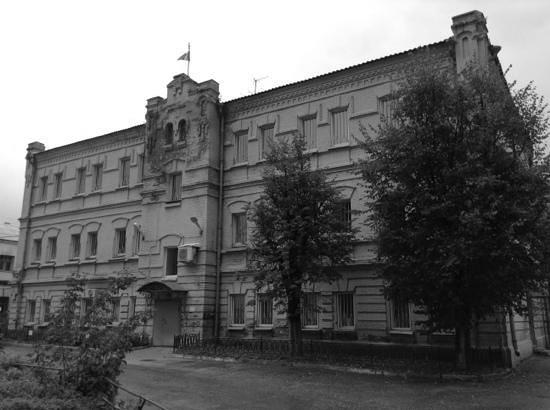
Vladimir Prison, 1968-1978
*
On 18 January 1976, Gabriel Superfin’s term of confinement on strict regime came to an end. He spent the last days of his term in the cooler.
On 19 January Superfin told his mother during a visit that, if his Bible was taken away from him, he would be forced to take extreme measures.
A day Iater, on 21 January, while Superfin was out exercising, his Bible was confiscated. (He had carried this Bible with him through all the searches since his arrest, though this had led to disputes with the authorities every time.)
On 22 January Superfin declared a hunger strike.
*
Leonid Pedan is on strict regime in Vladimir Prison; he was born in 1951, and was sentenced as a common criminal; in October 1973 in a camp, he got a three-year sentence under Article 70.
On 22 October 1975 Mo Khun was transferred to Alma-Ata, apparently for a review of his case. His real name is Yui-Shi-Lin. Mo Khun is the name on his Soviet documents. Mo Khun has been in the USSR since 1968. He was arrested in 1972.
*
The report in CCE 38.12-2 that the administration at Vladimir Prison had accepted the refusal of prisoners to work, has unfortunately turned out not to be true.
For example, Georgy Davydov, on completing four months on strict regime, has been put back on strict regime — this time for six months. He has been deprived of a visit.
The following were punished for refusing to work in summer 1975: Bukovsky, Grodetsky, Meshener — all 15 days in the cooler, and Makarenko — twice punished, for eight and 15 days.
*
In the summer of 1975 Nikolai Budulak-Sharygin (CCE 32.12) was deprived of his invalid status: he was a Group II invalid. He was refused permission to receive medicine from home (i.e., from England). Budulak-Sharygin suffers from hypertension and has a weak heart.
Alexander Chekalin continues to suffer haemorrhages from his ears. He is rapidly losing his sense of hearing. He receives no medical attention.
Anatoly Yefremov (a political prisoner who was formerly a common criminal) had an operation: he now suffers considerable kidney haemorrhages. He receives no medical attention. When he asked a doctor: ‘What am I supposed to do — hang myself?’, the doctor replied ‘Go ahead and hang yourself. That’ll be one swine less.’ Yefremov was offered medical aid in return for cooperation with the KGB.
Arie Khnokh is in bad health — he has gastritis and haemorrhoids; as is Yevgeny Pashnin (who has stomach ulcers and a duodenal ulcer). Both of them receive no medical attention.
Mikhail Makarenko has a liver illness and doctors have found a dark patch on his lungs. Although he has been prescribed glucose, he is not being given infusions of it. The response to his inquiries is; ‘We don’t have any glucose.’
Yury Shukhevich’s health has got worse.
*
One of the prisoners in Vladimir Prison — Oleg Spiridonov — has attempted to burn himself to death. He was sent to the cooler; two days later he was transferred to the hospital.
*
FEDORENKO
As has already been reported in CCE 38.12-2, Vasily P. Fedorenko was brought to Vladimir Prison on 20 April 1975. According to his sentence, he must spend the first five years of his term of imprisonment (i.e. until September 1979) in a prison, and the rest of his term — ten years —in a special-regime camp (CCE 38 mistakenly reported that the first five years would be ‘either in prison or on special-regime’). Besides ‘treason to the motherland’, he was also charged with ‘anti-Soviet agitation and propaganda’.
On 26 April Fedorenko went on hunger-strike. He continued the hunger-strike for 95 days — until 31 July. On 5 July the 31st day of his hunger-strike, he was beaten up by warders in the presence of Captain Dmitriev, the political-education instructor.
On 10 December 1975 Fedorenko again went on hunger-strike, demanding that his case be reviewed and that he should be released. He is determined to continue the hunger-strike until the end of the 25th Congress of the CPS U. On 1 February 1976 many prisoners held a one-day hunger-strike in support of Fedorenko’s protest.
*
On his arrival at Vladimir, Yevgeny Pashnin was put on strict-regime for six months. After this, he spent about a month on ordinary-regime, but was then again transferred to strict-regime for six months.
*
In October 1975 the Swiss organization ‘Movement for Freedom and Human Rights’ awarded its annual prize to Kronid Lyubarsky. A letter from the president of this organization states that the organization’s board wanted:
“1. To honour a representative of the Soviet dissidents, who, in extremely difficult circumstances, making many sacrifices, have made particular efforts in the fight for freedom and human rights.
“2. To honour a man who was a worthy representative and sufficiently well-known among Soviet dissidents, but not very well-known here in the West, thus emphasising the symbolic character of the prize; in other words, to honour in the person of Lyubarsky all those who, although they have sacrificed much, remain little known.”
Lyubarsky heard about the prize and gave instructions to have the money given to a fund for the aid of political prisoners.
At the beginning of February 1976 Lyubarsky was put in the cooler.
*
The administrative authorities at Vladimir Prison confiscate a considerable portion of outgoing and incoming correspondence under pretexts that are clearly absurd. Recently they have even stopped giving reasons for confiscation.
On 12 January Nikolai Budulak-Sharygin began a hunger-strike, demanding that the illegal confiscation of correspondence should cease. His wife, who lives in England, has not received any letters from him since August 1975.
*
On 19 January and 2 February (after a visit to her son on 28 January) Nina Ivanovna BUKOVSKAYA sent open letters to Amnesty International and the International Committee for the Defence of Human Rights. In these letters she reported on the serious condition of Vladimir Bukovsky’s health and the arbitrary violence of the prison administration.
In the letter dated 5 February, addressed to CPF General Secretary Georges Marchais, Bukovskaya asks him to visit her son or send him a food parcel.
*
While the 25th CPSU Congress was taking place, 32 political prisoners in Vladimir Prison went on hunger strike: Antonyuk, Abankin, Afanasyev, Balakhonov, Bondar, Budulak-Sharygin, Bukovsky, Valdman, [?] Vudka, Grodetsky, Davydov, Zdorovy, Lyubarsky, Makarenko, Moroz, Pashnin, Pavlenkov, Popadyuk, Pedan, [?] Prikhodko, Roketsky, Suslensky, Safronov, Sergiyenko, Superfin, Turik, Fedoseyev, Fedorenko, Chekalin, Khnokh, Shakirov and Shukhevich.
They were demanding an end to the practice of using hunger for political ends, as a punishment or means of applying pressure on the beliefs of political prisoners. They refer to the fact that the international court at the Nuremberg trials laid down that feeding prisoners on less than 2000 calories per person per day should be considered third degree torture and a crime against humanity.
At the same time, according to their calculations, a prisoner in a Soviet prison does not get more than 1900 calories per day. (In CCE 33.2 it was reported that the official prison food norm on ordinary regime is 2050 calories; the strict-regime food norm is 1950 calories, but for the first month of strict-regime it is 1250 calories, while in the cooler the norm is 1350 calories and 850 calories on alternate days.)
They also demanded an end to psychiatric repression and threats of psychiatric repression.
The administration of Vladimir Prison informed the hunger-strikers that it had no right to send their statement to the Congress.
Several dozen political prisoners in the Perm and Mordovian Camps also held a hunger-strike during the Congress in protest at the persecution of dissidents, at the cruel sentences imposed on them, at the inhuman conditions of confinement in places of imprisonment, the persecution of relatives and friends of political prisoners, and at the further persecution of those who had finished their sentences.
Tatyana Velikanova, Alexander Ginzburg, Yury Orlov, Malva Landa, Ida Nudel and Vladimir Borisov appealed to world public opinion, calling on people to support the demands made by the hunger-strikers. ‘We ask you to remember,’ they wrote in their appeal, that the existence of such political prisoners (whatever their number) creates an atmosphere of pervasive fear, of an all-pervading lack of freedom in our country.’
*
A criminal case has been brought against the prisoner Valery Timokhin, under Article 70 (Criminal Code of the RSFSR). Earlier he had got three years on a ‘criminal’ charge and was sent to Vladimir Prison as a domestic orderly, where he worked as a painter. The reason why the new case has been made out against him stems from certain of his caricatures found on the prison walls.
[CCE 41.7 corrects several errors in this account [1].]
*
5. Ordinary-Regime Camps
YURY LYTVYN
In March 1975 the Kiev district court sentenced Yury Timonovich LITVIN (Ukr. Lytvyn) to three years in ordinary-regime camps under Article 187-1 (UkSSR SSR Criminal Code; in CCE 37.13 [1] Litvin’s patronymic and sentence were wrongly given).
Yu. T. Litvin (b. 1934) has already spent ten years in prison, from 1955 to 1965, for his part in the Ukrainian national movement.
*
He was arrested a second time on 14 November 1974 in the city of Rovno.
In the indictment Litvin was charged with composing and disseminating his own verses and the article ‘The Tragic Gallery’ (its contents are not known to the Chronicle). At his trial Litvin refused to give evidence, he even refused to answer questions about his place of birth, etc.. If the trial was a ‘spectacle’ for the court and the witnesses, he stated, for him it was a ‘death-sentence’: Litvin has a very serious stomach ulcer.
When the judge asked him if his refusal signified a lack of respect for the court, he answered in the affirmative. Litvin’s wife, who appeared in court as a witness, stated that the defendant did not like Brezhnev: “When Brezhnev was on television, he would switch it off.” In his final statement Litvin repeated that the sentence would mean death for him [2].
*
In a camp in the Komi ASSR, he has been put on heavy labour. At the end of August, during a visit from his mother, Litvin lost consciousness from pain and the visit was terminated.
In December 1975 Litvin was taken to the republic’s hospital at Syktyvkar (in the corridor outside his ward an ensign was stationed). On 10 December he was operated on. On 8 January 1976 Litvin was transferred to the camp; he was supported under his arms as he went to the ’Black Maria’ and then the ‘Stolypin waggon’, and he was accompanied by a nurse. He is 170 cm tall and weighs 42 kg. On 28 December 1975 the doctor in charge of Litvin signed the following document:
“Clinical diagnosis: perforated stomach ulcer. Diffused suppurative peritonitis. On 10 December the ulcer was sewn up, In the postoperative stage, there were three haemorrhages from the stomach, with a haemoglobin fall of 4 per cent. The patient’s condition is extremely serious.”
The address of his mother, Nadezhda Antonovna Poruvchenko, is: Kiev Region, Vasilkov district, village of Barakty.
*
Alexander Feldman (“story of the cake” CCE 30.5) was deprived of a visit and a parcel in January-February 1976.
*
6. Releases
On 10 December L. G. Lukyanenko was transferred from Vladimir Prison to Chernigov, where his wife lives. On 8 January Lukyanenko was allowed a half-hour visit from his wife. On 20 January he was released at the end of his sentence.
On the same day his co-defendant Ivan Alexeyevich KANDYBA was released from Camp 35. In 1961 they were both sentenced to be shot, but later this was commuted to 15 years’ imprisonment (CCE 33.6-2 [9]).
*
Josif Meshener was transferred from Vladimir to Bendery (Moldavian SSR). There he was released on 12 February (a day late). Meshener was sentenced to six years’ imprisonment under Article 70 (CCE16.10 [9]).
During a search before his transfer, a number of handwritten documents were confiscated from Meshener: statements by prisoners and copies of sentences.
*
On 16 November 1975, Nikolai Andreyevich GORBAL (Ukr. Horbal) was sent from Perm Camp 35 into exile in the Tyumen Region (west Siberia). Gorbal was sentenced under Article 70 to five years in the camps and two years in exile (CCE 33.6-2 [28]).
*
On 5 January 1976, Petrov went into exile from Camp 35; he was sentenced to three years in camps and two years in exile.
*
Gunnars Astra was transferred to Riga from Camp 36. On 26 February he was released at the end of his sentence. He was sentenced to 15 years’ imprisonment under Articles 64, 70 and 228 (CCE 33.6-3 [120]).
*
Nikolai Kots (wrongly called Kotsnik in CCE 33) has been sent from Camp 36 into exile in the small town of Teguldet in west Siberia (Tomsk Region).
Kots is a graduate of the Agricultural Academy and the Department of Mechanics & Mathematics at Kiev State University. In 1967 he was working in Ternopol as a lecturer at a technical college. He was sentenced under Article 70 to seven years’ imprisonment and five years’ exile. He served his camp term in Mordovia and Perm.
*
In October 1975 Vladimir Ilych GANDZYUK (b. 1932) was sent into exile.
He is serving his second term: his last sentence was five years in camps and three or five years in exile. Before that he had already served ten years for being a member of the Ukrainian Insurgent Army. His second term was also for UPA activities.
In 1972 Gandzyuk made a statement renouncing Soviet citizenship but received no reply.
*
The following have been released under pardons from Camp 37 in the Perm camp-complex (cf. CCE 38.12-2):
- Vasily Yegorovich Doroshenko;
- Shaltayan, co-defendant of Gimpu and Grauer;
- Ararat Tovmasyan, sentenced in 1973 to three years imprisonment and one in exile (CCE 34.4), his co-defendant was Bagrat Shakhverdyan;
- Ruben Khachatryan, sentenced in 1974 to 21 years (CCE 34.4);
- Alexander Yegorov, sentenced to four years under Articles 70 & 72; his co-defendants were Yevgeny Kuzin and Oleg Savinkin (CCE 29.4);
- Nikolai Sentsov. In 1966 he was serving as a border guard and escaped into Iran, A few months later he returned and was sentenced to 12 years under Article 64.
*
In Camp 19 of the Mordovian complex:
On 28 January Victor Komarov was released early (two years and three months before the end of his term). Komarov wrote a statement asking for a pardon. He was imprisoned for eight years.
On 28 January Fyodor Korovin (CCE 34.3) was released. His sentence was two years of camps and two years in exile. He served his camp term in full. The term of exile was commuted by a pardon.
Vasyl Dolishny has been released at the end of his sentence. He has served five years.
*
7. Letters and Appeals from Political Prisoners
to Andrei Sakharov
[1]
Deeply respected Academician.
Dear Andrei Dmitrievich,
The spiritual genius of Russia through the complex and difficult years of its social existence has always presented a great man to the world, a symbol of the inner potential of the nation who, by influencing thousands of people through his personal self-sacrifice, through the power of truth, through the authority of his personality and his great courage, has himself defended — and inspired others to defend — freedom, justice and humanism. When you published Progress, Co-Existence and Intellectual Freedom you immediately and for many years thereafter became the standard-bearer of those forces of public opinion who, although they have their own national aims, have been following the same path, and are now walking side by side with you, as they intend to do in the future.
I am happy for you and the great recognition of your activity through the Nobel Prize award. Making use of a very rare and unexpected opportunity, I congratulate you with all my heart that you were picked out for award. I wish
you many, many years of life, good health and strength, and inspiration on your hard but noble path.
With deep respect,
Yours, Ivan Gel
*
[2]
to Andrei Sakharov
Dear Andrei Dmitrievich,
We — Armenians, Latvians, Estonians, Russians, Ukrainians and Jews;
We — democrats, nationalists and Zionists;
We — those serving twenty-five years and novices, all congratulate you, rejoice on your behalf and are proud of you, as a true human being, a great humanist! We thank you for providing a pure ray of light in this ninth circle of our concentration-camp hell.
Gluzman, Svetlichny, Marchenko, Shovkovoi, Motryuk, Demidov, Shakhverdyan, Prishlyak, Kalynets, Soroka, Asselbaums, Kivilo, Gurny, Ogurtsov, Grabans, Ermakov, Zakharchenko, Pidgorodetsky.
Those in the punishment barracks or in the cooler — Zograbyan, Altman, Vald-man, Pronyuk, Petrov and Gorbal — have asked Gluzman to sign on their behalf.
11 October 1975.
*
[3]
To the International Office of the World Postal Union, Berne, Switzerland.
Dear sirs,
I have the honour to inform you that the Soviet Union has just observed the World Postal Convention, and in this I perceive — with sincere gratitude — your personal influence: on 22 October of this year I was for the first time given a letter from outside the USSR, namely from Eva Butman, Kibbutz Naan, Israel 73268, dated 16 September 1975 (all correspondence formerly sent to me from abroad has been kept from me and has often be returned to the senders marked ‘inconnu’ (unknown). I deliberately write this in Russian (not in French), in order to shorten its passage through Soviet territory.
Yours respectfully,
S. Gluzman.
27 October 1975.
Similar letters were written by I. Kalynets and I. Svetlichny.
*
[4]
to Kurt Waldheim
Respected [UN] Secretary-General,
We wish to inform you that the penal system run by the USSR Ministry of Internal Affairs includes an official censorship department with many thousands of functionaries called ‘censors’, and we ask you to explain how this can be reconciled with Resolution 426(IV) passed by the United Nations in 1949.
which condemns censorship.
Political prisoners
Gluzman (signature),
Svetlichny (signature),
Shakhverdyan (signature).
November 1975, political Camp VS 389/35
*
[5]
S. Gluzman: Letter to M. A. Suslov (October 1975, eight pp.)
The author tries to convince the addressee that the Soviet penal system is senseless and useless in achieving the ends laid down for it by the authorities.
The letter ends as follows:
“I am very dangerous. I am a witness. I have within me thousands of pages of as yet unwritten articles, stories, essays and novels.
“I cannot be reformed and it may be that I shall survive and preserve my memories. My beliefs are those of morality and humanism, so I shall not keep quiet. My comrades, of whom there are hundreds, will not keep quiet either. Half-hearted measures will be no use. Tortures and cruelty have always been used as means of control in the political battle, but their effectiveness is temporary. If history and mankind have some kind of meaning, it is in this. Because of objective factors you cannot change the direction of internal affairs in the USSR, nor do you want to. Then take really radical measures!
“Shoot (or hang) all ‘especially dangerous State criminals’, my friends and myself. Death is the best way of re-educating dissidents — reliable and effective. Satisfy the primordial aspirations of those who, like the Khromushins and Polyakovs, who have often regretted aloud the passing of the old times. Then fear will reign once again, if only for about ten years, A dead enemy is a good enemy. Public opinion in the West will probably express its disapproval; altruistic committees and private individuals will publish new leaflets in defence of Siamese cats, stray dogs and Soviet political prisoners — but diplomats and professional politicians will still smile at you at parties and receptions and will continue to trade and trade and trade. That’s what the world’s like: why not have principles as regards a weak power like Spain, which doesn’t have a single atomic bomb? But the Soviet Union, that’s a power that has to be reckoned with.”
*
[6]
Bagrat Shakhverdyan
Open Letter to Academician V. A. Ambartsumyan (October-November 1975)
“I was pained to read in the newspaper Izvestiya of your ‘bewilderment’ and ‘indignation’ (among that of others) at the award of the Peace Prize to Academician Sakharov by the Nobel Committee of the Norwegian Parliament. I suffered this pain — not because of my heart disease, but from shame. Here political sympathies and beliefs are not the point. We are not born Communists or anti-Communists, we are born human beings, and our natural human characteristics, which civilization has defined in the legal term human rights’, are the basis of existence in a reasonable society, striving — ideally to achieve a prosperous life for all its members. You are not only the President of the Armenian Academy of Sciences, you are also a deputy.
“You know quite well that in Armenia, as in the rest of the USSR, human rights are not observed. Need I remind you of the events of April 1965 in Erevan? Or of the trials of 1965-74? Or of the fact that I was accused by the KGB in court of harbouring ‘a libellous document’ — the Universal Declaration of Human Rights? Have you ever tried to get into a closed trial, by making use of your authority as a deputy? No… Have you ever, even once, given any material aid to those who really need it — the families of Armenian political prisoners? No … Did you try to discover the cause of engineer Aika Spandaryan’s death in a KGB security prison? No. You, as an academician and a deputy, knew all this. But you never raised in the Supreme Soviet the question of putting an end to closed trials, of removing the artificially-created ‘anti-Russian’ label from Armenian patriots, who speak from a national-democratic position. You kept quiet, until the time came to ‘condemn’ Andrei Sakharov. This was an amazing situation: Academician Sakharov, a Russian, seeming to have no links with Armenia, its culture or its people, showed a sincere concern for the fate of many of its persecuted sons and daughters, while you, an Armenian, did not lift a finger in defence of your violated Motherland or in defence of basic human rights, yet you ‘condemn’ him. Did you think, at the moment when you signed, of those respected scientists who chose you as a worthy member of their scientific societies and universities? What position have you placed them in, ‘Honorary Doctor’?
“You express indignation, instead of standing in support of Andrei Sakharov as behoves a principled scientist and humanist. If you were a member of the Committee for Human Rights in the USSR, your name and scientific merits would be of invaluable help, not only to our homeland, Armenia, but to the whole of civilization. That is why I am pained. I am ashamed of a scientist and an Armenia who has forgotten the aims of science and the sorrows of his country. So, with the help of friends, I have translated this appeal into Russian: my short commentary on your disgrace should become known to the Russian people as well.”
*
[7]
B. Shakhverdyan
Declaration to J. Barroso Chavers, President of the World Federation of Societies of the Red Cross, the Red Crescent and the Red Lion and Sun (January 1976)
“… I have read in the Soviet press that the Chilean junta allows members of the International Committee of the Red Cross to send parcels to political prisoners and thus aid them. I hope that you will also find it easy to help me, in Soviet Russia. I ask you to send me a parcel containing food and medicines and thus relieve my sufferings …”
*
[8]
Demidov
Declaration to the Presidium of the Supreme Soviet of the Armenian SSR
(27 October 1975. Signature: Demidov, a Ukrainian)
“I am perplexed by the position adopted by the supervisory officials and Soviet authorities of your republic, in that they completely ignore their prime duty of making sure that Soviet laws are correctly observed with regard to Armenian citizens sentenced by courts of the Armenian SSR and now serving terms of imprisonment in Camp VS 389/35 on the territory of the RSFSR.”
Demidov lists a number of violations of the law with regard to Shakhverdyan and Zograbyan (see ‘Diary of Camp 35’ in this issue of the Chronicle).
The declaration ends as follows:
‘I dare to hope that through your persons the highest legislative authority of the Armenian SSR will show a proper concern for the fate of those Armenian citizens who have been temporarily handed over by the Armenian republic to a system of corrective labour institutions in the RSFSR. The aim is to ‘re-educate’ them, but it should not be to subject them to moral and physical sufferings and forcible Russification.’
*
[9]
Father Vasyl Romanyuk
Appeals to A. D. Sakharov, President of the Committee for the Defence of Human Rights in the USSR, and to the National Council of Churches in the USA.
==============================
NOTES
- Valiakhmed (Russianized form, Valery) Timokhin, an artist born in 1947, was arrested in November 1975 for circulating political leaflets. He was held in Vladimir Prison while under investigation (Article 70).
Timokhin was then ruled not responsible by psychiatrists and eventually (CCE 44.26-1 [15]) he was sent to the Sychovka SPH.
↩︎ - Litvin died in 1984 while still in the camps: see CCE 37.13 [1], CCE 46.10-2, CCE 47.9-4 and Name Index.
↩︎
=============================
 A Chronicle of Current Events