INVESTIGATION OF HELSINKI GROUPS
- 5-1. Alexander Ginzburg and Yury Orlov.
- 5-2. Anatoly Shcharansky, Ukraine, Georgia.
*
The Ginzburg Case
Former political prisoners all over the country are being interrogated about the Ginzburg case.
*
URALS
In May 1977 Georgy Davidenko (CCE 33.6-2 [8], CCE 41.6-2) was questioned in Nizhny Tagil; Victor Pestov [1], in Sverdlovsk; and Vladislav Uzlov (CCE 33.6-3 [11], CCE 45.12), in Serov, Sverdlovsk Region.
In June Sergei Khanzhenkov, who served a term for trying to destroy a radio-jamming device (CCE 18.3), was interrogated in Minsk (Belorussian SSR).
*
Davidenko was asked if he had received money from the Fund, from Ginzburg, or from Svetlana Pavlenkova (CCE 42.4-4). Davidenko replied that he had come to visit Pavlenkova because he had been friendly with her husband in prison, and that she had lent him some of her own money. Similar questions were put to Pestov, Uzlov and Khanzhenkov. They were also asked if they had received any ‘literature’ from Ginzburg.
*
Sergei Korekhov (Perm camps; CCE 41.6-2) has been questioned in connection with the Ginzburg case.
In May and June 1977 Valentin Novoseltsev from Novokuznetsk was questioned once more (CCE 45.4).
In April, during an interrogation about the Rudenko-Tykhy case in Donetsk, Kuzma Matviyuk (CCE 44.27 & CCE 45.6) was asked about the Fund. Matviyuk replied that he had received some money from the Fund and that he was grateful to the Fund for this, but he refused to say who had given him the money or how much.
*
KALNINS
On 6-9 June 1977 Victor Kalnins (CCE 41.5 [6]) was interrogated in Kaluga.
*
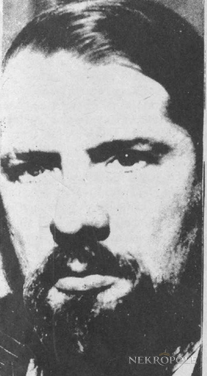
Viktors Kalnins (1938-2001)
*
He was questioned for four days continuously by Investigator E.M. Saushkin. The questions were mostly about the period Kalnins and Ginzburg had spent together in the Mordovian camps.
Q. Who wrote the ‘Appeal to Cultural Figures’ from Camp 17?
A. Platonov and I.
Q. Did Ginzburg have a copy of this Appeal?
A. Yes.
Q. Who produced the set of portraits of prisoners?
A. Yury Ivanov.
Q. Was Ginzburg in possession of these portraits?
A. Yes.
Q. What did he want to do with them?
A. He said they should be passed on to Amnesty International to be shown in an exhibition.
Q. Who passed on the “Appeal” and the portraits to Possev? [2]
A. I don’t know.
Q. Where did you get copies of an interview with Solzhenitsyn, which were confiscated in June 1976 during a search at Riga airport when you were returning to Moscow?
A. Two of the copies were from Gorbanevskaya, one from Ginzburg.
Q. Where has the Chronicle been getting facts about Latvia from?
A. I don’t know.
Q. Did the Fund help you?
A. Gorbanevskaya offered help, but I refused. Ginzburg was only interested in finding out who was in need of help.
Q. How did Ginzburg behave in the camp?
A. When he was the leader of the “commune” he knew how to get food in exchange for unofficially obtained money, how to arrange exchanges, and so on.
Q. Where did you get the nationalist literature confiscated from you during the search?
A. That has nothing to do with the Ginzburg case.
Investigator Saushkin asked about one of the new administrators of the Fund, Tatyana Khodorovich: “‘Now you’re going to take your libellous materials to her. If she doesn’t leave our country, we’ll lock her up.”
*
FYODOROV
The exile Yury I. Fyodorov was arrested in the Tomsk Region village of Podgornoye on 28 January (on the date CCE 45.13 was inaccurate).
A case was initiated against him under Article 186 (RSFSR Criminal Code: “Attempted escape from a place of exile”). At the end of February 1977 he was taken to Moscow by aeroplane, and from there to Kaluga. In March and April, Investigator Saushkin questioned him about Ginzburg, the Fund, his visit from Alexander Podrabinek (CCE 44.19) and about Yury Orlov.
In the intervals between interrogations Fyodorov was taken to a museum and a music-hall performance and a trip round the town was arranged for him.
During his interrogation the basic emphasis was on connections abroad, currency deals, speculation and drunken get-togethers. Investigator Saushkin promised that towards the end of the year they would hold a press-conference featuring “Ginzburg, Orlov & Co.”, which would be “even better than Yakir’s” (see CCE 30.2).
“Otherwise, what would happen to them? 15 years of special regime — under our control. That would mean death for them. They’re clever men. We’ll explain it to them, they’ll understand. As for witnesses, we’ve got them!”
The investigator told Fyodorov that there were two ‘centres of resistance to the regime’ in the USSR: a legal one in Tarusa, led by Ginzburg, and an illegal one in Luga (Leningrad Region), headed by Fyodorov himself.
Saushkin told Fyodorov the names of some of his assistants: Nikolai Ivanov (CCE 1.6, //42), Sergei Khanzhenkov, ‘head of the action department’, and Vladislav Uzlov, a member of the ‘centre for coordination”. Saushkin told Fyodorov that the KGB had all the proof, but that it was ‘too early’ to make it public. On 27 April Saushkin said, in parting, ‘Think it over! We’ll probably have to meet again.”
At the end of April Fyodorov was taken back to Kargasok in west Siberia (Tomsk Region). On 4 May he was tried for “attempting to escape from exile”, and sentenced to 10 months of corrective labour. As he had spent over three months in detention, he only had about ten days left to serve at corrective labour.
This description of Yu. Fyodorov’s interrogation was compiled on the basis of a letter he sent (see below).
*
On 29 June Ludmila I. Ginzburg, mother of Alexander Ginzburg, gave journalists a letter from Yu. Fyodorov, in which he described the interrogations in Kaluga, and her own ‘Statement for the Press’, which ends as follows:
“Read this letter and you will be convinced that the methods of the 1930s are still alive today!
“We still don’t know which Article will be used to charge Alexander Ginzburg, but we are firmly convinced that the KGB is preparing a terrible reprisal against him and future Petrov-Agatovs are already awaiting their hour.
“I appeal to all who value Goodness and Justice — help me to save my son’s life!”
***
In April and May 1977, Captain Obrubov, the KGB representative in Vladimir Prison, summoned prisoner V.P. Anisimov (CCE 44.17-4) a number of times, and suggested that he should appear as a witness in the Ginzburg case.
He demanded that Anisimov should write a statement saying that all information about the situation of political prisoners was slanderous and that the hunger-strikes by political prisoners were fictional.
Anisimov refused to make such a statement.
*
At the beginning of July 1977 Valentin Turchin received a summons to interrogation in Kaluga. He refused in writing to participate in the investigation.
On 4 July he was seized on the street and taken to Kaluga for interrogation. There he repeated his refusal. The investigator began to threaten him: ‘So you’re getting ready to emigrate from the USSR? Your refusal might prove a hindrance to your departure.”
In August the artist Khvoshchov from Tarusa was interrogated once more (CCE 45.4).
In Leningrad E. Murashov was interrogated (see the article by A. Kostrov “The Second Hypostasis of Teodor Voort” in Ogonyok 1977, No. 27), According to the same letter from Fyodorov, Murashov testified that in February 1975 Ginzburg had allegedly given Fyodorov dollars in his presence.
*
The Orlov Case
At the end of June Irina Valitova, wife of Yury Orlov, was summoned for interrogation. She made a statement refusing to take part in the investigation.
*
In July 1977 Alexander Podrabinek was summoned three times to the Moscow KGB, for interrogation by Investigator Kapayev in connection with the case of Orlov. After the second interrogation he issued a ‘Statement to the Press’:
“. . . the investigators’ desire to obtain evidence from me that would convict Orlov was so great that they went as far as blackmail and threats.
“The KGB investigator told me that they had quite enough evidence to be able to charge me at any time with anti-Soviet agitation and propaganda and to arrest me, and that it depended on me alone, on my willingness to cooperate with the investigation, whether charges would be pressed against me or not. Despite the fact that I was formally a witness, not the accused, during interrogation I was accused of committing a crime in compiling my work “Punitive Medicine”, the manuscript of which was confiscated from me by KGB agents during a search on 14 March this year, and also in participating in the activities of the Working Commission to Investigate the Use of Psychiatry for Political Purposes, which had been set up as an adjunct to the Helsinki Group.
“I was offered my freedom and unhindered emigration abroad in future, in exchange for my testimony. If I refused to give evidence, I was threatened with 7 years’ imprisonment in prisons and camps, where ‘the food and medical service are very bad’ — as the investigator candidly informed me.
“Of course, I shall not give any evidence now or in future, in spite of blackmail, threats and the possibility of arrest.
“All this is quite traditional, and I am issuing my statement only in order to show what kind of methods the KGB uses to try to obtain evidence to prove Yury Orlov’s non-existent transgression against the law.”
Igor Khokhlushkin, Father Gleb Yakunin and Vladimir Kornilov have also been summoned for interrogation.
*
On 11 July Academician Sakharov, Igor Shafarevich (USSR Academy of Sciences corresponding member), and Valentin Turchin, Naum Meiman and Yury Golfand (all D.Sc., Physico-Mathematical Sciences), made an appeal to the participants of an International Conference on Nuclear Accelerators taking place in Protvino (Moscow Region).
They called on them to:
“… demand that the Soviet authorities should immediately release Orlov and publicly examine in the press the charges made against him.
“We call on you to demand that the leaders of Soviet science should express their attitude to the Orlov case.
“We also consider it extremely important that you should take an interest in the fate of other persecuted members of the Group.”
The foreign participants in the conference sent a letter of solidarity to Yury Orlov.
*
On 10-11 August taxi-driver V.M. Pavlov (CCE 43.6) was interrogated in Maikop (Krasnodar Region [Krai]). When asked how his statements had reached the Helsinki Group, he replied that he had given them to Ludmila Alexeyeva (CCE 44.8) and Valentin Turchin.
When asked if he had agreed to his statements being passed to the West, Pavlov replied: ‘That was understood.” The investigator told him that Turchin had been arrested three days ago.
(See also the interrogation of V. Ivanov in “The Right to Leave One’s Country”, CCE 46.9 [9].).
===============================
NOTES
- On Victor Pestov, see CCE 33.6-3 [11], CCE 41.5 [8] and CCE 45.12.
↩︎ - Written in 1969 and summarized in CCE 11.14 [3]. (See P. Reddaway, Uncensored Russia, pp. 224-225.)
↩︎
=========================
 A Chronicle of Current Events