In February 1977, Julia Okulova-Voznesenskaya (CCE 43.5) was transported from Leningrad to the Far North (Vorkuta, Komi ASSR), to serve the five-year term of exile imposed by a court.
She ended the hunger-strike declared on 21 December 1976 at the beginning of February, not long before the transportation.
*
In January 1977, at the end of a five-year term of imprisonment, Stefaniya Shabatura (CCE 28.7) was transported from her Mordovian camp for her three-year term of exile.
Her mother was told that her daughter was being sent to Ukraine, but Shabatura’s place of exile is in the Kurgan Region of the Urals (Makushino village, 641610 poste restante). She was released there by the prisoner escort on 26 January.
Shabatura is currently working in an artistic workshop attached to the local Cultural Centre, designing propaganda graphics.
*
In January 1977, at the end of a his four-year term Victor Khaustov (CCE 32.2) was transported from Perm Camp 37 to start a two-year term of exile.
On 11 February he arrived at the designated place. He is working at a sawmill and living in a hostel. Pavel Kampov (CCE 42.4-4) lived in the same hostel.
***
Spending their exile in the Tomsk Region of west Siberia [1] are:
Vyacheslav Valentinovich PETROV — 636733, Kargasoksky district, Sredny Vasyugan, poste restante;
Yury Ivanovich FYODOROV and Andrei Mikhailovich KOROBAN — are living in the district centre, the village of Kargasok;
Vladimir Ilych GANDZYUK — Podgornoye village;
Nikolai Andreyevich GORBAL (Ukr. Horbal) — Parabel village, SU-6, barrack No. 16;
Andrei Nikolayevich KRAVETS — Verkhneketsky district, Poludenovka settlement, and Nikolai Braun.
*
Vyacheslav Petrov (CCE 29.2) has two years of exile to serve, until December 1977.
Petrov is suffering from gastritis, a stomach ulcer and chronic hepatitis. At the end of 1976 he was in hospital for about three months.
Usually those in exile receive living space from the enterprise where they work.
A.D. Baryshev, director of the only enterprise in Sredny Vasyugan, an oil-survey office, has refused to give political exile Petrov a job. Intervention on Petrov’s behalf by the village soviet and the local police did not help. Up till now, therefore, Petrov has neither a place to live or work.
*
Yury I. Fyodorov received a five-year term of exile in May 1976 for violating the rules of surveillance (CCE 42.3). He now works as a nightwatchman. He has been given a tiny, very cold room.
Andrei Koroban is a teacher of foreign languages. At present he is drawing cinema posters for the Kargasok Culture Centre. He is living in a private flat, in the district centre Kargasok. It has a population of over five thousand, but only two copies of Pravda go on sale a day.
Vladimir Gandzyuk (CCE 39.2-2) fell ill in the camps with tuberculosis (TB) of the lungs.
He is so weak that he cannot even carry a bucket of water to his house. An electrician, Gandzyuk is currently working in a cobblers’ workshop.
Nikolai Gorbal (CCE 33.6-2 [28]) also has TB. His two years of exile should end this autumn.
The term of exile of Nikolai Braun (CCE 17.14, CCE 41.6-2) is due to end in the first half of 1978.
*
Alexander Alexandrovich BOLONKIN is a former Assistant Professor of the Bauman Higher Technical School in Moscow, and a D.Sc. (Physical-mathematical Sciences).
He is working at a geological survey office in east Siberian exile. His address: 671511, Buryat ASSR, Bauntovsky district, Malovsky, poste restante.
*
PASHNIN
Yevgeny Ivanovich PASHNIN is spending his exile in the north Russian Komi ASSR (169913, Vorkuta, 13 Lomonosov St., room 50). He has a stomach ulcer. He works as a labourer on a building site.
He arrived in Vorkuta on 10 December 1976. He was put under surveillance. On 5 March 1977 the surveillance was halted. The reason: he behaves well, observes the surveillance rules, and has a positive work reference.
*
On 20 December 1976 Pashnin sent a complaint to the Chairman of the Council for Religious Affairs at the USSR Council of Ministers.
In Vladimir Prison, before he was transported into exile, a Bible and church calendar were taken from him. On 27 January 1977 he received a reply from A.D. Larin, acting head of the Corrective Labour Administration (Vladimir Region soviet executive committee): “The administration of [penal] institution OD-1-ST-2 acted correctly.”
On 7 March 1977 Pashnin sent a complaint to the head of the Orthodox Church, Patriarch Pimen of All Russia. He wrote about the confiscation in Vladimir Prison of religious literature officially published in the USSR. He described incidents of this nature involving himself and Gabriel Superfin (CCE 39.2-2). Pashnin also complained of the absence in Vorkuta of a church or prayer-house and of the impossibility of obtaining the Journal of the Moscow Patriarchate.
==========================================
NOTE
- Others were deported to this part of the Tomsk Region in the 1930s and 1940s, see the Joffe Foundation website A Necropolis of Terror and the Gulag, No 70-64.
For example, the Shchuchy Mys special settlement (today uninhabited) was set up for dekulakized peasant families in the Kargasoksky district in 1931. Deported Latvians, Soviet Germans and forced settlers from Moldavia were sent there in 1941. Those who died were buried in mass and individual graves in a cemetery half a kilometre to the south of the village.
In summer 2006, the territory of the special settlement and the graveyard was investigated by “Forgiveness and Memory”, the Kargasoksky district’s local history group.
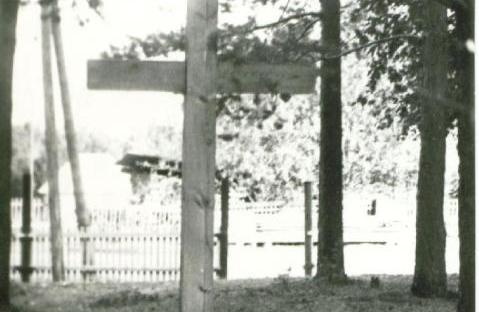
(1997 feature photograph shows Mogilny Yar (Tomsk Region) to which many were exiled from 1933 onwards.)
↩︎
===========================
 A Chronicle of Current Events