NINETEEN ITEMS
[1]
Anatoly Marchenko has refused to appeal against the sentence of the court (CCE 35.2).
In reply to a request from Marchenko’s wife, Larissa Bogoraz, that the sentence should be appealed by way of the procurator’s supervision, and that false witnesses in her husband’s case should be called to account, Sharafanov, the Procurator of Kaluga, answered that there were no grounds for this.
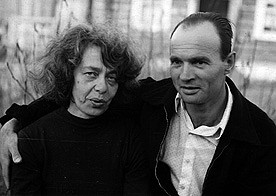
With regard to Bogoraz’s complaint about illegal actions in the Kaluga investigation prison, N. V. Kuznetsov, the prison governor, and Kagarov, an assistant to the Regional Procurator, stated that there had been no violations of the rules on the detention of prisoners in regard to Marchenko.
*
APRIL 1975
- 1 April. Marchenko had a meeting with his wife in the Kaluga investigations prison. The meeting proceeded as follows: there was a double partition between Marchenko and Larissa Bogoraz; their conversation took place through a tube apparatus.
- 12 April. The 45th day of his hunger-strike, Marchenko was sent to his place of exile. He continued his hunger strike en route; however, all kinds of artificial feeding were stopped.
- 20 April. Marchenko lost consciousness. When he regained it, he ended his hunger strike.
On 20 May Marchenko was brought to his place of exile: the east Siberian settlement of Chuna (Irkutsk Region). In 1968-1971 Larissa Bogoraz had served a term of exile in the same place. In 1971 (and not in 1970 as reported in CCE 35.2), Marchenko himself was sent there after his release from camp.
*
[2]
MOSCOW. On 9 April Tatyana Khodorovich ended the hunger strike which she had declared in court at Marchenko’s trial (CCE 35.2).
*
[3]
In November 1970, reported CCE 17.1, a Sverdlov court gave Lev Grigorevich UBOZHKO three years in an ordinary-regime camp under Article 190-1 (RSFSR Criminal Code).
After Ubozhko had served two-and-a-half years in a camp near Omsk, a new case was brought against him, this time under Article 70. A forensic psychiatric commission of experts pronounced him not responsible for his actions. Ubozhko was sent to the Tashkent Special Psychiatric Hospital (SPH) for compulsory treatment. He was ’treated’ in this hospital for about two years.
Then he was transferred to an ordinary psychiatric hospital in the Urals (Chelyabinsk Region, Chebarkulsky District, OPMB-2, section 2). His friends now fear that Ubozhko may be brought to trial again in a case being brought against Lvov, his friend in the Tashkent hospital. Lvov was previously sentenced under a political Article of the RSFSR Criminal Code and was also sent for compulsory treatment, but he managed to gain his release.
*
[4]
Until recently Armenians sentenced under Article 206-1 (Armenian SSR Criminal Code = Article 190-1, RSFSR Code) were held in camps in Armenia. Recently they have begun to be transferred to camps in Russia.
Female offender Anait Karapetyan (CCE 34.4), for example, is now in Penza.
*
[5]
On 12 May Andrei Amalrik [1] returned to Moscow from exile in Magadan at the end of his sentence.
Before the end of his term of exile it was suggested to him that he should submit a request to emigrate to Israel and he was promised a quick and positive response. He refused.
Amalrik was arrested in 1970 and sentenced to three years’ imprisonment under Article 190-1 (RSFSR Criminal Code), chiefly on account of his article Will the Soviet Union Survive Until 1984? He served his sentence in the Soviet Far East (Magadan Region).
Before his release in the spring of 1973 a new case was opened against him, again under Article 190-1, and once more he was sentenced to three years in camp. After a hunger strike lasting several months, the RSFSR Supreme Court changed Amalrik’s sentence from labour camp to exile.
*
[6]
At the end of April Vladimir Markman (CCE 25.2) was released after a three-year term of imprisonment. After his release he applied to OVIR in Sverdlovsk for permission to emigrate to Israel.
He was told: “Don’t hope to emigrate immediately. You’re no Kukui.” Valery Kukui, who ended a three-year sentence (CCE 20.4) in March 1974, had already left the USSR the next month.
*
[7]
The chemical engineer Valery Ronkin (CCE 9.10 [10]), one of the leaders of a Marxist circle in Leningrad from 1963-1965, finished his term of exile in April. Thus, all the participants of the “Kolokol” (Bell) Group are now at liberty [2].
Ronkin was arrested in June 1965 and sentenced at the beginning of 1966 to seven years in camp and three years’ exile under Articles 70 and 72 (RSFSR Criminal Code). He spent the last three years of his camp sentence in Vladimir Prison. He served his exile in the Komi ASSR (Northwest Russia).
*
[8]
Yu. I. Fyodorov (CCE 12.5) was released at the beginning of 1975 and sent to Luga, near Leningrad, where he was placed under surveillance. Fyodorov, a former MVD investigator, served a six-year sentence in connection with a case concerning the organization of a “Union of Communists”.
*
[9]
On 23 May Roald Mukhamedyarov (CCE 34.9) was discharged from the psychiatric hospital at Stolbovaya Station, near Moscow. The court which ended his compulsory treatment sat in November 1974. The Chronicle does not know the reasons for the delay in his discharge.
*
[10]
LEV TURCHINSKY
MOSCOW. On 4 February 1975 searches were carried out at the home (near Moscow) and the place of work of Lev Turchinsky, a researcher at the Museum of Fine Arts.
The searches were connected with a case against Fleshin, who among other charges (illegal currency deals, etc.), is charged with speculation in books. All foreign editions of Russian poets were confiscated from Turchinsky, who is one of the foremost collectors of Russian poetry, and also the first issue of the journal Kontinent, sent to him by his friend Igor Golomshtok, the art historian.
The interrogations which Turchinsky underwent during several days after the search digressed, in actual fact, from Fleshin’s case, and included threats to apply Article 70 of the RSFSR Criminal Code to Turchinsky. (In June 1973 Turchinsky was one of the first people interrogated in Superfin’s case, even before Superfin had begun to give evidence.)
*
[11]
GEORGY YERMAKOV
On 9 July 1974 the Leningrad City Court examined the case of Georgy Ivanovich YERMAKOV (b. 1931) senior engineer in a navy research institute, accused under Article 70 (RSFSR Criminal Code). The chairman of the court was B. F. Zhigulin. Procurator G. P. Ponomaryov acted for the prosecution. The lawyer Yarzhenets spoke for the defence.
The substance of the indictment was that from October 1970 to March 1974 Yermakov had sent anonymous handwritten letters to newspaper editors and Party organizations.
Yermakov was arrested on 20 March 1974.
The court’s sentence: four years of strict-regime camp. The sentence will be published in the Archive of the Chronicle.
*
[12]
SLEPAK HUNGER-STRIKE
MOSCOW. On 13 April Vladimir Slepak, his wife Maria (CCE 19.11 [3]), and son Alexander declared a hunger-strike, demanding permission to emigrate to Israel, where the mother of Maria Slepak, Berta Rolikovskaya, has already been living for several years.
The Slepaks were marking a twofold date by their hunger-strike: six years from the moment of Vladimir Slepak’s dismissal from his job on the grounds that it involved State secrets; five years from the day of handing in applications to emigrate.
On 16 April the Slepaks sent a letter to Podgorny, Presidium Chairman of the USSR Supreme Soviet. They received no reply.
*
In the West there were speeches and hunger strikes in solidarity.
Despite her diabetes and her age (73), Maria Slepak’s mother staged a three-day hunger strike in Israel. In New York, Washington, Chicago, San Francisco, Philadelphia, Detroit, Los Angeles, Cincinnati, Minneapolis, London and Paris, five-day hunger strikes of people sympathising with the Slepaks took place; four families from Florida staged a five-day hunger strike in solidarity. In Toronto, Montreal and several other Canadian cities Jewish and Christian schools were closed on 21 April; many mothers and children staged one-day hunger strikes in solidarity.
Alexander Slepak maintained his hunger strike until 20 April, Maria Slepak until 27 April, and Vladimir Slepak until 4 May.
On 22 May 1975 employees of the procuracy and the KGB conducted searches at the homes of Ilya Rubin (Moscow), Sarra Shapiro (Moscow), Rafail Nudelman (Vladimir) and Isaak Gindis (Vladimir). Copies of the journal Jews in the USSR, materials for the journal — articles and essays on Jewish cultural and religious life — and typewriters were confiscated.
Money vouchers received through official channels were confiscated from Ilya Rubin.
*
[13]
MOSCOW. On 28 May Anatoly (Nafan) Malkin, who was trying to emigrate to Israel, was arrested on a charge of ‘evasion of military service’. His parents — his father is a D.Sc., his mother works for the USSR procuracy — would not give their permission for their son’s emigration.
In April 1975 Melik (Mikhail) Agursky (CCE 34.18 [10]), Nikolai Bokov (CCE 32.20 [1], CCE 34.20-2). Valery Buiko (CCE 35.10 [16]), and Victor Fainberg’s fiancée, the Leningrad psychiatrist Marina Voikhanskaya, left the USSR.
In May 1975 Oleg Frolov (CCE 33.6-3 [8]) left the USSR.
*
[14]
TYMCHUK’S BUGGING DEVICE
ODESSA. Leonid Tymchuk (CCE 30.8, CCE 32.20 [5], CCE 35.10 [6]), having guessed that his flat was bugged, carried out a thorough search and discovered a newly plastered niche with wires leading to it in a wall of his house looking onto the grounds of a factory.
At the beginning of May Tymchuk disconnected the wires by night, opened the niche and forced open a metal box which was bricked up in the wall. Inside were dips of batteries and two or three boxes, tightly wound with insulating tape and connected together by different coloured wires; some of the wires went straight into the wall, behind which was Tymchuk’s room. Tymchuk took the boxes into the house and hid them. Very soon a car appeared at the house and some people began to swarm around the wall, but when they noticed Leonid observing them from the roof, they ordered him to dear off. He did so; he left the house unobtrusively, across the roofs.
Later, however, they tracked him down on the streets of Odessa and brought him home, having produced a search warrant for the purpose of confiscating ‘literature slandering the political and social order’. The search was conducted
by KGB officers; they did not discover the literature for which they were searching, but to make up for it they found the boxes and confiscated them. Tymchuk demanded that they should take the insulating tape off them and see what was underneath. However, the people conducting the search refused to do this.
Subsequently, at an interrogation, Tymchuk was reproached with having allegedly upset the anti-aircraft defences of the factory, although his house had nothing whatsoever to do with the factory and as a matter of fact is scheduled for demolition.
*
[15]
MOSCOW. In March and April 1975 exhibitions of independent artists from different cities of the Soviet Union took place in seven or eight apartments in Moscow, cf. items in CCE 34.16 and CCE 35.10 [30]. (There is an inaccuracy in CCE 35: the exhibition in the Hall of Russian Art in December 1974 was an ordinary exhibition in which, among other pictures, were four pictures by ‘independent’ artists.)
*
[16]
In the Moscow section of the Writers’ Union, an ‘official denunciation’ of the writer N. D. Otten, a member of the Soviet Writers’ Union since its foundation in 1934, was received from Party agencies.
Otten was accused because of his kind-hearted attitude to former political prisoners, Alexander Ginzburg, in particular: after his release, Ginzburg was deprived of the right to live with his family in Moscow and instead he lived for a while in Otten’s house in Tarusa (Kaluga Region).
In connection with the denunciation, Rekemchuk, a secretary of the Moscow section of the Writers’ Union, conducted an admonitory conversation with Otten in April. He tried to persuade Otten to sell his house in Tarusa.
*
[17]
When the parents of Povilas Peciulaitis were living in the USA in the 1920s, they became naturalized there. Now his mother is living in Lithuania and his father has died.
P. Peciulaitis applied to the US Embassy with a copy of the naturalization document in order to receive American citizenship for himself and his mother. As soon as he returned from Moscow, he was summoned to a police station and fined for non-possession of a residence permit. (Peciulaitis is a former prisoner.) After a while his passport (ID Document) was taken away and he was accused of violation of the residence regulations.
*
[18]
On 1 May 1975 a group of Soviet Germans held a demonstration in the town of Shchusev (Kokchetav Region, Kazakh SSR) demanding either autonomy or free emigration. The demonstrators were dispersed with fire engines and hoses.
*
[19]
BONNER REFUSED TREATMENT ABROAD
At the end of March 1975, the Moscow Visa & Registration Department (OVIR) refused Yelena Bonner, wife of Andrei Sakharov, permission to travel to Italy at the invitation of Italian doctors to receive treatment for her eyes.
*
Yelena Bonner has been a Group II invalid since the Second World War. Her eye disease is a consequence of war wounds. Soviet doctors have been unable to cure her. In OVIR Yelena Bonner was told: “Let relatives give you an invitation. Or let the USSR Ministry of Health write that you cannot be cured in the USSR. Or let foreign doctors come here.”
The conversation in OVIR was interrupted several times; after every reply given by Yelena Bonner and members of her family who had come with her, the bureaucrat who was talking to them would break off the conversation and leave the room for a long while. It was clear that he was consulting someone else.
*
On the morning of 7 May Andrei Sakharov telephoned the President of the USSR Academy of Sciences, M. V. Keldysh, and Ivanov, the official of the CPSU Central Committee who oversees OVIR, and informed them that in the evening he would call a press conference, at which he would protest against the refusal to allow his wife to make a trip to obtain treatment. At five o’clock on the evening of the same day he received a letter from OVIR by special delivery containing the reply of the USSR Ministry of Health to OVIR’s inquiry:
“In reply to your inquiry we can inform you: Citizen Bonner’s treatment can be accomplished within the country. On the demand of doctors and also at Mrs Bonner’s request, foreign specialists may be invited here.”
At a press conference the same evening, Sakharov handed correspondents his letters of protest addressed to foreign statesmen and public figures, and announced that he and his wife would stage a three-day hunger strike in protest. On 8, 9 and 10 May Sakharov and Bonner held a hunger-strike.
==============================================
NOTES
- On Amalrik, see CCE 17.1, CCE 29.7, CCE 30.14 [9] and Name Index.
↩︎ - See “The Bell Affair”, Joffe Foundation, 2015: Valery Ronkin, Sergei Khakhayev, Vladimir Gayenko, Venjamin Joffe and Valery Smolkin.
↩︎
=========================
 A Chronicle of Current Events