EIGHTEEN ITEMS.
EXILE (11) AND RELEASES (7).
*
SIBERIA (1-3).
[1]
BODAIBO (Irkutsk Region). On 3 October Zinovy Antonyuk (CCE 53.20) wrote to N. A. Shcholokov, USSR Minister of Internal Affairs (MVD) .
He requested permission to visit a specialized medical institution for examination and treatment, or that his place of exile be changed to an urban centre where there is an urologist, a specialist “in tuberculosis of the urinogenital area, and where the natural surroundings would not be as harmful for tuberculosis as they are in Bodaibo”.
*
Antonyuk contracted TB in Vladimir Prison, he writes, and in October 1978 a special commission from the Perm Region Department of Internal Affairs (UVD) decided he should be sent to an MVD hospital in Leningrad (CCE 51.9-1).
This decision was not carried out.
Antonyuk asks who was responsible and who concealed that he had active tuberculosis when his place of exile was selected. Antonyuk’s statement was supported by several political exiles (including the Kalynets couple, CCE 51.9-1).
In October-November Antonyuk was very weak, tired easily and sweated a lot (especially at night). After an hour’s walk he had to lie down for half a day. His temperature was always 37-37.2° C. On 5 November Antonyuk was discharged from hospital.
He is once again living in the hostel. Address: 666910 Irkutsk Region, Bodaibo, 38 “30th Anniversary of Victory” Street.
*
[2]
ALTAI REGION (Krai). Ivan Svetlichny (CCE 52.6) is in very poor health. He even finds it difficult to write letters.
*
[3]
BAGDARIN (Irkutsk Region). During a routine search in Perm Camp 36, where Yevhen Sverstyuk had served his sentence, some notes were found. They were written by a number of prisoners, including, apparently, Sverstyuk. In this connection an investigator came to see him.
On 20 October Sverstyuk was questioned about a visit from Pyotr Rozumny (CCE 54.11). Sverstyuk works as a carpenter.
*
FAR EAST
[4]
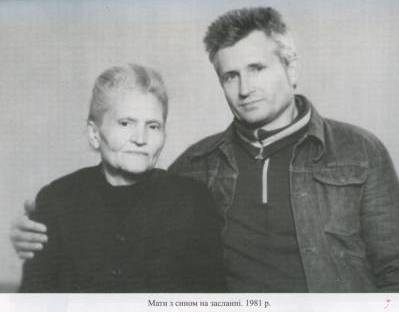
AYAN VILLAGE [1], Khabarovsk Region (Krai). Alexander Sergiyenko arrived here in February 1979 (CCE 52.5-2) and worked as a joiner.
The house which Sergiyenko (Ukr. Serhiyenko) was given to live in was falling apart; he repaired it himself. His mother Oksana Meshko and wife Zvenislava Vivchar came to visit him in the summer (CCE 53.20 [3]). After they left, a certain Rudyak was installed in his house. On several occasions Rudyak got drunk and attacked Sergiyenko — on one such occasion with a knife.
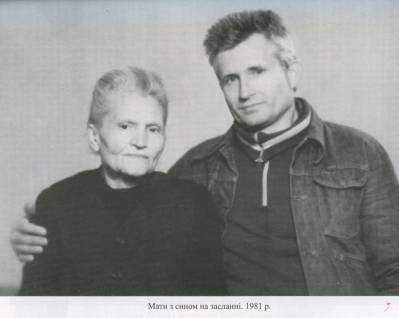
Oksana Meshko and Oles Serhiyenko (1981 photo)
At the very beginning of Sergiyenko’s exile, his mother Oksana requested that he be transferred somewhere else, even if it were still in the Khabarovsk Region. The climate in Ayan, which is on a peninsula, was very bad for his health: Serhiyenko has suffered from tuberculosis since before his arrest. Her request was refused.
During summer 1979, Sergiyenko felt worse and worse.
He went to the clinic several times, requesting that they send him, as promised after his arrival, to the city of Khabarovsk for examination. He was refused. In August, having spent a whole day in the clinic undergoing various tests, he was unable to obtain a medical certificate. The day was counted as ‘absenteeism’: he was immediately dismissed from his job.
Sergiyenko wrote to the Presidium of the USSR Supreme Soviet. On the strength of past experience, his and that of others, in camp and exile, he wrote, he did not trust Soviet doctors when they came to treat political prisoners. He requested permission to go for treatment to Australia, where he and his family had a long-standing invitation from relations.
*
In September Oksana Meshko appealed to the USSR Ministers of Health and Internal Affairs, the International Red Cross and the International Association of Democratic Lawyers, for help in obtaining her son’s admission to a hospital in Kiev.
Sergiyenko was given a warrant for treatment in Khabarovsk, on the grounds of suspected cancer, but the police would not let him go.
In October Oksana Meshko wrote to the USSR Ministry of Internal Affairs (MVD) in this respect. Finally Colonel Karagezyan, Head of Section Five (concerned with exiles), whom she had seen and spoken to on the telephone several times, informed her: “We’ve arranged to send him to Khabarovsk”.
On 11 October Sergiyenko set off, straight from a police cell, for the district Cancer Clinic in Khabarovsk. A few days before he had shouted at a doctor during his regular battle at the local clinic. He was sentenced to 15 days in jail (Rudyak was placed in the same cell).
The remaining 13 days of his sentence were not revoked, but simply postponed until Sergiyenko returned from hospital.
*
BURYAT ASSR
SIBERIA
[5]
In July1979, Vasily Lisovoi [Ukr. Lisovy] arrived for his three-year exile in eastern Siberia. Address: 671311 Buryat ASSR, Zaigraevsky district, Novaya Bryan settlement.
Lisovoi (CCE 53.19-1) lives in a hostel. On 1 November he was admitted to hospital with jaundice.
*
YAKUT ASSR (6-7)
FAR EAST
[6]
Viacheslav Chornovil (CCE 53.20 [7]) has moved to a district centre, the town of Nyurba. He lives in a rented house there, and works as a transport controller in a building administration.
*
[7]
Towards the end of summer 1979, a relative of Mustafa Dzhemilev (CCE 53.2) from Tashkent came to visit him in Zyryanka, intending to stay and work there. He moved into the hostel with Mustafa and found himself a job.
The police refused to give him a residence permit, however. No one who visited Zyryanka, they said, was issued with one. A local officials had a ‘chat’ with him:
“You’re a member of the Komsomol, yet you get mixed up with an anti-Soviet!”
He was turned out of the hostel, the hotel was forbidden to admit him and Mustafa was moved to another room, occupied by a number of people, where no space could be found for his guest. The police began to threaten Mustafa’s relative with criminal proceedings under Article 198 (RSFSR Criminal Code: “Violation of the Residence Regulations”). He was forced to return to Tashkent.
On 9 September Dzhemilev sent a statement to the Uzbek SSR Supreme Court. He demanded that criminal charges be brought against Yu. Kruzhilin, author of the article “Profession: Sponger” (CCE 53.2) for defamation and libel.
*
SIBERIA.
BOGUCHANY DISTRICT (8-10)
[8]
Pyotr Sartakov left Mordovian Camp 19 on 22 June (CCE 53.19-1).
He did not arrive at the village of Irba, Boguchany district, Krasnoyarsk Region (his Siberian place of exile) until 4 August. For 26 days of his 43-day journey he was held “at the whim of the warders in Krasnoyarsk Prison No. 1, noted for its inhuman conditions” (from his letter).
*
Earlier he requested exile near Zima (Irkutsk Region), the large town [2] where his sister lives. The request was refused.
To his request to be exiled to the village of Shushenskoe he received the reply that one had to earn such a place of exile. In Irba it was some time before his money arrived from camp, and at first he had to eat in the canteen on credit.
Divisional police Inspector Sharoglazov and the chairman of the village soviet tried to give him a labouring job, despite the invalid’s certificate issued to him in the camp. When Sartakov managed to find a job as a guard in a store, they forbade the store manager to employ him. In their opinion he had no right to such a job, they said. Sartakov managed to get the job in October, after making numerous complaints.
*
As he suffers from a number of chronic illnesses, Sartakov wanted to move from Irba to the district centre of Boguchany, where there is a hospital.
Travel there from Irba is very difficult and costly and possible only by air. In response to this request Sharoglazov threatened to pack him off to an even more remote village. Sartakov also received a written refusal from MVD official Soldatov, who is in charge of all exiles in the Boguchany district.
On 2 October Sartakov was beaten up by a local hooligan, who afterwards boasted that a KGB man had put him up to it. The same day Lieutenant Khmurovich, a KGB official from Boguchany, visited Irba. At the local health centre Sartakov was not given the certificate listing the injuries he had sustained.
Letters written by Sartakov to people abroad are not accepted for dispatch. They tell him at the post-office that they are not sure whether he is allowed to send letters abroad, but promise to find out.
*
On 12 October 1979 Josif Dyadkin and Alexander Lavut wrote to the Boguchany district Procurator about the illegal persecution of Sartakov: according to the Corrective-Labour Code an exile has the right to choose his job and place of residence within the confines of the administrative district to which he has been exiled.
*
[9]
At the beginning of August Maria Semyonovna RUSAK arrived in Boguchany district to serve her term of exile.
Rusak lived in Chernovtsy until her arrest. She was sentenced to five years in the camps and five years’ exile under the first section of the ’religious’ Article 209 (UkSSR Criminal Code). The equivalent Article 227 of the RSFSR Code has a maximum sentence of five years in the camps: Article 209 of the UkSSR Code carries a maximum of five years in the camps and an additional five years in exile.
Rusak served her term of imprisonment at a camp near Odessa. Address: Odessa-59, penal institution YuG-311/74.
*
[10]
Parcels and printed matter sent to Nijole Sadunaite from abroad (she is in exile in Boguchany, CCE 47.9-1) are systematically stopped at customs and returned to the senders.
*
NORTHWEST RUSSIA
[11]
MIKUN (Komi ASSR). On 6 August Vadim Konovalikhin (CCE 52.6) wrote to the head of the Ust-Vym district department of internal affairs (OVD) requesting permission during the time allotted for his holiday to visit his wife and his parents: his father is a Great Patriotic War invalid (Group I); his mother is a Group II invalid.
On 9 August the deputy head refused his request.
On 10 August Konovalikhin sent a statement to the Procurator of the Komi ASSR:
“The deputy head of the district OVD refused my request on the grounds that I am violating the moral code of the builder of communism!“
To me, a person who has been suppressed by the Soviet authorities — who are led by communists — such a reason to refuse permission to travel sounds like mockery. I consider the refusal an inhuman act on the part of the Soviet authorities.
“As a protest I declare a hunger-strike from 12 to 22 August 1979!“
*
Releases
[12]
Andrei Koroban’s three-year exile in the Tomsk Region (CCE 18.5 [3]; CCE 44.19; CCE 46.23-2) ended in September 1978.
Koroban (b. 1930) now lives in the town of Vasilkov (Kiev Region). An English teacher by profession, he is working as a loader.
*
[13 & 14]
The five-year exile sentences of Mark Nashpits and Boris Tsitlyonok ended in the summer of 1979.
They were sentenced for a five-minute demonstration (CCE 36.4) on the steps of the Lenin Library, in support of their demand for permission to emigrate (CCE 54.20-1).
*
[15]
Yevgeny Pashnin’s three-year exile sentence ended in October (the length of his exile term was given wrongly in CCE 43.3).
*
[16]
Nikolai Kots’s five-year exile sentence (CCE 46.23-2) ended in September.
He returned home, to the town of Novovolynsk (Volyn Region), but has been unable to find anywhere to live or to get a job: before his arrest he taught mathematics in a school.
Kots travelled around the three neighbouring Regions in search of somewhere to live. When one woman finally agreed to register him as her lodger and he went to the police station with the house book, the book was taken from him and the woman was fined ten roubles (as if he had been staying with her without a residence permit) and threatened with criminal proceedings for “speculation in living space”.
Kots has been unable to obtain permission to visit his mother’s grave: the cemetery is two kilometres from the Polish border.
*
[17]
The term of exile of Vasyl Stus (CCE 45.12, CCE 51.10) ended in the autumn.
He returned from the Far East to Kiev. At the beginning of October Stus wrote to the Ukrainian KGB asking for the return of the manuscripts they confiscated between 1972 and 1978; he also demanded a job which would take into account his speciality and his undermined health.
He received a reply to this effect: the manuscripts confiscated during a search in 1972 were in his case file; the other manuscripts had been burned, with Stus’s own consent and there was a report to this effect, which Stus had refused to sign. The manuscript of the collection of poems Winter Trees had been confiscated from the publishing house ‘Ukrainian Writer’ and was also in his case file.
As he was unable to find a job in his own profession, the poet Stus found work as a moulder in a factory.
*
[18]
Pyotr Vinnichuk’s (CCE 47.10) two-year exile sentence has ended.
======================================
NOTES
==============================
 A Chronicle of Current Events