- 26-1. Registration and Exchange; Trial of Pyotr Naritsa (1-15).
- 26-2. SAKHAROV: Exchange of letters with President J. Carter; Six Interviews (16-22).
*
FIFTEEN ITEMS
[1]
A special group at the publishing house of the Novosti Press Agency is working on a book, The Deportation of A.D. Sakharov. It is planned to publish the greater part of the edition in foreign languages. The book has already undergone its first proof-reading.
A book is also being prepared there on dissidents, how their activities hinder trade and increase economic difficulties. Many documents and photographs have been assembled for the book.
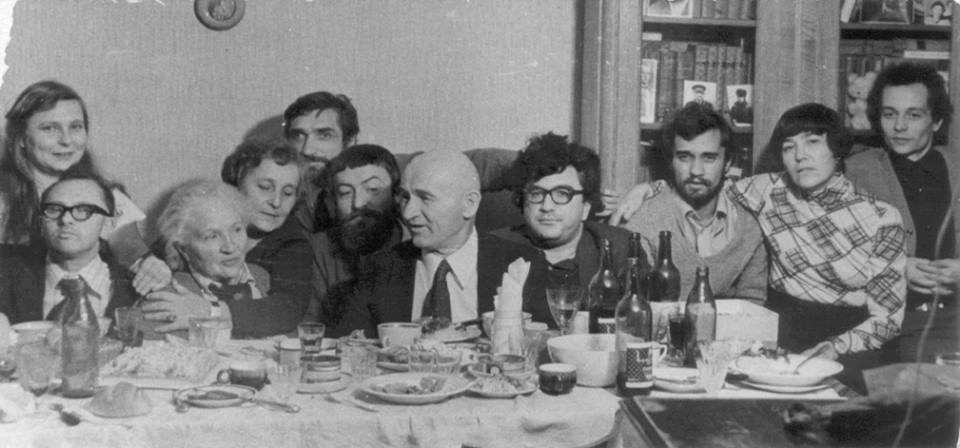
Gathering at Serebrovs, 1977 [1]
*
In February-March 1977 the Department of Agitation & Propaganda of the CPSU Central Committee held a conference of editors of certain newspapers and journals.
At this conference an unknown man spoke (it is known that he was not from the Central Committee) and said roughly the following:
“Numerous demands come into the editorial offices of newspapers and journals from Soviet people asking the authorities to display, at last, firmness and to muzzle the dissidents. In this connection it has been decided to imprison the fifty most active dissidents and to deal strictly with those who have ‘got in with them’. It is time to show strength and not to pay attention to the West.”
On the subject of emigration, the man who had spoken said:
“The Soviet Union showed its good will by signing the Helsinki Agreement. We know that there is no reunification of families. Young people are using their departure abroad for selfish ends. Let those who challenge the regime go, rather, to build the Baikal-Amur railway.” [2]
*
[2]
Registration and Exchange
On 15 January 1976 the police of Moscow’s Perovsky district refused to register Andrei Sakharov in the two-roomed cooperative flat belonging of his wife Yelena Bonner.
The police representative, who had earlier authorized this registration, told Sakharov that members of the cooperative were protesting against his registration, and the police could not act against the public will. Subsequently it became clear that the majority of residents in the cooperative did not know about the protest made on their behalf by the building’s commandant and the secretary of the Building Cooperative’s Party group. The authorities asked Sakharov to register in the building where he had not lived for a long time, but he refused.
At the beginning of December 1976, he was suddenly registered at the place which he had requested. Shortly afterwards Sakharov’s family of seven, then occupying two two-bedroomed flats with a total floor-space of 62.86 square metres, applied for an exchange. As a result, they would move to a four-bedroomed flat with a floorspace of 70.97 square metres.
The complicated exchange, in which seven families took part, was authorized on 27 January 1977 by the housing commission of the Cheryomushki district soviet executive committee. On 2 February, however, the committee (chairman, E.A. Asoskov) revoked the commission’s decision and forbade the exchange, as one participant in the exchange “aIone occupies a room of 16.07 square metres in dimension, is thus provided with living space, and, according to point six of the Model Statutes for Building Cooperatives, cannot be accepted as a member of a cooperative” (as a result of the proposed exchange this participant was to have received a one-room cooperative flat of 16.8 square metres).
On 10 February 1977 the Cheryomushki district people’s court, and on 2 March the Moscow City Court, upheld the refusal of the exchange.
On the morning of 2 March 1977 TASS correspondent Alexander Isayev reported to the West:
“In Moscow there exists a housing norm of 10 square metres per person.
“As for Sakharov, his family already has 30 square metres of space for each member of the family. Sakharov also has a two-storey brick villa near Moscow, 30 minutes’ journey from the city centre — as well as three flats in Moscow… It would seem that everything was clear but Sakharov, having shown himself to be a tireless litigator, brought a complaint against the decision of the people’s court of Cheryomushki district to the Moscow City Court, not forgetting to invite to the hearing a group of foreign correspondents.
“The question arises: why did Sakharov need this new farce? We do not think that he acted thus because he was suffocating from the crush in his three flats and out-of-town villa. Doubtless the reasons for this farce must have been something else: with some prompting Sakharov was compelled once again to draw the scandal-seeking section of a part of the foreign press to his person and, at the same time, cast aspersions on Soviet laws.”
*
[3]
MOSCOW. On 14 February 1977 Valentin Turchin was detained near his house by unknown persons. They forced him to get into a car. The car set off for Lefortovo and stopped at the KGB building.
One of those accompanying him got out of the car and went into the KGB building. He returned 20 minutes later and the car set off again. Turchin was taken to the Cheryomushki district offices of the KGB (Turchin lives 10 minutes’ drive from here; Lefortovo is at the other end of town). Here a man who did not introduce himself referred to the Decree of 25 December 1972 and stated that Turchin was being warned for the last time in connection with the fact that he was inflicting damage on the Soviet Union by means of slander and, moreover, was associating with foreigners. Turchin objected that he had never engaged in any slander, and he did not regard conversations with foreigners as in any way reprehensible. He wrote a statement in which he set out his views. Turchin refused to sign the record of the warning.
During the talk the KGB representative said that in his opinion slanderous thoughts were contained in, for example, Turchin’s unpublished book “The Inertia of Fear: Socialism and Totalitarianism” (CCE 42.12 [3]). During the talk he resorted to threats, saying for example that “besides Article 190-1 there is also Article 70”. He finished the talk with the words: “For the moment, you are free”, stressing ‘for the moment’.
In a statement for the press Turchin said:
“The KGB representative also declared to me that not a single organization in the Soviet Union will employ me. I have not had a job since July 1974. In September 1975 I turned to the authorities for permission to go abroad, where I could find work. I shall again seek to obtain permission to go abroad but only after the fate of the arrested members of the Helsinki Group has been elucidated.”
*
[4]
MOSCOW. The Chronicle report about Alexander Zinoviev (CCE 43.14) concluded: “Zinoviev has not yet been dismissed”.
The logic sector of the Institute of Philosophy (USSR Academy of Sciences) has not recommended Alexander Alexandrovich ZINOVIEV for re-election to the post of senior research officer.
On 20 January 1977 A.A. Zinoviev was dismissed.
On 3 February Zinoviev’s telephone was cut off.
At the beginning of February 1977 Zinoviev received the following document through the post:
“Higher Degrees Commission of the USSR Council of Ministers.
“Extract from record No. 4 of the session of 4 February 1977 (the original is in the files of the Higher Degrees Commission).
“HEARD:
“Petition of the specialized council attached to the Institute of Philosophy (USSR Academy of Sciences) to deprive A.A. Zinoviev of the academic degrees of candidate and doctor of philosophical sciences (certificate attached).
“DECIDED:
“1. For carrying out anti-patriotic actions incompatible with the title of a Soviet academic, in accordance with point 104 of the ‘Statutes concerning the procedure for awarding academic degrees and academic titles’, to deprive A.A. Zinoviev of the academic degree of candidate of philosophical sciences (diploma MFS No. 000566), of the academic degree of doctor of philosophical sciences (diploma MFS No. 000051), of the academic title of senior research officer (certificate MSN No. 002392), and of the academic title of professor (certificate MPR No. 006992).
“2. To consider the diplomas and certificates of A.A. Zinoviev enumerated in point 1 as invalid and returnable to the Higher Degrees Commission of the USSR.
“E.F. Stroganov, Deputy head academic secretary”.
In March 1977, by decree of the Presidium of the USSR Supreme Soviet, Zinoviev was deprived of his government awards. Of military distinctions he has been left only with his wound stripes.
*
[5]
The Trial of Pyotr Naritsa, January 1977
The case was heard on 6 and 7 January 1977 in a court in Jelgava (Latvian SSR).
The Judge was Medvedeva; the Prosecutor, Granit; the defence lawyer, Mintsker.
Pyotr Mikhailovich NARITSA, arrested on 27 August 1976 (CCE 42.3), was charged under Article 184 pt. 2 (“Resistance to representatives of authority”).
*
On 27 August 1976 Naritsa’s family went out of town in their car. Their acquaintance Khrenov, who had persuaded them to make the trip, was driving the car. In a forest a car with vigilantes from the State Car Inspectorate approached them. According to the prosecution, Naritsa refused to produce his passport (ID document); and as he was ‘very drunk’ and swearing abusively, the five vigilantes decided to arrest him. Naritsa resisted, struck the vigilantes (two of the five figured at the trial as having suffered), and raised a car inspectorate key threateningly.
Naritsa told the court that the attack was pre-arranged. He told how the incident had begun: the people who later turned out to be vigilantes caled out rudely to him, insulted his wife, and, when he asked them to show their documents, they jumped on him. Naritsa took cover in the car but three of them (the vigilantes who were witnesses confirmed this), dragged him out, beat him cruelly and bundled him into a police car.
The evidence of the vigilantes was contradictory in many important specific details.
The powerfully-built vigilante Pitkas was, in his own words, knocked off his feet by Naritsa’s punch. The ‘unproduced passport’ turned out somehow to be in the possession of the investigator. This episode was for a moment clarified: vigilante Gvozdev said that Naritsa had shown him his passport, but here the prosecutor stated that Gvozdev, who had recently suffered a head injury, was mentally incompetent. The witness was removed without finishing his evidence.
At the trial a chain of procedural violations by the investigators came to light.
The Judge, interrogating Naritsa sympathetically about the number of blows received, elucidated that there were about fifty of them. Naritsa said that not all of them were hard but he was suffering from some to the present day. Then the prosecutor ‘unmasked’ Naritsa: he would have died from fifty blows, which meant he was lying about other matters too.
The sentence was two years of ordinary-regime camps.
*
On 20 January 1977 Pyotr Naritsa was transferred to the hospital of the Riga Investigations Prison with a diagnosis of an unhealed wound from a blow to the right hip.
*
[6]
MOSCOW. Some students from the Moscow Highway Institute were suspected of printing and circulating leaflets.
The investigation was conducted at the institute, the number of the auditorium was indicated on the summonses. In November 1976 at a Komsomol meeting of the third year it was said that students V. Shishkin, V. Litterov, S. Voronov, V. Glushko, S. Ordanovsky, S. Nikolayev, Yu. Zhigarev and Yu. Lemeshev had been causing disturbances, behaving provocatively and tactlessly in regard to those around them in public places. (It was whispered around the hall that they had been circulating leaflets), Komsomol reprimands were issued to them.
After a while these students began to disappear from the institute.
*
[7]
TARTU (Estonian SSR). On 3 December 1976 a great number of people came to the club of the Agricultural Academy for an evening to mark Constitution Day.
The director of the club called the police. The students began to perform Estonian national circle dances, moving round the policemen. Then, chanting slogans (“Long live the Soviet police”, “Long live the Forest Brethren!” [3], ”Yankees, go away beyond Lake Peipus!”) they began to process around the town. The following day Komsomol organizers were summoned to the KGB, shown photographs and cine-films taken the previous day, and asked to identify the faces on them.
Then students started to be called in for ‘chats’. More than sixty people have already been summoned.
*
[8]
LENINGRAD. On 13 December 1976 at the Vyborg Palace of Culture (Omsk Street) Boris Smelov, a member of the palace’s photography club, gave an account of his creative work.
37 photographs in exhibition format were displayed, and the meeting passed with great success. The management of the club and its members asked the author not to remove his works, so that they could show them to relatives and friends. The palace directors gave their agreement to this. Smelov added another 60 photographs. On 30 December 1976 the exhibition was taken down on the instructions of KGB officers.
The palace director said on the telephone that he had handed the photographs over to the Vyborg district Party committee. In the committee’s department of agitation and propaganda they denied they had the photographs. In a private conversation the director again said that he had given the photos to the district committee and added that the majority of them had an anti-Soviet and religious character.
B. Smelov is 25 years old. His wife Natalya Zhilina is an artist who has taken part in exhibitions of nonconformist artists.
B. Smelov and N. Zhilina displayed their works at the most recent unofficial exhibition in Leningrad, which took place at the flat of Natalya Kazarinova from 18 to 23 January 1977.
*
N. V. Zhilina, a mother of two children, was deprived half a year ago of her usual order from one of the Leningrad institutes for taking part in exhibitions. For taking part in the exhibition at the flat of N. Kazarinova, the management of the art firm where Zhilina works was ordered to dismiss her at the slightest opportunity.
*
[9]
ODESSA. The young artists Victor Risovich, Vladimir Strelnikov, Vladimir Sychev, Khrushch and Shapovelenko are showing their pictures at ‘picture exhibitions’. In Odessa six such exhibitions have already taken place. They have been widely visited by artists, educated people and young people. Vladimir Asriyev, who provided his room for one of the exhibitions, has been beaten up on the street by strangers.
*
[10]
KAZAKHSTAN. After the arrest in July 1976 of presbyter Ivan Shteffen of the Baptist community in Issyk, Alma-Ata Region, the authorities gave instructions for the community’s prayer house to be destroyed (CCE 42.6). Members of the community wrote a statement to the Central Committee of the Communist Party demanding the release of the presbyter and the restoration of the prayer house; 138 passports were appended to the statement.
On 1 November 1976 Shteffen received five years of strict-regime camps under Article 200-1 (“Infringement of the personality and rights of citizens under the guise of performing religious rites”) and Article 170-1 of the Kazakh SSR Criminal Code.
*
[11]
UFA (Bashkir SSR). In December 1976 Sergei Shuvalov was eventually forced to write a statement refuting the contents of the Open Letter by Alexander Ogorodnikov to the chairman of the World Council of Churches Dr Potter about the persecution of participants of his seminar (CCE 43.9).
The KGB have approached 32 people in various towns with demands for a similar refutation.
*
[12]
TOMSK REGION. Brothers Vladimir (15) and Vasily (16 years) Yavorsky are in the children’s home in the village of Sredny Vasyugan [4]. Their parents have been deprived of their parental rights for giving their children a religious education.
Their mother is Frida Mikhailovna YAVORSKAYA. Her address in the Volga Okrug: Saratov Region, Tatishchevsky district, Yagodnaya Polyana village.
*
[13]
MOSCOW REGION. Pavel Kuznetsov (CCE 41.7) and Vladimir Avramenko (CCE 39.3) have been transferred from the Kazan Special Psychiatric Hospital to an ordinary psychiatric hospital, No. 5 at Stolbovaya Rail Station near Moscow. Sergei Musatov is also there (in CCE 39.3 there is an inaccuracy).
*
[14]
ODESSA. On 22 January 1977 Vyacheslav Igrunov (CCE 38.8) was released from a psychiatric hospital on completion of his compulsory treatment (CCE 43.8).
*
[15]
The report in CCE 41.7 (August 1976) that V.Kh. Timokhin had ‘recently’ been transferred to the Sychovka Special Psychiatric Hospital was, evidently, premature.
In January 1977 he was still in the Vladimir regional psychiatric hospital. In February-March he was transferred to Sychovka.
=====================================
NOTES
- Those included in the photo (l. to r.): Lyalya Golubkova, Alik Grigorenko, Zinaida Grigorenko, Vera Serebrova, Yury Grimm, Vladimir Golubkov, Pyotr Grigorenko, Mikhail Utevsky, Alexander Podrabinek, Saida Starchik, Kirill Podrabinek.
↩︎ - BAM was one of three great construction projects handed to the OGPU with its rapidly expanding corrective-labour camps and ‘special settlements’ in the early 1930s (see Map of Memory).
Much later, in the 1970s, attempts were made to turn it into a vast volunteer project for the Komsomol, repeating the Virgin Lands campaign of the immediate post-Stalin era.
↩︎ - The anti-Soviet resistance which fought as guerrillas in the forests of the Baltic area and West Ukraine in the years after 1944 were known as the “Forest Brethren”.
↩︎ - See Note 1, CCE 44.19 (In Exile), about 1930s forced settlements in this area.
↩︎
========================
 A Chronicle of Current Events