HELSINKI GROUPS UNDER INVESTIGATION
- 3-1. The case of Alexander GINZBURG
- 3-2. Yury Orlov; Persecution of the Working Commission
- 3-3. Anatoly SHCHARANSKY; Matusevich and Marinovich
*
INTERROGATIONS
At the end of February or the beginning of March 1977, I.L. Ivanov and his wife, a worker from Tarusa who helped Alexander Ginzburg rebuild his house, were summoned to an interrogation in Kaluga. Ivanov testified that he had a case of Ginzburg’s with some papers in it at his home, and handed over the case to the investigators.
*
In August 1977, Investigator Saushkin interrogated former criminal prisoner Arkady Gradoboyev several times. Gradoboyev is an acquaintance of Ginzburg; they worked together at the Tarusa Holiday Home. Gradoboyev testified that Ginzburg gave him The Gulag Archipelago to read.
At the end of August, Investigator Saushkin twice interrogated the 70-year-old Moscow writer N.D. Otten (CCE 36.10 [16]), who has a house in Tarusa, and his wife, translator E.M. Goiysheva, old acquaintances of Ginzburg who spoke out in his defence in 1968.
Otten confirmed that he had kept a case belonging to Ginzburg at his house and that he had given this case to I.L. Ivanov for safekeeping. Asked who owned the issue of Kontinent which she had given Gradoboyev to read, Goiysheva said that the journal had been given to her as a present by N. Vilyams (CCE 44.2-1), the husband of Ludmila Alexeyeva, who is now living in the USA.
*
In summer 1977, Tarusa woman M.R. Vogelzang, and Moscow theatre producer Yu. Shcherbakov, who has a dacha in Tarusa, were interrogated in the Ginzburg case.
*
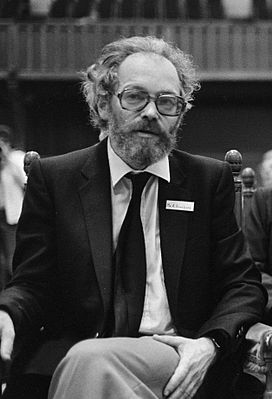
Alexander Ginzburg (1936-2002)
*
Former political prisoners continue to be interrogated in the Ginzburg case.
In August 1977, Vladimir Potashov (CCE 33.6-3) was summoned from Omsk to an interrogation in Kaluga. Asked whether he had received money from the Prisoner’s Relief Fund, Potashov replied that he had once received 175 roubles. “What for?” “I considered it was due to me as a political prisoner.” Potashov was asked questions about the situation of political prisoners in strict-regime camps.
*
In the middle of August, Leonid Borodin [1] was summoned to an interrogation in Kaluga.
Borodin refused to testify. Nevertheless, the investigator began to read him questions about the behaviour of Ginzburg in the camps. He then read the evidence of a certain anonymous witness, who described the details of a camp hunger-strike in 1969, with the aid of which political prisoners (including Borodin) had sought to obtain permission for the registration of the marriage between Ginzburg and Irina Zholkovskaya.
The evidence describes how materials about the hunger-strike were sent out of the camp. Conversations between those who took part in the hunger-strike were also related, in particular those between Borodin and Victor Kalnins.
*
On 29 August 1977, in Kaluga Investigator Odintsov interrogated V.I. Gandzyuk (CCE 39.2-2), who is now in exile in western Siberia (Tomsk Region; CCE 44.19 and 46.12 [1]). Gandzyuk confirmed that he had received a transfer of 100 roubles from Ginzburg and a parcel from his wife Irina Zholkovskaya. Asked “Do you regard yourself as a political prisoner?” Gandzyuk replied: “Of course; I’m not a criminal.”
*
At the end of August or beginning of September 1977, Sergei Malchevsky [2], now in exile in Northwest Russia (Komi Republic: CCE 37.5-1), was summoned to an interrogation in Kaluga. He testified that, all in all, he had received about 1,000 roubles from the Relief Fund. Malchevsky was also interrogated about the life of Ginzburg in the camps.
*
GALANSKOV’S DEATH
In the middle of October 1977, Vyacheslav Platonov (CCE 1.6, CCE 23.3) was summoned to an interrogation in Kaluga.
Investigator Saushkin told Platonov that it was Ginzburg who had ‘killed’ Yury Galanskov (CCE 28.2). At first, he allegedly incited Galanskov to activities which led him to the dock, and then, when he was in the same camp, forced him to take part in a protest hunger-strike which was the reason for his death.
Platonov replied that as he had been in the same camp as Ginzburg and Galanskov he had seen the warmth with which Ginzburg had taken care of his sick friend. He remembered well how Ginzburg had tried to dissuade Galanskov from taking part in hunger-strikes. In particular, in the spring of 1969 Ginzburg himself had cut short a hunger-strike because of the serious state of health of Galanskov who was supporting his hunger-strike.
Platonov said that he considered the camp administration to be guilty of Galanskov’s death, as well as he himself and his other camp comrades who had not succeeded in obtaining medical help for Galanskov in time, in the way they had obtained it for others.
The investigator did not enter this reply by Platonov in the record.
*
Investigator Saushkin told how in summer 1977 a former political prisoner from Mordovian camps, artist Yury Ivanov (CCE 10.9, CCE 29.11 [7]) had been summoned to Kaluga for an interrogation in the Ginzburg case.
According to Saushkin, before entering the building of the Kaluga KGB, Ivanov had stuck a poster on it which read “Freedom for Alexander Ginzburg”; the same day he was arrested and was now under investigation in Kaluga Prison. He was charged under Article 70 (RSFSR Criminal Code). The investigation was being conducted by the same officers as those on the Ginzburg case, Ivanov himself had allegedly explained his action by the fact that he was tired of living in freedom and worrying about his crust of bread.
*
At the beginning of November, Investigator Saushkin interrogated Yaroslav Gasyuk.
Gasyuk was asked about the behaviour of Ginzburg in the camps. Gasyuk told of Ginzburg’s numerous virtues. When he was shown materials of the Helsinki Group about food norms in the camps, he said: “On the whole, you don’t die of starvation in the camps . . . there are parcels …”
On 11 November 1977, Investigator Gaideltsov again interrogated Leonid Borodin; and on 14 November he interrogated V. Uzlov (CCE 46.5-1). They were once more presented with the questions that had already been put to them, and for the second time refused to answer them. Both were charged under Article 182 (RSFSR Criminal Code: “Evasion or refusal of a witness to give evidence …”).
*
In the middle of November Sergei Khakhayev [3] was summoned from Luga (Leningrad Region) to an interrogation in Kaluga.
Khakhayev testified that in the camps his path had not crossed with Ginzburg’s and he had not received money from the Relief Fund.
The investigator claimed that Ginzburg had transferred 2,500 roubles to Yury Fyodorov [4] and V. Novoseltsev (CCE 45.4) through Khakhayev, in order to set up an illegal organization of former political prisoners. Khakhayev did not confirm this. For this reason, no doubt, it was not recorded in the protocol of the interrogation.
*
In Kaluga on 23 and 24 November 1977, Investigator Gaideltsov interrogated Sergei Ponomaryov [5], a co-defendant of Vladlen Pavlenkov (CCE 42.4-4).
After Ponomaryov had spoken of Ginzburg with respect, Gaideltsov declared that the “White Book” (a collection of documents about the Sinyavsky-Daniel case) had in fact been compiled by Yury Galanskov: Ginzburg had only been the instigator in this affair.
Gaideltsov said that when Ginzburg was in the Mordovian camps he had bribed the whole administration and “lived better than we do in freedom — he always had both tea and coffee.” Investigator Gaideltsov alleged that when he had been in charge of the Relief Fund Ginzburg had hardly helped some people, while he had laid on feasts for others and given them all sorts of imported clothing.
*
ZHOLKOVSKAYA STATEMENT
On 26 November 1977, Irina Zholkovskaya, the wife of Alexander Ginzburg, sent the following statement to Investigator M.V. Oselkov, who is leading the group on the ‘Ginzburg case’.
“On 23-24 November 1977 an employee in your investigative group which is conducting the case of my husband A. I. Ginzburg, Investigator Gaideltsov, interrogated the witness S.M. Ponomaryov (Gorky).
“Investigator Gaideltsov began the interrogation by reading to the witness, before everything else, a long lecture about Ginzburg, which was full of ridiculous inventions and slander. He informed the witness Ponomaryov authoritatively that the book about the Sinyavsky-Daniel trial was not the work of Ginzburg (as recorded in the verdict in the case of Ginzburg, Galanskov and others in 1968). According to Gaideltsov, the book was the work of the now deceased Yury Galanskov, who died in 1972 in a concentration camp in Mordovia.
“It was Ginzburg, according to Gaideltsov’s information, who forced Galanskov to work for him and then got him imprisoned, cunningly contriving for himself a shorter term of imprisonment than for the sick Galanskov, for whom Investigator Gaideltsov has greater sympathy. And generally speaking, according to Gaideltsov, ‘Galanskov’s death’ is ‘on Ginzburg’s conscience’.
“This is not the first time the KGB has started this monstrous and cynical rumour.
“At the beginning it was spread by the provocateur Yevgeny Murashov, whose source was the KGB; now it is being openly pronounced by a KGB interrogator himself.
“I state with full responsibility that I regard these actions of Investigator Gaideltsov as illegal and amoral, and his statement as insolently slanderous. After this, Investigator Gaideltsov informed the witness Ponomaryov that while he was in the camps in Mordovia Ginzburg ‘bribed the whole administration’, that after his return from prison he bought his friends (former political prisoners) houses from the money of the Relief Fund.
“I consider these statements by Investigator Gaideltsov to be shortsighted and irresponsible lies. Investigator Gaideltsov is using methods of blackmail and slander with the aim of vilifying a man who has not yet been convicted, and of putting pressure on a witness so as to obtain from him the evidence needed by the investigation.
“I express my lack of confidence in Investigator Gaideltsov and request that he be removed from the conduct of the investigation. I have every reason to fear that the investigation in my husband’s case is not being conducted objectively. I have therefore been forced to turn to an American defence attorney, E.B. Williams, who represents the interests of my husband in the West, and to send him a copy of this statement so that he and other Western lawyers can see how the investigation in the Ginzburg case is being conducted. I know that E.B. Williams has received a great deal of evidence about the character, life and activities of my husband from people living both here and in the West (including Dina Kaminskaya, Galanskov’s and subsequently Ginzburg’s defence attorney).
“In connection with the latest statements by Investigator Gaideltsov I am requesting defence attorney Williams to use the evidence of witnesses which he already has, as well as new evidence, and to present it to any instance of his choosing.”
*
On 28 November 1976, Vitaly Pomozov was interrogated in Kaluga.
A former student of the history faculty of Gorky University, Pomozov served three years under Article 190-1 (RSFSR Criminal Code); today he lives near Tarusa. He was asked what Ginzburg had given him to read. Pomozov refused to give evidence as the substance of the charge was not explained to him.
According to rumours, Lev Ladyzhensky (CCE 34.3, CCE 43.3) has also been interrogated in the Ginzburg case.
Mikhail Sado (’Releases’ this issue CCE 47.9-4) is at present in Kaluga.
The wives of Korovin (CCE 34.3, CCE 39.2-2) and Mikhail Makarenko (CCE 46.10-2) have been interrogated in the Ginzburg case. The wife of Korovin said that she received help from a ’Zionist fund’, but she knew nothing about a Russian public fund.
*
GORKY
In the city of Gorky, from 17 to 22 October 1977, Investigator Gaideltsov interrogated the following in the Ginzburg case: T.L. Batayeva, N.N. Lepekhin, V.I. Zhiltsov (a co-defendant of Vladlen Pavlenkov, CCE 13.3) and Pavlenkov’s wife, Svetlana Pavlenkova (CCE 42.4-4).
All those summoned used to send money to political prisoners some time ago. During their interrogation they were asked mainly about this. Batayeva, Lepekhin [correction CCE 48.25] and Zhiltsov testified that they sent their own money to the camps. Svetlana Pavlenkova stated that she knew Ginzburg well and could not give evidence about a friend; she therefore refused to give evidence.
*
Gaideltsov summoned Svetlana Pavlenkova to another interrogation on 10 November 1977, this time in Kaluga. He repeated three of the questions he had put in Gorky; she again refused to give evidence.
After this Gaideltsov charged her under Article 182 (RSFSR Criminal Code). On 19 November 1977, Pavlenkova and her defence counsel E.A. Reznikova studied the case file. Reznikova wrote a petition about closing the case. The acts with which Pavlenkova was charged had been committed before the decree on an Amnesty had come into force, and nothing new had taken place at the interrogation on 10 November.
On 22 November 1977, the newspaper Gorkovskaya pravda (Gorky Truth) carried an article about the Pavlenkov family and their friends. It represents Svetlana and Vladlen Pavlenkov as slanderers and anti-social elements, living off Western handouts.
The Ponomaryov family is accused in the article of helping war criminals and members of the Organization of Ukrainian Nationalists (OUN), who are serving a ‘just’ punishment. Pavlenkov’s brother M. Pankratov and his co-defendant V. Zhiltsov are mentioned in the article.
On the interrogations of Lyubarsky, Salova and Turchin, see “The Right to Leave” in this issue (CCE 47.8-3).
*
On 1 November 1977, Irina Zholkovskaya, Ginzburg’s wife, was summoned to an interrogation at Lefortovo Prison.
Senior Investigator Yu.F. Suchkov who interrogated her there was emphatically polite.
In reply to his first question, Zholkovskaya said, for the record, that she regarded her husband as a remarkable man and was proud of him; she refused to answer the rest of the questions. Suchkov informed Zholkovskaya that the investigation was drawing to a close and suggested that she look for a defence attorney. To the words of Zholkovskaya that the American defence attorney E. B. Williams (CCE 44.3) would be defending her husband, Suchkov replied that this was an international problem and would be settled separately.
Then for 40 minutes Suchkov looked into the complaints of Zholkovskaya about the reception of parcels in Kaluga prison, but essentially did not reply to a single question.
*
Zholkovskaya began to look for a defence attorney.
During the course of November eight defence attorneys from Moscow and four from Leningrad refused to undertake the defence of Alexander Ginzburg.
*
SUPPORT
On 4 October 1977, more than fifty people from Moscow, Leningrad and other Soviet cities and towns carried out a one-day hunger strike in support of Ginzburg and Orlov.
On 21 November 1977, Ginzburg’s birthday, dozens of congratulatory telegrams from friends and acquaintances of Alexander Ginzburg arrived at Kaluga Prison addressed to him. A group of American Congressmen [6] also congratulated Ginzburg; they sent their telegram to USSR Minister of Internal Affairs Shchelokov with a request that it be passed on to the addressee.
See also “Samizdat Update” in this issue (CCE 47.18 [10]).
=====================================================
NOTES
- On Borodin, see CCE 1.6, CCE 19.4, CCE 34.20 [12]) and Name Index.
↩︎ - On Sergei Malchevsky, see CCE 9.10 [4], CCE 17.14, CCE 23.3 and Name Index.
↩︎ - On Khakhayev see CCE 35.10 [40] and “The Bell Affair” (2015).
↩︎ - On Yury I. Fyodorov, see CCE 12.5, CCE 42.3 [8], CCE 44.19, CCE 45.13 [2] and CCE 46.5-1.
↩︎ - On Sergei Ponomaryov, see CCE 13.3, CCE 15.4 [4] and CCE 32.12.
↩︎ - The American Congressmen who congratulated Ginzburg were: R. Bauman, J. Jeffords, S. Solarz, F. Spence, N. Steers, M. Edwards.
↩︎
=============================
 A Chronicle of Current Events