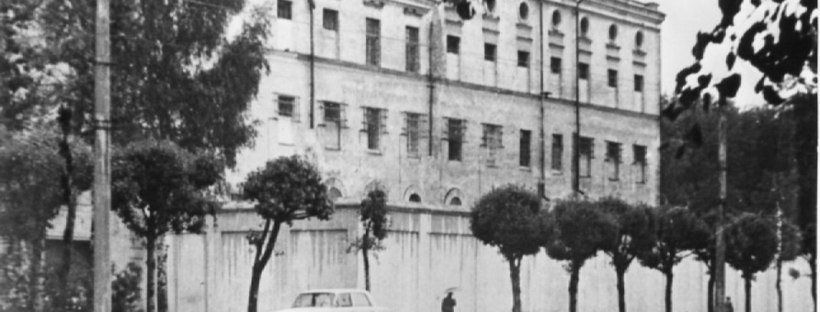
This section has been compiled mainly from material in the Information Bulletins of the Working Commission, Nos. 14 (5 Jan 1979) and 15 (8 March 1979).
*
Special Psychiatric Hospitals
Kazan SPH
In 1974 Raisa Ivanova was transferred here from the psychiatric unit in the Mordovian camp complex (CCE 33.4 & CCE 35.7). Here she was subjected to intensive treatment, from which she suffered severely. At the end of 1977 she committed suicide by hanging herself.
Ivanova (b. 1929) was arrested for belonging to the True Orthodox Church.
*
In accordance with a court decision taken on 12 January 1979, Boris YEVDOKIMOV (CCE 51.11) has been transferred to an ordinary psychiatric hospital. He has been sent to the Kashchenko Hospital near Leningrad (Gatchina, Nikolskoye village). [note 10]
*
Oryol SPH
Nikolai Ivanovich BARANOV (CCE 39.3) has been transferred here from the Kazan SPH. At present he is evidently being subjected to intensive treatment. He finds it difficult to write letters and to read.
*
Alma-Ata SPH (Talgar)
Sergei PURTOV (CCE 51.11) was transferred to an ordinary hospital at the end of 1979, in accordance with a court ruling. He is in a hospital near Leningrad.
*
Tashkent SPH
Vera Ostapovna LIPINSKAYA (b. 1941) is confined in Tashkent SPH.
Lipinskaya (a mother of four) was arrested on 26 June 1977 for “circulation of fabrications known to be false …” (letters to official bodies). Lipinskaya was pronounced mentally ill, with the diagnosis ‘sluggish schizophrenia’.
On 25 August 1977 the Dzhambul Region Court in Kazakhstan sent Lipinskaya for treatment to this SPH. Her doctors are, Head of the 9th Section, Magrunova, and Deputy Head of Tashkent SPH, Dr Kakharova.
*
Ordinary Hospitals
ANATOLY PONOMARYOV
On the evening of 14 December 1978 four police officers entered the apartment of Leningrader Anatoly Dmitrievich PONOMARYOV (b. 1933). They ordered him to show them his ‘passport’ and then took him away to the police station. From there Ponomaryov was sent to Skvortsov-Stepanov Psychiatric Hospital No. 3.
Anatoly Ponomaryov was first arrested in 1970 for circulating samizdat and charged under Article 190-1 (RSFSR Criminal Code; CCE 26.5). In January 1971 he was declared not responsible for his actions and sent to a psychiatric hospital, but was not subjected to treatment. After his discharge he remained on the psychiatric register and was subjected to compulsory hospitalization on more than one occasion [1].
Recently Ponomaryov stopped attending the out-patients clinic and made a written statement that he refuses to take medication.
After Ponomaryov’s forced hospitalization, his mother approached his doctor, A.I. Tobak (CCE 38.10, CCE 43.7 & CCE 44.21). Tobak told her that Ponomaryov would not be released soon; and his complaints about bad conditions in the hospital were a symptom of his illness.
*
SPINENKO
In 1976 Vasily SPINENKO was transferred from the SPH in Alma-Ata to the Makeyevka Psychiatric Hospital (on him see CCE 33.6-2 [8]; there is a mistake in CCE 47.12).
From 1968 onwards Spinenko (b. 1947) was the ‘ideologue’ of an organization calling itself the “Intellectuals Party”, which had members in several Soviet towns and its centre in Sverdlovsk (Urals Okrug).
He was arrested in March 1971. He and seven other members of the organization were charged under Articles 70 & 72 (RSFSR Criminal Code). Spinenko was sent for a forensic psychiatric examination and pronounced responsible. Six months after his arrest, however, Spinenko was once again subjected to examination by a psychiatric commission, this time at the Serbsky Institute of Forensic Psychiatry (chairman Shostakovich, reporting doctor Azamatov). Diagnosed as suffering from ‘sluggish schizophrenia’, Spinenko was sent to an SPH for compulsory treatment. On hearing the appeals, the Supreme Court removed Article 72 (“membership of an organization”) from the indictments of Spinenko’s co-defendants. In Spinenko’s case it remained.
A year ago, a medical commission recommended Spinenko’s release, but the court did not act upon the recommendation. At present he is being given injections of Aminazin and Stelazin. His doctor is Section Head Victor Mitrofanovich Zarubin.
*
LYAPIN
Alexander Sergeyevich LYAPIN (CCE 49.6, CCE 51.19-1) is still confined to Section 11 of the Third Leningrad Regional Psychiatric Hospital.
His new doctor, Victor Nikolayevich Petrov, makes a point of calling Lyapin out for ‘ideological discussions’ and threatens to prescribe for him a course of treatment with neuroleptic drugs.
On 12 December 1978 Lyapin declared a hunger-strike in protest, and continued it for ten days.
In January Petrov ordered that writing materials and a transistor radio be taken away from Lyapin, saying that Lyapin was using the latter to obtain instructions from Radio Liberty.
*
DEMYANOV
Nikolai DEMYANOV is at present in Perm Regional Psychiatric Hospital No. 1.
Nikolai Demyanov refused to complete his studies at a military academy and was subsequently sent into the Army. He managed to get a discharge on psychiatric grounds (he stated that he had earlier suffered a heavy blow to the head).
In 1971 he was arrested at Tyumen Airport. When they searched him they found explosives and some notes. He was taken to Moscow and charged under Article 70 and Article 218 (RSFSR Criminal Code: “Illegal … possession … of explosive matter”). The investigator in charge of the case was Zaitsev of the Moscow KGB.
A commission at the Serbsky Institute pronounced Demyanov not responsible. Until 1978 he was confined in Kazan SPH and treated with various neuroleptic drugs. In 1978 he was transferred to an ordinary hospital.
Despite Demyanov’s pledge to renounce his ‘anti-Soviet activities’, and despite his readiness to live in any backwater, the next medical commission, on 26 January 1979, did not recommend his discharge. Demyanov understood from conversations with doctors that there was no intention of discharging him in the near future, at least not before the 1980 Olympic Games.
*
Nikolai PLAKHOTNYUK (CCE 28.7 [1], CCE 49.10, CCE 51.11) is still being held in a psychiatric hospital in the town of Smela (Cherkassy Region, Ukraine).
Plakhotnyuk is in poor health. His doctor told his family that he would not be discharged until after the Olympic Games.
*
On 12 January 1979 a visiting commission from the Serbsky Institute ruled that V. A. DZIBALOV (CCE 49.10, CCE 51.11) could be released from compulsory treatment.
*
Zita KIRSNAUSKAITE (CCE 51.15) was allowed to spend the New Year holidays at home.
After the New Year, Zita decided that she would not return to the hospital voluntarily. On 16 January 1979 an ambulance was sent for her, but Kirsnauskaite would not open the door.
*
Releases
In December 1978 Yevgeny NIKOLAYEV [2] was told in Moscow Psychiatric Hospital No. 15 that Valeria Novodvorskaya (CCE 51.11) was ill and in need of treatment, and that she was socially dangerous.
However, her doctor, who was the head of the section, had already told him in January that Novodvorskaya’s condition had improved and that she would soon be discharged. On 6 February 1979 Valeria Novodvorskaya was released. Her release was preceded by a widespread campaign on her behalf, both in the USSR and abroad.
*
VALOV
On 15 February 1979 Yury VALOV (CCE 51.11) was released from the Central Moscow Regional Psychiatric Hospital.
On 7 February Valov was examined by an enlarged commission. Alexander Voloshanovich, a consultant psychiatrist of the Working Commission, who examined Valov in April 1978, took part in this examination.
Part of the commission’s conclusion was that Valov “is in need of biological treatment, psychotherapy and subsequent socio-psychiatric help. This last has already become necessary as regards the question of accommodation. After discharge needs quick assignment to a job.”
Voloshanovich agreed with the commission’s conclusions. He wrote to R.N. Murashkin, Chief Psychiatrist of Moscow Region, however, pointing out that forced hospitalization in this case was groundless and illegal. “I consider further hospital treatment of Yu.S. Valov only permissible with his own consent”, wrote Voloshanovich.
Although the official reason for Valov’s forced hospitalization was family problems, the head of the hospital’s First Section, V.P. Shablevich, asked him about his convictions, what he was aiming for, etc.
Before his discharge, Valov was told that the hospital administration had submitted a written request that he be provided with accommodation. If this request was refused by the district soviet, the hospital would make appropriate representations to the procurator’s office.
*
On 26 December 1978 Andrei BESOV (CCE 51.8; see also CCE 53.6) was released from Moscow city’s Yakovenko Psychiatric Hospital No. 2, near Stolbovaya Station.
*
On 26 February Arvidas Cehanavicius was released from Vilnius Republican Psychiatric Hospital.
========================================
NOTES
- On Ponomaryov, see CCE 35.10 [10], CCE 38.10, CCE 39.3 and Name index.
↩︎ - On Nikolayev, see CCE 48.12, CCE 49.10, CCE 51.11 and Name index.
↩︎
=============================
 A Chronicle of Current Events