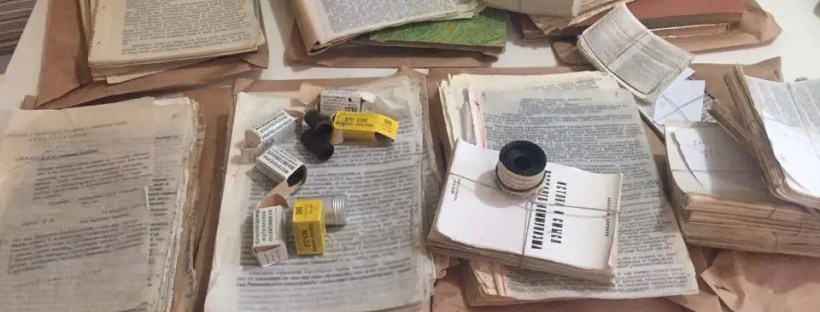
EIGHTEEN ENTRIES
(Periodicals, 13-18)
*
VICTOR SOKIRKO (1-5)
[1]
Grigory Pomerants
“My Interlocutor Victor Sokirko” (March 1980, 9 pp.)
“… Obviously, any alarming idea is tendentious: it suggests something, calls something into question. Sokirko was never an extremist. He even wrote a letter defending conformism, opposing escape into an inner exile and favouring dialogue with the government that exists …
“People who hold far more extreme views (but whose conditioned reflex system has been cultivated by society) live and die in their beds without any interference from the security organs. But Sokirko has always brought misfortune on himself. Not so much for his ideas as the directness and fervour with which he expounds them. The only motives behind Sokirko’s activities and the passionate sharpness of his prognostications were a sense of responsibility and civic duty. If I don’t do it, who will?”
“I am not an economist and am not qualified to evaluate Sokirko’s chief works: Essays on an Advancing Ideology and the collection In Defence of Economic Freedoms (both written under the pseudonym K. Burzhuademov).”
Elsewhere in his essay Pomerants recounts Sokirko’s explanation of his pseudonym: “K is for communist and the surname derives from bourgeois democrat” (when Russian forms are used). The essay ends with an extract from a conversation between Sokirko and the investigator in charge of the case against the journal Poiski:
“I explained that, of course, I was afraid of prison and, of course, I would like to avoid prosecution, but not by refraining from expressing my convictions, which would be tantamount to spiritual suicide.
“Moreover, I joined the Poiski editorial board of my own free will, fully aware of what I was doing and acting out of a sense of duty. Someone has to begin a debate about the country’s future development, start the search for alternatives and mutual understanding; otherwise, our country will come to an impasse and catastrophe.”
*
[2]
VICTOR SOKIRKO
“The Economics of 1990: What awaits us, can it be avoided?” (November 1979, 22 pp.)
After analysing the state of our economy, the author reaches the following conclusion:
“By simple extrapolation one can place the crisis point somewhere around 1990, but if one takes the unacknowledged inflation into account, then it will come sometime around 1984; by this I mean the beginning of a decrease in national income per capita, or, in Marxist terms, the beginning of the overall impoverishment of the Soviet population.
“However, an analysis of the basic factors — i.e., sources of growth of national income — shows that even now they are nearly depleted, and in the near future this will not only cause a gradual decrease in our real income, but may also result in a sharp decline in this income, leading to revolts and social and economic disaster.”
The author predicts that ‘the leaders of the country’
“will continue their present opportunistic policy of maintaining the superficial image that society is prosperous, without a radical change of policy until an obvious crisis arrives, i.e., they will neglect the socio-economic disease of our society until it has become incurable… As a last means of trying to strengthen discipline, the incentive system and labour efficiency, the leaders will evidently resort to foreign adventures of a ‘defensive’ character.”
Nevertheless, the author “is convinced that chances of salvation do exist, even though they are not great”. He considers that
“the only real alternative facing the country and its leadership” is an honest and fearless re-evaluation of values and, in the first place (and as soon as possible), the abolition of the disastrous system of comprehensive planning and the immediate legalization of economic regulation through the market.”
The author sent this article to Pravda with the following request:
“I ask only one thing: that you discuss it, criticize it thoroughly, and convince me of the groundlessness and misguidedness of the fears expressed in it… My attempts to question experts about the impending crisis horrified them because the subject itself is taboo. I am writing to you even though, to tell the truth, I too am frightened to do so.”
*
[3]
VICTOR SOKIRKO
“The possibility & vital necessity of a union between Stalinists and dissidents” (Nov 1979, 7 pp.)
Popular Stalinism today appears to be a completely natural, traditional and healthy reaction by people to the sick state of our society. And it is for this reason that dissidents must undertake a dialogue with the Stalinists, who also wish their country to recover — though, it’s true, along very different lines.
The fact is, both Stalinists and liberals need one another. If the former attain power without liberal reforms, they will not be able to rebuild the country: they will only lead it into an even worse crisis. The liberals, on the other hand, will never be able to introduce their reforms without a strong government.
Therefore, the Stalinist slogan “For a strong boss!” and that of liberal dissidents “For freedom and human rights!” must be combined to form the basis for a union: “For a genuine, firmly based, developing Soviet system!“
*
[4]
‘K. Burzhuademov’ [VS],
“Dissident Ethics” (November 1979, 9 pp.)
The author considers that by arresting Tatyana Velikanova and Gleb Yakunin (CCE 54.1-1, CCE 54.1-2) the authorities hope to finally “cure society of the plague of dissidents”.
He discerns some recent ‘alarming tendencies’ in the human rights movement;
- In recent years ties between dissidents and the West have grown immeasurably. The more heavily Soviet dissidents rely on help from like-minded people abroad, the less significant (and therefore weaker) is the support they’ll receive in their own country: and the greater will be the isolation and inner weakness of the human rights movement;
- The movement’s actual membership has changed. A large proportion now consists of people who have decided to emigrate;
- The development of their ideas by different dissident groups has slowed down. Samizdat rarely contains works about real-life problems and ways of solving them;
- Dissident indifference towards the defence of human rights in their full complexity: not just the right to freedom of emigration, of speech, of creation, of communicating information, etc, but also the right to free disposal of one’s labour, to free economic activity, the rights of working collectives and their leaders.
The author discusses “three ethical imperatives which are required if the dissident movement is to grow stronger and overcome its present weaknesses”.
It must
“(a) recognise its duty and responsibility (before the Nation or God) for developing self-awareness, for the emergence of forums for debate on social topics, for the existence and effectiveness of samizdat;
“(b) be diligent in creating, circulating and preserving samizdat … A genuine intellectual should dedicate one tenth of his time to the printing of samizdat; only the intelligentsia’s diligence in producing samizdat can turn the development of national self-awareness into a widespread, invulnerable and irreversible process.
“(c) Authors and readers of samizdat must both be bold, fearlessly keeping, reproducing and exchanging it. Samizdat must be openly displayed on bookshelves. I do not see anything terribly wrong even in noting down the name of someone to whom you have given a book to read …
*
[5]
VICTOR SOKIRKO
“Letters” (Nov 1979-Jan 1980)
This collection contains the articles “The Economics of 1990: What Awaits Us and Can It Be Avoided?” and “On the Possibility and Vital Necessity of a Union between Stalinists and Dissidents” (see above), “Letter to F.A. Abramov” and “A request to L.I. Brezhnev to withdraw troops from Afghanistan” (this issue CCE 56.27-1), and is supplemented by K. Burzhuademov’s “On the Question of Dissident Ethics” (see above).
*
[6]
Gleb Yakunin
“The present situation of the Russian Orthodox Church and prospects for a Religious Renaissance in Russia” (15 August 1979, 47 pp.)
A report to the Christian Committee with these headings:
- The Patriarch of Moscow and All Russia;
- The Episcopate;
- The Priesthood;
- The Elders;
- the Executive Agency of the Church, the ‘Council of Twenty’;
- The Parishes, Lay Orthodox Believers;
- Monasteries;
- Religious Schools:
- Seminaries and Academies;
- The Administration of Church Affairs;
- Economic Administration and Financial and Economic Activities of the Patriarchate;
- The Publishing Department and the Journal of the Moscow Patriarchate;
- The Department of External Relations of the Church;
- The Moscow Patriarchate and Prospects for the Renaissance of Orthodoxy in Russia.
*
[7]
“Document No. 18, or a Chronicle of Legal Complaints” (February 1980, 20 pp.)
A collection of complaints sent by Yury Velichkin about a search of his home on 11 February 1979 (CCE 52.4-2), and official replies.
*
ERNST ORLOVSKY (8-10)
[8]
Ernst Orlovsky
A Few Comments on the Newspaper Russkaya Mysl” (September 1979, 7 pp.)
“I read several articles with great interest, while others seemed to me incompetently or even carelessly written.”
*
[9]
Ernst Orlovsky
“Changes in the Hierarchy of the Soviet Leadership, March 1979 to Feb 1980” (4 pp.)
“The publication of pre-election speeches is a good guide to the position of a Soviet leader in the official hierarchy …”
The author compares the ‘ranks’ of leaders, calculated according to this guide, from March 1979 to February 1980.
*
[10]
Ernst Orlovsky
“Comments on the 1980 Election Campaign” (8 pp.)
***
[11]
Victor Tomachinsky
“Concerning the Soviet Blitzkrieg in Moscow and Afghanistan” (24 January 1980, 7 pp.)
1. … The ‘unexpectedness ’ of Afghanistan embarrassed and shocked the whole world only because no one in the world had noticed the tendencies of recent years.
2. … Sakharov was seized for the same reason as Kabul: the time had come for decisive action.
3. … It all started, in fact, with the American hostages. The inefficiency of democratic institutions was evident throughout the crisis. Thank God, Carter had the courage to admit his mistakes and bring himself to use force.
4. Moscow is a different subject altogether. A different pain… Moscow is much more straightforward than civilized old men think. Moscow should be shown force more often — then… it will be possible to begin genuine dialogue. But until then it will be war.
*
[12]
DISABLED ACTION GROUP
Action Group to Defend the Disabled
Newsletter No. 8 (20 February 1980) 30 pp.
The title page bears two names: Yu. Kiselev and V. Fefyolov.
The Newsletter contains a survey of “Disabled Political Prisoners in the USSR”, Document No. 14 of the Action Group (see also the Group’s Document No. 4, CCE 52.13).
This is supplemented with a list of eight political prisoners in most urgent need [1] of immediate release. Five are held in the camps (Oksana Popovich, Konstantin Skripchuk CCE 52.5-3 [2], T. Reinhold, CCE 56.21, Mykola Rudenko and Vladimir Osipov); three are in exile (Iryna Senik, Pyotr Sartakov and Ramzik Markosyan). The document is signed, as are most of letters and statements in the Newsletter, by Yu. Kiselev, V. Fefelov and O. Zaitseva.
The Action Group to Defend the Disabled has been accepted, it reports, into the Free Invalids’ Association (President: Baroness Masham).
There is also an account of the persecution (CCE 51.17, CCE 52.13, CCE 53.26) endured by Valery Fefyolov and Olga Zaitseva (CCE 56.25).
***
PERIODICALS
POISKI 6-8 (13-15)
[13]
POISKI
“Searches”, No. 6
The name Gleb Pavlovsky appears on the list of editors instead of ‘P. Pryzhov’ (Pavlovsky’s pseudonym).
This issue contains the beginning of Grigory Pomerants’s book Dreams of the Earth (parts 1-3). The following take part in a discussion about the 19th-century Native Soil movement: I. Ponyrev, P. Pryzhov, Pyotr Abovin-Egides and N. Rerikh.
There follows an article by K. Burzhuademov: “The Style in which the Country is Run” (about Brezhnev’s book Virgin Soil).
The “Crossroads” section contains the following articles: “The Yugoslav Phenomenon” by N. Kirillov; “What is Worth Fighting For” by Mihajlo Mihajlov; and “Djilas—Marx—Mihajlov” by Gleb Pavlovsky.
Prose and poems by M. Krymov, Vladimir Voinovich and Gely Snegiryov are also published. This issue contains a translation of the first part of Antoine de Saint-Exupery’s Notebooks.
The section “Events and Fortunes” contains an interview with Valery Abramkin and Pyotr Abovin-Egides, notes by Yu. Velichkin and P. Rastin, a review by N. James of books by Bukovsky and Sakharov, and excerpts from Kronid Lyubarsky’s and M. Popovsky’s letters from abroad.
*
[14]
POISKI
“Searches”, No. 7 (about 500 pp.)
The issue contains articles by Victor Sokirko and Pyotr Abovin-Egides (responses to Igor Shafarevich’s article on “Socialism” (CCE 34.20-2) published in the collection From Under the Rubble), another article by Abovin-Egides, written in collaboration with Pinkhos Podrabinek, and a work by V. Grin about the socio-political structure of Soviet society.
The following section contains articles by Grigory Pomerants (“The Bronze Horseman”, part 4 of his book Dreams of the Earth) and Revolt Pimenov (“Glazunov, Life and Something Else”), as well as Raissa Lert’s reply to Pimenov, “Crossing Oneself with Two Fingers or Double-Crossing”.
The priest Sergy Zheludkov’s work “Reflections on a Church of All Mankind” states that there exists not only a ‘Christianity of faith’ but also a ‘Christianity of conscience and will’, which is confessed by ‘anonymous Christians’ — people who do not believe in Christ but live according to His precepts. On the subject of ‘the defence of man’. Father Sergy writes:
“In my country, it is not the priests of the Church who show compassion for convicts, but people like Andrei Sakharov and his wife, almost all of them people without a religion. There is one comforting thought; that the churches of our faith do not represent the whole church of Christ.”
The literary section contains poems by A. Velichansky, prose by N. Tolmachev and A. Zaitsev, an article on Boris Pasternak by Pomerants, and the second part of Antoine de Saint-Exupery’s Notebooks.
The “Events and Fortunes” section contains articles by Yury Grimm (about his imprisonment in a special detention centre), V. Repnikov, R. Popova (on the elections) and R. O’Connor. It also contains an “Open Letter” to the editors of the Chinese journal “Searches” (CCE 54.23-1) and reviews by S. Shagin and P. Pryzhov of the “Appeal of the Russian Liberation Movement to the Russian and Ukrainian Peoples” (CCE 53.31 [4]).
*
[15]
POISKI
“Searches”, No. 8 (547 pp.)
The issue opens with a “Message to Our Readers” (CCE 56.5), in which the editors of the journal announce that publication is to be suspended.
In an essay Yelena Gaidamachuk recounts the circumstances in which her husband Valery Abramkin (CCE 55.2-2) was arrested.
The issue also contains three articles: V. Smirnov on his refusal to vote in the elections; Mikhail Zotov about the 1970 uprising in the Togliatti camps; and ‘P. Pryzhov’ on liberalism in contemporary Russia.
*
CROSSROADS
A discussion of the idea of dialogue between dissidents, society and the governments of East European countries. An interview with Jacek Kuron of Poland and R. Slansky of Czechoslovakia, taken from the journal Alternative (France); comments by Victor Sokirko and an article by Mikhail Gefter.
*
The following section of Poiski contains an introduction to the journal Obshchina (Community) No. 2 (CCE 51.21 [19]). There is an article by Alexander Ogorodnikov; an account by Vladimir Poresh of how he was followed by KGB officers on one of his visits to Moscow; and a narrative poem written in Vladimir Prison between 1949 and 1953 by D. Andreyev entitled “Leningrad Apocalypse”,
Mikhail Gefter’s article “Russia and Marx”, published in this issue, is the subject of comments by Sokirko and P. Yulin.
*
LITERATURE
Works by Lev Kopelev, V. Gusarov, Grigory Pomerants, D. Sokolov, L. Apraksin, M. Sukhotin and P. Rastin.
*
EVENTS & FORTUNES
Contains: Documents 102 & 111 of the Moscow Helsinki Group (CCE 54.23-2); a letter to the USSR Supreme Soviet concerning events in Iran (see CCE 56.27-1); a joint letter in defence of Tatyana Velikanova (CCE 54.1-1); and a statement by the editors of Poiski on the searches of Valery Abramkin’s home on 4 December and his arrest (CCE 55.2-2).
It also contains the Founding Declaration of the Democratic International, established in New York in March 1979, and an interview with Sakharov for the French newspaper Le Monde, which he gave in connection with the 10th anniversary of the Soviet invasion of Prague.
***
[16]
EMIGRATION TO ISRAEL, 6-7
Emigration to Israel: Legal Theory and Practice
Nos. 6 (Jan 1980, 48 pp.) & 7 (Feb 1980, 48 pp.)
*
[17]
ITOGI (3)
“Summary” No. 3 ( 1979) 78 9pp.
(For a general description of the synoptic journal Itogi (“Summary”), see CCE 53.31 [4].)
A. “Synopses and Extracts”
36 articles
- Twenty two are based on samizdat publications (Jews in the USSR No. 19, The Watch No. 19, and Information Bulletins Nos. 14-16 of the Working Commission)
- and on the following foreign journals (Herald of the Russian Christian Movement No. 127, Kontinent No. 17, The Ark Nos. 1 and 3, Time and Us (Vremya i my) Nos. 37 and 38, Third Wave No. 6, Syntaxis No. 3 and K. Lyubarsky’s USSR News Update);
- and on 19 August 1979 issue of the newspaper Sovetskaya Rossiya.
This section also contains summaries of books:
- Maksudov’s Dynamics of Population Loss in the USSR in the First Half of the 20th Century (samizdat, 1979),
- Bukovsky’s To Build a Castle (Khronika, 1978),
- A. Avtorkhanov’s The Riddle of Stalin’s Death (The Berta Plot) (1976),
- Menachem Begin’s White Nights (Tel-Aviv, 1972),
- Sergei Dovlatov’s Invisible Book (Ardis, 1978),
- the samizdat almanac The Call (Moscow, 1971),
- the samizdat Memoirs of E. Gertsyk.
It also includes the following articles:
A. Sakharov’s “The Human Rights Movement in the USSR and Eastern Europe: Aims, Significance and Difficulties” (CCE 51.21 [1]); Yevhen Sverstyuk’s “The Cathedral in Scaffolding” (in Ukrainian), and “The Christian Plague” (anonymous); the work “Masonry in the Twentieth Century” by Zh.L. Nagy (in Hungarian); an interview of Igor Shafarevich with a correspondent of the Frankfurter Allgemeine Zeitung (CCE 51.21 [3]); and E. Orlovsky’s letters on the draft constitutions of the USSR and the RSFSR (CCE 47.16-2 & //CCE 49).
A review of The Jewish Datszybao by ‘I. Garik’ (Igor Guberman’s pen-name) is taken from the Israeli journal “22″.
*
B. “Points of View, Reviews”
11 articles
a survey of the samizdat collection In Defence of Economic Freedoms No. 7; a summary of V. Ozolis’s article “Individual, State and Revolution”; a selection of reviews of V. Turchin’s book The Inertia of Fear; a review of R. Redlikh’s book Stalinism as a Spiritual Phenomenon: Essays in Bolshevismology; extracts from an Open Letter by Semyon Lipkin, one of the Metropole authors (CCE 52.14, CCE 54.21 and see “Miscellaneous Reports” in the present issue); poems by Yevgeny Rein and Vsevolod Nekrasov (the latter with a review);
extracts from: V. Lakshin’s “The Golden Autumn of Fauvism”, a parody oF Valentin Katayev’s “My Crown of Diamonds”; from Lev Kopelev’s review (“A Soviet Litterateur in the Wild West”) of Vladimir Maximov’s “Saga of Rhinoceroses”; from a review of an article by M. Skuratov, “Russian Nationalism and Zionism”; also an essay by P. Rastin called “I am an Anti-Fascist”.
*
C. “Contents of Recent Publications”
Contents tables of the following samizdat publications:
Poiski 5, The Watch 10, Jews in the USSR 20, No. 18 of the journal “37”, and A Chronicle of Current Events, 51.
*
D. “Supplements”
Contents tables of issues 1-7 of the collection In Defence of Economic Freedoms.
The compiler of these collections, ‘K. Burzhuademov’ [Victor Sokirko], concludes his message to the reader in No. 7 as follows:
”This is not yet a final decision; much depends on the authorities, but it is a possibility.
“In any case, it would be a good thing if the cause of defending economic freedoms lived on and developed in our country without K. Burzhuademov. Good luck!”
Issue 8 of In Defence of Economic Freedoms was compiled by V. Grin, CCE 54.24 [11].
*
[18]
ITOGI, 4
“Summary”, No. 4 (1979) 36 pp.
Section A:
selection of poems by Alexander Galich on the second anniversary of his death;
*
Section B:
selection of responses to the arrest of Tatyana Velikanova (CCE 54.1-1);
*
Section C:
Contents Tables of samizdat publications:
A Chronicle of Current Events Nos. 52 & 53; Poiski Nos. 6 & 7; The Watch Nos. 20 & 21; journals “37” No. 19 & Northern Post No. 1 (a new “journal of poetry and criticism”, Editor-in-Chief: Victor Krivulin); the almanac Women and Russia No. 1 (CCE 55.11 [4]);
*
Section D:
contents of the collection Tarhut (Culture) over the past three years.
*
The issue also contains an index of authors (including those covered in section C) whose work has been summarized.
=====================================
NOTES
- All these prisoners and exiles were included the 1977 Relief Fund list, compiled by Kronid Lyubarsky and Tatyana Khodorovich (CCE 46.23-2).
↩︎
============================================
 A Chronicle of Current Events