PRE-TRIAL INVESTIGATIONS.
- 9-1. (1) Yakunin-Kapitanchuk-Regelson-Dudko Case. (2) The Josif Dyadkin case and the arrest of Sergei Gorbachev (Kalinin).
- 9-2. (3) Mark Morozov case (Vorkuta). (4) Case of Alexander Kuzkin. (5) Alexander Daniel interrogated. (6) Case of Terleckas and Sasnauskas (Lithuania).
*
FOUR ENTRIES
[3]
The Case of Mark Morozov
In mid-May 1980, the exile Alexander PODRABINEK was interrogated in connection with the Morozov case (CCE 56.22).
KGB Investigator A.D. Kolmogorov from Yakutsk conducted the interrogation. Podrabinek replied to only one question, about whom he knew. He refused to answer the other questions, stating that he considered that the institution of a case against Morozov was ‘incorrect’.
*
On 16 May 1980, KGB Investigator Lietenant-Colonel G.T. Turkin interrogated Irina Nagle in Moscow about the Morozov case.
Nagle refused to give evidence, saying that she did not like to take part in the investigation of a man “in such a weak physical condition”; she also wished to protest against the measure of physical restraint chosen for Morozov. Turkin, nevertheless, asked 12 questions: about Morozov, about Nagle’s acquaintance with him, about his Vorkuta friends; what she knew about the anti-Soviet propaganda which Morozov was conducting in Vorkuta; about his unsanctioned visit from exile to Moscow in autumn 1979.
Turkin asked Nagle about the search of Irina Kaplun’s home on 14 March 1980, when a man arrived carrying papers from Morozov (CCE 61.1): this was an article by Morozov about the sending of Soviet troops into Afghanistan. It was confiscated from this man, an inhabitant of Vorkuta. At an interrogation in the Procurator’s Office the man said he had found the ‘papers’, and come to that flat, by mistake; after the interrogation he was put on a train and sent back to Vorkuta.
To each question Nagle repeated her refusal to answer; the questions were not even written on the record.
In July 1980, two KGB officials visited Nagle at work.
They ‘chatted’ about the Hebrew lessons she was taking from P. Abramovich [1] and about her ‘bad’ acquaintances, particularly Osipova, who “began in the same way”. Two of her colleagues (Osipova and Lavut), they ‘reminded’ Nagle, had already been arrested.
*
On 17 May 1980, Turkin visited Irina KAPLUN at home — she had not responded to his summons — and tried to interrogate her.
He showed her a xeroxed copy of a letter taken from the man who had come to her house during the search, which, according to Turkin, was intended for her. Kaplun refused to answer his questions. (Kaplun died in a road accident several months later, CCE 57.4.)
*
In Leningrad on 19 May Investigator Cherkesov interrogated Natalya Lesnichenko (CCE 56.20).
Formal questions about Morozov were put to her. At this interrogation Lesnichenko wrote a statement to the KGB informing them that she was giving up her public activities and in future intended to devote herself to bringing up her child. Lesnichenko discussed the definition of public activities with the investigator and he agreed with her that it did not cover personal contacts.
*
The mother of Albina Yakoreva (CCE 51.19-2), exile Vladimir SKVIRSKY (CCE 53.9 & CCE 56.22), and many inhabitants of Vorkuta were interrogated in connection with the Morozov case: the interrogations encompassed even acquaintances of his acquaintances.
It is clear that several people in Vorkuta gave evidence about ‘circulation’ of papers. Morozov has been charged on the basis of the article he wrote about the sending of Soviet troops into Afghanistan, and his part in circulating The Gulag Archipelago in Vorkuta.
*
[4]
The Case of Alexander Kuzkin
When Alexander Kuzkin was arrested (26 March 1980, CCE 56.13), materials for the defence of V. Zaitsev (CCE 54.15, CCE 56.13) and a stencil which read “Freedom for Sakharov!” with traces of paint were found in his bag.
Shortly before this, painted graffiti about Sakharov had appeared in central Moscow, particularly on the Central Telegraph building. Kuzkin’s wife was asked what he was wearing on the days leading up to his arrest and whether there were any traces of paint on his clothes. During the search of Kuzkin’s home the day after his arrest (CCE 56.13) no traces of paint were discovered.
Kuzkin’s mother was interrogated in June. Most of the questions were about her son’s acquaintance with Father Dmitry Dudko.
*
[5]
Alexander Daniel is Interrogated
On 3 July 1980, Senior Investigator Yu. A. Burtsev of the Moscow City Procurator’s Office interrogated Alexander Daniel about the results of a search at his home on 6 March 1979 (CCE 53.2).
Daniel was shown the documents and other materials confiscated from him and, as each piece of paper was produced, Burtsev asked to whom it belonged, from whom it came and with what purpose it had been kept. Daniel replied that the documents and materials shown him by the investigator belonged to him; he either did not remember, or did not want to say, from whom he had received them. The confiscated materials were in his possession because they had literary, historical or other value.
Two final questions were put to Daniel:
- Did he know Belanovsky, and did he know how Belanovsky got hold of an issue of the almanac Pamyat [Memory]?
- Was Daniel involved in the publication of A Chronicle of Current Events?
Daniel said he did not know Belanovsky or how he got hold of Pamyat. Concering the Chronicle, Daniel said it was not a libellous publication and he considered it unlawful to investigate the periodical – therefore, he refused to answer the investigator’s questions.
*
[6]
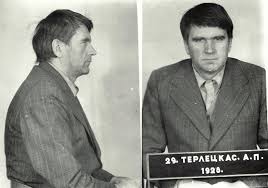
The Case of Antanas Terleckas and Julius Sasnauskas
Terleckas (CCE 54.18 [7]) and Sasnauskas (CCE 55.6) are accused of organizing two press conferences: one in 1976 in Terleckas’s flat; the other in 1979 in Ragaisiene’s flat.
*
*
Antanas Terleckas is also charged with being involved in writing a collective letter about the 40th anniversary of the Molotov-Ribbentrop Pact (CCE 54.18), with collecting signatures and its circulation. An investigator told Julius Sasnauskas’s mother that her son did not wish to renounce his convictions.
Vyacheslav Cherepanov (CCE 52.15-2 [8]) from Vilnius testified at an interrogation that Terleckas and Sasnauskas were the organizers of the 1979 press conference. Vytas Bastis (CCE 48.10-3) gave the same evidence. On 1 or 6 May 1980, a search was conducted at the home of Angele Paskauskiene (CCE 52.10, CCE 54.18). After the search she was interrogated.
*
Erik Udam (CCE 46.17, CCE 47.5, CCE 54.1-3) and Endel Ratas (CCE 54.1-3) were interrogated In Estonia on 20 June 1980. Enn Tarto [2] was interrogated there on 4 July. None of them — all three had signed the collective letter — gave any evidence.
*
On 2 July 1980, Investigator Katalikov (CCE 55.2-1) of the Moscow KGB interrogated Ivan S. Kovalyov.
That morning Katalikov woke Kovalyov with a telephone call to the friends with whom he was staying. Kovalyov refused to give evidence and refused to sign a statement that he would not speak about the interrogation.
===========================================
NOTES
- On Abramovich, see CCE 38.19 [19], CCE 39.4, CCE 43.12, CCE 44.10, CCE 47.8-4 and Name Index.
↩︎ - On Tarto, see CCE 2.7 [5], CCE 47.5, CCE 48.4 & CCE 54.2-2 [7] and Name Index.
↩︎
=========================
 A Chronicle of Current Events