<< No 30 : 31 December 1973 >>
EIGHT ITEMS
[1]
Investigation of the Superfin Case
As previously reported (CCE 29.4), Gabriel Gavrilovich SUPERFIN was arrested on 3 July 1973, his home was searched and the following items confiscated: notebooks, books in foreign languages including detective stories by Agatha Christie and a literary work to which Superfin had devoted years of effort.
*
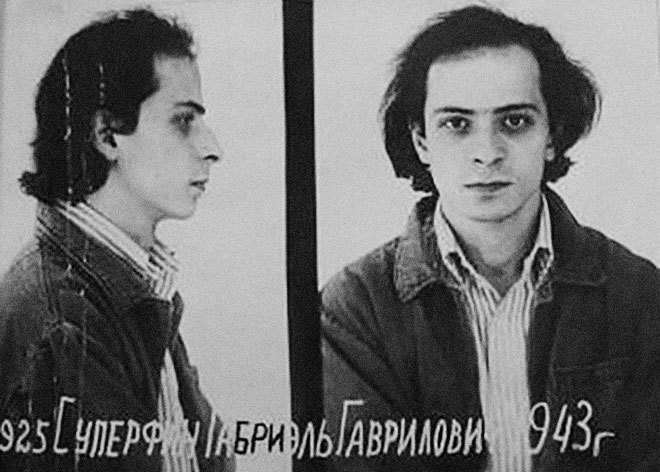
Gabriel Superfin, b. 1943
*
Ilyn, an investigator of the KGB Directorate for Oryol City & Region, was present at the search. Then a search was conducted in the flat of Superfin’s sister, who was summoned for the search from the oral examination of her doctoral thesis.
Shortly after Superfin’s arrest, M. Slonim’s flat was searched. Superfin’s friend Vadim Borisov was summoned for interrogation by llyn, who was assisted by Colonel Syshchikov.
On 24 August, the flat of Vladimir Dolgy was searched.
Immediately before that, Dolgy was handed a note from Superfin who asked him to turn over to the investigation a copy of Eduard Kuznetsov’s Diaries. Superfin had testified that at his request Dolgy had typed three copies of the Diaries, one of which the latter kept, while Superfin passed another to Yelena Bonner. No trace of the Diaries was found during the search.
In the interrogation that followed, Dolgy did not corroborate Superfin’s testimony.
On 11 September 1973, Dolgy was summoned for questioning to Oryol, where he was interrogated from 12 to 20 September and on the last day brought face to face with Superfin. The chief issue remained that of the Diaries. During the confrontation, as in his interrogations, V. Dolgy did not corroborate Superfin’s testimony.
*
In conjunction with the Superfin case, Yevgeny Barabanov’s home was searched on 24 August. After 27 August 1973 Barabanov was interrogated several times by Ilyn.
A statement by Barabanov dated 15 September is in circulation. It expresses his indignation at current violations of freedom of speech and conscience. He reminds people of the traditional practice by which uncensored works of Russian literature reached Russia via the West; and cites as examples works by Khomyakov, Leo Tolstoy and Vladimir Solovyov. Barabanov declared that he had sent to the West the following works: A Chronicle of Current Events, the Diaries of Kuznetsov, prison poems by Andreyev and Radygin [1], unpublished poems by Akhmatova, Mandelstam, Pasternak and Tsvetayeva, as well as other works — because he believed it was essential to preserve free Russian culture.
In September Yelena Bonner issued a statement in support of Barabanov, saying that she, too, had transmitted samizdat works to the West.
*
On 14 November Yelena Bonner was summoned to the KGB concerning a letter she and Andrei Sakharov had written to KGB chairman Andropov, requesting that Victor Khaustov be released on their surety until his trial (CCE 29.4).
KGB officer S. I. Sokolov termed this offer of surety “frivolous”, since, as he put it, Bonner herself was “an accomplice” of Khaustov’s. Sokolov said that the activities of “dissenters” were harmful; he stated that the authorities were trying to achieve greater democratization and did not wish to become more repressive, but the activities of “dissidents”, and particularly statements by Sakharov, impeded them.
*
In late November and December 1973, investigator Syshchikov of the Oryol KGB directorate repeatedly interrogated Bonner, primarily about Kuznetsov’s Diaries.
The interrogations pertained to what Syshchikov called “The Superfin-Khaustov-Bonner Case”. Bonner refused to answer his questions. At the same time, Bonner issued a statement to the press acknowledging that she had transmitted E. Kuznetsov’s Diaries to the West and did not consider this a violation of the law.
After publication of his Diaries in Paris, it is known that Kuznetsov spent about two months in the Saransk Investigations Prison (Mordovia ASSR). No information is available on the questions put to him during interrogation. Other people interrogated about the Diaries were given to understand that Kuznetsov had “confessed everything”, was faced with the threat of execution (under what article of the criminal code was not specified), and the implementation of this threat hinged on the degree of candour of their testimony.
During the autumn Tatyana Velikanova, Yuly Kim and Irina Yakir were also questioned about the Superfin case. An analysis of all the interrogations in the case made it clear that Superfin was giving detailed depositions, particularly about A Chronicle of Current Events.
*
[2]
Sergei Kuzmich PIROGOV was released in 1964 after serving an eight-year sentence under Article 58 (pre-1960 RSFSR Criminal Code), a case involving criticism of Soviet reality from a Marxist standpoint.
Pirogov was re-arrested in Arkhangelsk in July 1973. On 11, 12 and 13 July, the Arkhangelsk City Department of Internal Affairs (UVD) searched his flat as well as the flat and dacha of his mother, N. G. Pirogova. Shortly afterwards, the KGB repeated the searches and confiscated the following items: two issues of Veche, [2] works by A. D. Sakharov, some poems about Stalin, books, photographs, photographic film, writing pads containing notes, two radios, a typewriter, and other material.
According to the search warrant presented by the MVD officers, the grounds for the search was Pirogov’s suspected involvement in the death of a man unknown to him: a lecturer at the Arkhangelsk Institute for Fishing Technology called Vadim Sokolov, who committed suicide in February 1973 by hanging himself in the woods [correction CCE 32.23].
One of Pirogov’s acquaintances found in the deceased’s jacket pocket a notebook with critical comments Sokolov had made about the defective nature of social and economic relations in the USSR. Pirogov wrote about his find to Sokolov’s sister. In reply, the latter criticised the deceased’s moral character and the type of life he had led — criticisms that elicited a sharp rebuke from Pirogov in a second letter to her. Both of Pirogov’s letters were turned over to the office of the procurator in Arkhangelsk. There is reason to believe that Sokolov’s suicide was merely a pretext for searching Pirogov’s home. Apparently, he had been shadowed for about six months prior to this.
To begin with, MVD investigator Chilikidi conducted the investigation of Pirogov’s case. It is now in the hands of KGB investigators Nikolai Nikolayevich Beleyev and Gennady Grigorevich Romashenko. Charges against Pirogov have been preferred under Article 190-1 (RSFSR Criminal Code). The case has involved interrogations of many witnesses in Arkhangelsk, Moscow, Kaunas, Vilnius and Leningrad. In July 1973 the home of one of these people, I. Abramovich (of Moscow), was searched.
Since 11 November 1973, Sergei Pirogov has been confined to the Serbsky Institute in Moscow for in-patient examination by psychiatrists. The investigation of his case, which was extended until 14 December, has apparently been prolonged again.
*
[3]
There are unconfirmed reports that Vylegzhanin, Zaritsky and Lifshits were arrested in Kiev early in November 1973. They have been charged under Article 62 (UkSSR Criminal Code) [3].
*
[4]
Lev Alexandrovich LADYZHENSKY was arrested in Riga on 6 December and indicted under Article 183-1 (= Article 190-1, RSFSR Criminal Code). Ladyzhensky (Cand.Sci, Physical & Mathematical Sciences) heads a laboratory at the Riga Scientific Research Institute for the Fishing Industry [4].
*
[5]
In August the KGB searched the Moscow flats of: Tatiana Velikanova with regard to the Superfin Case; and of Vyacheslav Bakhmin and Andrei Tverdokhlebov with regard to “Case 24”.
*
[6]
Yelena Semeka’s apartment in Moscow was searched in mid-October.
According to the warrant, the search was prompted by suspicions that her husband, Mikhail Pankratov, had forged certain documents. The search party, however, seemed primarily interested in samizdat [5].
*
[7]
Early in November, Anatoly Marchenko’s home in Tarusa (Kaluga Region) was searched. According to the warrant presented by the KGB officers, the search related to “Case 24”.
*
[8]
In August the flat of Tatiana Zhitnikova, wife of Leonid Plyushch, was searched in Kiev in connection with the case of Victor Nekipelov (CCE 29.11 [13, 17]).
============================================
NOTES
- On Radygin see, especially, CCE 24.11 [5], CCE 27.12 [2] and Name Index.
↩︎ - On Veche, a “Russian nationalist journal”, see CCE 18.11 [6], CCE 26.16, CCE 32.16 and 16-1. Social Issues, Veche, Poiski, Obshchina (1969-1980).
↩︎ - Confirmed in CCE 32.20 [1], which gives details of a number of related searches. On 22 November 1973 the paper Russkaya Mysl (Paris) reported the arrests and gave their first names, respectively, as “Vladimir, Alexander and Yury”.
↩︎ - See more details in CCE 32.20 [4]. In October 1974, Ladyzhensky was sentenced to three years in strict-regime camps, plus three in exile.
↩︎ - Yelena Semeka and her husband emigrated to the US in 1974. That year she compiled a collection of documents about the case of Bidiya Dandaron (CCE 28.6).
↩︎
=======================
 A Chronicle of Current Events