A List of those Known to the “Chronicle”
- 33.6-1. Preface
- 33.6-2. Prisoners in Camp 35
- 33.6-3. Prisoners in Camp 36
*
PREFACE
Some comments are necessary as a preface to this list.
[Also see corrections to lists CCE 35.16.]
1.
For easier reference, the prisoners in the list below are divided into groups according to the type of their “case”. This grouping is, however, not in any way meant to be an attempt at a strict ‘classification’ based on the essential facts of each case concerned: this would be too difficult in many instances because of insufficient information.
Each prisoner is classified according to the kind of charge brought against him, though often, when several charges are involved, it is difficult to single out the main one. The division can, therefore, only be relative and largely arbitrary. For instance, many of those in the Ukrainian “intake” of 1971-1973 could be included among those convicted for ‘ideological crimes’ — samizdat, letters and petitions (Ivan Svetlichny, Igor Kalynets, Nikolai Gorbal, Alexei Reznikov and others); and the same could be said to apply to some of the Lithuanians. Indeed, in the great majority of political trials, during recent years at least, it has been ideological motives which have, generally speaking, provided the reason for conviction. However, the authorities have defined all these people, be it the Ukrainians or the Lithuanians, as nationalists. On the other hand, such ‘group’ cases as that of D. Grinkov can be seen to be related to ‘national’ movements; while groups like that of O. Frolov may be regarded as involving ‘ideological’ activities.
Therefore, for the sake of convenience, those persons convicted for “forming groups” have been classified together in a separate category. In the process this category has incorporated, for example, the ‘case’ of Lukyanenko, which is widely regarded as having been fabricated by the Lvov KGB. (Concerning this, see V. Chornovil’s book, known in samizdat as “The Green Book”, see The Chornovil papers, 1968.)
Another example is that of those convicted in the famous Leningrad ‘aeroplane’ trial; here below, they are placed in the category of ‘Zionists’, although, strictly speaking, they ought to have been classified among the people who have tried to leave the USSR. ‘Zionists’ is a self-description on the part of the ‘aeroplane people’.
*
2.
It should be borne in mind that there may be errors in the dividing of the prisoners into groups.
For example, among the Lithuanians listed under ‘national movement’ there are some of whom the Chronicle knows only their names and terms of imprisonment; among these there may be some persons convicted for collaboration with the Germans during the [1941-1944] war [1].
*
3.
The reader should be warned against the temptation to use the number of prisoners listed in each category to calculate the numerical correlation between various categories of prisoners; the information on the prisoners in the Perm camps is not comprehensive, so it is impossible to indicate how far the numerical correlation in the list corresponds to the real situation. For instance, there is hardly any information on prisoners convicted for religious offences, but this does not mean that there are no such prisoners in the Perm political camps.
*
4.
In cases where articles of the Criminal Codes of the non-Russian Republics are concerned, these have been ‘translated’ into the corresponding Articles of the RSFSR Code. It should be noted, though, that the texts of the corresponding articles are not always identical.
*
NOTE
This list was extensively annotated in the English edition.
Here the amendations made on the basis of corrections in subsequent issues of the Chronicle (especially CCE 34 and CCE 35) are not separately recorded. Information added by the English editors has been included in the text of the individual entry as a [note] rather than as a footnote or an end note.
Abbreviations used
- CCE = Chronicle of Current Events (Moscow)
- CHR = A Chronicle of Human Rights in the USSR (New York)
- OUN = Organisation of Ukrainian Nationalists (1929 onwards)
- SKK = Council of the Colony Collective (see Camp 35: 1.7 “War Criminals”)
- UPA = Ukrainian Insurgent Army (1942 onwards)
*
SOME EXAMPLES
1. Prisoners in Camp 35
1.1 – CHARGES RELATING TO SAMIZDAT, LETTERS, PETITIONS & PROTESTS
(1) Meshener, Josif: 39 years old, history teacher in a school in the town of Bendery.
In 1969 he was expelled from the Party and dismissed from his job for a letter on the Czechoslovak question sent to the Central Committee. He then wrote to the United Nations about his letter and the consequences. Arrested in 1970 (CCE 16.10 [9]). Sentence: six years, Article 70.
- Co-defendant: Ya. Suslensky.
(2) Gluzman, Semyon (Samuel): 27 years old, psychiatrist.
Arrested on 11 May 1972, tried for samizdat activity under Article 70; sentenced to seven years in camps and three years’ exile (CCE 28.7 [4]). Well-known as the author of “An ‘in Absentia’ Psychiatric Report on the Case of P.G. Grigorenko”.
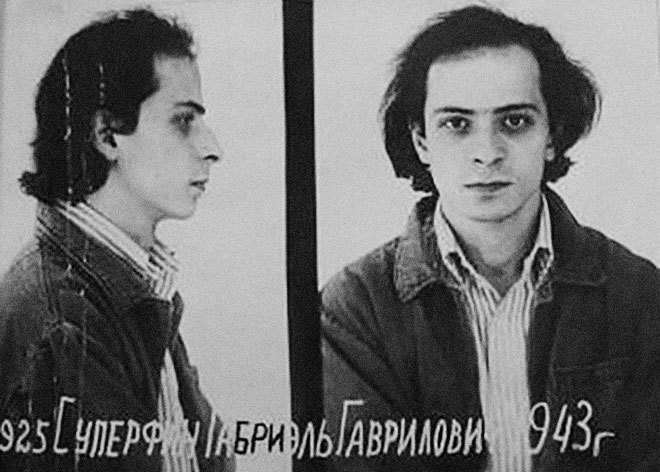
Gabriel Superfin, b. 1943
(3) SUPERFIN, Gabriel Gavrilovich: 30, literary critic and literary historian. (Sentence: five years in camps and two years’ exile, Article 70.)
Arrested on 3 July 1973. Convicted in May 1974, basically for collecting material for the Chronicle of Current Events and for participating in its publication. For Superfin’s trial, see CCE 32.3. He arrived at the camp in September.
(4) ZHUCHKOV, Konstantin Vasilyevich: 48, a worker.
Wrote anonymous letters to various organizations. Article 70, sentence, three years.
*
1.2 – BELONGING TO “ANTI-SOVIET ORGANIZATIONS”
(5) PAVLENKOV, Vladlen Konstantinovich: 45 years old, until his arrest taught history at a technical college in Gorky [Nizhny Novgorod]. Arrested in October 1969 on charges of trying to set up an anti-Soviet organization (on the “Gorky case”, see CCE 11.15 [13], CCE 12.4 & CCE 13.3). Articles 70 & 72, sentence — seven years.
(6) GAVRILOV, Gennady Vladimirovich (b. 1939), engineer, Lieutenant-Captain in the Soviet Navy; was a member of the Party.
In the autumn of 1968, at an officers’ meeting, he described the entry of troops into Czechoslovakia as an act of aggression. In February 1969 he was, in a single day, expelled from the Party, dismissed from his job and transferred to the naval reserve. In June of the same year he was arrested, and, in 1970, sentenced to six years in camps. He was charged under Articles 70 & 72 with founding an illegal organization, the ‘Union to Struggle for Political Freedom’, with writing theoretical politico-philosophical works and distributing them, and with attempting to organize the underground publication of a newspaper, “The Democrat” (for “The case of the Baltic Fleet Officers” see CCE 11.5 & CCE 15.4 [1]). In June 1974 Gavrilov was pardoned (CCE 32.12).
- Co-defendants: Kosyrev (two years, released in 1971) and Paramonov.
Gennady Paramonov, a re-enlisted petty officer, was an external student in the Faculty of Philosophy and History of Tartu University, and a Komsomol leader in the garrison at Paldiski. Was ruled non-responsible for his actions and is now in his fifth year of internment in the Chernyakhovsk Special Psychiatric Hospital.
(7) OGURTSOV, Igor Vyacheslavovich (b. 1937) expert on oriental languages, worked as a translator from Japanese. One of the leaders of the All-Russian Social-Christian Union for the Liberation of the People (ASCULP): trial, CCE 1.6; also CCE 4.7 [1] & CCE 19.4. Articles 64, 70 & 72. Sentence: seven years in prison (which ended this year), eight years in camps and five years’ exile.
(8) DAVIDENKO, Georgy Mikhailovich, 27, a metalworker from Nizhny Tagil, formerly a member of the Party. Sentence, four years. Arrested in March 1971 in connection with the case of the “Revolutionary Party of Soviet Intellectuals”. The case was examined by the Sverdlovsk Region Court in the middle of November 1971. (Note: The trial is described in some detail, but without naming the defendants in CCE 24-11 [1].)
The Revolutionary Party of Soviet Intellectuals (RPSI) was formed as a result of a merger between the so-called ‘intellectuals’ and an organization called URC (Urals Regional Committee, founded in April 1970; Secretary, Lavrentyeva); at the URC third regional conference, in August 1970, Davidenko was appointed ‘president’. They set up a printing press, held meetings, wrote and distributed articles: “Trampolism” and “The Birth of New Classes and the Struggle in the Era of Socialism”. The verdict refers to these articles as making assertions about the degradation of socialist society and the degeneration of the Komsomol. The Chronicle has no information on the ideological position of this organization; it is only known that they called themselves ‘anti-trampolists’, but what is meant by the term ‘trampolism’ is not clear.
Davidenko’s co-defendants:
- Spinenko, Vasily (wrote under the pseudonym Smolin), b. 1945, a graduate of the Faculty of Philosophy at Donetsk University, the “ideologist of the organization”; declared mentally incompetent, not responsible for his actions and interned for “compulsory psychiatric treatment”;
- Kiselev, Alexander Ivanovich, b. 1951, a metalworker in a mine in the town of Makeyevka. Sentence — three years; now released;
- Belomesov and Semiletov (see Camp 36, 2.2 “Anti-Soviet Organisations”).
The fate of two workers from Nizhny Tagil is unknown: BABISHCHEVA, Yevgenia Kirillovna (b. 1948) and LAVRENTYEVA, Natalya Dmitrievna (b. 1950).
(9) KANDYBA, Ivan Alexeyevich, Ukrainian. Arrested in 1961 and sentenced to 15 years — apparently under Articles 64, 70 & 72 — for participation in the ‘case’ of Lukyanenko (see V. Chornovil, “The Green Book”).
(10) DYAK, Mikhail Dmitrievich, 39, Ukrainian; until his arrest he was a neighbourhood commissioner, with the rank of police-lieutenant, in the Dolinsk district of the Ivano-Frankovsk Region. Arrested in March 1967 as one of the leaders of the “Ukrainian National Front” (on the case of the UNF, see CCE 17.7). Articles 64, 72 and 218 (“illegal possession of weapons or explosives”). Sentence: five years in prison (which he has served), seven years in camps and five years in exile.
Mikhail Dyak is seriously ill; the authorities proposed to him that he write a plea for a pardon, promising that this would be granted. Dyak refused.
(11) DEMIDOV, Dmitry llych, 26, Ukrainian, engineer. Arrested on 13 April 1973 in connection with the case of the “Union of the Ukrainian Youth of Galicia”. The verdict stated that Demidov “effectively took upon himself the responsibilities of deputy leader for ideological questions concerning the organization’s activities”. Articles 70 & 72, and an accomplice under Article 218-1, Pt 2 (“stealing firearms, ammunition or explosives”). Sentence, five years.
(12) Melekh, Nikolai: b. 1930, Ukrainian. Arrested in Lvov in 1961. Sentence, 15 years. Melekh’s four co-defendants were executed by shooting. It is known that the case is described in the book Ferment in the Ukraine, [1971] published in England.
*
There follow lists of: [3] Zionists, [4] those who crossed borders, [5] Ukrainian nationalists, [6] Lithuanian nationalists, [7] war criminals, 1941-1945, and [7] those convicted of especially grave crimes against the State …
For full Camp 35 list, see CCE 33.6-2 …
=========================================
NOTES
- Years later, an accusation of this kind was brought against Memorial.
Its extensive online database of the “Victims of Soviet Terror, 1918-1991”, which included a million names, was said by Putin’s regime in 2020 to have included certain war criminals (ref ///). That report in State-controlled media was a prelude to the organisation’s ban in 2022.
↩︎
==========================
 A Chronicle of Current Events