On 20 May 1969 a letter was sent to the UN Commission on Human Rights [1] with a request to look into the violation in the Soviet Union of one of the basic human rights, the right to hold independent convictions and to propagate them by any legal means.
*
People in our country, the letter pointed out, are being prosecuted in political trials for slandering its State and social system, with the intent (Article 70) or without (Article 190, RSFSR Criminal Code), of undermining the Soviet system.
None of the accused, in fact, has attempted to slander, still less to undermine, the Soviet system.
People have been convicted on fabricated charges, in effect for their ‘convictions”.
“You are not being tried for your convictions” is a favourite phrase of the presiding judges. The letter exposes the falsehood of this assertion by referring to a succession of trials:
- Sinyavsky and Daniel (January 1966);
- Khaustov and Bukovsky (September 1967);
- Ginzburg and Galanskov (January 1968, CCE 1.1);
- That of the 25 August 1968 demonstrators (October 1968, CCE 4.1);
- Trials of Anatoly Marchenko [2], Irina Belogorodskaya [3], Yury Gendler and Lev Kvachevsky [4];
- A series of trials in Ukraine, including that of Viacheslav Chornovil (November 1967);
- Trials of Crimean Tatars (CCE 5.1 [17]), (CCE 7.1);
- Trials in the Baltic States, particularly of Victor Kalninš (1962) and others;
- Trials of Soviet Jews demanding permission to emigrate to Israel (e.g., the conviction of Kochubievsky, CCE 8.1);
- Trials of religious believers.
The letter mentions the recent arrests of Victor Kuznetsov (CCE 7.3), Ivan Yakhimovich (CCE 7.2), P.G. Grigorenko (CCE 8.3) and Ilya Gabai (CCE 8.4), and refers to “a particularly inhuman form of persecution, the placing of normal people in psychiatric hospitals because of their political convictions.”
*
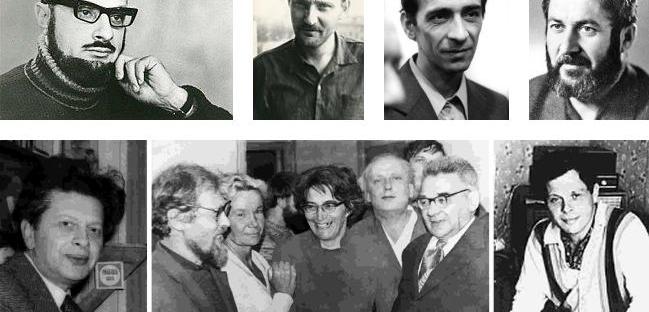
This letter was signed [5] by the Action Group “for the Defence of Human Rights in the USSR”, surnames are listed in Russian alphabetical order:
- Genrikh Altunyan (engineer, Kharkov)
- Vladimir Ye. Borisov (worker, Leningrad)
- Tatyana Velikanova (mathematician)
- Natalya Gorbanevskaya (poet)
- Mustafa Dzhemilev (worker, Tashkent)
- Sergei Kovalyov (biologist)
- Victor Krasin (economist)
- Alexander Lavut (mathematician)
- Anatoly Levitin-Krasnov (church writer)
- Yury Maltsev (translator)
- Leonid Plyushch (mathematician, Kiev)
- Grigory Podyapolsky (scientific research worker)
- Tatyana Khodorovich (linguist)
- Pyotr Yakir (historian)
- Anatoly Jakobson (translator).
There are a further 38 signatures of support beneath the appeal.
*
*
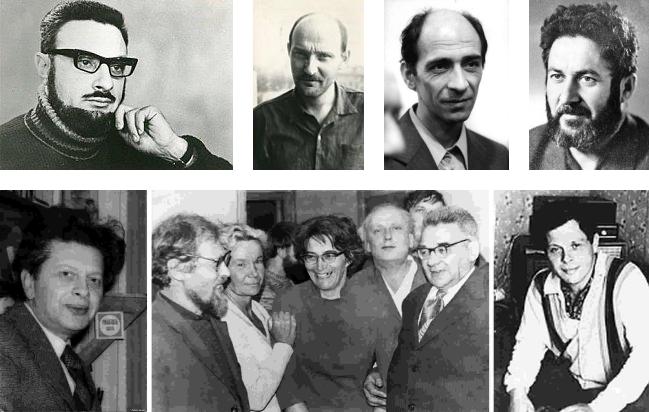
MEMBERS OF THE ACTION GROUP
(top row, l. to r.) Genrikh Altunyan, Victor Krasin, Leonid Plyushch, Pyotr Yakir;
(bottom row, l. to r.) Alexander Lavut; Sergei Kovalyov, Tatyana Khodorovich, Tatyana Velikanova, Grigory Podyapolsky and Anatoly Levitin-Krasnov; Anatoly Jakobson
*
Staff at the UN Office in Moscow refused to accept the letter, declaring that they did not accept anything from private individuals. The letter was sent by post and copies handed to foreign correspondents.
*
On 30 June the Action Group sent an additional letter to the UN Human Rights Commission with information on
“new, particularly painful facts about the violation of human rights: the new case [6] brought against Anatoly Marchenko; and imminent trials, aimed at shutting dissenters away within the walls of prison psychiatric hospitals.”
=========================================
NOTES
- The Action Group sent three more appeals to the UN Commission in 1969 (CCE 10.15 [9], CCE 11.14 [16]).
↩︎ - Anatoly Marchenko was arrested, tried and imprisoned on numerous occasions, from 1958 onwards (see CCE 3.1 [1] and CCE 35.2).
↩︎ - Irina Belogorodskaya was arrested in August 1968 (CCE 3.1 [1]) and tried in February 1969 (CCE 6.1).
↩︎ - Gendler, Kvachevsky and others were arrested in Leningrad in August 1968 (CCE 3.4) and went on trial in December that year (CCE 5.2).
↩︎ - The Action Group for the Defence of Civil Rights in the Soviet Union
This Group, the first post-Stalin human rights group, was formed a fortnight after Petro Grigorenko’s arrest (CCE 8.3). The late Peter Reddaway offered this commentary on its character and emergence:
“From the start the terms ‘civil rights’ and ‘human rights’ were used interchangeably in the group’s title and other such phrases. Both terms have a fairly modest ring.
“Perhaps because of the re-Stalinization process which the group saw beginning, the more radical notion of ‘political rights’ was eschewed. Indeed, in such an atmosphere the very creation of the group required enormous courage, given the acute, almost paranoiac fear which the secret police in totalitarian States always feel for groups beyond their close control.
“As the 15 people concerned represented not only Moscow but also Leningrad, Kiev, Kharkov and the exiled Crimean Tatars in Central Asia, violent KGB antagonism was in fact certain. Nor were these people cranks, but intelligent, mostly professional men and women with an average age of somewhat under forty.“
Peter B. Reddaway, Uncensored Russia, hbk (1972, Chapter Seven, p. 150).
↩︎ - “Marchenko again under investigation” (CCE 8.9).
↩︎
=============================
 A Chronicle of Current Events