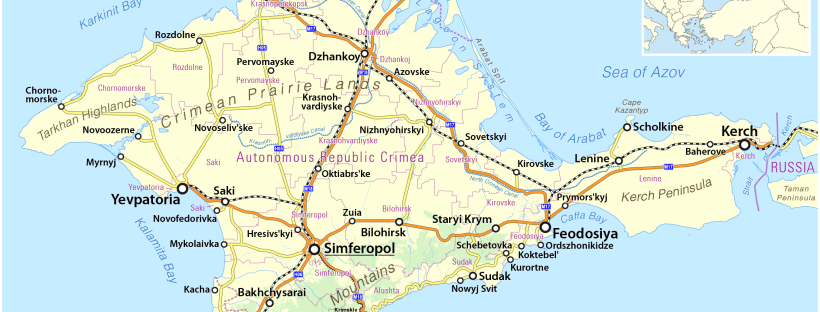
The 31st issue of the Chronicle appears exactly thirty years after the tragic and shameful night of 17-18 May 1944 (mass deportation from Crimea) and consists entirely of materials relating to the Crimean Tatar movement.
It is a movement unique in our country for its mass character, embracing definitely more than a half of the adult Crimean Tatar population, and for its duration, having been operative since 1956.
Two short addenda (items 25 & 26) require no additional commentary.
The issue has been compiled from items made available by representatives of the Crimean Tatar movement.
*
PART ONE
Texts 1-9 include several individual appeals to the press, to the USSR Supreme Soviet and to international organizations.
In the main they describe the events of the past 18 months (1973-1974).
*
PART TWO
The second, retrospective part of the issue (texts 10-24) summarizes items of the Crimean Tatar movement from 1966 to 1973.
The latter can be roughly divided into
[a] Informational items
These offer accounts of meetings of representatives of the Crimean Tatar nation, of activities they have undertaken, and of “legal actions” which the movement has been concerned to oppose.
[b] Collective statements by Crimean Tatars
These carry from dozens to tens of thousands of signatures. They are addressed to Soviet and international organizations, setting forth and explaining the aims of the movement.
♦
The exposition of all the items is, necessarily, extremely condensed.
It pursues the goal of conveying not only maximum communication of information about specific facts but also of a maximally precise reproduction, in content and form, of the movement’s platform.
From the materials of this issue it is evident that this platform, whilst fully maintaining a communist and Soviet basis with regard to its ideas and terminology, has in recent years noticeably broadened to include points of international law (in which connection the range of addressees has also broadened).
At the same time the Crimean Tatar movement has at all stages, been closely linked to the general thrust of activities in defence of human rights in the USSR.
This is clear, for example, from the numerous materials published in previous issues of the Chronicle [note 1, below]. In particular, activists of the Crimean Tatar movement have repeatedly participated in the work of the Action Group (CCE 8.10) and have supported its letters and other declarations.
In turn, the Crimean Tatar movement has enjoyed, and enjoys, the support of all in the USSR to whom human rights are important.
*
This spirit of active sympathy and solidarity manifested itself, perhaps, with especial clarity in the life and activities of two people imprisoned precisely because of their statements in defence of the rights of the Crimean Tatar people:
Ilya Yankelevich GABAI (1938-1973),
who died tragically last year (CCE 30.1)
and
Pyotr Grigorevich GRIGORENKO (1909-1987),
who has already languished for five years in Soviet prisons and psychiatric hospitals.
(See CCE 12.2 : The Trial of P. G. Grigorenko, February 1970)
=============================
NOTES
The Moscow-based editor of CCE reports about the Crimean Tatar Movement was Alexander Lavut: trial CCE 60.2 and brief obituary notice (1929-2013).
[1]
The relevant materials from issues 1-11 (1968-1969) were gathered together in Chapter 12, “The Crimean Tatars” (pp 249-270) of the late Peter Reddaway’s Uncensored Russia (1972).
Some, by no means all, of those reports are listed below:
2.4 (30 June 1968) “An appeal by Crimean Tatars to world public opinion”
7.1 (30 April 1969) “The Trial of Gomer Bayev” (Simferopol)
7.7 (30 April 1969) “The ‘resettlement’ of Crimean Tatars in the Crimea”
8.5 (30 June 1969) “The 6 June 1969 demonstration on Mayakovsky Square” (Moscow)
9.2 (31 August 1969) “The trial of ten Crimean Tatars” (Tashkent)
*
[2]
Subsequent issues of the Chronicle contain extensive materials about the Crimean Tatars:
12.3 (28 February 1970) “The trial of Ilya Gabai and Mustafa Dzhemilev” (Tashkent)
13.10 (30 April 1970) “News in brief”, [12] (The Crimean Tatar movement)
18.7 (5 March 1971) “The Crimean Tatar Movement”
19.5 (30 April 1971) “An appeal by the Crimean Tatar nation”
27.4 (15 October 1972) “The persecution of the Crimean Tatars”
*
[3]
All related news items and reports have been gathered in the CCE Contents Page:
3. The Crimean Tatar movement, 1968-1980
*
[4]
The largest collection of Crimean Tatar documents to appear at that time in book form was Delo 709 [Case 709], published by the Herzen Foundation (Amsterdam, 1975).
About 100 items appeared in the Samizdat Archive.
*
At that time the most recent study was Ann Sheehy’s The Crimean Tatars, the Volga Germans and the Meskhetians (Minority Rights Group: London, 1973). An earlier version of her work appeared in B. Whitaker (ed.), The Fourth World, London, 1972.
Her study also appeared in German, Krimtataren und Meschier, Pogrom (Hamburg, 1973).
*
Recently, The Crimean Tatars: From Soviet Genocide to Putin’s Conquest was published by Hurst (London), a 2015 volume by Brian Glyn Williams.
==================
 A Chronicle of Current Events