On 24 September the Moscow City Court, presided over by Judge Yevstigneyeva, began hearing the case of Valery Fyodorovich ABRAMKIN (b. 1946 [1]). The prosecutor was Procurator Ostretsova; the defence counsel (appointed by the court) was the lawyer Yefremov.
*
THE CASE OF “POISKI”
- 7-1. The case of “Poiski”, introduction,
- 7-2. The Trial of Victor Sokirko,
- 8-1. The Trial of Valery Abramkin,
- 8-2. Abramkin’s prison letters,
- 9-0. The Trial of Yury Grimm.
*
On the petition of Abramkin, who had not had time to study the case, the trial was postponed until 1 October. (By this time Yekaterina Gaidamachuk had reached an agreement with Yefremov concerning her husband’s defence.)
The hearing of Abramkin’s case continued from 1 to 4 October. The trial took place on the premises of the Moscow City Court.
*
Several days before the beginning of the trial, Abramkin’s friends sent a statement to the Court requesting permission to attend, but they received no reply. They then addressed a complaint to the Procurator of the RSFSR.
On 4 October Abramkin’s friends who had come to the court building (22 persons) sent a statement to the Court demanding to be admitted to the courtroom while the judgment was read out, in accordance with Article 18 of the RSFSR Code of Criminal Procedure. At the end of the trial to which none of them had been admitted, fourteen of the authors of the first statement wrote a ‘Report’ on the fact that, although they had arrived in good time, none of them was admitted to a single court session on Abramkin’s case. Thus ‘an officially open trial was in fact turned into a closed one’.
When the Court working hours were over, although the hearing of Abramkin’s case was still in progress, policemen pushed his friends on to the street, where they were told to ‘disperse’. On 3 October the court Commandant confiscated a portable tape-recorder from Gaidamachuk, which she wanted to take into the courtroom.
*
On 1 October Abramkin made several petitions to the Court:
[1] to summon as witnesses Seitkhan Sorokina, Raissa Lert, Mikhail Gefter, Sergei Belanovsky, V. Kucherov, V. Zhulikov, T. Zamyatkina (CCE 54.2-1 [2]).
Also Zakharov, Abramkin’s superior at work, in order to check out a character reference given at his place of work which mentioned that he had absented himself from work, although Abramkin had written a statement saying that he had missed that day on account of the death of a close friend;
[2] to postpone the trial for another week, as during the additional time from 24 September to 1 October the case file had been brought to him only twice and he had not been able to read the last 1,000 pages;
[3] to allow him a visit from his wife Yekaterina Gaidamachuk in order to settle the matter of his defence counsel;
[4] to remove from the case file the record of his interrogation taken down by Investigator Zhabin, as the record contained a sentence someone had inserted, in which Abramkin pleaded guilty. For the same reason Abramkin petitioned the court to summon the barrister Akselbant and Investigator Zhabin.
*
In order to allow him to finish studying the case file, the Court called a three-hour recess.
The Court refused the other petitions, agreeing only to summon Seitkhan Sorokina (at first this petition was also turned down, on the grounds that her husband had been summoned). After the indictment was read out Abramkin stated that he would not answer the court’s questions if he were not allowed to finish studying the case file.
On 2 October Abramkin told the Court that notes and other papers related to the case had been confiscated from him in prison, and that without them he was unable to take part in the proceedings: ‘I’ve been gagged.’ The Judge said that the court had nothing to do with this, but, on the following day, she allowed time from 10 to 12.30 am for him to continue studying the case and the notes. Some of the confiscated notes were returned to Abramkin (without the most important page) on 3 October.
*
WITNESSES
The witness Rubasheva stated that she did not know Abramkin.
In February 1979 a search was made at the home of Rubasheva. According to the search record, an archive given to her for safekeeping by Yegides was confiscated, as well as Poiski No. 1-2. Rubasheva recounted that she had been visited at work without a warrant or summons and taken home. There the searchers removed rucksacks containing papers, without drawing up a description or a record, guided apparently by their sense of smell (the searchers had gone out on to the balcony and said: ‘It smells of anti-Sovietism here’). Only on the following day was Rubasheva summoned to the police station and given a record to sign. At the trial Rubasheva confirmed that she had signed the record, but did not know whether it corresponded to the items confiscated from her.
*
The witness N. Kasatkin — he had formerly introduced himself as Rozanov to Yegides and Gershuni. whom he had met “as fellow-book-lovers” — testified that he had been to a church caretaker’s lodge, where he had seen Abramkin.
It was dark and there were some people there. Someone (he did not remember if it was Abramkin himself) gave him an issue of Poiski to read, asking him to return it to Abramkin after reading it, or to any other caretaker. Kasatkin did not like the journal: it was of a poor literary standard and had an anti-Soviet bias. Kasatkin also testified that he had not been invited to contribute to the journal, but had been asked to help duplicate it. He had refused.
Abramkin stated that he had never seen Kasatkin before and that the latter had never visited the caretaker’s lodge. He requested that the elder of the Moscow Church of Antioch and the caretakers be summoned.
*
Sorokin testifies
The witness Victor Sorokin (“The Trial of Sokirko” CCE 58.7-2) was interrogated for over an hour.
Judge: Place of work?
Sorokin: According to Article 282 (RSFSR Code of Criminal Procedure), passport information is sufficient for establishing identity. I can cite another reason: the possibility of illegal persecution after the place of work is revealed to the official agencies; I have been convinced of this more than once.
Judge: Tell me, witness: was your home searched on 25 January 1979?
Sorokin: On the basis of Article 283 (RSFSR Code of Criminal Procedure), my right and obligation is first to give an account of everything I know bearing on the present case.
Judge: That is not necessary. Answer the question put to you.
Sorokin: On the basis of Article 283 … (ditto)
Judge: We’re listening.
Sorokin: I am unable to saying anything bearing on the present case, as the court has infringed Article 270 (RSFSR Code of Criminal Procedure): a witness summoned in advance has the right and the obligation to attend the opening of the court proceedings.
Judge: Then answer specific questions.
Sorokin: On the basis of Article 283 … (ditto). This is my civic duty. As long as the court refuses to inform me of the charges against Abramkin, I am forced to base myself on information I have received in conversations with other people.
Judge: First you say that you are not aware of the substance of the case, then you say you are.
Sorokin: I would like to know the officially formulated indictment.
(Sorokin went on to describe Abramkin both as a worker — for several seasons they had worked in forestry together — and as a person who, on principle, was incapable of falsehood, lying or slander.)
Sorokin: As an editor, Valery adopted a critical approach to any information. So, for instance, when he received information that political trials in the USSR were closed, he went to the court building and personally checked the authenticity of the report.
*
Further attempts by Sorokin to describe Poiski were interrupted by the Procurator, who questioned him about the search of his home on 25 January 1979.
Sorokin refused to answer these questions and to continue giving evidence, citing the court’s infringements of the Constitution and the Code of Criminal Procedure. The Procurator demanded that a criminal case be instituted against Sorokin for refusal to give evidence.
Sorokin was then sent out of the courtroom, while the court retired for a consultation.
*
While the judges were conferring, a certain person walked into the witnesses’ room.
Yakovlev recognized him as the man who had interrogated him at a police station when he was detained in November 1979; he had not then introduced himself. (On 24 September 1980 he was in the court building and asserted that he was ‘Burtsev’. Witnesses who have often met Investigator Burtsev, however, categorically affirm that this assertion was false.)
The man attempted to call Yakovlev to one side.
When he did not succeed, he intimidated the witness in front of everyone. “Consider, Misha,” he said, “that a criminal case has already been instituted against Sorokin. So think about that before you give evidence.” He did not have time to say anything else.
Tomachinsky darted out into the corridor and shouted (the shout was heard in the courtroom): “I demand to see the Chairman of the Court! A crime has just been committed in this room!” While police and plainclothes men pushed Tomachinsky back into the room, the stranger vanished.
In the room, besides Yakovlev and Tomachinsky, were Gaidamachuk, Malinovskaya and Sorokina. All of them reported what had happened in a statement to the Chairman of the Moscow City Court.
In the statement they demanded that criminal proceedings be instituted “for inadmissible pressuring of witnesses prior to their giving evidence, by means of intimidation”. Yakovlev, Tomachinsky and Sorokina later began their testimony with similar oral statements to the court.
*
During the consultation, which lasted about 25 minutes, the court resolved to ask Sorokin to continue giving evidence.
Judge: Tell me, witness: was your home searched?
Sorokin: It’s no secret. Of course it was. There is a document and witnesses … And not just one, but two searches: on 25 January and 4 December 1979.
Procurator: And what was confiscated from you?
Sorokin: Everything they could lay their hands on: toilet paper, a photographic exposure meter, an exposed film containing pictures of Abramkin’s child. They took away three sacks altogether. They spent eight hours taking things, but gave us only a few minutes to examine them.
(There followed questions from the Court Chairman and the Procurator on the materials taken in the search.)
Sorokin: I refuse to testify against myself.
To questions concerning his ‘evidence’ during the investigation, Sorokin replied that he had written a statement in the record of the second interrogation to the effect that he considered both interrogations invalid, in view of the numerous infringements of the Code of Criminal Procedure, and asked that it be read out.
At first the court refused, but Abramkin insisted that the statement be read out:
“As the investigator categorically refuses to inform me of the facts and circumstances in connection with which I have been summoned for interrogation, I cannot know which questions I am obliged to answer.
“The investigator has not informed me by whom, when and where a crime was committed. As the record of the first interrogation is the result of severely condensing what was said. I consider my evidence at both interrogations to be invalid.”
Sorokin (explains): An interrogation which lasted about four hours was then recorded on four or five pages. As the investigator’s questions were not written down, it is impossible to understand what this or that answer pertains to.
For instance, we were talking about Stalinist repression and the materials of the [1956] Twentieth Congress, and about the writer Daniil Kharms and materials on Kharms. The investigator did not indicate exactly which materials Valery had brought — materials on the Twentieth Congress or materials on Kharms; he wrote only: ‘Valery brought the materials’. In the reply to the question: ‘Who are the members of the editorial board?’ the investigator omitted my words ‘As reported by the radio-station Deutsche Welle.’
Judge (reading extracts from the first record): The journal was set up as discussion platform, with the aim of enabling all who so wish to express their opinion on problems everyone is concerned about.
Sorokin: This corresponds to actual fact.
Judge: “I read the third issue of the journal at Abramkin’s.”
Sorokin: This does not correspond to fact. I said that I saw it at Abramkin’s.
Judge: “The fifth issue of the journal was typed in my flat.”
Sorokin: This is absolutely false, and it’s impossible that I could have said it.
Procurator: And how did “Charter-77” come to be in your flat?
Sorokin: I have no idea. Generally speaking, “Charter-77” is a document to be found in every decent home.
Assessor: Where did you read the issue of the journal?
Sorokin: What do you mean — where? In a private library.
Assessor: Couldn’t you tell us the address of this library?
Sorokin: No! Only honest people are allowed into it.
After Sorokin had answered defence counsel’s questions, the Chairman announced that he was free to go.
Sorokin: On the basis of Article 283 (RSFSR Code of Criminal Procedure) I have the obligation and the right to remain in the courtroom until the end of the judicial investigation.
Judge: Take him out of the courtroom!
*
In reply to the Judge’s question as to whether his home was searched and which issue of Poiski was confiscated from him, Victor Tomachinsky took out the following statement and passed copies to the court and defence counsel:
“I am a regular subscriber to the journal Poiski. I have been in regular touch with the editorial board, and in the course of the criticisms regarding the tendency and contents of the journal, which I have brought regularly to the attention of the editors. I have had the opportunity to elucidate indirectly not only the aims proclaimed by the editors in their publication, but also the less clear motives, of which the editors themselves are perhaps not always aware behind their undertaking.
“As a witness I can talk only about the collective results of Abramkin’s activities as a member of the editorial board, not about Abramkin the activist or Abramkin the man, for I have never seen Valery Abramkin until today.
“The journal Poiski contains not a few works which are, in my opinion, of a poor literary standard, or intellectually weak, or uninteresting. It also contains things of unique artistic value and remarkable impact, such as, for instance, ‘Balthazar’s Feasts’ [2] and the notes written by Gely Snegiryov before his death.
“I would like to dwell particularly on the libel disseminated in our country and abroad by the journal Poiski. This libel is contained in one of the last issues of the journal — No. 12 or 13, I can’t remember which — and is obviously aimed at defaming our social system. The libellous materials published in Poiski are called an ideological report in connection with Case No. 50611/14- 79, and are signed with five names: Timofeyev, Ukraintsev, Modrzhinskaya, Rzheshevsky and Trukan [3].
“These Academicians’ reviews of the first seven issues of the journal Poiski make use of all the classic trappings of professional libellers: from juggling the text by picking out fragments of sentences, to all five varieties of false proofs, even to breaking the rules of syntax — i.e., to the ridiculous. However, this libel bears no relation to V. Abramkin as its source, only as its target.“
(Tomachinsky apparently assumes the journal Poiski and the journal Searches and Reflections to be one and the same.)
Tomachinsky attempted to read through his statement, but was not allowed to finish.
Assessor: You spoke about libellous materials published in Poiski?
Tomachinsky: Yes. This material was produced by four institutes and contains libel against the journal.
After reading out his statement Tomachinsky stated that he had already given evidence at the trial of Sokirko, but was now refusing to testify ‘in view of the aggravated conditions’.
Judge: Where can one subscribe to the journal Poiski? Do you mean there are organizations dealing with subscriptions? Who is involved in them?
Tomachinsky: Tomachinsky, and I don’t know who else.
(Tomachinsky evidently preferred not to give the KGB any leads.)
*
Abramkin’s ex-wife Irina Malinovskaya was questioned briefly, mainly on the record of an interrogation during the pre-trial investigation, where she allegedly said that Abramkin had expressed dissatisfaction with the Soviet system. Malinovskaya stated that she had not said that. The record contained gaps and was illegibly written.
She was asked about Abramkin’s relationship with their son and about alimony. Malinovskaya said that he had a good relationship with their son, and that they had an agreement regarding assistance.
*
Witness Yakovlev was the only one whose statement about the “crime in the witnesses’ room” elicited any response from the court:
Judge: But you are not giving the evidence you wished to give?
Yakovlev: Yes.
Judge: Then how are you being pressurized?
Yakovlev: If someone beats you up without leaving any bruises, that doesn’t mean you haven’t been beaten.
It transpired in the end that Yakovlev was unable to name the man who had threatened him; on this pretext the Judge dismissed the subject: ‘The fact that the witness was intimidated has not been established by the court.’
Yakovlev was confronted with the evidence he gave at a police station when he was detained (CCE 55.2-2). This evidence contains a statement that Abramkin had given him Poiski to read (the third issue) and that, on Abramkin’s suggestion, he had submitted some of of his works to Poiski, At the trial Yakovlev said that could not have given such evidence, as it contained several crude ‘distortions’.
For instance, the title of one of his stories was distorted; his literary pseudonym was incorrectly written (‘Aliyatov’ instead of ‘M. Liyatov’).
He had not submitted his play (‘Some Mendoza’, Poiski No. 1-2); he did not know how it had come to be printed there; he had found out through ‘Voice of America’ that it had been published; and he did not know whether it was his signature under the record of the police interrogation.
Judge: Did Abramkin give you the journal Poiski?
Yakovlev: No.
Judge: What do you mean ‘no’, when in your evidence …
Yakovlev: I did not give that evidence.
Defence counsel asked whether Yakovlev had read the records of his interrogations. The latter said that it was possible that he had overlooked that passage. The barrister asked him to describe Abramkin’s character; Yakovlev described him in positive terms. Despite Yakovlev’s protests, he was pushed out of the courtroom after giving evidence.
*
The witness Seitkhan Sorokina (//CCE 52) stated to the court that she had read all eight issues of the journal Poiski, and had not found libel in a single one. The journal, said Sorokina, constituted ‘a search’ for various means of exchanging views, publishing one’s own works and expressing one’s convictions.
‘I think,’ she said,
“that the court will examine this case objectively and will not give reason to suppose that words and thoughts are persecuted in our country … Publication of the journal does not contradict the Constitution … It is carried out in the interests of the State; the editors derive no personal gain from its publication …
“I consider Abramkin innocent, and as a token of my sympathy and conviction that he will win, whatever the outcome of the trial, I offer him these flowers.“
Sorokina placed a bouquet on the barrier.
Sorokina, as well as her husband, was questioned chiefly about the materials of the search conducted at their home: about typewriters, carbon paper and paper. Sorokina confirmed that she was a collaborator in the journal Poiski. On these grounds she refused to answer questions concerning the technical side of the case.
Abramkin asked Sorokina questions about the incident in the witnesses’ room and about details of the searches carried out at the Sorokins’ home. Sorokina gave a detailed account of the numerous violations of legal procedure committed during the first search: the pages of the confiscated texts were not numbered; persons not introduced and not noted in the record took part in the search; after the search many valuable books were found to be missing from their home. During the second search, even cruder violations were committed: the warrant had been issued for the day before; the door was broken down; they were not allowed to write comments on the record; the householders were called ‘anti-Sovietists’ and ‘CIA agents’; the witnesses did not read the record, and not once were their rights and obligations explained to them. The Sorokins did not sign the record of the search.
Abramkin: Since the case file contains your [Sorokina’s, Chronicle] statement renouncing Party membership and your speech at a Party meeting, I would like to ask you about this …
Judge: This was not included in the indictment.
Abramkin: But it is in the case file, therefore it has a bearing on the case. And if it has a bearing on the case, then I have the right to ask questions …
Judge: Well, there are all kinds of things in the case file.
Abramkin: If you consider this to have no bearing on the case, then I request that this material be removed from the case file.
After the interrogation was over, Sorokina sat down on a bench in the courtroom, but a man in plain clothes immediately went up to her and took her out of the room, despite her loud protests and appeals to the Judge, He also threw out the bouquet (the guards had forbidden Abramkin to take the flowers).
*
The Procurator asked Yekaterina Gaidamachuk about Abramkin’s salary. Gaidamachuk replied that she did not take an interest in it.
Judge: Which one of you is in charge of the housekeeping?
Gaidamachuk: Both of us.
Judge: Does your husband pay you an allowance for your first child?
Gaidamachuk: Yes, he helps.
Judge: Have you read the journal…
Gaidamachuk: I refuse to answer on ethical grounds, as the accused is my husband.
Judge: You said at the pre-trial investigation …
Gaidamachuk: I sent a statement saying that my evidence had been distorted.
*
On 3 October the court again turned down several petitions by Abramkin, including requests:
- to allow him a visit from his wife;
- to allow those who wished into the courtroom (the reason for the refusal: ‘That is not necessary, as it is an open trial’);
- to remove from the case file Poiski No 1-2, which had been included as material confiscated during a search of Rubasheva’s home, since the copy in question belonged to him and could not have been found at Rubasheva’s;
- to include in the case file a statement made by Yekaterina Gaidamachuk, which she had written after the interrogation in February (about her evidence in the investigation having been incorrectly recorded: it was not Abramkin who ‘gave’ her the journal to read, but she herself who had read it. E. Gaidamachuk had received a letter saying that her statement had been filed, but it transpired at the trial that this was not true);
- to provide the books The Programme of the CPSU and We and the World, containing figures on the economic situation of the USSR: the reason for the refusal, ‘Abramkin is literate, with a a higher education and experience of editorial work’;
- and to remove from the case files the materials of the searches of the Sorokins’ home, in view of the many infringements of the Code of Criminal Procedure committed while they were carried out.
*
The evidence given during the pre-trial investigation by Oleg Kurgansky was read out.
At the first interrogation he had made a statement saying that he was under the impression that the members of of the Poiski editorial board were motivated by gain. P. M. Abovin-Yegides was trying to emigrate from the USSR and was scraping together political capital for himself (Yegides emigrated in January 1980, CCE 56.20). For these reasons, he Kurgansky had declined the offer to be published in Poiski. At the second interrogation Kurgansky had testified that his ’statement’ had been made under pressure from the investigator.
The court turned down Abramkin’s petition to summon Kurgansky and the authors of the ‘expert reports’ (the court’s term for the reports drawn up by the institutes of the Academy of Sciences) and to read out the documents in the case file, notably articles from Poiski and the above-mentioned reports.
In reply to the Procurator’s question as to whether he had been warned of the possibility of charges being brought against him, Abramkin gave a vivid and detailed account of how he had been detained in the Blue Bay (on the Black Sea) – ‘they were looking for a radio-transmitter’ – held at gunpoint in his trunks, shown a document stamped ‘not for publication’, and finally threatened with being driven out into the steppe with his three-year-old child and left to spend the night there (CCE 42.3 [13], CCE 43.14 [5]), warned that he would never find work with a salary of more than 70 roubles (CCE 43.14 [5]), and warned by Burtsev that if a sixth issue came out he would be thrown in jail.
Procurator Ostretsova grew nervous, interrupted him, told him not to get carried away, just to answer the question (to almost all the questions Abramkin replied: ‘I’ll speak now and answer a question afterwards’, said that he had submitted petitions on purpose to prolong the trial. (When Abramkin made one of his petitions one of the people’s assessors said in an exhausted tone: “That’s the 36th!”)
On 4 October Abramkin made several more petitions: to dismiss the court (he listed all the violations of legality committed at the trial and stated that the Judge had a personal interest in the sentence as her position and career were at stake: there were plenty of others to replace her; the other court officials and the Procurator, also because of their personal interest); to institute criminal proceedings again investigator Burtsev and the ‘specialists’ for insult and libel; to appoint a commission of philosophical, historical and factological experts, since the comments of the ‘specialists’ had not even been read out.
All the petitions were turned down, except for his request to see his lawyer alone; this was granted during the recess, but for one hour, not two.
*
SUMMING UP
After the petitions were refused, the summing up began.
The Procurator demanded the maximum sentence under Article 190-1: three years in camps. Her speech consisted of paraphrases of the indictment. She suggested that the charge of circulating Poiski Nos. 6 and 7 be withdrawn (they had come out after Abramkin’s arrest); the court did not agree to this.
Defence counsel drew the court’s attention to the fact that the indictment was wholly founded on the so-called ‘comments of the specialists’. But these comments had not been legally defined: they were termed ‘reports’, ‘enquiries’ and ‘conclusions’ by turns. These ‘reports-enquiries-conclusions’ had not even been read aloud in court. Therefore the documents were not valid proofs. The subjective aspect of the crime had not been proved either, said the barrister. Abramkin himself had pleaded not guilty, and none of the witnesses had confirmed the ‘deliberate nature of the slander’. For these reasons the lawyer considered it necessary to ask the court to acquit Valery Abramkin, as the charges had not been proved.
*
Then Abramkin made his final speech, lasting over two hours. (His request for a three-day break to prepare it was refused by the court.)
He summed up the numerous violations of the law committed during the investigation and appealed to the court to pass a separate resolution to institute criminal proceedings against investigator Burtsev and the ‘specialists and scholars’ for insult and libel. Abramkin noted the fact that the Xeroxed copy of the investigators’ case file sent to the court contained defective pages (the court agreed that these pages were illegible, but refused to request a legible copy from the Procuracy). But it was possible, said Abramkin, that these pages contained materials essential to the prosecution or the defence. He reminded the court that he had been virtually deprived of the opportunity to study the case file, the barrister Akselbant having been barred from this procedure. Notes had been taken from him; true, they were later returned, but without the most important pages: those containing his notes for refuting the ‘conclusions of the specialists’.
The authors of the ‘conclusions’ had not been summoned to court, neither had the ‘conclusions’ themselves been read out, though these formed the basis of the charges. His petitions had not been granted; the witnesses had been sent out of the courtroom; the proceedings had in effect been conducted in camera. The trial featured evidence given by witnesses in the pre-trial investigation which proved to have been recorded with additions and distortions. His wife’s statement about the incorrect interpretation of her evidence had not been included in the case file. His request to summon the witness Kurgansky to the trial had been refused, while there was reason to believe that a page had been removed from his evidence: the beginning of one page did not follow on from the end of another. Abramkin did not know Kasatkin at all.
When Abramkin said that he was about to move on to the most important point, an analysis of the materials he was charged with, they began to hurry him.
The Judge stated that the accused was granted a final speech in order to appeal to the court, ‘And now you must appeal.’ Abramkin replied curtly that he was not about to appeal to anyone for anything, and continued his speech.
Abramkin attempted to formulate an answer to the question: ‘What is libel?’ According to Abramkin’s definition, libel was a lie, the purpose of which was to defame someone or something. He gave a detailed analysis of this definition, demonstrating by example that every component of libel played an essential part and was indispensable. (This took a great deal of time, as Abramkin was continually interrupted.) In particular, a value judgment could not, according to Abramkin, constitute libel, as it was an expression of someone’s subjective opinion.
He then went on to analyse specific materials. Tamarin’s article ‘Twenty-five Years Without Stalin on the Stalinist Path’ did not contain assertions, only evaluatory descriptions given from a Marxist viewpoint. The same applied to Egides’s afterword to chapters from the book by the General Secretary of the Spanish Communist Party, Santiago Carrillo. It contained a review (from a Marxist viewpoint!) of this book, which unfortunately had not been translated in our country.
P. Pryzhov’s article The Third Force’ was written during the discussion of the draft of the new Constitution. The entire nation was urged to participate in this discussion; this included the author of the article, who was fulfilling his civic duty by stating his ideas on the draft Constitution …
*
Here Abramkin’s speech was interrupted: the judges, without a word, stood up and withdrew to pass sentence. The court sentenced Abramkin to three years in ordinary-regime camps.
*
BIOGRAPHY
Abramkin graduated from the Mendeleyev Chemical & Technological Institute in Moscow. For six years after graduating Abramkin worked in his profession (physical chemistry) in a research institute; he has published extensively in scientific collections and reports.
*
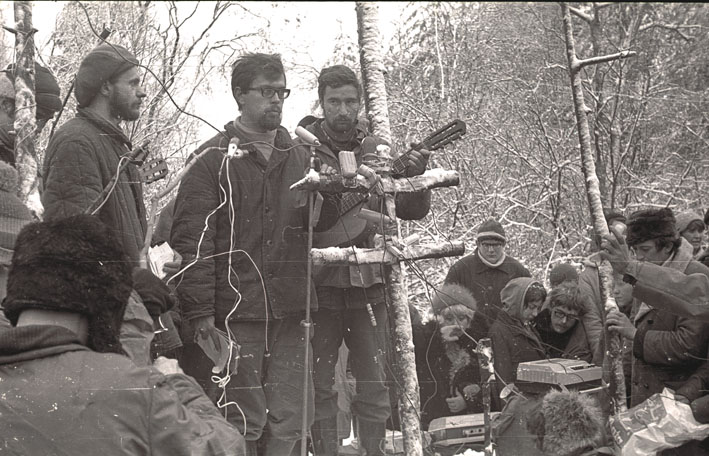
Abramkin (1947-2011), bearded and with spectacles
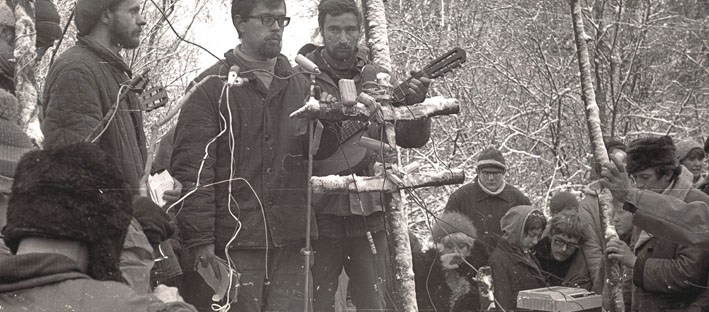
In his student years and afterwards Abramkin was a member and organizer of the Moscow Unofficial Song Club (USC), where he performed as part of a small group at USC gatherings and ‘consciousness-raising outings’ [agitpokhody]. They presented compositions based on documents and works of literature (Pasternak, Kharms, Galich’s long poem Kaddish).
In 1975 the USC, whose numbers had increased to several thousand, broke up into ‘groups’; meetings of these groups were organized, out of which appeared (independently of the USC) the ‘Sundays’ — meetings of creative young people in the woods (CCE 41.13, CCE 42.9 [16]). Here Valery and his group performed sketches (Radishchev; ‘City of the Sun’ after Campanella) and programmes they had written themselves (‘The Man with the Kerosene Lamp’, ‘The Horse’).
Out of the materials of these meetings the almanac Sunday was created. Valery was one of its authors (‘Notes on the Other Side of the Page’, the cycle of stories ‘The Little House on its own’ and articles on the work of Kharms and Vvedensky). In addition, Abramkin published the samizdat collection Selected Works of Daniil Kharms [4].
On 30 April 1976 Abramkin was warned that he would be sacked from his job if the ‘Sundays’ continued (CCE 42.9 [16]); in September he was searched in Blue Bay by the Tuapse department of the KGB (when on holiday), presented with the decree and warned that he might be charged with ‘anti-social activities’ (CCE 42.3, CCE 43.14 & CCE 44.27); and in October 1976 he was sacked, despite the fact that he had not finished an important project (CCE 43.14).
Forced thus to abandon science under pressure of the KGB, from he worked as a worker on a geophysical expedition, in a team of builders, clearing woods, as a stoker and as a caretaker in a church. From 1978 Valery Abramkin was one of the founders and editors of the journal Poiski.
[See two letters written by Abramkin in prison, dated 5 & 8 October, CCE 58.8-2.]
====================================
NOTES
On Abramkin and Poiski, see CCE Contents 16.1, “Social Issues, Veche, Poiski, Obshchina (1969-1980)”.
*
- According to Kronid Lyubarsky’s list of Soviet prisoners (CCE 46.23-2), Abramkin was born on 19 May 1947.
↩︎ - ‘Balthazar’s Feasts’ is a chapter from a short novel by Soviet (Abkhazian) writer Fazil Iskander, Sandro from Chegem (Ann Arbor, 1979).
↩︎ - Official assessors of Poiski and its contents (see CCE 58.7-1).
↩︎ - Poet, writer and dramatist Daniil Kharms (1905-1942) has since been recognised as a unique voice in Russian literature. He was barely published in the Soviet period.
↩︎
=============================
 A Chronicle of Current Events