An excerpt from the judgement, 24 January 1979, of the Judicial Board (USSR Supreme Court) for Criminal Cases: see “Explosions in Moscow” (CCE 44.16) and “The Metro Explosion Trial” (CCE 52.1).
***
The Court was presided over by E.A. Smolentsev, Vice-Chairman of the USSR Supreme Court, with People’s Assessors of the USSR Supreme Court V.V. Fanardzhyan and K.A. Amosov, in the presence of secretaries Yu.V. Vinogradov, T.I. Poshurenko and Yu.V. llyn.
Senior Councillor of Justice S.A. Zakharov, a Procurator from a department of the USSR Procurator-General’s Office, was the prosecutor; defence lawyers G.A. Matevosyan, I.A. Isagulov and A.L. Melkonyan, were members of the Armenian Republican Bar; and interpreters R.Kh. Avetinyan and G.V. Vardanyan and G.T. Tumanyan.
*
“Having examined in open court” the criminal case against:
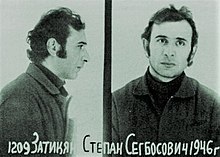
- Stepan Segobovich ZATIKYAN (b. 20 June 1946) […],
- Akop Vazgenovich STEPANYAN (b. 1 January 1947) […] prior to his arrest employed as an electric welder in mobile mechanical unit No. 14 of Glavarmvodstroi […], and
- Zaven Melkonovidi BAGDASARYAN (b. 12 November 1954) […] secondary education, did not work prior to his arrest;
who were all charged with committing a crime under Articles 68 (“Sabotage or subversive activity”) and 72 (“Organisational activities to commit especially dangerous State crimes”) of the RSFSR Criminal Code,
the Court established that
- Zatikyan, after release in 1972 from his term of imprisonment (see CCE 27.12 [4]) for his part in setting up the anti-Soviet nationalist organization “The National United Party” (NUP), continued his struggle against the Soviet State by committing acts of diversion. He carried out his criminal intention in 1972, when he secretly renewed contact with his former NUP accomplices, whom he incited to struggle against the Soviet regime and induced to turn to activities of a more hostile nature.
- In the summer of 1976 Zatikyan involved Stepanyan and Bagdasaryan in this anti-Soviet group, set up especially to perpetrate diversionary operations with the aim of weakening the Soviet State, and instructed them to obtain explosives, detonators and other objects required for producing explosive devices (bombs) …
- At the end of December 1976 Zatikyan and Stepanyan produced three working explosive devices which Stepanyan and Bagdasaryan took to Moscow on 4 January 1977, to set off in public places for the purpose of wounding people and creating the impression that there exist in the USSR organized forces fighting against the Soviet regime, Stepanyan and Bagdasaryan caused three explosions in Moscow on 8 January 1977.
As a result of the explosions seven people were killed and 37 wounded with varying degrees of severity.
*
Zatikyan and Stepanyan continued their subversive activities; in August and September 1977 they produced and tested two experimental explosive devices. Later they produced three working explosive devices, using gunpowder. On 26 October Stepanyan and Bagdasaryan took these three bombs to Moscow with instructions from Zatikyan to explode them in public places. However, they did not succeed …
The accused Zatikyan pleaded not guilty and during his trial refused to testify on the substance of the charges brought against him, declaring his hatred for the Soviet State and the existing system.
The accused Stepanyan and Bagdasaryan confirmed the evidence they had given during the investigation and gave in court a detailed account of the diversionary actions in Moscow they had prepared and committed […]
Having investigated the materials of the case, the USSR Supreme Court’s Judicial Board for Criminal Cases pronounces the accused Zatikyan, Stepanyan and Bagdasaryan guilty of the above-mentioned crimes, on the strength of the whole range of evidence in the case files.
*
WITNESSES
Witnesses V. P. Saratikyan, S. L. Manukyan and R. M. Oganesyan, former members of the NUP youth organization, testified in court that after Zatikyan returned from prison in 1972 he tried to persuade them to renew their hostile activities.
At the same time, he stressed that the previous methods of anti-Soviet activity (circulating nationalist leaflets) were inadequate, and that to fight the Soviet State it was essential to use diversionary-terroristic means. He suggested making bombs and obtaining guns.
In this connection witness R. M. Oganesyan in particular testified that after Zatikyan returned from prison, he had definite extremist intentions: at one of their meetings in 1972 he suggested that someone in the group begin to specialize in producing explosive devices.
The evidence given by Stepanyan and Bagdasaryan and an analysis of the other evidence show that the accused began preparing for their subversive activities by acquiring the necessary materials, assembling test models and setting off experimental explosions.
*
ZATIKYAN
Zatikyan worked out the construction of an explosive device. In a search of his home a sheet of paper containing diagrams, figures and notes in Armenian was confiscated.
The report of a technical forensic team concluded that on one sheet of paper was drawn a diagram of the electric circuit of a home-made explosive device, and that it was in accordance with this diagram that the explosive devices were assembled which were detonated on 8 January 1977 and discovered on 29 October of the same year. The results of a forensic graphological examination show that the figures and notes on the sheet in question were made by Zatikyan.
The accused Zatikyan, after admitting during the pre-trial investigation to his part in producing the bombs, testified under interrogation on 12 January 1978:
“I wish to state truthfully what I am guilty of, and to request the investigating agencies to release from custody all those who have been arrested in connection with the case, except for myself, Akop Stepanyan and Zaven Bagdasaryan: only the three of us are guilty of preparing the explosions in Moscow, which were to have been set off in October 1977.
“As for the explosive devices which were found, it was I who produced them. Stepanyan’s part in producing them was insignificant.
“I myself was a radio buff, and I have some knowledge of other fields of technology as I studied at a polytechnic institute for four years and read literature on explosives. It was this knowledge which enabled me to produce explosive devices.”
In an interrogation on 18 January 1978 Zatikyan confirmed this statement:
“No, I did not make a mistake: I was telling the truth when I said that I produced explosive devices with the help of Akop Stepanyan […]
“If you like, I am proud that I helped to produce explosive devices and intended to explode them in Moscow”.
In an interrogation on 31 January 1978 Zatikyan said, regarding his motives for producing explosive devices for the purpose of diversionary actions:
“I will not hide the fact that I do not recognize the Soviet Union as a State, or the existing system […] My actions in connection with producing explosive devices with the intention of exploding them in Moscow are one of the ways of fighting the system which exists in the Soviet Union.”
Stepanyan admitted that, under Zatikyan’s instructions, in July 1976 he obtained, from a person whose identity has not been ascertained by the investigation, over 20 electric detonators, capsule detonators and several kilograms of explosives (ammonites 6 ZhV) and made four cases for explosive devices from sections of metal pipe.
The explosives left over from production in 1976, and some of the electric detonators, were passed on by Stepanyan to his cousin A. A. Muradyan for safe-keeping.
The witness A. A. Muradyan, when questioned on this subject, confirmed the above and testified that he did in fact conceal the explosives and electronic detonators in his home.
In a search of Stepanyan’s flat two electric detonators, a capsule detonator and four unused cases for explosive devices, which he had made, were found.
Stepanyan recounted in detail how he had acquired metal containers, batteries, watches, insulation tape and other items necessary for the production of explosive devices.
Bagdasaryan admitted that in the summer of 1976 he took three to five kilograms of ammoniac saltpetre from his parents and gave it to Stepanyan to be used as explosive. In autumn 1976, he attempted to obtain electric detonators through K. V. Adamyan, and at the Yerevan machine-tool factory he drilled holes in eight metal disc-shaped objects according to a pattern given to him by Zatikyan, produced nine more components called detonators by Zatikyan, and obtained a certain number of screws. He gave all the items listed above to Zatikyan and Stepanyan.
The witness Adamyan confirmed that Bagdasaryan did in fact ask him to obtain electric detonators and gave him 7 or 8 roubles for this purpose.
The witness O. S. Termendzhyan, a worker, […] helped drill the holes […]
The accused Stepanyan and Bagdasaryan admitted to taking part in test explosions and recounted in detail how Zatikyan and Stepanyan, as they obtained the explosives, assembled, then tested three experimental home-made bombs in September and October 1976.
The witness A. A. Muradyan, who was present when the first and second explosive devices were tested, testified that the above-mentioned experiments did in fact take place. One of the experiments ended with an explosion being set off by Zatikyan, Stepanyan and Bagdasaryan. After experimentally exploding bombs, Zatikyan and Stepanyan produced three working explosive devices in December 1976, Stepanyan admitted to helping to produce them, white Bagdasaryan testified that he had been told by Zatikyan and Stepanyan that these devices were being made, which he, Bagdasaryan, and Stepanyan subsequently exploded in Moscow on 8 January 1977.
There is other evidence to corroborate the fact that Zatikyan and Stepanyan produced working explosive devices.
Investigations by the relevant experts show that:
- Deformed watch parts found on the site of the explosion belong to Pobeda men’s wrist-watches and a Slava alarm clock, i.e. the same types that Stepanyan testified to having obtained.
- A brass plate welded to the hand of a Slava alarm clock — it was found in the underground railway carriage where the bomb exploded — is identical in chemical composition and thickness to a metal plate found in a search of Stepanyan’s flat.
- The tumblers and electric batteries used in the exploded bombs are identical to the tumblers confiscated in a search of Zatikyan’s home, and to two tumblers and the electric batteries confiscated from Stepanyan.
- Fragments of cambrics, pipe and lilac-grey insulation tape, metal studs and other items found on the site of the explosion were ascertained on examination to be of identical characteristics and description to corresponding objects and components confiscated during searches of the homes of Zatikyan and Stepanyan.
*
STEPANYAN & BAGDASARYAN
Stepanyan and Bagdasaryan pleaded guilty and described their trip to Moscow at the beginning of January 1977 on Zatikyan’s instructions, and their detonation of the bombs. There is other proof of their trip to Moscow at this time.
The witness A.A. Muradyan testified that from 2 to 4 January 1977, at Stepanyan’s request, he concealed in his home a bag containing an explosive device, which, according to Stepanyan, was to be used to set off explosions in Moscow. On 4 January 1977 he gave the bag to Stepanyan before he left for Moscow.
The witnesses V.T. and L.I. Yefremov confirmed the fact that Stepanyan and Bagdasaryan travelled in the same railway carriage as they from Moscow to Yerevan on 9 January 1977.
The accused do not deny the fact that Zatikyan and Stepanyan assembled explosive devices for the purpose of organizing subversive acts in Moscow in October 1977.
In their account of their trip to Moscow for this purpose, Stepanyan and Bagdasaryan testified that they were unable to carry out their criminal intentions because they suspected they were being watched by officials of the security agencies. After leaving the bag of explosive devices […] they hid, then took a train to Yerevan, and were arrested on the journey.
There is other evidence to corroborate the fact that the accused were involved in assembling explosive devices. Examination by a commission of experts of the explosive devices found on 30 October 1977 and material evidence confiscated during searches of Zatikyan’s and Bagdasaryan’s homes shows that:
The electric circuits of the explosive devices were assembled according to the diagram on the sheet of paper confiscated during the search of Zatikyan’s flat. The various layouts of clocks, tumblers and electric light bulbs on the cardboard bottoms of the explosive devices correspond, furthermore, to the assembly design drawn by Zatikyan on the same sheet of paper.
On the inner surface of a Zima watch used in one of the explosive devices, a print of Zatikyan’s left middle finger was found. On one of the sheets of paper and on a plastic bag found in the travelling-bag containing the explosive devices, prints of Zatikyan’s left palm, little finger and ring finger were found.
Various objects and components used in assembling the explosive devices, such as cambrics, tumblers, metal discs, bronze and brass plates, were found on examination to be of identical chemical properties, external description and other characteristics, to the objects and components confiscated in searches of Zatikyan’s and Stepanyan’s flats.
In particular, the cambrics from the explosive devices have identical properties, superficial microstructure and diameter to four cambrics confiscated from Zatikyan. In addition, a fragment of cambric 2.8 mm by 13 mm from the explosive device, and a fragment of cambric of the same diameter 160 mm long confiscated from Zatikyan, once formed a single piece.
A many-sided criminological […] examination of the material evidence found on the sites of the explosions set off on 8 January 1977 in Moscow, and of the explosive devices found on 30 October 1977, shows that all the explosive devices, both those set off on 8 January 1977 and those found on 30 October 1977, were produced either by the same group of people, or by the same person.
It has thus been established, on the strength of all the evidence verified in court, that Zatikyan as leader, and Stepanyan and Bagdasaryan as members of an anti-Soviet organization whose purpose was to commit especially dangerous crimes against the State, committed diversionary acts in Moscow […] The cost of the damage […] to the Moscow Metropolitan Railway Administration was assessed as 23,649 roubles 13 kopecks, and to the Bauman District Food Centre (Moscow) 2,940 roubles 41 kopecks. The acts committed by the accused, therefore, come under Articles 68 and 72 of the RSFSR Criminal Code.
[…] In addition, regarding Zatikyan, taking into consideration his earlier conviction for committing an especially dangerous crime against the State […]
Court costs to the amount of 3,900 roubles […]
The material evidence — explosives, detonators and fragments of an urn from the site of the explosion on 25th October Street — is to be destroyed; the remaining material evidence is to be kept with the case file […]
***
Supplement to the Bill of Indictment in Criminal Case No. 197
INFORMATION
(1) Criminal proceedings
were instigated on 8 January 1977 by the USSR KGB Administration for the Moscow City and Region. Proceedings were begun by the Investigation Department of the USSR KGB on 14 November 1977.
(2) The pre-trial investigation
concluded on 16 October 1978.
(3) The accused were held in custody
Zatikyan, from 4 November 1977; Stepanyan, from 1 November 1977; Bagdasaryan, from 1 November 1977. All three were held in the Investigations Prison of the USSR KGB [Lefortovo].
(4) Charges were brought
against Zatikyan, on 14 November 1977 and 18 August 1978;
against Stepanyan, on 10 November 1977 and 24 August 1978; and
against Bagdasaryan, on 10 November 1977 and 21 August 1978.
(5) Material evidence in the case
A.
Filed as evidence with the case:
- Objects found in the home of the accused Zatikyan; a sheet of paper bearing a diagram of an electric explosive circuit for a homemade explosive device and an assembly design for the positioning of the circuit’s components on the shell of the explosive devices; three related sheets of paper; a diagram of the Moscow Metropolitan and three maps showing the routes of the Moscow passenger transport system;
- Objects found in the home of the accused Stepanyan: a diagram of the Moscow Metropolitan lines;
B.
Kept in connection with the case:
- Objects found on the site of the explosion of 8 January 1977 in the Metropolitan railway carriage: fragments of an electric light bulb, fragments of an electric battery, part of a tumbler lever, sections of wire, part of an electric detonator, pieces of cambric and electric insulation tape, parts of a Slava alarm clock, metal pins, a screw, fragments of cast iron pipe, and pieces of an imitation leather bag;
- Objects found on the site of the explosion of 8 January 1977 in Shop No. 15 on 25th October Street in Moscow: fragments of cast iron pipe, pieces of an electric detonator, tumbler components, metal pins, screws, parts of a ‘Pobeda’ wrist-watch and pieces of a cloth bag;
- Objects found on the site of the explosion of 8 January 1977 outside Shop No. 5 on 25th October Street, Moscow: parts of an electric detonator, a metal mantle from an electric battery, a piece of electric insulation tape, a metal pin, fragments of cast iron pipe and parts of a Pobeda wrist-watch […];
- Objects found on 30 October 1977 at Kursk [Metro] Station, Moscow: three home-made explosive devices, three plastic bags, a mesh bag and a sheet of paper;
- Objects found at the home of the accused Zatikyan: 54 metal pins, three screws, 12 metal discs, six tumblers, four fragments of cambric, four pieces of wire and a hank of wire, 11 electric light bulbs, solder, pieces of vulcanized rubber, two brass plates, sheets and pieces of cardboard, electric insulation tape, two candles and pieces of paraffin wax, three electric soldering irons, a small plastic bag;
- Objects found in the home of the accused Stepanyan: a metal disc, four screws, two hanks of wire, solder, tumblers, electric insulation tape, a piece of wire, two bronze plates and a plate of a brasslike alloy, 11 electric light bulbs, two electric batteries, gunpowder, candles, four metal welded cases for explosive devices, an electric soldering iron;
- Objects found in the home of the witness A. A. Muradyan: three electric batteries;
- Objects found on the sites of the experimental explosion: nine steel fragments, a fragment of cast iron, remains of an electric detonator, two fragments of newspaper.
C.
The following are being kept in the material evidence room of the USSR KGB’s Investigations Department:
- […]Electric detonators and explosives from an explosive device found on 30 October at the Kursk Station, Moscow, a travel-bag, a sweater (or shirt), a cap with ear-flaps and gloves belonging to the accused Stepanyan;
- Objects found in the home of the accused Stepanyan: two electric detonators, a capsule detonator, the trousers of a track suit, an electric motor, and also an abrasive stone handed in by the witness R. M. Muradyan.
(6) Other objects filed with the case:
- A sample of shopping bag […] ;
- A sample of steel pipe […] ;
- models of explosive devices […] ;
- a camping rucksack and a folding shovel, confiscated from the accused Stepanyan and used by the accused when they were setting off experimental explosions; a travel-bag […]
*
7. Six hunting knives confiscated from witness G.Kh. Ambartsumyan, and a hunting knife confiscated from the accused Stepanyan as having been obtained without the required permission.
8. The property of the accused is not subject to confiscation.
9. In connection with the case the following civil claims are recognised:
- T.K. Gainutdinov, 465 roubles
- L.P. Erokhina, 309 roubles
- R.I. Slepchenkova (Lyakhova), 158 roubles
- N.V. Tishchenkova (Karachevtseva), 1,098 roubles
- N.M. Tukhvatulina, 373 roubles and
- R.D. Shapiro (?).
10. The following were acknowledged as victims:
[…] D.V. Tyuzhin, V.P. Tyuzhina, L.D. Tyuzhina […]
[11.] …
12. The following criminal cases have been separated from the present case:
- the case of V.P. and M.P. Saratikyan (Vol. 61, pp 10-16) and A.A. Muradyan (Vol. 61, pp. 17-21),
- as well as the materials on V.N. Vvedensky, A.Yu. Sluchevsky, M.N. Khomutetsky and A.V. Galayev.
=======================================
Stepan Zatikyan (1946-1979)
===================
 A Chronicle of Current Events