
[1]
THE TRIAL OF ROMUALDAS RAGAISIS
Romualdas Ragaisis (b. 1942) was arrested on 9 January 1979 (CCE 52.10).
The investigation went on for half a year. Ragaisis was under arrest all this time. Despite his mother’s pleas, he was not allowed out to attend the funeral of his father, who died a month after Romualdas’s arrest. (Afterwards Ragaisis’s mother was told that the order permitting her son to attend the funeral had been ‘delayed’.)
*
On 9 July the court, with Ivanauskas presiding, began to examine the case of Ragaisis, who was charged with speculation . Procurator Jakuicis acted as prosecutor at the trial, the defence counsel was the Moscow lawyer Viktorovich. The trial was open.
The charge against Ragaisis was that he had bought lenses for spectacles, framed them and sold the spectacles at speculative prices, and also that he had re-sold lenses and frames at speculative prices (Ragaisis is a qualified optician). According to the indictment, Ragaisis had made a profit of 326 roubles 59 kopecks in this way over five years.
The witnesses questioned did not support the charges.
Witness Vitkaukas denied that Ragaisis had bought 70 frames from him. The witness Kalk refused to confirm testimony he had given during the pre-trial investigation that Ragaisis had bought a large number of lenses from him.
Investigator Benetis put only one question to the expert witness; did the dioptrics of lenses confiscated from Ragaisis fit the standard dioptrics required for lenses which were on sale? In the courtroom expert witness Simkuniene replied in the affirmative to this question. However, when Ragaisis asked her; ‘What material are the lenses made of?’, she replied that most of them were made of cinescopic glass (so that they could not have been on sale and the charge of speculation was invalidated).
On 10 July the court declared that elements of private enterprise were discernible in the activities of Ragaisis and ordered a new expert examination to take place (at the Procurator’s request) and sent the case back for further investigation.
*
Rimaitis Matulis, a senior researcher at the Lithuanian SSR Museum of History and Ethnography, was reprimanded ‘for infringing the disciplinary regulations’ because he had attended the trial of Ragaisis. Matulis handed in a complaint and the reprimand was withdrawn.
Sometime later Matulis received another reprimand ‘for neglecting his work’. He complained again and the trade union committee declared that the reprimand was unjust; but the Director of the Museum, A. Jankeviciene, refused to withdraw it (her husband is a KGB colonel; she herself searches the writing-desks of her colleagues).
On 9 July Zita Vanagaite, Senior Architect at the Institute for the Conservation of Monuments, was present at the trial of Ragaisis. On 10 July she was suddenly sent on an assignment out of town.
A senior researcher at the ‘Thermos-Isolation’ Institute, Birute Burauskaite was reprimanded ‘for infringing the disciplinary regulations’ because she had helped Ragaisis’s wife to travel to Moscow to find a lawyer. Sometime later she received a rebuke for being away from work for half an hour. Eight of her fellow-workers confirmed in writing that she had not been absent at the time indicated.
*
On 12 September the new hearing of the Ragaisis case began. The charge remained the same (although there were a few changes in it: for example, that he had bought 41 frames, not 70, with the intention of selling them).
As at the first hearing, the witnesses did not support the charges. Mrs Karoliene, manageress of the ‘Optika’ shop, stated that Ragaisis had bought only two frames from her, not 41. The judge found it necessary to comment on this testimony by saying: ‘He could have bought more frames in another shop.’ Kalk, who had confirmed his previous testimony about Ragaisis purchasing lenses during the new investigation, again repudiated it in court. Ragaisis’s clients insisted that the prices for which they had bought spectacles from him could not be described as ‘speculative’. Ragaisis himself refused to plead guilty, as he had refused in July. He explained that he had sometimes accepted private orders — this was normal practice among all qualified opticians, but though he had bought the frames in a shop, he had made the lenses himself.
Some of the lenses confiscated from Ragaisis were acknowledged certainly to be standard models by the experts. Ragaisis explained the existence of some standard lenses by saying that during the liquidation of the workshop where he had been employed, some lenses must have remained unclaimed.
The prosecutor asked that Ragaisis be sentenced to three-and-a-half years’ imprisonment. The defence counsel said that there had been no proof that Ragaisis was guilty of speculation. His client had sometimes accepted private orders, for which he had received 81 roubles in four-and-a-half years. The defence counsel asked that Ragaisis be found not guilty.
On 14 September the verdict was announced. The court found Ragaisis guilty of speculation. The sum of money he had obtained was not mentioned in the verdict, but a summing-up of separate episodes made a total of 80 roubles’ ‘gain’. Ragaisis was sentenced to one-and- a-half years in camps.
The appeal hearing confirmed the sentence of the district court.
*
In 1961-1965 Ragaisis spent four years in the Mordovian camps for nationalist activity. For refusing to give evidence at the trial of Petkus (CCE 50.5) he was sentenced to six months corrective labour (CCE 52.10).
*
[2]
THE CASE OF ANGELE RAMANAUSKAITE
On 20 July Angele Ramanauskaite, a 23-year-old laboratory assistant at Kaunas Training College for Economists, was detained by police in the village of Giry, Belorussian SSR.
She had come there on 17 July, as she explained, to collect folklore and material for an academic dictionary of the Lithuanian language from the Lithuanians living in these areas (there are many archaisms in the speech of Lithuanians living in Belorussia which have not survived in Lithuania itself).
The police, accompanied by district Procurator Abramovich, deputies and teachers, turned up at the house of the teacher Luksas, where Ramanauskaite was staying. At the time, Angele was talking to the local children, going over Lithuanian songs with them, reading them stories and talking to them about religion, among other things.
The intruders asked her to produce her documents (Ramanauskaite did not have them with her), searched her belongings, confiscated religious literature and questioned the children. Then Angele was taken to Ostrovets (the district centre) to establish her identity.
Ramanauskaite was detained at the police station in Ostrovets until 26 July. On 24 July Procurator Abramovich made out a criminal case against her on a charge of organizing the religious teaching of children (Article 139, pt. 1, Belorussian SSR Criminal Code = Article 142, pt. 1, RSFSR Code). Ramanauskaite was interrogated: they were particularly interested in who had sent her to Belorussia and which students had travelled round the Lithuanian villages with her. The Procurator stated that Lithuanian was dying out in these places and was not needed by the inhabitants. ‘Let the students collect their folklore in Lithuania itself’, he said. ‘On this pretext they’re bringing bourgeois nationalism and religious prejudices here’,
From 26 July to 18 August Ramanauskaite was held in a special detention centre in the town of Lida. On 18 August Investigator Bobrov, having finally checked out Ramanauskaite’s identity, released her after she had given a signed promise to attend the trial. He kept the things confiscated at the time of her arrest (including the folklore material she had collected). Bobrov also refused to confirm in writing the fact that she had been detained.
The Ramanauskaite case was heard on 18 September in Ostrovets Town Court. The Judge was Khalko, the prosecutor was Abramovich. Ramanauskaite refused the services of a defence counsel. The trial was conducted in Belorussian; an interpreter was provided for Angele.
The accused denied that she had intended to organize systematic classes in the Catholic religion for children in Girjos. She insisted that she had come to Belorussia to collect folklore.
The witnesses (the house-owner Luksas and pupils from the local school) confirmed that on 18, 19 and 20 July Ramanauskaite had talked about religion and read out prayers. The ‘material evidence’ was presented: a catechism and a book entitled Our Father, which had been confiscated from Angele.
The prosecutor asked for the sentence to be limited to a fine of 50 roubles, taking into account a positive reference on Ramanauskaite’s work and the fact that it was her first offence.
The court granted the prosecutor’s request.
*
[3]
THE STORY OF DANA KELMELIENE’S ILLNESS
On 28 June in the town of Varena, a case was to be heard concerning the motor accident in which the allegedly guilty party was Father Tamkevičius, a member of the Catholic Committee for the Defence of Believers’ Rights.
Religious believers filled the courtroom; many gathered outside the court-house. However, they were told that the trial had been put off. (Later, in the autumn, the court found the other driver guilty of the accident.)
*
The police began to disperse the crowd. While this was going on, Dana Kelmeliene, who had come to the trial from Vilkaviskis, was detained and beaten up.
After the beating, she was questioned about the reasons for her visit and put in the Preliminary Detention Cells for 15 days. Two days later, however, she was released — because of her grave state of health. When she returned to Vilkaviskis, Kelmeliene went to the town hospital. Dr Yeliseyev diagnosed severe concussion of the brain, admitted that Kelmeliene should have hospital treatment, but refused to hospitalize her. Yeliseyev explained that he could not write in her medical record the reason for her illness — the beating by the policemen and KGB officials.
Kelmeliene nevertheless managed to get a hospital place in the town of Kazlu Ruda, from which she was transferred to the sanatorium in Valkininkai.
On 25 July an official from the Varena Procuracy came to question Kelmeliene. The doctors would not allow the patient to be interrogated because she was in a serious condition. Germaniskas, a doctor from Vilnius, who went to the sanatorium at the Procurator’s request, supported Yeliseyev’s diagnosis. The next day a new commission, also from Vilnius, arrived at the sanatorium. This commission declared Kelmeliene to be healthy, after which she was quickly discharged.
*
[4]
AFTER THE STATEMENT BY 554 PRIESTS
As already reported (CCE 53.23), 554 Catholic priests in Lithuania signed a statement declaring their refusal to observe the ’Statute on Religious Associations’, which contradicts the norms of church life and the canons of the Roman Catholic Church.
In particular, the priests declared that they would run their own parishes: according to the Statute, religious congregations are run by a church committee — formally speaking elected — and its chairman. They also emphasized that they would ignore the ban on religious education of children and adolescents.
*
After the death of J. Tarulis, Chairman of the Daugailiai Church Committee, a meeting of Committee members on 6 May unanimously elected Father Petras Baltuska, Rector of the church, as the new chairman.
The local authorities declared that a ‘servant of the cult’ could not be chairman of the Committee. On 30 May Baltuska was summoned to the district centre (the town of Utena) by the Deputy Chairman of the district Soviet executive committee, J. Labanauskas; also present in his office were Talmantas, the Chairman of the executive committee, and district Procurator F. Levulis. Baltuska was asked to sign a statement warning him that he was subject to criminal prosecution for summoning a meeting of the Church Committee without the permission of the authorities, and for allowing a priest to be elected to an administrative post. The priest refused to sign the warning, basing this decision on the law separating Church and State.
Afterwards the executive committee tried on a number of occasions to call a meeting of the believers, but the attempts failed — nobody came to the meetings.
*
In the same district, the Chairman of the Church Committee of Kirdiaikiai parish, Kinduris, himself resigned from his post.
On 9 May a meeting of Committee members accepted Kinduris’s resignation and elected the Rector, Father Petras Krazauskas, as the new chairman. On 13 May the same Labanauskas called a meeting of believers and suggested they should elect a new church committee. Despite the fact that most of the parishioners left the hall after this, a new committee was then chosen, the choice being directed by Labanauskas. 267 parishioners of Kirdiaikiai sent a complaint about this to the Catholic Committee for the Defence of Believers’ Rights.
*
On 15 June the church in Josvainiai was visited by: S. Sereikis, chairman of the district soviet executive committee, V. Rakickas headmaster of the Josvainiai Middle School and A. Laurinavicius, chairman of the Jaunaste collective farm. They made a list of the children in the church and drew up a statement charging Father L. Kalinauskas with violating the laws on religious observance. Kalinauskas refused to sign the statement.
On 25 June A. Juskevicius, chairman of the Kedainiai district soviet executive committee, summoned Kalinauskas to see him and accused him of breaking the law on religious cults. Kalinauskas replied that the law was contrary to the commandments of God and the precepts of humanity, so he was refusing to observe it. He was threatened with a fine and even with administrative arrest.
On 17 July Kalinauskas was sent a summons by the Deputy Procurator of Kedainiai, R. Gorgas. “On this occasion,” Father L. Kalinauskas wrote in a statement to Bishop L. Povilonis, “the Soviet Procuracy defended me from the unjust fury of the godless authorities. The case was closed.” The Procurator told him: “Those times are past, he [Juskevicius] has exceeded his authority.”
*
[5]
TAMKEVICIUS AND SVARINSKAS ARE WARNED
On 29 August Father Tamkevičius, a member of the Catholic Committee for the Defence of Believers’ Rights, was summoned to the Procuracy of the Lithuanian SSR.
There J. Bakucionis (CCE 50.5, CCE 51.14), Senior Assistant Procurator of the Lithuanian SSR, officially warned Tamkevičius against violating Article 68 (Lithuanian SSR Criminal Code: “Anti-Soviet Agitation & Propaganda”). The accusations against Tamkevičius [1] concerned his sermons which, according to the warning, included deliberately false fabrications slandering Soviet reality. In addition, Tamkevičius was accused of being one of the founders and members of the ‘illegal’ Catholic Committee (illegal as it was unregistered, explained Bakucionis). His third crime was inciting believers to break Soviet laws — this was a reference to their behaviour at the hearing of the traffic accident (see above). Tamkevičius wholly rejected the charges against him and refused to sign the text of the warning.
On 3 September A. Novikov, Deputy Procurator of the Lithuanian SSR, read a similar warning to another member of the Catholic Committee, Father Svarinskas. Svarinskas also refused to sign the warning.
On 5 September the official newspaper Tiesa [Truth] published a short report issued by the Lithuanian news agency ELTA, stating that Svarinskas and Tamkevičius had received official warnings. The report briefly repeated the basic accusations against the priests. On 6 September the report was reprinted in Valstiedu Laikrastis [The Agricultural Workers’ Gazette] and the Raseiniai district paper Naujas Rytas [New Morning].
On 6 September Tamkevičius sent an ‘Open Letter’ to the Procurator of the Lithuanian SSR, in which he categorically refused to admit that the actions of which he was accused were crimes and sharply attacked the ‘atheists’, accusing them of systematically infringing the rights of the Church and Catholic believers. On 1 October Svarinskas wrote and sent off a similar letter.
The parishioners of Tamkevičius and Svarinskas have come to the defence of their priests. Letters supporting them have been signed by Catholics from the parishes of Kybartai, Simnas and Prienai (2,150 signatures in all).
*
[6]
ARRESTS, SEARCHES, INTERROGATIONS
On 5 August Stase Baltrusaite was detained in the town of Silale, while she was collecting signatures in the local churchyard for an appeal to the Soviet government. The appeal asks for the return to the believers of the Catholic Church of the Mother of God in Klaipeda, which was confiscated over 15 years ago.
Baltrusaite was interrogated by Alisauskas, head of the local KGB. He threatened her and tried to persuade her to become an informer; three copies of the petition (with signatures) were confiscated from her. After nine hours Baltrusaite was released.
Baltrusaite sent a protest to the Procurator of the Lithuanian SSR; she sent a copy to the Catholic Committee for the Defence of Believers’ Rights.
*
On 6 August there was a search at the home of Virginija Vosiulaite, an employee of the Thermo-Insulation Institute in Vilnius. The material confiscated included a typewriter, some religious books, documents, articles and poems in the handwriting of the late Mindaugas Tamonis (1940-1975; CCE 38.19 [8], CCE 39.8).
After the search Vosiulaite was detained; for three days she was interrogated in a KGB Investigations Prison. The interrogation was carried out by Major J. Markevičius, a KGB Investigator for Specially Important Cases. Vosiulaite stated that the typewriter belonged to her; she refused to say who had given her the books and paper. The interrogation was conducted in an emphatically polite and correct manner. On 9 August a search was carried out at Vosiulaite’s place of work. In the middle of August Jonas Vosiulis, Virginija’s 75-year-old father, was summoned to Vilnius from Kaunas. He was questioned about bis daughter [correction CCE 56.30].
*
In September, KGB officials carried out a search at the work-place of Algis Patackas, a research worker at the Institute of Chemistry (CCE 43.18). Patackas was a friend of the late Mindaugas Tamonis. After the search he and Juozas Prapiestis, a senior research associate of the Thermo-Insulation Institute, were interrogated.
In all the above cases the KGB officials referred to ‘Case No. 58’. As far as could be understood, this case concerns the dissemination of Lithuanian samizdat.
*
On 8 August — also in connection with Case No, 58 — the KGB carried out two searches in Kaunas.
Major Raudys, Captain Stankevičius and Senior Lieutenant Rainis searched the flat of Liucija Kulvetite, a laboratory assistant at the Inkaras rubber manufacturing works. Objects confiscated included the journal Ausrele (CCE 49.20 [9]), Kulvetite’s private memoirs and a large number of typewritten articles with editorial corrections on them.
The second search was at the home of Vitalija Zvikaite, an engineer and technologist at the same factory. The search was conducted by Senior Lieutenant Matulevicius. The material confiscated included: a typewriter; a number of books on Lithuanian history and culture; the journals LCC Chronicle (30), Rupintojelis (No. 6), Perspektyvos, and Ausra; and the memoirs of Lithuanian former exiles.
After the search both women were summoned to Vilnius three times, where they were further questioned by Markevičius. He threatened Kulvetite and Zvikaite with arrest. Other employees of the Inkaras factory were also questioned.
*
On 3 October in Vilnius the following were searched in connection with Case No. 58: Julius Sasnauskas (CCE 47.5, CCE 52.10); Lithuanian Helsinki Group member Algirdas Statkevičius; Vladas Sakalys; and Antanas Terleckas [2] . The next day a search was also carried out at the home of A. Statkevicius’s neighbour (his name is not known to the Chronicle).
The following were confiscated from Julius Sasnauskas:
- two typewriters,
- material on the history of the Second World War (documents and articles about the Soviet-German Pact of 1939),
- materials on the Ragaisis trial,
- numerous documents about the movements to defend the rule of law, in Lithuania and the Soviet Union as a whole. The latter included:
- the text of a collective letter on the 40th anniversary of the Soviet-German Pact (this issue CCE 54.23-1),
- a copy of the Chronicle of Current Events, and
- documents by the Lithuanian Helsinki Group.
In addition, two copies of the journal Vytis (CCE 53.31) were confiscated; one was an old issue, the other had only just been prepared for publication.
At the home of Terleckas, manuscripts of articles and a typewriter were confiscated.
An insignia of the Lithuanian Freedom League (CCE 51.14) was discovered in the cellar of the house where Statkevičius lived.
The searches were carried out on the orders of Petkevičius, Chairman of the republic’s KGB.
*
On 11 October the home of A. Paskauskiene (CCE 52.10) in Jurbarkas was searched.
*
[7]
THE ARREST OF ANTANAS TERLECKAS
The following declaration by the Lithuanian Helsinki Group (Document No. 18, dated 2 November 1979) is about the arrest of Terleckas [see note 1, below]:
‘At 12.30 on 30 October 1979 Antanas Terleckas, a well-known Lithuanian fighter for national and human rights was arrested in Vilnius.
‘Two KGB men took A. Terleckas away from the film-studio storehouse where he was working as a porter. The next day, KGB Colonel Kalakauskas told A. Terleckas’s wife that her husband had been arrested, without revealing the charges against him, and advised her to apply to Lieutenant Colonel Markevičius if she had any inquiries. The latter also refused to give the reasons for his arrest.
‘We are convinced that the arrest of Antanas Terleckas is closely linked with the recently observed 40th anniversary of the Molotov-Ribbentrop Pact. This international agreement, directed against humanity, freedom and the independence of nations, was publicly condemned by people of good will in the Soviet Union and throughout the world. Antanas Terleckas was among the 45 Balts who dared to appeal to the governments of certain nations, asking them to nullify the results of the Molotov-Ribbentrop Pact and give the Baltic nations the right to self-determination. The arrest of Antanas Terleckas and the recent searches and interrogations all over Lithuania are the only reaction so far to the above-mentioned Baltic Memorandum …
‘Antanas Terleckas is an honest and decent man. He was not afraid to express his opinion courageously in public, he did not hide his convictions. His only weapon was the word, and he was enabled to use this weapon in the fight by the Final Act of the Helsinki Conference …
‘Members of the Lithuanian Helsinki Group:
Ona Lukauskaite-Poskiene, Eitan Finkelshtein, Father Bronius Laurinavicius, Mecislovas Jurevicius and Algirdas Statkevičius.‘
*
The statement by the Moscow Helsinki Group “A Sharp Intensification of Persecution of the Movement to Defend the Rule of Law in the USSR” (this issue CCE 54.1-3) says:
“Antanas Terleckas has actively participated in the Lithuanian cultural and human rights movement and is a deeply religious Catholic.
“He is well known for his numerous articles on historical, national and human rights themes, which have been published in samizdat, and also for his public statements in defence of people persecuted for ideological reasons, both in Lithuania and beyond its borders. The last statement signed by Terleckas (among other citizens of the Baltic republics) was about the Molotov-Ribbentrop Pact of 1939, which allowed the USSR to occupy the Baltic States.
“KGB officials have more than once told a number of people they interrogated, including Terleckas himself, that they are convinced that he contributes to several samizdat journals, for example to the currently appearing journal Perspectives ([Perspektyvos] 15 issues to date), which covers cultural and socio-political themes [CCE 51.21, CCE 52.10, CCE 53.31].
‘The authorities have been persecuting Terleckas since 1945 [CCE 40.10]. He was first arrested then at the age of 16 on suspicion of participating in the partisan movement. He was beaten up, subjected to a fake firing-squad, then released.
‘In 1957 he was sentenced to four years in the camps on a charge of participation in the so-called ‘Lithuanian National Front’ (Terleckas did not even know his ’fellow-conspirators’).
‘Terleckas was arrested for the third time in 1973 on a charge of theft fabricated by the KGB, and was sentenced to one year’s imprisonment.
‘There have been a number of searches at Terleckas’s home: the last was at the beginning of October this year. He has been subject to preventive detention. The authorities have continually taken measures to isolate him, especially from young people: together with his friend Viktoras Petkus, Terleckas was doing a lot of work in cultural education, teaching people about the history of Lithuania and its heritage.
“Antanas Terleckas believes in the development of the national movement through peaceful means alone, and links this closely with the common task of defending human rights.“
*
In 1954 Terleckas (b. 1928) graduated from the Faculty of Economics at Vilnius University; in 1955 he began post-graduate studies but was unable to conclude them.
After his release in 1961 Terleckas worked as an economist. At the same time he was taking evening courses at the History Faculty of Vilnius University. He was not allowed to defend his thesis, “Lithuania under Russian rule 1795-1915”, which was even examined by the KGB.
After his third term of imprisonment Terleckas did not manage to obtain employment in his specialized field.
========================================
NOTES
- On Tamkevicius, see CCE 32.10, CCE 36.7, CCE 39.8, CCE 44.22, CCE 46.7, CCE 47.5 and Name Index.
↩︎ - On Antanas Terleckas, see CCE 47.5, CCE 48.3, CCE 49.13, CCE 50.5, CCE 52.10 and Name Index.
↩︎
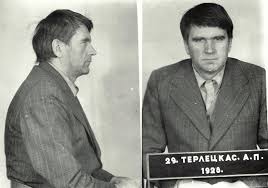
Antanas Terleckas (1928-2023)
===============================
 A Chronicle of Current Events