ELEVEN ITEMS
[1]
THREATS TO SAKHAROV’S FAMILY
In December 1974 Andrei Sakharov received an anonymous letter.
If he did not stop his public activities, threatened members of ‘the Central Committee of the Russian Christian Party’, they would kill “the Yankeleviches, who are known to you, both the older and the younger”, i.e. Sakharov’s son-in-law, Efrem Yankelevich, and his young son (CCE 34.18 [20]). In January 1975 the threat was repeated (CCE 35.11).
In autumn 1975 the KGB attempted to blackmail Efrem Yankelevich’s mother by declaring their intention of accusing him of speculation in books.
*
Now (1976) they are trying to accuse Yankelevich of causing a car accident in a car which he used to drive before spring 1973.
The methods of investigation: forcing the mechanic V. Tomachinsky to testify that the car, which he repaired in 1973, bore marks of an accident, and that, at Efrem’s request, he removed them. Tomachinsky, despite the KGB’s threats to bring a criminal case against him, has not yet given the evidence which the investigation needs.
On 11 June 1976 the Sakharov family called a press conference. In a statement handed to correspondents Yankelevich writes:
“However, I realize that my sentencing under any criminal Article is an enterprise too attractive to the KGB for them to renounce further attempts to accuse me of a car accident, of hooliganism (like Alexander Feldman and Leonid Tymchuk), of taking bribes (like Dr Shtern), of resistance to authorities (like Lev Roitburd), or of rape (like the Tbilisi historian Teimuraz Dzhvarsheishvili)” [1].
In a statement on the subject, A. D. Sakharov reported that during the investigation into the case of Sergei Kovalyov, the investigator, KGB Major Istomin, said: “We shall not interrogate Yankelevich, we don’t want a world-wide fuss about Sakharov’s son-in-law.”
The statement ended:
“The persecution of Yankelevich has three aspects: persecution of him personally, a form of pressure on myself, and an attempt to hinder our common civic activities.”
*
[2]
HARASSMENT OF GINZBURG
MOSCOW. On 2 June Alexander Ginzburg, who was working under contract for A. D. Sakharov, was stopped at the latter’s cottage in the village of Zhukovka and taken to the police station.
There a report was prepared, which stated that Ginzburg was allegedly living in A. D. Sakharov’s cottage and violating residence regulations by doing so. It was suggested that Ginzburg pay a fine. He refused both to sign the report (in view of its nonsensicality) and also to pay the fine.
On 7 June Ginzburg had scarcely arrived at the same cottage when policemen burst into the house and took him off to their station once again. A second report on violation of residence regulations was made, and two men whom Ginzburg saw for the first time testified that he had spent the night in the cottage.
The same day, A. D. Sakharov sent the Barvikhin police station a protest against the “two illegal and unfounded arrests” of A. I. Ginzburg.
The statement ends:
“These actions are a form of persecution not only of Ginzburg, but of me personally.”
*
WALL SLOGANS (3-4)
[3]
‘FREE TVERDOKHLEBOV’
LENINGRAD. On the morning of 6 April, the day when Tverdokhlebov’s trial should have taken place but did not (CCE 40.2), an inscription appeared on the conservatory building, “Freedom for Andrei Tverdokhlebov!”
By evening the inscription had been painted over. The same day a tram drove around Leningrad bearing the inscription “Freedom for Andrei Tverdokhlebov and all political prisoners!”
*
[4]
KALANTA ANNIVERSARY
KLAIPEDA. On 14 June, the anniversary of the self-immolation of Romas Kalanta (CCE 26.11), slogans demanding freedom for Lithuania appeared on the streets of the town, on the pavements and on the walls of houses. Under the slogans was the signature: ‘Kalanta’.
***
[5]
GEORGIAN KOMSOMOL AT EASTER
TBILISI. For the third year in a row now, Komsomol officials have appeared in the Church of St George on Easter night (CCE 32.19, CCE 36.8).
This time the Young Communists stopped young people leaving the church and took them to the headquarters of the volunteer police, wrote down their names and their place of work, photographed them and threatened them with expulsion from the Komsomol and administrative punishment at their workplace.
In a conversation with Merab Kostava, a member of the Group for the Defence of Human Rights in Georgia, I. Chelidze, the First Secretary of the Kalinin district Komsomol committee stated:
“This is not the result of orders from higher bodies, but only the personal initiative of the Young Communists. We are taking church attenders to our headquarters in order to ascertain the psychological and ideological mood of the masses.”
*
[7]
CHAKOVSKY INTERVIEW
The Italian newspaper Corriere della Sera (4 May 1976) has published an interview with Alexander Chakovsky, in Rome on an unofficial visit. Chakovsky is chief editor of Literaturnaya gazeta.
The Polish weekly Politika (No. 22, 29 May 1976) published some of Chakovsky’s replies in an article entitled “On Translations, Dissidents and the Historic Compromise”. On being asked on the basis of what principles the selection of Italian literature for translation was made in the USSR, the editor-in-chief of Literaturnaya gazeta, remarking that his reply was valid for all foreign literature, replied:
‘The chief principle is the artistic value of the work. However, this is not a complete answer.
“It would be silly to hide the fact that we willingly publish the works of writers who are close to us; but at the same time, we also publish the works of writers who do not share our views, but who honestly and objectively reflect the life and problems of their peoples. Everyone knows how far from communism Alberto Moravia is, at least from our point of view, but we translate him, just as we have translated Mauriac, Graham Greene and even Albert Camus and Heinrich Boll, whose novel Group Portrait with a Lady we published, although in the West they write that we have not translated it.
“This does not mean, however, that we translate everything that turns up. For us the most important role is played by issues concerning the ideological aspect and artistic worth.’
The Italian journalist asked Chakovsky what he thought of so-called dissident writers. Chakovsky suggested that first of all they should agree on the meaning of the term ‘dissident’.
“If it is a question of writers who, from a socialist position, criticize the imperfection of our society, we call that criticism and self-criticism. There is not an issue of Literaturnaya gazeta which does not contain a sharp criticism of negative features and point out the people responsible for them, even ministers.
“Works directed against the socialist system, which we call anti-Soviet, are a different matter. The most obvious example here is Solzhenitsyn. Solzhenitsyn’s works are imbued with a spirit of anarchy and contempt for socialist society. Such ideas are not in fact dissident, but counter-revolutionary. We will not publish these works. They say that our censorship will not allow them to be printed. The reality is that our society is striving towards the clearly outlined aim of the creation of the New World and the New Man.
“Our people have suffered during the transformation of the country and have made the sacrifice of 20 million dead during the war. In such a situation there can be no room for such works.’
Speaking of criticism provoked in the West by several judicial prosecutions and internments in psychiatric hospitals, Chakovsky said that this ‘testified to the lack of information concerning a series of attendant circumstances’.
*
[8]
HARRASSMENT OF RUBASHKIN EXHIBITION
MOSCOW. On 16 June an exhibition of the pictures of Samuil Yakovlevich RUBASHKIN (1906-1975) opened in the Moscow City House of Amateur Art (6 Bronnaya Street).
S. Ya. Rubashkin was born in Vitebsk (Belorussia), and in 1931 he graduated from the Film Operators’ Faculty of the USSR Institute of Cinematography. He worked in the country’s leading film studios, filmed more than 20 feature films, and was on many occasions a prize winner at all-union or international film contests, for his mastery as a cameraman.
He took up painting in 1960. A personal exhibition of his work took place in May-June 1975 in a Leningrad cinema. His pictures were shown at the Exhibition of Economic Achievements (VDNKh) in the House of Culture in September 1975 (CCE 37.13 [17]).
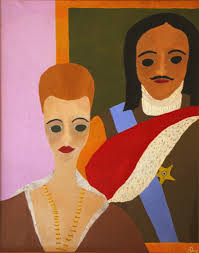
“Peter the Great” by Rubashkin
The first day of the exhibition in the House of Amateur Art passed off peacefully. The next day, before the exhibition opened, people from the KGB came to the director of the House of Amateur Art and forbade the showing of the pictures, giving as their reason the fact that on some of the pictures Jewish inscriptions were portrayed (the series ‘Recollections of Childhood’ and ‘Jewish Festivals’). They said that this was ‘Zionist propaganda’.
These pictures were taken into the director’s office, but even after this the exhibition was not permitted. The organizers of the exhibition (Tatyana Kolodzei, a methodologist of the Fine Arts Department, V. Volpina, the head of the department of Fine Arts, and I. Rubashkina, the artist’s widow) appealed to officials of the propaganda department of the Party Central Committee, insisting on the information of a competent commission to evaluate the political and artistic worth of the pictures on exhibition. A commission was formed, including representatives of the People’s University, the House of the People’s Art, and the RSFSR and USSR Ministries of Culture. The commission looked at the pictures remaining on the walls and came to the conclusion that the exhibition had the right to take place in view of the national colour, directness and artistic worth of the pictures represented in it.
However, immediately after the commission had left, firemen appeared and drew up a statement about the insufficient fire precautions on the premises, and the exhibition was closed. All the pictures were returned to I. Rubashkina, including those which had been taken from the walls after the KGB officials had visited the exhibition.
*
[9]
ATTACKS ON CHERNYAVSKY FAMILY
MINSK. On 19 December 1975 the newspaper Sovetskaya Belorussia (Soviet Belorussia) published an article by B. Zdolnikov, “Baseness”, describing a drama in the family of F. B. Chernyavsky, a prominent Minsk engineer.
In April 1975 he and his student son Ilya informed the remaining members of the family of their intention of moving to Israel. Over several months Chernyavsky’s wife and daughter tried to persuade them to forget about this ‘wild venture’. But this turned out to be impossible, since F. B. Chernyavsky, as the newspaper reported in his wife’s words, “has yielded to persuasion and is acting in accordance with a scenario worked out by the ardent Zionist Ovsishcher [2], who carries on agitation for emigration to Israel among the residents of Minsk”.
The newspaper goes on to describe in detail all the subterfuge of this ‘terrible man’ and other ‘recruiting agents’ who have broken up a united family which had lived in peace and concord for 22 years, but which had now split up (F. B. Chernyavsky has filed a petition for divorce) under the impact of ‘Zionist intoxication’. Included in their arsenal of methods were flattery, promises of a wonderful life in Israel, blackmail, intimidation and ‘straight bribery’, in the form of parcels from Israel.
Chernyavsky wrote a letter to Sovetskaya Belorussia. In it the 47-year-old engineer pointed out that he was capable of taking serious decisions in life himself, and repudiated the insinuations of the author of the article with regard to the role of Ovsishcher in his family drama.
*
By that time his son Ilya Chernyavsky had already been expelled from the fourth year of the Belorussian Technological Institute, within nine days of applying to the administration of the institute for a character reference for the Department of Visas & Registration (OVIR).
Still not having received a reply to his appeal to emigrate, Ilya had received a call-up summons from the Military Commission. Considering it amoral to serve in the Soviet Army and give an oath of loyally to the Soviet State after renouncing Soviet citizenship, and not wishing to study military affairs and thus gain access to the secrets of a country which he intended to leave, Ilya Chernyavsky refused to appear at the call-up point and on 16 June was arrested “for evading military service”.
From the first day of his arrest, he declared a total hunger-strike in protest.
After a while they tried to force-feed him, but this turned out to be impossible, since, because of a naso-pharynxal illness, he began to suffocate immediately the tube for artificial feeding was put down his throat. After an 8-day hunger-strike Ilya Chernyavsky was released from detention and almost immediately received permission to emigrate to Israel.
*
On 11 November 1975, his father F. B. Chernyavsky asked for a character reference from the Minsk Experimental Design Office Myasomolmash, where he headed a department. He was immediately demoted, and in January 1976 dismissed.
His documents were not accepted by OVIR because they did not include a certificate of divorce.
*
[10]
OTHER REPORTS
On 9 July 1976 Irina McClellan appealed to the Group to Assist the Implementation of the Helsinki Agreements in the USSR with a request to help her in reuniting her family.
In 1974 she married the American historian W. McLellan, and since then she has been trying unsuccessfully to obtain permission to emigrate to the USA. Since his marriage the Soviet authorities have been refusing W. McLellan entry visas.
*
YEREVAN. Shagen Arutyunyan, a former political prisoner, who had served three years from 1968 to 1971 under Articles 65 & 67 (Armenian SSR Criminal Code = Articles 70 & 72, RSFSR Code), appealed to the Soviet ‘president’ Podgorny with a request to assist him in emigrating:
“… my moral and political convictions differ from the official ideology, and I feel myself to be alien and irrelevant in this country.”
*
On 6 April 1976, biologist Ludmila Alexandrovna MARTEMYANOVA (b. 1942), stepped on to the English shore from a Soviet steamship and asked for political asylum. [According to a 11 April 1976 Reuters dispatch, she is an oceanographer.]
In Kaliningrad, where she lived, a case was brought against her on a charge of treason against her country. In Kaliningrad and Leningrad her co-workers and acquaintances were questioned, and searches were made in Martemyanova’s flat and at the home of her friend in Leningrad.
*
At the end of May Sergei Pirogov, a former political prisoner (CCE 32.5), emigrated from the USSR.
At the beginning of June the well-known historian Alexander Moiseyevich NEKRICH, author of the book 22 June 1941, left the USSR.
In June Vitaly Rubin, a long-standing ‘refusenik’, an activist in the Jewish emigration movement (CCE 40.12), and a member of the Helsinki Group, left the USSR with his wife, Inessa Axelrod.
*
[11]
AMALRIK & MAKUDINOVA LEAVE USSR
On 15 July 1976 Andrei Amalrik [3] and his wife Gyuzel Makudinova left the USSR.
In spring 1975, not long before the end of his term of exile in Magadan, it was suggested to Amalrik that he emigrate to Israel, without any invitation. He refused (CCE 36.10 [5]).
After his return to Moscow, Amalrik received an invitation to the University of Utrecht (Holland) and to an American university. He made an application to OVIR in Kaluga, the place where he was registered on release (CCE 37.13 [12]), requesting to be allowed out of the country for two years: a year in Holland and a year in America. His wife made a similar application to the Moscow OVIR. She was refused. Then Amalrik withdrew his application.
In spring 1976 a KGB official in charge of Amalrik’s case said to him: “Andrei Alexeyevich! You must believe me, you can leave only via Israel.” After this the Dutch consul, who represents the interests of Israel in the USSR (after the breaking-off of diplomatic relations with Israel in 1967), gave Amalrik and his wife a paper in which it was stated that the Israeli government was granting them permission to live in Israel. Then OVIR gave permission for Amalrik and his wife to leave for permanent residence in Israel (Amalrik is Russian; his wife is Tatar and a Moslem) and gave them exit visas from the USSR. In the Dutch Embassy the Amalriks were granted entry visas to Holland.
*
At the Customs the day before their departure, officials suddenly demanded that Amalrik pay 4,000 roubles duty for the 25 pictures of modem artists belonging to him (first of all the pictures had been valued at 2 roubles 50 kopecks each). Amalrik refused to pay this sum, stating that if they insisted he would not go anywhere.
The Customs officers reduced the duty to 1,500 roubles. Then, finally, the Customs agreed to the original sum. On 15 July Amalrik and his wife flew to Amsterdam.
==============================================
NOTES
- Earlier issues of the Chronicle recorded various criminal charges: Alexander Feldman (CCE 30.5) and Leonid Tymchuk (CCE 38.5) were convicted of hooliganism; Dr Shtern (CCE 34.5) was accused of bribe-taking; Lev Roitburd (CCE 37.3) was charged with resistance to the authorities; and Tbilisi historian Teimuraz Dzhvarsheishvili was found guilty of rape (CCE 38.16 [5]).
↩︎ - The “ardent Zionist” Ovsishcher is probably a reference to Belorussian war veteran and refusenik Lev Ovsishcher (see CCE 40.6).
↩︎ - On Amalrik, see CCE 17.1, CCE 29.7, CCE 30.14 [9], CCE 36.10 [9] and Name Index.
↩︎
=====================================
 A Chronicle of Current Events