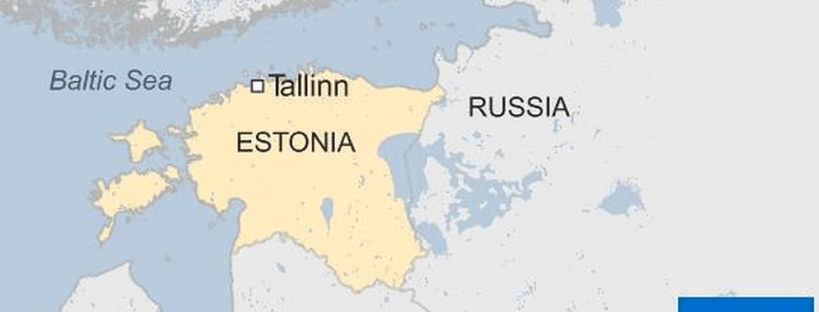
From 21 to 31 October 1975 the Estonian SSR Supreme Court in Tallinn tried the case of Sergei Soldatov, Kalju Mattik, Matti Kiirend, Artyom Yuskevich and Arvo Varato, all of whom were charged with “Anti-Soviet Agitation & Propaganda”. (Their arrest and the pre-trial investigation were reported in CCE 36.3.)
The presiding judge was P.V. Afanasyev, deputy chairman of the Estonian SSR Supreme Court; the People’s Assessors were Bartels and Vanikver. The prosecution was conducted by procurator Kestler.
*
DEFENCE
Soldatov refused the services of a lawyer after studying the case materials. The reason he gave was that at this trial a lawyer could not defend the world outlook of the accused without coming into conflict with the official demands made on Soviet lawyers.
Kiirend stated at the beginning of the trial that a Communist lawyer was not suited to take on the defence in such a case and that he would therefore conduct his own defence.
On 27 October Mattik renounced the services of a lawyer.
On 28 October, 15 minutes before his lawyer was due to start speaking, Yuskevich also refused legal assistance: “I want to be on the same level as the others,” he said. The accused Varato was defended by the lawyer Kon.
*
CHARGES
The accused were charged with compiling, reproducing and disseminating over forty documents, including the following:
- ‘Programme of the Estonian Democratic Movement’,
- ‘Programme of the Estonian National Front’,
- the journals Estonian Democrat and Estonian National Voice (in Estonian),
- the journals Democrat and Ray of Freedom (in Russian),
- a ‘Memorandum to the UN General Assembly’,
- a ‘Letter to K. Waldheim, Secretary-General of the UN’ (referring to these last two documents, the indictment says: ‘Soliciting the interference of the UN in Soviet affairs [the accused] took part, in 1972, in planning, compiling, reproducing and storing the ‘Memorandum’ and ‘Letter’ with the intention of disseminating them’),
- ‘The Tactical Foundations of the Democratic Movement in the USSR’,
- the article ‘Russian Colonialism in Estonia’,
- the Chronicle of Current Events,
- the book Sources and Meaning of Russian Communism by N. Berdyaev,
- Will the Soviet Union Survive until 1984? by A. Amalrik,
- The New Class by M. Djilas,
- The Gulag Archipelago by A. Solzhenitsyn,
- the story ‘This is Moscow Speaking’ by N. Arzhak,
- the Czechoslovak manifesto of 1968, ‘Two Thousand Words’.
(In October 1970 the Kaluga Regional Court had to remove “Two Thousand Words” from the Indictment against Revolt Pimenov after it was proved during the court investigation that it had been distributed in the Soviet Union by official Soviet organizations, see CCE 17.5.)
All the above material was confiscated during searches. Five typewriters and a camera were also confiscated during the searches: the record of the search at Soldatov’s home mentions only one confiscated object — a typewriter.
*
At the beginning of the trial Soldatov objected to the composition of the court, as a panel of judges consisting of communists could not judge democrats objectively. His objection was overruled.
MATTIK
Mattik asked for observers from the UN to be invited to the trial, as the case included documents concerning that organization. Soldatov and Yuskevich upheld this request. The court rejected it.
Before the trial began, Mattik had asked that the case should be ’investigated in its fundamental aspects’: that the documents should be analysed to determine if they were indeed libellous. The presiding judge refused to comply with this request, stating that competent authorities had already come to a conclusion and that matters of dispute could be resolved during the trial.
Mattik then refused to take part in the court proceedings, while retaining his right to a speech in his self-defence and a final statement.
*
Soldatov and Kiirend also refused to give evidence in court. In addition, Kiirend stated that he renounced the evidence he had given during the pre-trial investigation (he had stated then that he was the author of the ‘Programme of the Estonian Democratic Movement’ and had told the investigators the hiding-place of his draft of it).
Varato pleaded guilty of all the acts he was charged with. As he had done during the pre-trial investigation, he cooperated fully during the trial with the authorities.
*
WITNESSES
The court heard evidence from 13 witnesses. Four of them (Pyotr Yakir, Victor Krasin, Kosyrev (CCE 11.5) and Tutremov) were not present in court.
Kosyrev and Tutremov sent telegrams saying they could not appear because of their state of health and that they upheld the evidence they had given at the pre-trial investigation, Yakir’s testimony — both old (1972-3) and new — was read out in court. Reference was also made to Gavrilov and Paramonov (CCE 11.5), Alexander Bolonkin and Balakirev (CCE 30.4), Soldatov tried to persuade the court to call Yakir, Gavrilov and Tutremov. The court refused to call Yakir or Tutremov and completely forgot to take a decision about calling Gavrilov.
Of the nine witnesses interrogated in court, two denied that the accused had disseminated any anti-Soviet material; one admitted that ‘a document’ had changed hands but said he did not consider it anti-Soviet; three confirmed the passing on of certain documents referred to in the charges; one (a typist) agreed that some documents had been reproduced but pointed out that the facts contained in these documents were true. One of the witnesses (Joost) was described as a false witness and a provocateur by the accused. In regard to the ninth witness, while the pre-trial investigation was still going on, Yuskevich had asked the Procurator of the Estonian SSR for a psychiatric diagnosis to be made of him. Yuskevich had received no reply to his request.
During the pre-trial investigation A. Amalrik was also interrogated about the case in Moscow; he refused to answer any questions.
*
PROSECUTION & DEFENCE
In his speech for the prosecution the procurator declared that the activities of the accused ‘had played into the hands of world imperialism’, that ‘the so-called democratic movement in the USSR was inspired from abroad’ and that ‘the original programme for this movement was compiled by the CIA in 1968’.
Listing the ‘incidents’ which figured in the charges against the accused, he asserted they had been proved by the objects confiscated during searches, by the testimony of witnesses, the evidence given by the accused Varato, and the admission of certain facts by the accused Kiirend and Yuskevich.
The procurator asked that Mattik be given a sentence of 7 years’ imprisonment and 3 years’ exile, that Soldatov should be sentenced to 6 years’ imprisonment and 4 years’ exile, Kiirend to 5 years’ imprisonment and Yuskevich to 4 years. In the case of Varato, he asked for a conditional sentence of 3 years with a five-year probationary period.
In his defence speech, the lawyer retained by Varato asked that his client be given a milder sentence, as he was the only one of the accused to admit his guilt in full, to repent sincerely and actively to assist the investigation.
*
In his defence speech Yuskevich disproved most of the charges against him. He admitted certain actions but noted that he was admitting only facts, not the interpretation put on them, as his actions on these occasions were fully in accord with the rights guaranteed in the Soviet Constitution, whereas the charges, by contrast, were based on an excessively free interpretation of the Constitution. Article 68 (Estonian SSR Criminal Code = Article 70, RSFSR Code) was, he declared, unconstitutional. Yuskevich said that he did not consider himself a participant, still less a leader, of any ‘movement’ and that he had become a ‘democrat’ only since his arrest. At the end of his speech Yuskevich referred to the abnormal conditions in which suspects were held: insulted by officials, badly fed and subjected to psychological pressure by the interrogators.
*
Kiirend declared in his speech that the Soviet Constitution and the ‘Universal Declaration of Human Rights’ formed the basis for the activities of Estonian democrats. The democrats’ aim had not been to overthrow Soviet rule or slander it, but to correct certain shortcomings. They had wanted to fight for democratic freedoms by peaceful means.
He also said he did not consider the material covered by the charges to be either anti-Soviet or libellous, and that he was therefore not guilty of infringing the Criminal Code. Kiirend stated that the greater part of his testimony during the pre-trial investigation had been given under strong psychological pressure, which he had been unable to resist because of his weak state of health. This testimony bore no relation to the facts and he had renounced it in court, but the court was making use of it in spite of this. Kiirend also said:
“I feel I must mention the unworthy, even contemptible behaviour of Varato. Freedom obtained at such a price will be a heavy burden for him and for his family.”
*
In defending himself, Mattik stated that the material listed in the charges was not libellous, as all the facts mentioned therein had been taken from the Soviet press. They could not, therefore, be covered by Article 68 (Estonian SSR Criminal Code) and consequently he did not consider himself guilty. Mattik referred to the curious fact that a document condemning the cruelty of the Tsarist government in 1905 was described as libellous in the indictment.
*
Soldatov described himself as a humanist and a religious believer.
His activities had consisted of peaceful campaigning for democratic freedoms; they had not been directed against Soviet rule. He had also tried to speak openly about the shortcomings he was campaigning against: in May 1974 he had written a letter to Andropov but had received no reply [correction CCE 39.14]. As a Russian living in Estonia, he was sorry that relations between the Russian and Estonian peoples had been ’clouded by certain matters’; he considered that any improvement in their relations would depend largely on the Russians, and by his activities he had tried to atone in some degree for the sins of the Russian nation.
Soldatov did not consider himself guilty of any crime.
*
In his final statement Yuskevich declared himself to be a materialist, a convinced Marxist-Leninist and a Communist. All his life he had criticised shortcomings and this had never been called ‘anti-Soviet activity’.
He said that theirs was a political trial and that in 10 or 15 years it would be regarded as shameful, in the same way that the trials of the thirties and forties were now so regarded. He said:
“I was living a well-off life and I could have lived quietly, but my convictions would not allow me to do so, I was made a democrat on 13 December 1974; I never was one before, and after I come out of prison, I will never take part in democratic activities. I want to bring up my grandchildren and live in peace.”
He also said that he considered himself partly guilty of criminal activity, and that he could boldly and honestly look any man in the eye. As he had done in his defence speech, so in his final statement Yuskevich quoted Lenin a great deal.
*
Kiirend asked the court in his final statement to take into account the fact that the only aim of his friends and himself had been to correct the shortcomings in our society.
In his final speech Mattik tried to develop the idea that the moving force in history was not so much the proletariat as the intelligentsia, especially those people who had fought over the centuries for freedom and human rights. He said:
“Dictatorships are a misfortune for mankind. Floods, earthquakes and plague have not brought as much sorrow on mankind as dictatorial regimes. Communists cannot consider themselves the avant-garde of society.”
Mattik said that the present court owed its existence to the dissenters who had contributed to the development of society over the ages by their efforts and sacrifices. “If there had been no Razin uprising, or other popular movements, no revolutions like those in 1905 and 1917, then judges today might still be bought in exchange for borzoi hounds and racehorses.” Mattik declared:
“The very fact that Estonian democrats are being tried here shows that their position is taken seriously.”
He said he would always go on fighting for a free and independent Estonia.
*
Soldatov said in his final statement:
“An honest idealist cannot be a subversive or harmful element. Like some others, I could plead bad health and difficult living conditions, but this is in the evidence and the court knows it. I only ask the court to be lenient to my friends. I have always tried to make life better, not to undermine it.”
In his final statement Varato expressed repentance, understanding, regret and admission of his crimes. He asked the court for a light sentence.
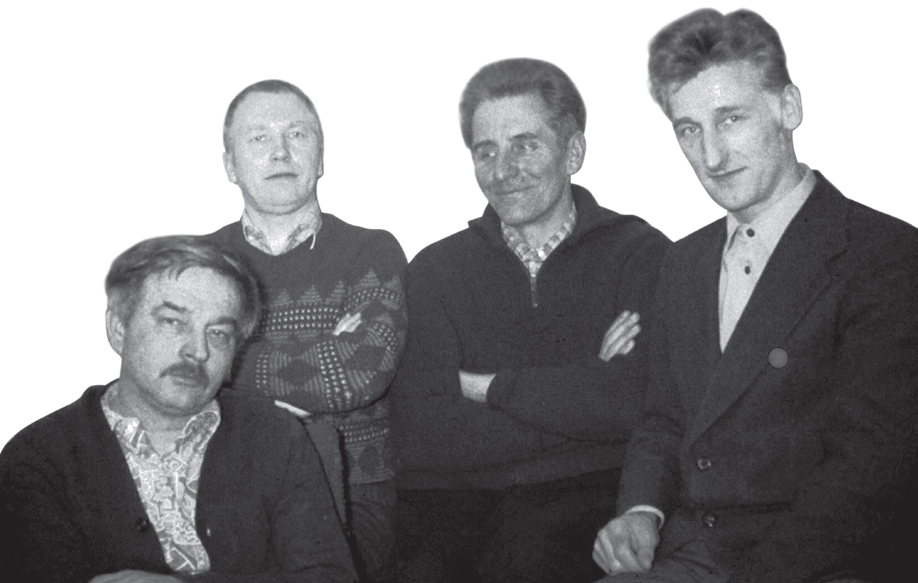
Artyom Kuskevich, Mati Kiirend, Kalju Mattik and Endel Ratas (1980 photo)[1]
*
SENTENCE
The court sentenced Mattik and Soldatov to six years, and Kiirend and Yuskevich to five years, all in strict-regime camps. Varato was given the sentence asked for by the procurator. The court made a separate decision asking the procurator’s office to start criminal proceedings against the witness Heinasto for refusing to give evidence.
The indictment included a charge relating to Article 70 (Estonian SSR Criminal Code: “Organized action … and also participation in an anti-Soviet organization”), but the State prosecutor waived the charge relating to this article. Mattik was charged with contravening Article 207 (Estonian SSR Criminal Code: “Unlawful possession of weapons”). The sentence relating to this Article was subsumed in the ‘overall’ sentence.
The trial was public; however, almost the entire courtroom was filled by specially invited people. Nevertheless, apart from relatives, some of the additional people who wished to attend were allowed into the courtroom. None of the lecturers or students from Tallinn Polytechnic Institute, where Mattik and Soldatov had worked at various times before their arrest, were allowed into the courtroom.
All the accused had been subjected to a forensic-psychiatric examination. Soldatov had even been examined twice: in Tallinn, where he was declared not responsible, as had occurred seven years earlier (CCE 11.5), and in Moscow at the Serbsky Institute (CCE 36.3).
Mattik also had been sent to the Serbsky Institute for diagnosis.
============================================
NOTES
See Section 4.1 “Events in Estonia” (1968-82), listing 29 reports or news items in 02. CCE Contents.
*
- Photo from “The Estonian dissident movement and the KGB”, Estonian Internal Security Service, Annual Review, 2021-2022.
================================

