- 11-1 Prisons and Camps
- 11-2 Statute on Political Prisoners
- 11-3 Letters and Statements; Releases
*
6. Letters and Statements
15 ITEMS
[1]
Paruir Airikyan
“Open Letter to UN Secretary-General Waldheim” (21 October 1976)
Written in a cell of Yerevan Prison (CCE 43.3), the letter was timed to coincide with Political Prisoners Day, 30 October 1976.
Paruir Airikyan describes the range of ‘political crimes’ in the USSR and, referring to precedents, calls (in his own name and that of other political prisoners) for the formation of a UN commission to study the position of political prisoners and to monitor the observance of human rights and the rights of nations in the USSR.
Stating that the National United Party (NUP) is struggling by peaceful means for the independence of Armenia, Airikyan says that between 1968 and 1975 there were 18 trials in connection with the NUP; 43 people were sentenced to imprisonment for terms of from six months to ten years. (Information about the trials of 1973-74 was given in CCE 34.4, Chronicle.)
“Thus the Soviet Union, which speaks before the world of its mission to defend the right of nations to self-determination, … in reality persecutes those who try to implement this right.”
(+ LETTERS 6-10 BELOW)
*
[2]
Sergei Soldatov (Mordovian Camp 19)
“To the USSR Procurator-General. To the Soviet Government” (30 October 1976)
On Political Prisoners Day Sergei Soldatov makes representations on behalf of 16 political prisoners sentenced for their beliefs “whom I know personally, and of whose moral worth I have no doubt”. He asks for them to be released from custody and for those who wish it to be allowed to emigrate. Soldatov also urges the early release of six participants in national movements who used force, but who, “by the length of their prison sentences and the degree of their sufferings, have long since exculpated the deeds attributed to them”.
Soldatov demands an improvement in the conditions of confinement of political prisoners and better treatment of them. Besides this Soldatov asks the Soviet government
“… to convey my invitation — to a personal meeting at my place of detention — to representatives of the UN Commission on Human Rights, Amnesty International and the foreign press, so that I may openly express my religious and civic position as I do in conversations with the authorities, and may discuss the problems of my present circumstances. I recall the fact that the chairman of a Communist Party, Luis Corvalan, arrested by the Chilean government, was accorded this right.
“In solidarity with all political prisoners whose moral worth there are no grounds for doubting, and in protest against my continued detention under guard I as a believer and a citizen declare a hunger-strike.”
(see LETTER 13, BELOW)
*
HELSINKI ACT & BELGRADE CONFERENCE (3-5)
[3]
Abankin, Antonyuk, Afanasev, Balakhonov, Davydov, Rode & Safronov (Vladimir Prison)
“To L. Shwartz, Andrei Sakharov, P. Emmanuel and Jiri Pelikan;
To the Committee for the Defence of Human Rights in the USSR, Amnesty International, the PEN Club, and the Democratic Public of the Soviet Union and the Whole World” (December 1976)
The authors of the letter judge the release of their prison comrade Vladimir Bukovsky to be
“…effectively an acknowledgement by the Soviet government of the existence of political prisoners in the USSR. Thus it is also an acknowledgement of an opposition that, although unofficial, does actually exist and stands up for civil, political, economic, social and cultural rights and freedoms, and against persecution of people for political, national or religious motives.”
The authors express the hope that the Belgrade Conference will open new opportunities for the universal establishment of the rights and freedoms defined in the 1948 Universal Declaration of Human Rights.
*
[4]
V. Abankin, Z. Antonyuk, V. Afanasev, V. Balakhonov, N. Bondar, G. Davydov, K. Lyubarsky, M. Makarenko, Z. Popadyuk, G. Prikhodko, G. Rode, A. Safronov, Ya. Suslensky, G. Superfin, A. Turik, A. Khnokh, V. Fedorenko, B. Shakhverdyan, T. Shinkaruk, Yu. Shukhevych (Vladimir Prison)
“To the Committee for the Defence of Human Rights in the USSR
and the Independent Citizens’ Committee [Helsinki Group] to Assist the Implementation of the Helsinki Agreements in the USSR” (25 December 1976)
“… we consider it desirable to declare 1977 the year for demanding the implementation of the Final Act by the Soviet Union …
“We request the countries participating in the preparatory meeting for the Belgrade Conference to include on the agenda the question of the full implementation of the provisions of the Final Act by the Soviet Union. For our part, we, political prisoners of the Soviet Union, intend to conduct a series of actions under the general slogan ‘We demand the implementation of the Final Act by the Soviet Union’, …
“We intend to mark the opening day (15 June) of the preparatory meeting, which we hope will include this question on the Conference agenda, by a campaign of statements on the Soviet Union’s violation of the Final Act; the opening day of the Belgrade Conference will be marked in addition by a hunger-strike in protest against these violations and by demands that all provisions of the Final Act be strictly implemented …
“We intend to mark the anniversary of the signing of the Final Act (1 August) by a campaign of statements demanding the implementation of the provisions of principle VII of the Declaration on Principles of the Final Act …
“We intend to mark Political Prisoners’ Day in the Soviet Union (30 October) by a campaign of statements — upheld by a one-day hunger-strike — demanding an end to persecution for political, religious or similar reasons and the legal exculpation of all people arrested for these reasons …
“We intend once more to mark USSR Constitution Day (5 December) by a campaign of statements and demands for the implementation of the provisions in Principle X [1] of the Final Act: the first such actions were carried out on 5 December 1976 …
“We intend to mark Human Rights Day (10 December) by a hunger-strike protesting against the failure by the Soviet Union to observe the above-mentioned provisions of the Final Act and by a campaign of statements demanding their implementation …
“We intend to mark, in the spirit of the Final Act, the second anniversary of the day when prisoners started to adopt the Statute (10 January) by a campaign of statements protesting against the authorities refusal to produce a statute on political prisoners …
“Remembering the necessity of daily struggle for civil rights, and giving our respected, patriotic forerunners in this matter their due, we intend to conduct other campaigns throughout the whole of 1977, linking them with demands for implementation of the Final Act and conducting them in the spirit of the statement referred to, and also to mark important historical landmarks from the [1825] Decembrists to the present day — such ones as the first political hunger-strike in Russia on 25 (13 Old Style [2]) September 1827, the Remembrance Day for Victims of the Red Terror (5 September), the death of Galanskov [CCE 28.2] and the death of Soroka [CCE 20.13].”
*
[5]
Sergei Kovalyov, Yevhen Sverstyuk, Dmitry Demidov, Mykola Slobodyan, R. Chuprei, D. Grinkiv, Dmytro Basarab, Stepan Sapelyak, Kulja Mättik, I. Popadichenko, Petras Plumpa, Vulf Zalmanson, Josif Mendelevich, M. Dymshits (Perm Camp 36, December 1976)
“To the Belgrade Conference”
“While we understand that the problem of political prisoners is not the primary question facing the world today, we nonetheless bring it forward insistently, as it reflects a dangerous epidemic of our age — the crime of a State against the laws and declarations accepted by it, and the application of force in the face of morality and the law.”
Further on, the letter gives an account of what political prisoners in the USSR stand for, and says:
“We are witnesses to the fact that persecution for thought remains the central concern of the regime even after the signing of the Helsinki agreement.
“We think that it is clear to the West, as it is to us, that the ‘third basket’ is pure air and sunshine, without which all the rest loses its meaning …
“We also hope it is clear to the authorities of the West that if they enter into compromise agreements with a regime of militant illegality … by doing so they assume responsibility for the erosion of the ground we stand on.”
***
PARUIR AIRIKYAN, LETTERS & STATEMENTS (1 & 6-10)
[6]
Paruir Airikyan (Mordovian Camp 3):
“Three Statements: to the USSR Procurator-General, the Procurator of the Mordovian ASSR, and the Chairman of the Presidium of the Armenian SSR Supreme Soviet” (17 January 1977)
The cause of the statements: on 14 January Airikyan fulfilled his norm by only 55 per cent, and for this was deprived of the right of a scheduled visit. The statements say in particular:
“In effect we [Airikyan and his mother, Chronicle] have been unable to meet for a whole year …
“I demand an end to the persecution of my relatives and the restoration of the visit taken away on an absurd charge …
“It is anyway a crime to demand that a political prisoner should work, but to punish him and his relatives for non-fulfilment of a work norm is doubly so …
“Mr Sarkisov, you ought to know that Pinochet did not and does not deprive his temporarily imprisoned citizens of weekly visits …
“Be so good as to permit me to receive a visit, if only once a year.”
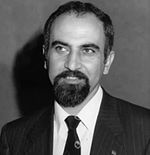
Paruyr Hayrikyan, b. 1949
*
[7 & 8]
Paruir Airikyan: Two statements:
“To the Chairman of the Presidium of the USSR Supreme Soviet” (12 February 1977)
“To the USSR Procurator-General” (14 February 1977)
Naming himself the legal representative of a party as yet not legalized, Airikyan offers to start negotiations “with the aim of bringing the programme and principles of the NUP into full accordance with the demands of the Soviet legal order”. He declares that persecution of the NUP contradicts the Universal Declaration of Human Rights, the UN Charter and the Constitution of the USSR (Article 17).
*
[9]
Paruir Airikyan
“To the USSR Procurator-General & other High Organs of the USSR and Armenian SSR” (4 March 1977)
A declaration of a hunger-strike in protest against violation of the rights of nations to self-determination. A demand to release all members of the NUP and allow a referendum on Armenia’s secession from the USSR.
*
[10]
Paruir Airikyan
“Three Statements:
“To the Chairman of the Presidium of the Lithuanian SSR Supreme Soviet”
“To the Chairman of the Presidium of the Ukrainian SSR Supreme Soviet”
“To the Chairwoman of the Committee of Soviet Women, Mrs Tereshkova” (8 March 1977)
Airikyan declares a hunger-strike in protest at the detention in the camps of the women political prisoners Nijole Sadunaite, Iryna Stasiv-Kalynets, Oksana Popovich, Iryna Senik, Nadezhda Usoyeva and, in exile, of Stefania Shabatura”.
In the letter to Tereshkova he says:
“It is possible you do not know that the Soviet Union is not only one of the few States in the world where there are political prisoners, but almost the only one which can pride itself on having women political prisoners.”
***
PETROV-AGATOV’S ARTICLE (11-12)
[11]
Paruir Airikyan, N. Budulak-Sharygin, Ivan Kalynets, L Kravtsov, R. Markosyan, V. Moroz, M. Osadchy, V. Osipov, O. Popovich, V. Romanyuk, N. Sadunaite, P. Saranchuk, I. Senik, S. Soldatov, G. Ushakov, M. Kheifets, V. Chornovil, D. Shumuk, A. Yuskevich (February 1977)
Political prisoners of the Mordovian camps reply to the article by A. Petrov-Agatov in Literaturnaya gazeta (2 February 1977):
“… he has also committed perjury, in the pages of a mass-circulation newspaper, by calling the view that political prisoners in Soviet camps face difficult conditions a ‘lie’ and ‘nonsense’.”
They write what their situation is in reality.
“And Petrov-Agatov knows this truth perfectly well. Many of us remember well how in his time he repeatedly complained of intolerable conditions … Now, since about the beginning of this year — the year of the Belgrade Conference — the escalating harshness of the regime has reached a still higher level.”
The authors send greetings to Ginzburg and other members of the Helsinki Group.
*
[12]
Vitold Abankin
“To Literaturnaya gazeta, An Open Letter to A.A. Petrov-Agatov” (Vladimir Prison, 4 February 1977)
The author recalls meetings long ago with Petrov-Agatov in Camp 11 in Mordovia.
“I liked your verses and especially the narrative poem ‘Kolyma Highway’, and frankly I envied you then for your spirit, the firmness you maintained while going through the most arduous trials … Now I read your letter and am struck by the metamorphosis that has taken place in you.
“You speak of the spirit of malice that supposedly ‘stayed alive’ in you and ‘reawakened’ during meetings with dissidents. Now — through associating with some other kind of people — there burns within you malice against your former comrades.”
Abankin is indignant at the accusation that dissidents are mercenary.
“… do hundreds of people go into camps for 3, 5, 7, 10, 15 years for the sake of clothes or money?
“Do you know that Galanskov, who had two ulcers, took part with us in protest hunger-strikes, disregarding all bans? He refused to eat the better portions that we obtained and saved up for him as a sick man; he shared them with everyone.
“Do you know that Lyubarsky, a man with an ulcer, with a stomach of which only 20 per cent remains, starved himself here with us, was put in punishment cells, on strict-regime; and when he received improved food (two months in spring, two in autumn) he shared it with everyone in the cell?”
Abankin also rejects the words regarding good conditions in the camps and prisons, giving many concrete examples including some from the camp biography of Petrov-Agatov himself.
“You talk of helping one’s neighbour. Perhaps by your letter you wished to help one or other of your former comrades?”
*
[13]
Sergei Soldatov
“Statement” (Mordovian Camp 19, 24 February 1977)
“I openly declare that the Estonian KGB fabricated a criminal case against my son Alexander, using the criminal H. Pint, who had been released before the end of his term.
“It has become known to me that the latter on 23 August lured my son by deception to a meeting, supposedly for ‘negotiations’, and then suddenly staged an attack on a passer-by, after which detentions were immediately carried out by people in civilian clothes who were already waiting (Pioneeride Street).
“During the investigation pressure was put on my son using my name and situation. He was deceived. The case was widely advertised on radio and television. My letters to him and his to me were stopped. The case was thought up for the purpose of publicly compromising my name (a criminal family!), and as a means of putting pressure on me during the indoctrination session which followed soon after the trial of my son (in Saransk, which lasted until 22 November [1976]). Here, in exchange for my son’s freedom and my own, an attempt was made to obtain my repentance and recantation.
“I register my open and official protest to the Soviet government, which has used an unworthy method of political struggle borrowed from the Stalinist arsenal of illegal repression. At the same time, I appeal to the public for the public verification and investigation of the true circumstances of my son’s case and for the defence of my family from provocations.”
*
[14]
S. Soldatov, V. Chornovil, G. Ushakov, M. Karpenok, B. Shukirov, N. Budulak-Sharygin and M. Ravins
“An Open Letter to the President of the USA, J. Carter” (Mordovian Camp 19, March 1977)
“Firmly defending our rights, we dedicate to the start of the preparatory meetings in Belgrade our action, long since advertised, of unilaterally adopting the ‘Statute on Political Prisoners in the USSR’ from 19 April to 27 July 1977, i.e. for 100 days.
“By adopting the Statute we consciously resort to a new form of struggle against the barbarity which is legalized in Soviet concentration camps. This is one of the ways of attracting the attention of the world public and of all participants in the international forum in Belgrade to the situation of dissenters in the USSR.
“Besides this, we are declaring a series of hunger-strikes, each of which will be dedicated to one of the provisions of the ‘Statute on Political Prisoners in the USSR’.”
By their hunger-strikes the authors express their protest against the application to political prisoners in the USSR of the same legislation as is used for criminals; against secret legislation, harsh and unconcealed exploitation of political prisoners, the almost total absence of legal defence for political prisoners, deliberate attempts to damage the health of political prisoners, and degradation of the personality and human dignity of political prisoners; against religious discrimination in Soviet concentration camps, national discrimination, and the ban on political prisoners marrying; and against the forcible ideological indoctrination of political prisoners, the deliberate ban on them maintaining their professional qualifications and the deliberate isolation of Soviet political prisoners from the outside world.
*
[15]
Yury P. Fyodorov: “Statement” (Mordovian Camp 1, April 1977)
“…The administration of Corrective-Labour Colony 1, by threatening me with physical violence, forces me to address the following statement to: all government agencies of the Soviet Union; the UN Committee on Human Rights; the Committee [Helsinki Group] to Monitor the Implementation of the Third Basket of the Helsinki Agreement; the world public; the Central Committees of Western Communist Parties … the World Council of Churches; and to all citizens of the Orthodox faith — my brothers by faith.”
Yury Fyodorov (an ‘aeroplane man’, serving a 15-year sentence, CCE 17.6) writes that in 1977 the administration of camps and prisons “began a new stage of unprecedented terror and provocation”. He links this with the latest arrests and with the general direction of internal policy on the eve of the Belgrade Conference.
“A Stalinist period is beginning in the camps and prisons of the Soviet Union.
“The Corrective-Labour Code, just issued, has totally lost its significance as law, while the real source of authority has become the many directives and orders from the USSR Ministry of Internal Affairs.”
Fyodorov shows that many Articles of the Fundamental Principles of Corrective-Labour Legislation “are cancelled by corresponding orders from the USSR MVD or not observed at all.”
Citing Article 1: “…the carrying out of punishment does not have as its purpose the causing of physical suffering or the lowering of human dignity”, he writes:
“Wearing dog tags on the chest; the obligation to stand up and to take off one’s hat when a member of the administration appears; the frequent, humiliating, daily personal searches; the punishment cell regimes; the lower food norm and the general near-starvation food allowance; the ineffectiveness of any complaints about the administration — all this totally refutes the content of this Article …”
Fyodorov shows how the right to obtain goods and books, to receive parcels, packages and visits (Articles 23, 24 & 25), is treated in practice. He makes this comparison:
“… during the seven years to date of my second prison term I have seen my wife and mother a total of five times. What would Mr Luis Corvalan say to this if the Soviet corrective-labour colony [rules] were applied to him, not to mention the usual practice of depriving one — for any misdeed, even imagined — of everything prescribed?”
(The Soviet press had carried information about the weekly visits to Corvalan by his wife.)
“… Mr Corvalan complained that in the dungeons of the Fascist junta the jailers ripped the labels off the Soviet goods which he and his comrades continually received from the Soviet Union, I would have given my jailers even the wrappers as well from all parcels.
“Alas, I have no parcels …”
In connection with Article 26 Fyodorov says that he was put into solitary confinement for two months for a rough draft of a complaint to the CPSU Central Committee about the actions of the administration, confiscated from him during a search.
After being in solitary he was transferred to the hospital: with a height of 185 cm he then weighed 55 Kg.
Commenting on Article 36, which concerns daily provisions (for example, Order 115 lays down that margarine must replace butter, gram for gram), and Article 37 on medical services, Fyodorov writes:
“From my own experience I declare that medical services do not exist in the camp system.
“I have fallen ill here with the following illnesses: chronic conjunctivitis, chronic bronchitis, chronic colitis, gastritis, arthritis of the right knee joint, and chronic left-sided nephritis.
“I have received no treatment at all. The most that was done was to give a diagnosis. The medical service is entirely in the hands of the administration, which at its discretion either permits doctors to give medical aid or does not.
“For example: when I was in a solitary cell I fell ill. The doctors demanded that I be sent to hospital for investigation, but the administration detained me until I had served the term of solitary confinement in full.”
Regarding handcuffs, which, according to Article 39, should be used in cases of violence or resistance, Fyodorov writes that they are used “arbitrarily and most often as a form of punishment”. In commentaries to Article 39 it says that “handcuffs are to be put on the wrists”,
“In the cases I know of where handcuffs were used, they were always put on 23-25 cm above the wrists. Prisoners lose consciousness from the hellish pain. My own hands did not function for three days afterwards.”
Concluding his review of Articles of the Corrective-Labour Code, Fyodorov writes:
“In general, in whatever connection we political prisoners refer to a law the administration at once refers to an order or directive nullifying the law, or else in the most brazen fashion simply ignores any laws whatever.
“That tiny particle of the truth that I have set out here I have understood and dragged around with me during the whole of my ten years in these accursed parts.
“Over the last months I have been deprived of the right to obtain food products and deprived of a scheduled visit. For the last three months (January-March) I have not been allowed — and for no declared reason — to buy not only provisions but also essential articles such as soap, tooth powder and tobacco.
“I am constantly terrorized by the use of physical force in the form of handcuffs, although I am in no way violent and do not threaten the life or health of those around me. And I am insulted.
“The administration has formed a group of common criminals who have repeatedly threatened the political prisoners with murder and insulted them. The administration has taken these people under its protection and sets them on us from time to time, staging ‘chance’ encounters in order to provoke brawls and murders.
“Of what human rights and respect for human dignity can there be any question? It is not a matter of rights, gentlemen, but of how to remain alive… Only recently, the senior security official of Camp 1 said, ‘Well, of course this was only his personal opinion, but, given the chance, he would have us all shot’.”
In conclusion Fyodorov writes:
“I ask all those who are concerned, and the competent international organizations, to discuss the question of forming a committee to investigate the situation in the camps and prisons of the Soviet Union.”
*
7. Releases
VOLODOMYR ROKITSKY
On 15 January 1977 Vladimir Yulianovich ROKITSKY was released, having served a five-year term. He had been in Vladimir Prison since the end of 1975. Before his release he was taken to Ternopol.
Rokitsky was arrested for Ukrainian samizdat. At the time of his arrest he was studying in the law faculty of Kiev University. Earlier — at Lvov University — he had taken part in the publication of the typewritten student journal “Movement” (Postup) in connection with which an extra-judicial investigation was conducted. (This episode did not feature in Rokitsky’s criminal ‘case’.)
*
YOUTH OF GALICIA
Two of the five people convicted in 1973 in the case of the “Union of Ukrainian Youth of Galicia” (CCE 33.10) have been released after serving four-year terms: on 15 March 1977, Nikolai Motryuk (Perm Camp 35); and on 17 March, Roman Chuprei (Perm Camp 36).
A month or two before their release they were both taken from camp and transferred to Ivano-Frankovsk. Chuprei was at first held for a month in the hospital of Camp 35. In the Ivano-Frankovsk Prison they were put in a cell with a third person accused in their case, Grinkiv (term seven years, Camp 36). KGB officials from Ivano-Frankovsk and Kiev had talks with all three, as did other persons such as the director of the Markovka village school. They demanded that Motryuk renounce his intention to emigrate (while in camp he had sent off a request for French citizenship).
After their release they settled in their homes in neighbouring villages of the Kolomiya district: Motryuk in Markovka, Chuprei in Pechenezhina. They were immediately put under surveillance, the rules for which (besides the usual ban on leaving the district) included a prohibition on Motryuk going to Pechenezhina, and on Chuprei going to Markovka. They both have to report at the same time on Saturdays in Kolomiya.
*
On 9 April 1977 Azat Arshakyan was released before the end of his term. He is living in Yerevan. Arshakyan was sentenced in 1974 to seven years in a camp and three years of exile (CCE 34.4).
*
FELDMAN
On 17 April 1977 the Jewish activist Alexander Feldman was released from a camp for criminals near Kherson. He was sentenced to 3.5 years under the Article “hooliganism” with the help of a crude frame-up (“the case of the cake”, CCE 30.5).
Ten days before his release he was put in a punishment cell on an absurd pretext (“he spoke rudely to the brigade head”), and, in accordance with the usual directives, shaved bald. (Another instruction lays down that for three months before their release prisoners are no longer shaved bald.)
Feldman returned to Kiev (see CCE 45.16).
*
SHIBANOV
On 20 April Nikolai Alexeyevich SHIBANOV was released from Mordovian Camp 1. Sentenced in 1969 under Article 70, pt. 2, for distributing leaflets. He was arrested in Zagorsk. The trial was held in Moscow.
It was Shibanov’s third appearance in court. The first two were also ‘political’, with sentences of 25 and eight years, respectively.
*
In mid-May Gunars Rode was released in Riga (CCE 18.2, CCE 44.17-4 [14]), having served a 15-year term.
*
CHAMOVSKIKH
In February 1977 Victor Petrovich CHAMOVSKIKH (CCE 33.6-3 [16]) was released having served a term of one year in a camp in Magadan for violating the rules of surveillance.
Chamovskikh was given a year-long sentence when in exile in west Siberia (CCE 40.15 [18]). From Magadan Chamovskikh was sent back in a prisoner convoy to the village of Podgornoye (Chainsky district, Tomsk Region), where his wife lives with the son born before his last arrest.
*
IVAN DANILYUK
At the beginning of 1977 Ivan Filaretovich DANILYUK was released from a camp near Ryazan (CCE 32.20 [13]), having served a three-year term under Article 190-1 (RSFSR Criminal Code). Danilyuk returned home to Ryazan.
Danilyuk, who is about 40 years old, is a lawyer and graduated from Kazan University. He was a Party member, carrying out propaganda work, but about a year before his arrest he ceased to pay membership dues and was expelled from the CPSU. Surveillance of him was soon set up.
He was arrested in April 1974 after a search during which two or three of his articles were confiscated. One of them was entitled “From Joseph to Leonid” (i.e. Stalin to Brezhnev).
===================================
NOTES
- The provisions in Principle X (10) of the Final Act concerned “fulfilment in good faith of obligations under international law“.
↩︎ - Old Style refers to the Russian (Julian) Calendar, which in the 19th century was 12 days behind the Western (Gregorian) calendar.
The 1827 event referred to by Airikyan … ///.
↩︎
===========================
 A Chronicle of Current Events