29 ITEMS
*
ITALIAN CP & EUROCOMMUNISM (1-3)
[1]
Mark A. Morozov
“To the Leaders of the Italian Communist Party” (5 August 1977)
The author asks for help on behalf of Yury Orlov, Alexander Ginzburg and Anatoly Shcharansky. In particular, he suggests that the Italian Communist Party should send an Italian lawyer as an observer to their trials.
*
[2]
Valentin Turchin
“To the Leaders of the Italian Communist Party” (3 October 1977)
In support of M.A. Morozov’s letter (above), the author points out that — besides the three men mentioned by Morozov — Marinovich, Matusevich, Gamsakhurdia, Kostava, Petkus and Serebrov are also awaiting trial.
The importance of human rights, proclaimed by Eurocommunists, he hopes, will mark the beginning of a new political policy, leading to a form of true socialist democracy being worked out.
*
[3]
Boris L. Altshuler
“Eurocommunism and Human Rights. A Statement to the Press”[1] (18 October 1977)
The author is a Muscovite and Cand.Sc. (Physics and Mathematics).
The basic theme of his statement is that détente has provided wide opportunities for the defence of human rights, but these opportunities are not being exploited by the Eurocommunist parties: the passive attitude of these parties is a dangerous symptom of the fact that their ideological dogmas and party interests are still more important to them than humanity and justice.
*
APPEALS TO BELGRADE CONFERENCE (4-6, 8-11)
[4]
Lev Regelson
“Appeal to those taking part in the Belgrade Conference” (16 September 1977)
The author raises the question of the right to a free choice of one’s work.
He considers that forced labour in places of imprisonment and compulsory labour for free citizens in the State economic sector are violations of the Final Act of the Helsinki Agreement, and he suggests that this question be examined at the Belgrade Conference.
*
[5]
75 signatures
“To the Heads of State Participating in the Belgrade Conference” (27 September 1977)
Concerns the persecution of Jews, the Hebrew language, Jewish culture and Judaism in the USSR, the limitation of the right to emigrate, and the position of refuseniks.
The signatories state that on 16 October 1977 they intend to begin a three-day protest hunger-strike against the continuing limitations on the human rights of the Jewish national minority in the USSR.
52 other people signed the letter separately, as a sign of support, but will not be participating in the hunger-strike for medical reasons.
*
[6]
127 signatures
“To the Participants in the Belgrade Conference”
The letter reports that “Jewish repatriation is subject to completely arbitrary administrative action” and formulates demands “catling for the establishment of legality in this field”. The authors of the letter consider:
“… permission for repatriation should be given on the application of the person desiring it, without his obtaining an invitation from relatives …
“On receiving a refusal on the grounds of State security, the applicant should have the right to see the conclusions arrived at by experts and to express his own objections …
“The maximum terms of delay for various security risks and the conditions permitting emigration in cases not linked with State security should be stated openly. …
“On being refused a visa, the applicant should receive a written refusal stating the concrete reasons for refusal, based on the law, and the period of delay or the conditions for possible emigration. The authors of the letter ask the participants in the Conference to support their demands:
- that the material claims of relatives on the emigrant should be made through the emigration authorities themselves and without delay, so that material disagreements can be decided in court on the basis of the testimony of both sides. …
– that a decision to refuse should be liable to appeal in court;
– … that the following order of events should be adhered to:
(a) the applicant should be called up for military service only if he is to perform it in conditions unconnected with security; at the end of his period of service he should be given the opportunity of repatriation without delay;
(b) the applicant, having applied to renounce his Soviet citizenship, should not be called up for military service …
… it should be established that after an applicant and members of his family have applied to emigrate, they should not be transferred to work in worse conditions than those prevailing before their application.
The letter reminds the participants in the Conference that the repatriation of Jews from the Soviet Union is accompanied by repressive measures:
- those sentenced in the “aeroplane cases” (Dymshits, Kuznetsov, Vulf and Izrail Zalmanson, Fyodorov, Khnokh, Murzhenko, Mendelevich, Penson, Butman and M. Korenblit) are in prisons and strict- or special-regime camps;
- Glezer, Zavurov, Levinson [sentenced for speculation, Chronicle], Shkolnik, Malkin and Silnitsky are serving terms of punishment after specially organized criminal trials;
- Nashpits, Tsitlyonok and Begun have been sent into exile.
The authors devote their attention especially to the case of Anatoly Shcharansky. They write:
“… Such legal activities as sending appeals and letters from Jews to the Soviet authorities and to the West on various aspects of emigration; meetings with foreign social and political activists who are interested in the problem of Jewish repatriation; discussing our problems with foreign journalists; and any information about arbitrary violence and illegality which has reached the West — all this has turned into the subject-matter for a trial with charges of ‘Betrayal of the Motherland’.”
*
[7]
Alexander Lerner
“An Open Letter to Brezhnev”
The letter begins:
“Dear Leonid Ilych,
“In 1975 I wrote to you about the necessity of liberalizing emigration policy and about the fact that, in my opinion, this is not only in the interests of the emigrants but also in the interests of the Soviet government. And although I am a mere dabbler in politics, my appraisal of coming events turned out to be correct, and the ensuing hard line and arbitrary repression in matters of emigration have had a serious effect.”
Later Lerner writes that infringement of the more humane emigration policy promised by the Soviet Union has had its effect on international détente, on the prestige of the USSR, the relations of the CPSU with many Western Communist Parties and on the prestige of Soviet propaganda. “
… Such a policy is not only condemned for its cruelty, but also causes amazement by its absurdity and short-sightedness.”
Lerner expresses doubt as to the sense and far-sightedness of the authorities’ attitude to many individual refuseniks. He concentrates particularly on the case of Anatoly Shcharansky. He writes:
“All the cruelties and injustices committed by wicked and stupid agents will not be linked with their names. They will not be remembered. However, all this will be a black mark on the red flag and will mean dark pages in your biography.”
Lerner assumes that the letter may be answered by repressive measures; after the way the Izvestiya and Evening Moscow newspapers had written about him, he had reason to expect “any illegality, any arbitrary violence towards myself and my family” [2]:
“… But I cannot be intimidated any more. I am 64 years old and I have had an interesting and productive life … I have succeeded in leaving my mark in science, in educating my students, who include a number of leading theoreticians on management; I have published over 150 books and articles, which have been translated into many languages … I have many friends here and also millions of well-wishers in other countries.
“No one, not even the almighty KGB, can take all this away from me. So now I am not afraid of any outcome to my Exodus.”
*
APPEALS TO BELGRADE CONFERENCE (4-6, 8-11)
[8]
SAKHAROV APPEAL
Andrei Sakharov
“Appeal to the Parliaments of all Countries which Signed the Final Act of the Helsinki Agreement” (27 September 1977) [3]
“Two years ago, the Final Act of the Helsinki Conference was signed. Its historic significance lay in the declaration that there was an indivisible connection between international security and an open society: that is, freedom for people to move across State borders, freedom to exchange information, freedom of belief.
“Is the West ready to defend these high principles which are of vital importance? Or is it prepared gradually to accept, in secret and step by step, the interpretation of the Helsinki principles and of détente as a whole which the leaders of the USSR and Eastern Europe are trying to impose?
“Let me mention here
- those persecuted for their religious activities;
- those Pentecostals and Baptists and the many Germans and Jews and people of other nationalities who are being denied emigration visas;
- those who have suffered repression for their humanitarian and legal activities such as: Sergei Kovalyov, Semyon Gluzman, Georgy Vins, Vasyl Romanyuk, Sergei Soldatov, Igor Ogurtsov, //emyonova, Oles Sergienko, Matti Kiirend, Vladimir Osipov, Gabriel Superfin, Balys Gajauskas, Viacheslav Chornovil, Petgrop Ruban and hundreds of others;
- and let me remind you of those suffering for their attempts to leave the country.
“It is an extremely worrying fact that repressive measures are being used against people for collecting and publishing material about the violation of the humanitarian articles of the Helsinki Agreement, for organizing groups to monitor the fulfilment of the Helsinki Agreement, and for belonging to such groups.
“The amazingly cruel sentences passed on Rudenko and Tykhy, who were deprived of a public trial and the right to defend themselves; the arrests of Orlov, Ginzburg, Shcharansky, Marinovich, Matusevich, Gamsakhurdia, Kostava, Serebrov and Petkus; the exile of Malva Landa — these are not merely routine violations of the right to freedom of conscience, but a challenge //from the Soviet authorities. They test Western firmness in defending the principles proclaimed at Helsinki.
“… I appeal in particular to the US Congress. The President of the USA, relying on the great power and influence of his country, on the clearly expressed will and freedom-loving traditions of his people, has declared the defence of human rights throughout the world to be the moral basis of U S policy. These principles must now be actively upheld.
“We are now experiencing a moment in history when decisive support for the principles of freedom of conscience, the open society and human rights is absolutely necessary. The alternative is capitulation to totalitarianism, the loss of all the treasures of freedom, and political, economic and social degradation.
“Today the West, its political and ideological leaders, its honest and free people, are still capable of preventing this.”
*
On 27 September 1977 Sakharov handed this Appeal to Western journalists, among them the correspondent of the New York Times.
On 30 September and 3 October he visited the embassies of the USA, Great Britain, France, West Germany, Italy, the Netherlands, Austria and Norway, and gave his Appeal to the responsible officials of these embassies, to send to their parliaments.
On 4 October 1977, the day the Belgrade Conference opened, the New York Times printed a shortened and distorted version of the Appeal, as an article by Sakharov, under a heading thought up by the editors.
On the same day the article was included in the Russian broadcasts of “Voice of America”.
*
On 15 October 1977 Sakharov wrote a Ietter to the editor of the New York Times — copies were sent to the editor of the Herald Tribune (which had reprinted the article) and to “Voice of America” — in which he pointed out necessary corrections and asked that his letter be published.
In particular, Sakharov asked for the original heading to be restored (it was an appeal to parliaments, not an article written for a paper) and for the restoration of the passage about people persecuted and repressed. He writes:
“… The paper omitted all surnames, except for those of five members of the Helsinki Group, and has distorted the whole meaning of that paragraph in an impermissible way. The struggle and sufferings of Kovalyov and the other people I mentioned deserve more respect. In Moscow we are convinced that mentioning particular individuals in the press and on the radio is very important and has a real practical effect.
“Any Western editor has access to information about the people I mentioned and other dissidents – for example, this is available from the Khronika Press publishing house, New York – if he wishes to comment on my text; that would be very easy.
The letter ends as follows:
“I consider the correction of these distortions to be a matter of principle.
“I and other dissidents have had similar experiences with the press much too often. Here we are carrying on a difficult fight for publicity, involving heavy casualties. We cannot allow our voices, which have reached the West with such difficulty, to be distorted; this deprives us, at least partly, of the fruits of our struggle.”
*
[9]
Yelena Bonner, Petro Grigorenko, Naum Meiman
“To the Belgrade Conference to Monitor the Fulfilment of the Helsinki Agreement” (November 1977)
Three members of the Moscow Helsinki Group write:
“We are following the course of the Belgrade Conference with close attention. The discussion which has begun at the Conference about the humanitarian articles of the Final Act of the Helsinki Conference is extremely important.
“… We particularly emphasise that Article 7 in the preamble of the Final Act contains a direct reference to the Universal Declaration of Human Rights and the International Covenants on rights. For this reason, the Belgrade Conference has not only the right, but the duty, to consider violation of human rights over the whole range covered by these documents, independently of whether or not some principles are repeated in other parts of the Final Act.
“… We consider it very important that the discussion of human rights at the Belgrade Conference should not be limited to general formulas and should not concentrate only on violations of human rights that have come to the attention of the Western delegations more or less by chance, as, while sometimes these are very important, sometimes they are of secondary significance. A principled analysis must be made of the situation as a whole, using all the information available to the delegations, particularly the 23 documents drawn up by the Group to Assist the Fulfilment of the Helsinki Agreements in the USSR. Provision must be made for wide-ranging measures to rectify both general deficiencies and all substantial specific violations.”
The authors go on to list the problems of human rights which, in their opinion, should be examined at Belgrade.
The following expressed their full agreement with the letter:
Andrei Sakharov, Tatyana Velikanova, Alexander Lavut, Vladimir Borisov; members of the Christian Committee (Father Gleb Yakunin, Varsonofy Khaibulin and Victor Kapitanchuk) and representatives of the Free Adventists (Rostislav Galetsky and Vladimir Shelkov).
*
[10]
Eduard Arutyunyan, Robert Nazaryan, Samvel Osyan
“To the Representatives of Nations at the Belgrade Conference;
“To our Armenian compatriots” (10 July 1977)
Three members of the Armenian Helsinki Group (CCE 46.15 [13]) describe the persecution to which they are subjected. A number of cases of illegal detention are reported, together with personal searches, pressure on members of their families, harassment in educational institutions and at work (which also affect their relatives), threats and libel in the press, e.g., “The False Prophet” about Deacon Robert Nazaryan, an article published in the newspaper Sovetakan Aiastan (5 May 1977).
“We appeal to the Armenian nation, in the USSR and abroad; to Armenian political, economic, social, humanitarian and cultural organizations, and to the Armenian Church: we call on them to come to the defence of the Armenian Helsinki Group. We appeal in particular to the four Armenian [political] parties and anarcho-socialist organizations which exist in the West and have promised to help Armenian patriots in all countries: be the first to condemn the Soviet authorities and to give us help and moral support.
“We don’t want a confrontation between the Armenian people and the Soviet government, but we declare our intention to continue the fight for civil and political rights.”
*
[11]
Raisa Rudenko
“Open Letter to the Governments of States Participating in the 1977 Belgrade Conference”
(1 November 1977)
Mykola Rudenko’s wife asks them to demand the release of her husband, of Oleksiy Tykhy and other arrested members of the Ukrainian Helsinki Group.
*
[12]
Lev Kopelev, “Letter to Professor I.I. Stebun” (26 November 1977)
The author asks Professor Stebun, who appeared as a witness at at the trial of Rudenko and Tykhy (CCE 46.4), to answer the following questions:
(1) Did you really describe Rudenko and Tykhy as ‘anti-Soviet’, as enemies of the State and society?
(2) What facts and specific circumstances justified your becoming a witness for the prosecution in a criminal trial directed against the poet Rudenko and the educationalist and journalist Tikhy?
(3) Do you consider that they were deservedly sentenced to long terms of imprisonment? (You are no doubt aware that for Rudenko this could mean death.)
(4) Do you remember how Rudenko behaved at the time of the campaign against the ‘cosmopolitans’, which seemingly also involved you?
(5) How long have you known M. Rudenko and O. Tykhy, and what was your attitude to them earlier?
(6) Do you remember what you prepared and wrote about Maxim Rylsky in the years 1937-1938 and how it differed from what you wrote about him later? Have you not thought that your statements about Rudenko and Tykhy may also have to be revised?
(7) How do you, as an ageing literary figure, imagine your future, your posthumous reputation? Perhaps you have never even considered this question?
*
[13]
Georgy Vladimov
“To the Board of the USSR Union of Writers” (10 September 1977) [4]
“You did not allow me to go to the book fair in Frankfurt-am-Main, to which I was invited by the Norwegian publishing house Gyldendal … It is difficult … to explain to Mr Gordon Holmbakk, the chief editor, who naively invited me, how my union, a voluntary creative union of like-minded people, could confiscate the invitation and refuse to answer my enquiries, how it can refuse to allow an author to meet his publishers and his readers or to see his book.
“… When my story Faithful Ruslan appeared in the West and began to be distributed, you realized how little you had achieved by your long struggle against Three Minutes of Silence [1969] … You decided you had been mistaken in the whole campaign and in giving me the status of an ‘undesirable’, which I had always been to you, and you called on me to ‘return to Soviet literature’ … I could have asked Mr Holmbakk to rewrite his letter of invitation, so that no reference would be made to Ruslan … but for me that would mean rejecting my own book; I shall not humiliate myself. Like you, I cannot change my nature, and because that is my nature, this will be my last letter to you.
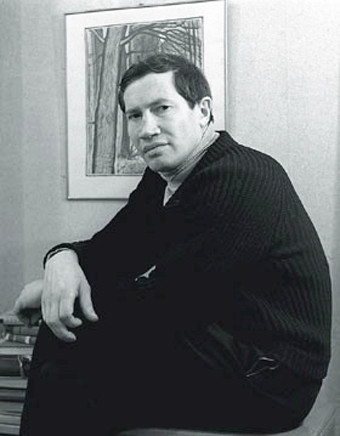
Georgy Vladimov (1931-2003)
“Have you considered what you are asking me to ‘return’ to? …
“To where a book has to wait seven years for publication, after it was printed in the chief journal of the country? … Where any half-literate editor can demand any excisions, even after giving his approval? … And where an independent court …will take the side of the State publishing-house in 90 cases out of 100?
“… Ten years ago, in a letter to the Fourth Congress [of Writers, May 1967], I spoke of the arrival of the era of Samizdat; and now that is coming to an end, another more long-lasting era is on its way, that of Tamizdat.
“… You invite me to ‘make myself clear’, to choose — but I’m afraid the choice is not between publication ‘here’ or ‘over there’, but between my readers and you …
“… This is the point of no return: when the fate of writers whose books are bought and read is decided by writers whose books are neither bought nor read.
“… While remaining on this earth, I don’t want to share your company. Not for myself alone, but for the sake of all those you expelled, ‘destined’ for extermination and oblivion, I exclude you from my life, even if you have not authorized it; but I think you won’t object.
“… Go on carrying your grey burden, go on doing what you are fit for and called to do: oppress, persecute and ‘refuse to permit’. Without my assistance.
“I hereby return Union membership card No. 1471.”
*
[14]
Vladimir Voinovich
“To the Members of the ‘Brigantine’ Club” (2 November 1977)
A few years ago, Vladimir Voinovich received notice from the members of the literary “Brigantine” club that he had been chosen as an honorary member of the club (founded at School No. 7 in Artyomovsk, Voroshilovgrad Region, east Ukraine). After this Voinovich regularly received greetings on 1 May from the members of the “Brigantine” club.
On 1 November 1977 he received the following letter, signed by the headmaster of School No. 7 and twelve pupils who are members of the club:
“To Citizen V.N. Voinovich:
“It has come to our notice, from foreign radio broadcasts and from the year-book of the Union of Writers, that you have been expelled from the Union of Writers for anti-Soviet activities.
“We are indignant at your ‘creative work’ and we feel that, after this, you are unworthy to be a member of the ‘Brigantine’ literary club, of which fact we hereby inform you.”
In an answering letter to the pupils Voinovich wrote, in particular:
“… About four years ago (you’ve realized it a bit late) I was indeed expelled for activities which it would be more correct to describe as literary and social, that is, for trying to write according to my abilities and live according to my conscience.
“… My books have not become worse because of my expulsion from the so-called Union of Writers.
“… My books are not now published in the USSR, but the fault for this is not mine.”
Quoting Lenin’s words about many Russian writers being forced to publish abroad, Voinovich ends his letter thus:
“I hope that someday Lenin’s dream will come to pass and that among the many books which are as yet unavailable to you, you’ll have access to mine. And then some of you will be ashamed of signing the letter composed by your headmaster.”
*
[15]
Sophia Kalistratova, Naum Meiman, Petro Grigorenko and Andrei Sakharov:
“To the Psychiatrists of the World, the World Psychiatric Association, Amnesty International, and all Honest People. In Defence of Alexander Podrabinek and Josyp Terelya” (17 October 1977)
“… Recently the memoirs of Josyp Terelya were published in the West. With touching simplicity and credibility, he describes the horrors of the Sychovka Special Psychiatric Hospital. The authorities reacted swiftly — Terelya was again imprisoned in a special psychiatric hospital [CCE 45.14, CCE 46.13, CCE 47.12]. We call on you to come to his aid.
“The threat of repression is now hanging over Alexander Podrabinek [CCE 45.10 and CCE 47.3-2, Chronicle] … This threat must and can be averted.”
*
[16]
Alexander Podrabinek, Irina Kaplun, Vyacheslav Bakhmin, Vadim Shcheglov, Gleb Yakunin, Naum Meiman, Victor Kapitanchuk, Petro Grigorenko and Vladimir Slepak
“Statement” (19 October 1977)
In defence of Vaclav Havel, Jiri Lederer, Frantisek Pavlicek and Ota Ornest, whose trial began in Prague on 17 October.
“The undersigned consider very timely the foundation of the International ‘Helsinki Agreements Implementation Group’ [5] and they announce publicly their adherence to it.
“… We are convinced that the activities of the Public Groups to Assist the Fulfilment of the Helsinki Agreements are both legal and useful and in that conviction, we are continuing our work.“
- “Members of the Moscow Helsinki Group: Petro Grigorenko, Sophia Kalistratova, Naum Meiman, Vladimir Slepak
- “Members of the Working Commission: Vyacheslav Bakhmin, Irina Kaplun, Alexander Podrabinek
- “Members of the Christian Committee: Father Gleb Yakunin, Victor Kapitanchuk, Nikolai Goretoi, Nikolai Kunitsa, Vadim Shcheglov”
*
“Members of the Armenian Helsinki Group [CCE 46.15 [13], Eduard Arutyunyan, Robert Nazaryan, Shagen Arutyunyan and A. Khlgatyan, have declared that they are joining the international ‘Helsinki Agreements Implementation Group’.”
***
AMNESTY FOR POLITICAL PRISONERS (17-20)
[17]
Malva Landa
Vershino-Shakhtoma town (Chita Region), 4 October 1977
“Political Prisoners’ Day in the USSR is approaching, the day of prisoners of conscience in the USSR. This year political prisoners in prisons, in the small zones of various regimes of camp, will be marking this day for the fourth time …
“On this day, in the ‘large zone’ outside [6], although in distant exile and formally sentenced for arson (in fact for ideological nonconformism [CCE 46.1]), I declare my solidarity with political prisoners and prisoners of conscience in the USSR.
“On that day I shall be fasting, like them.
“Freedom for prisoners of conscience in the USSR!
“Open up the camps and prisons, for independent international inspection! for Amnesty International! and for the independent press!”
*
[18]
46 signatures
“Appeal to the Supreme Soviet of the USSR concerning an Amnesty for Political Prisoners”
(30 October 1977)
“… 7 November will be the 60th anniversary of the October Revolution … There is no doubt that an amnesty will be announced for that reason. We appeal to the Supreme Soviet not to exclude political prisoners from that amnesty.
“We would remind you that in Spain, which experienced the cruellest of civil wars, all the political prisoners have been amnestied. We remind you that the coming year, 1978, has been officially declared ‘Political Prisoners Year’ by the United Nations.”
*
[19]
46 signatures
“Statement to the Supreme Soviet of the USSR” (30 October 1977)
The authors, referring to their Appeal for an amnesty for political prisoners (see above), write:
“… At the same time, we consider it necessary to call attention to the absolutely unbearable situation of all categories of political prisoners in the USSR, which is incompatible with human dignity, humanity and accepted international standards.
“… We call on you, in connection with the adoption of the new Constitution and the 60th anniversary of October, to take the necessary measures on these matters so important to the well-being of Soviet citizens and to the prestige of our State.”
*
[20]
Andrei Sakharov
“To Academicians B.N. Ponomaryov and A.P. Alexandrov” (15 November 1977)
“I and many of my friends are convinced that an amnesty for all political prisoners in the USSR, liberalization of the regime and shortening of prison sentences for all prisoners, abolition of forced labour, abolition of the death penalty, measures to ensure full human rights in this country, which in the past has lived through monstrous terror and national suffering, would have a great significance both internally and internationally.
“What is the official point of view on this, the view of the CPSU Central Committee? What is your personal point of view?
The extremely limited nature of the last amnesty disillusioned many in the USSR and abroad. Prisoners of conscience, among them Kovalyov, Dzhemilev, Romanyuk, Vins, Orlov, Ginzburg, Shcharansky, Gluzman, Gamsakhurdia, Kostava, Rudenko, Tikhy, Petkus, Ogurtsov, Sergienko, Gajauskas, Shumuk, Chornovil – and hundreds of others I have not named merely for lack of space – should be released.
“I appeal to you, as members of the CPSU Central Committee. I hope that my letter will become known to the CPSU Central Committee, its Politburo and also to L.I. Brezhnev, General Secretary of the CPSU Central Committee.”
*
WORLD PSYCHIATRIC ASSOCIATION (15, 21-22)
[21]
Vyacheslav Bakhmin, Irina Kaplun, Alexander Podrabinek and Felix Serebrov
“To Psychiatrists Participating in the Honolulu Congress” (August 1977)
“… We hope you will not remain indifferent to the fact that in the USSR psychiatry is not used only to treat the mentally sick, but also as a means of suppressing civil freedoms.
“… In this connection, we call your attention to the fact that the establishment of international norms for the treatment of mentally ill persons could to some extent prevent the well-known abuses of psychiatry.
“The absence of internationally agreed criteria concerning the danger to society of the mentally ill leads to a situation where thoughts and words are sometimes defined as an illness dangerous to society.
“We call on you, the participants of the International Congress of Psychiatrists, to condemn in the name of humanity and charity the abuse of psychiatry for political ends.”
This appeal from the Working Commission to Investigate the Use of Psychiatry for Political Purposes was supported by 39 people.
*
[22]
Vyacheslav Bakhmin, Irina Kaplun and Alexander Podrabinek
“Appeal to the World Psychiatric Association, two months after Honolulu” (4 November 1977)
“Two months have gone by since the days when a resolution was passed at the Psychiatric Congress in Honolulu, condemning the Soviet Union for abusing psychiatry for political ends. However, the Commission cannot, unfortunately, perceive any visible change in the use of medicine as a punishment …
“We call on the Psychiatric Association not to slop short at passing resolutions but to make every effort to have them put into effect.”
*
[23]
Josif Dyadkin
To P.A. Ivanov, editor of Kalininskaya pravda (17 November 1977)
On 15 November the newspaper Kalininskaya pravda printed an article entitled “Under the cover of the slogan ‘Defence of Human Rights’.” The article was signed ‘V. Bolshakov’. In connection with this article Josif Dyadkin, a resident of Kalinin (CCE 45.20 [4]), asks a number of questions.
For example:
“How can I, a reader, obtain the journal Aussenpolitik, the newspaper New York Times, the book The Year 2000 and the work by Solzhenitsyn The Gulag Archipelago, which are quoted by V. Bolshakov, so that I may read their full text and thus be sure that the ideas of the authors have been honestly reported?”
He suggests that the editors should ask A.D. Sakharov, who is attacked in the article, to give his views on the pages of Kalininskaya pravda, so that we may be certain of the proposition that Sakharov is an enemy of socialism, while Bolshakov is its friend.
“Without this I cannot vouch for Bolshakov’s integrity: he is carrying on a dialogue with an opponent whom he has first gagged.”
*
S.V. Belyakov, deputy editor of Kalininskaya pravda, replied to Dyadkin on 18 November:
“Citizen Dyadkin,
“In your letter you asked quite a lot of questions, which are difficult to answer all at once. We invite you to come to the publishing house, so that we can have a talk on the subjects you mention.”
The talk took place. During the conversation Belyakov told Dyadkin that he could not meet Bolshakov, as the latter did not work there: the material had been sent from the Novosti Press Agency.
*
AFL-CIO CONGRESS INVITATIONS (24-25)
[24]
Vladimir Borisov, Anatoly Marchenko, Alexander Podrabinek and Andrei Sakharov
“To Mr Meany, President of the AFL-CIO”
The authors of this letter (together with Nadezhda Mandelstam and Val. Ivanov) were sent invitations to attend the AFL-CIO Congress in Los Angeles as guests.
Vladimir Borisov received seven copies of the invitation through the post. Andrei Sakharov received the envelope his invitation had been in: it now contained a cutting of an insulting nature from some journal. The others received nothing. At the Department of Visas & Registration (OVIR) Borisov was told that invitations to individuals from foreign organizations could not be considered.
The authors of this letter, after expressing their thanks for the invitation, write:
“We would gladly visit Los Angeles, if the Soviet authorities would grant us tourist visas and would guarantee that we would be allowed to return to the USSR.”
*
[25]
Anatoly Marchenko
“To those taking part in the AFL-CIO Congress”
“… I could not visit you for reasons that were neither my fault nor yours. I would, however, like my short speech to be heard at your congress in spite of this.”
Later the letter describes labour conditions and the daily life of workers in the Siberian settlement of Chuna, where Anatoly Marchenko is serving his term of exile (CCE 35.2); it also describes the “‘principle of the hierarchical allocation of benefits”. The letter ends:
“Such conditions for the working population of our huge country are possible only because we are completely deprived of rights in our own homeland.
“In the USSR the management, the trade unions, the authorities in power and the punitive organs are all links in the same chain, which has our nation securely shackled. All organizations, including the Church, are under the control of a small group of rulers, and are subordinated to them. May our 60 years of experience serve as a warning to other nations!
“I can understand those Americans who are dissatisfied with the political, social and even economic conditions in their country. I sympathize with their wish for a better life. However, when I read ecstatic journalistic accounts of my country by your fellow countrymen, I long to address them in the words of a modern song of ours: ‘If you really envy us, come and sit beside us here’. …
“I invite Mike Davidow, Gus Hall [7] and anyone else who wants to come, to be my guests in Chuna, together with their families. If they agree, I’ll make out official invitations for them. I also invite any delegate at your congress who is willing to visit me, and I ask you to send me his name so that I can make out an official invitation.”
*
[26]
GUNARS RODE TO BREZHNEV
Gunars Rode
“To L.I. Brezhnev, the Chairman of the Presidium of the USSR Supreme Soviet, from Soviet dissident Gunars Oskarovich Rode (b. 1934),
who is resident at the following address:
226029, Latvian SSR, Riga-29, 9 Gramzdas Street, flat 1” (31 July 1977)
The former political prisoner (1967-1977), released on 19 May 1977 (CCE 18.2, CCE 45.11-3), writes:
“I ask you to relieve me of citizenship of the Union of Soviet Socialist Republics, as it was forcibly and groundlessly imposed on me.
“I was not born in the USSR, as in 1934 Latvia was an independent State, and my parents were Latvian citizens. So I was not a citizen of the USSR by birth.
“The fact that Latvia was occupied by the Soviet Union in 1940 could not be a reason for an automatic change of citizenship.
“It was not without reason that in 1950, when I received my first passport at the age of 16, I was told to write an application asking for Soviet citizenship. When I attempted to refuse to write such an application, I was threatened with arrest at Riga Police Station 7 and told my parents family would be punished. Faced with such threats, I had to give in and write the application. Thus I formally became a citizen of the USSR …
“… After being sentenced, I applied over ten times to the Soviet authorities and the government, asking to be relieved of my Soviet citizenship. I did not make any other demands or requests — either for remission of my sentence for unproven lawbreaking, or for permission to leave the USSR. I merely did not wish (and still do not wish) to have anything in common with those who support the policy of the CPSU and obey it, or with those who direct the internal and foreign policies of the USSR, which have nothing in common with the internationally accepted concepts of human rights.
“I do not want to have anything to do with traitors to the Latvian people, who are even now transforming the full-blooded Latvian nation into a dying national minority in its own land, destroying its historical and cultural values, distorting the recent history of Latvia and the Latvian people.
“… In January 1975, I sent a statement to the Chairman of the Presidium of the USSR Supreme Soviet from Corrective-Labour Colony 17/A in the Dubrovlag Corrective-Labour Institution (Mordovian ASSR), in which I renounced the responsibilities of Soviet citizenship on my own initiative and openly declared that in future I would no longer consider myself a Soviet citizen … After repeated requests, I received an answer only from the Vladimir Corrective Labour Department, noting my statement.
“… I ask you to annul my application for Soviet citizenship, which I wrote under intimidation at the beginning of October 1950 in Police Station 7 in Riga, and also the second statement I wrote there in similar circumstances 11 years later; I ask to be considered a Stateless person living on the territory of the USSR, and to be given the opportunity of making out my personal documents as for a Stateless person.”
*
[27]
Vadim G. Baranov and G.E. Baranova
“To the Chairman of the USSR Constitution Commission”
Vadim Baranov (a worker with 25 years seniority) and his wife, who have been trying since January 1977 to obtain permission to emigrate from the USSR (CCE 45.15, CCE 46.22), write:
“We consider it our duty to inform you that, because of our convictions, we cannot accept the new Constitution …
“We no longer consider ourselves citizens of the USSR. We do not believe that a happy future is being constructed …
“We do not believe in the ruling Party … Of course, we could congratulate you on the great achievements of the 60th Anniversary [of the October 1917 Revolution], such as: the shortage of food-products or their complete disappearance, the replacement of foodstuffs by vodka … the complete breakdown of agriculture, the absolute decline in morality among the population, the existence of psychiatric hospitals, camps and prisons for political prisoners …
“On the basis of the [UN] Covenant on Civil and Political Rights … we applied to the Presidium of the USSR Supreme Soviet, expressing our wish to leave the USSR.
“… We have had no answer to this day.”
*
[28]
Valery Abramkin
“To the RSFSR Procurator: A Statement” (9 November 1977)
Having received no answer from the procurator’s office to his two previous statements (to the procurators of Moscow and Tuapse, CCE 43.14, CCE 44.27), Abramkin insists that the violations of legality which he reported should be examined, as they were committed not only by the KGB but also by the procurator’s office, which has now not answered him for several months. He proves that the actions of the KGB which he complained about were violations of his constitutional rights (Articles 118, 125 and 127 of the old 1936 Constitution).
In conclusion, Abramkin discusses the two-faced nature of the officially proclaimed principle that rights and duties are one. He reaches the following conclusion:
“Having exhausted almost all the possibilities of defending my rights which are afforded to me by the Constitution and the laws, I declare, as a citizen of the USSR, that if I do not receive a reply from you giving fundamental answers to my questions within the period of time laid down by law, that is, if it is officially established that a State body, whose duties include observance of the law, is basically sanctioning violations and limitations of my civil rights, I shall be forced to absolve myself of responsibility for fulfilling the duties enjoined on my by the Constitution, as a citizen of the USSR.”
Abramkin’s statement was sent, ‘for checking out’, from the RSFSR Procurator’s Office to the Moscow Procurator’s Office and that of Krasnodar Region (Krai).
On 28 November an assistant procurator of Moscow, S. N. Chistyakov, replied to Abramkin: “Violation of the law by officials of the KGB Administration for Moscow & the Moscow Region at the USSR Council of Ministers has not been proven.”
*
[29]
Alexander Bolonkin
“To the Supreme Court of the Buryat ASSR” (14 August 1977)
STATEMENT
“I have written twice to the chairman of the Buryat ASSR Council of Ministers (7 April 1977, registered letter No. 163; and 19 January 1977, registered letter No. 181), asking him to give me work appropriate to my qualifications as a Doctor of Technology and living quarters fit for a human being (Article 122 of the RSFSR Constitution).
“I have received no reply.
“I demand that the chairman of the Buryat ASSR Council of Ministers be charged in accordance with Article 150 (RSFSR Criminal Code), for abusing his public position and ignoring the Constitution of the RSFSR.
“I attach a photograph of the hut in which I live (a worker’s palace in the land of developed ‘socialism’), and which I share with two other families.”
*
On 23 August a reply was sent from the Supreme Court of the Buryat ASSR:
In answer to your statement of 14 August 1977, we must explain to you that the Supreme Court is not competent to deal with the questions you raised in your letter.
A.A. Sidorin
Chairman of the Supreme Court (Buryat ASSR)
==================================================
NOTES
- Altshuler’s text was published in The Baltimore Sun in October 1977.
↩︎ - Lerner to Brezhnev. The Russian text contains a play on words which cannot be rendered in English: Russian uses the same word for ‘outcome’ and ‘Exodus’.
↩︎ - The full text of Sakharov’s 27 September 1977 Appeal was published by the New York Times after some delay.
↩︎ - Vladimov’s letter of resignation from the Writers Union was published in full in Index on Censorship (London, 1978, No. 2) and in Notes from a Madhouse, Smoloskyp Publishers (Maryland USA, 1977) 21 pp.
↩︎ - The Helsinki Agreements Implementation Group (HAIG) was based in Belgium (President, Willy Kuijpers). On 22 March 1978 the Group issued a press release announcing the adherence of the Moscow Groups and the Armenian Helsinki Group, and a dossier of relevant documents, including that summarized here and the succeeding item.
↩︎ - Malva Landa is referring to a common distinction made in the USSR between those held in prisons and camps (the ‘small zone’), and those trapped within the country itself (the ‘large zone’). Cf. Konstantin Gursky: “I remember a 1939 issue of Krokodil … . The front page carried a map of Hitler’s Germany …”, see Resistance in the Gulag, Vozvrashchenie: Moscow, 1992, p. 134 (“A Lesson in Geography”).
↩︎ - Mike Dawidow whom Anatoly Marchenko invited to eastern Siberia, was Moscow correspondent of the US Communist Party newspaper Daily World [R, 25 December 1968]; Gus Hall was a leading figure in the CPUSA (see Bukovsky Archives, [R] 1 October 1969 and Judgement in Moscow, Chapter One, 1.3 “Firms run by Friends“).
↩︎
============================
 A Chronicle of Current Events