- 2-1: 1-4. 1. Case No. 46012; 2. The Journal Poiski (Searches); 3. The Journal Obshchina (Community) and 4. The Arrest of Vladimir Poresh (Leningrad)
- 2-2: 5-9. 5. Igor Guberman Case; 6. Case of Boris Zubakhin; 7. Interrogation of Enn Tarto (Tartu); 8. Persecution of Members of FIAWP Council of Representatives; 9. A. Voloshanovich and M. Kovner are Searched
*
[1-4]
1. Case No. 46012
(see CCE 52.4-4 and CCE 53.15)
On 26 August 1979, a search was conducted at the home of member of the Moscow Helsinki Group Victor Nekipelov in the town of Kameshkovo (Vladimir Region).
G.P. Yurov, Assistant Procurator of Vladimir city; KGB Major N.A. Obrubov; and V.N. Khokhorin, an inspector of the police Criminal Investigation Department, took part in the search. One hundred and seventeen points are listed on the search record. Among other things, an issue of A Chronicle of Current Events, Moscow Helsinki Group documents, documents of the Action Group to Defend the Rights of the Disabled, and uncensored literature printed in samizdat and abroad were confiscated.
Nekipelov’s own articles and letters were also taken (this issue, CCE 54.22).
*
BELANOVSKY
A search was conducted at the Moscow home of Sergei Belanovsky (CCE 45.18) on 13 September 1979.
Several hours before the search, someone claiming to be “an acquaintance of Sergei” telephoned Belanovsky’s acquaintance B. Yurovsky and asked him to “get a suitcase ready”. At 7 pm this suitcase, sealed with plaster and labelled ‘Belanovsky’, was confiscated. It contained samizdat, including back issues of the Chronicle.
The search of Belanovsky’s home also began at 7 pm.
It was conducted by Investigator Yu.A. Burtsev (CCE 52.4-2, CCE 53.16). Three others, apart from the witnesses, participated. Two of them, officials of the Crime Department, presented their identity papers but, with Burtsev’s support, did not allow their names to be written down. A third person arrived later.
Burtsev asked Belanovsky to hand over ‘deliberate fabrications’ voluntarily. He would hand over all his samizdat, Belanovsky said, but he didn’t consider that any of it contained ‘deliberate fabrications’ (Article 190-1). He would also insist that anything confiscated be returned to him.
Belanovsky kept his promise, but a search was undertaken nevertheless. The final result was that issues of A Chronicle of Current Events (the most recent being No. 45); Komarov’s book The Destruction of Nature (Posev Publishers), eight typewritten copies of the same book; Roy Medvedev’s Let History Judge [1]; translations of Stanislaw Lem’s articles published in Poland; and two typewriters were confiscated. Ten folders of writings by ‘M. Liyatov’ (i.e., Mikhail Yakovlev, see CCE 53.16) were also taken. These folders were not among the documents “handed over voluntarily”.
Several days later, Belanovsky was notified by telephone of an outdoor meeting at which the confiscated articles would be returned. They gave him back the empty suitcase and asked to have a chat with him. They told him that Investigator Burtsev was not counting on receiving authentic evidence from him: therefore, he would not be summoned to an interrogation in the near future. They informed Belanovsky: “Some people think that because the case has been going on for a long time and no one has yet been charged, that state of affairs will continue. That’s not true. A decision one way or the other will be taken very soon.”
They tried to obtain a promise from Belanovsky not to engage in any further activities and, on parting, asked him to meet them again. He told them to send him a summons.
On 12 October 1979, Belanovsky was taken from work to the Cheryomushki district department of the Moscow KGB. In sharp contrast to the previous chat, he was informed very rudely that he had not responded to summonses and was therefore being cautioned “in accordance with the Decree” (25 December 1972). Belanovsky refused to counter-sign the warning. (Two days later he found a summons in his letter-box for a date that had long passed.) At the end of October Yurovsky was also issued a caution, which he signed.
Sergei Belanovsky is 26 years old. A chemist by profession, he works in the sociological research laboratory of the All-Union Research Institute on the Organization of the Coal Industry.
*
VELIKANOVA AND OSIPOVA
On 11 October 1979, on a warrant signed by Investigator Burtsev, searches took place in Moscow at the homes of Tatyana Velikanova and Moscow Helsinki Group member Tatyana Osipova. Ponomaryov (CCE 44.7), a Senior Investigator of the Moscow City Procurator’s office, conducted the search.
According to the record, two police officials from the internal affairs department, a local policeman and vigilante S.E. Shipilov also took part in the search, as did KGB official L.B. Karatayev (who was not mentioned on the record). The search began in Tatyana Velikanova’s absence; she arrived about three hours later, when the search was already drawing to an end. The members of her family who were present during the search had the impression that they were hurrying to finish the search before she arrived.
On the search record, consisting of 99 points, the majority of the confiscated articles were not properly described. For example: “43. A folder containing typewritten papers, from the words ‘Trial with Dogs’ to the words ‘Ida Nudel 20 June 1978’, 136 pages”. Among the articles confiscated were:
- Documents concerning the arrests, trials and present situation of political prisoners, believers and would-be emigrants.
- Documents of various groups to defend the rule of law.
- Issues of A Chronicle of Current Events, in samizdat and as printed by Khronika Press (New York); an Information Bulletin published by Kronid Lyubarsky in Munich [2].
- Books and journals published abroad.
- Samizdat, including three copies of each of issues 3-7 of the collection In Defence of Economic Freedoms (compiled by ‘Burzhuademov’ [Victor Sokirko]).
After the search Tatyana Velikanova was almost constantly followed, right up to her arrest on 1 November 1979 (CCE 54.1-1).
*
Vorobyov, a Senior Investigator from the Moscow City Procurator’s office, conducted the search at the home of Tatyana Osipova.
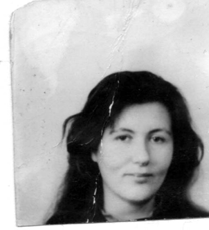
Tatyana S. Osipova (b. 1949)
The following articles were confiscated:
- Documents of: [i] the Moscow Helsinki Group; [ii] The Working Commission ; and [iii] the Action Group (for the Defence of the Rights of the Disabled in the USSR);
- Letters and statements, addressed to Tatyana Osipova personally and to the Moscow Helsinki Group;
- Letters and statements to official Soviet organizations and replies from some of them;
- Copies of search records, indictments, judgments and appeals;
- Documents about the persecution of defenders of the rule of law, believers and Crimean Tatars, and about prisoners circumstances;
- A list of political prisoners (about 300 pages);
- A table comparing the Criminal Codes of various [Soviet] Republics (copy of an official publication);
- Proposals regarding the draft USSR Constitution;
- Several issues of A Chronicle of Current Events;
- Books and journals published abroad, including Solzhenitsyn’s The First Circle, Avtorkhanov’s The Technology of Power and Zinoviev’s Bright Future;
- Two typewriters, two tape-recorders and two cameras;
- Three jackets, a jumper, gloves, a set of underwear, canned goods, chocolate, coffee, cigarettes and chewing-gum;
- 1,074 roubles.
Tatyana Osipova and her husband Ivan Kovalyov refused to sign the search record, but did add their corrections to it, Kovalyov commented in particular that
“This record has been drawn up in such a way that it is impossible to identify the confiscated materials. For example, it is not clear what is meant by ‘various documents’ …
“I strongly protest against the illegal confiscation and the incorrect completion of the record.”
On 20 October 1979, Tatyana Osipova sent a statement to the RSFSR Procurator’s office demanding that a criminal charge be brought against Vorobyov under Articles 171 (“exceeding one’s authority or official powers”) and 172 (“negligence”) of the RSFSR Criminal Code:
“… Vorobyov took a large number of articles which could not have been deliberately slanderous, namely:
“a. Money — 1,074 roubles
“b. Clothes — jackets, gloves, a set of underwear, etc.
“c. Foodstuffs — canned goods, chocolate, coffee, etc.
“In so doing he exceeded his official powers and caused my family real hardship, i.e., he committed actions that fall under Article 171 of the RSFSR Criminal Code.
“Moreover, Investigator Vorobyov, in violation of Article 171 (RSFSR Code of Criminal Procedure), not only did not offer to let me see the confiscated articles and documents: he refused to do so after I had expressly demanded it. I was therefore deprived of the opportunity to ensure that all the articles confiscated were correctly entered on the record, I was also deprived of the opportunity of finding out whether the record was read out correctly, as they refused to give me a copy of the record so I could check what was being read against what was written.
“A number of other illegal actions were committed which, like the ones mentioned above, were noted by myself and my husband in our corrections to the record. Since the search and the confiscation of materials are connected with a criminal case, the investigator, in an act of negligence, has caused actual harm to my interests (which are protected by law) and possibly to the interests of other citizens, i.e., he has acted in a way that comes under Article 172 (RSFSR Code of Criminal Procedure) …”
*
2. The Case of the Journal “Poiski” [Searches]
(CCE 52.4-4 and CCE 53.16)
*
SEARCHES AND ARRESTS
On the morning of 15 August 1979, several policemen broke into the flat of T.N. Babukhina, Victor Sorokin’s mother, in the town of Pushkino (Moscow Region).
After breaking down the door, they took 70-year-old Babukhina to the police station by force, allegedly for an interrogation to be conducted by Investigator N.M. Tsyganok. Together with other police officials, Tsyganok insulted Babukhina and threatened her with 15 days in jail. Only towards evening did they inform her that the interrogation would take place the next day.
When Babukhina arrived the next day at the appointed time (10 am), the investigator was not there. She waited all day, and in the evening was told that the investigator did not need her.
*
Victor Sorokin and his wife Seitkhan sent a statement to several Soviet newspapers and journals describing the incident, protesting against the tyranny of the police officials. They demanded an end to such persecution and the punishment of the guilty parties. Copies of this statement were sent to the police and the Procurator’s office.
*
That same day, 15 August 1979, a search was conducted in Moscow at the flat of Vladimir Gershuni, a member of the editorial board of the journal Poiski. Senior Investigator of the Moscow City Procurator’s office Sazonov and Captain V. S. Vasilev from the Crime Department were in charge of the search, which lasted over eight hours.
Personal notes, 31 photographs (including ones of Mayakovsky and Pasternak), Poiski No. 5, and unused paper were confiscated from Gershuni.
*
On 18 September Mikhail Yakovlev (CCE 53.16) was detained in the town of Zhukovsky (Moscow Region).
He was taken to the police station, where officials conducted a body-search. They did not show him their credentials or a warrant for the search. A notebook and two exercise books containing his own writings were confiscated. They did not give Yakovlev a copy of the list of confiscated items. He was cautioned in writing for violating the residence regulations.
*
The same day, on the platform of the Kazan Station in Moscow, Valery Abramkin, a member of the Poiski editorial board, was detained and searched.
A man whose papers identified him as A.A. Ryzhov, a Moscow Crime Department official, conducted the search. As a reason for the detention and search, which took place without the sanction of a procurator, Ryzhov said that they were looking for explosives: “It’s all to do with that same case about the explosions in the Metro of two years ago.” Nothing was confiscated from Abramkin.
*
On 3 October 1979, A.P. Chus, Party Secretary of the Computer Centre at the Moscow Fruit & Vegetable Industry Directorate, told Leonid Blekher that “someone from the agency was coming for a chat” with him and with Tatyana Zamyatkina.
Zamyatkina and Blekher were called into the secretary’s office in turn, where they found a man who introduced himself as “an official from the city’s internal affairs department”. He told them that a case concerning the publication of Poiski by Valery Abramkin was being conducted at that time: they were assisting Abramkin, he said, and if they continued to do so there would be sad consequences. On this note the chats ended.
*
On 29 October and 1 November 1979, Investigator Burtsev summoned Valery Abramkin to the Procurator’s office and once again (CCE 53.16) threatened him with arrest if a sixth issue of Poiski [Searches] appeared.
*
3. The Case of the Journal “Obshchina” [Community]
& 4. The Arrest of Vladimir Poresh.
On 1 August 1979, the philologist Vladimir Poresh was arrested in Leningrad.
Poresh (b. 1949) is one of the editors of the journal Obshchina [3]. It is published by the Christian Seminar on Problems of the Religious Revival [4], which is led by Alexander Ogorodnikov (CCE 51.15 and CCE 52.11).
Searches of the flats of Poresh and his wife were conducted on the same day. Philosophical and religious books were confiscated.

Vladimir Yu. Poresh (1949-2023)
*
At the same time searches were conducted at the homes of O. Okhapkin, N. Epishev and V. Lazutkin, also in Leningrad.
Typewritten copies of Obshchina [Community] and other samizdat were confiscated from Lazutkin. A short while before the search, materials and books which he said he had never seen before had been planted in his flat. The planted material made up about 50% of the 92 items in the record.
The record had been drawn up in advance and some of the books on it simply could not be found. V. Lazutkin (D.Sc. Physical & Mathematical Sciences) works at Leningrad State University. He is not a member of the Christian Seminar, but a close acquaintance of Poresh.
*
On the same day, 1 August 1979, searches took place in Moscow.
Philosophical and religious literature, several speeches by Solzhenitsyn, Sakharov’s book My Country and the World, Nadezhda Mandelstam’s memoirs and letters and statements of the Christian Committee (for the Defence of Believers Rights in the USSR) were confiscated from T. Lebedeva, in whose flat the Christian Committee had recently been meeting.
In Vladimir Burtsev’s flat, where no one currently lives, they found nothing apart from a postcard in the letter-box and an old notebook. The search warrant was signed by R.G. Topolyan, a Senior Investigator of the Leningrad Procurator’s office.
Lazutkin was interrogated in Leningrad on 6 August. He was then summoned again. He refused to be a witness in the case. On 10 August a search was conducted in Leningrad at the home of P. Kulagin, who had amended meetings of the Seminar. On 13 August he was summoned for interrogation.
*
Members of the Christian Seminar (Vladimir Burtsev, Victor Popov, Tatyana Shchipkova, Lev Regelson and V. Sokolov) have appealed to the Italian organization of young Catholics “Community and Liberation” to defend Alexander Ogorodnikov and Vladimir Poresh, the founders of the Seminar.
Eleven participants in the Leningrad seminar also issued a statement in defence of Poresh. Tatyana Shchipkova (this issue CCE 54.19) has known Poresh since he was her student, although both were then far from religion. She has written an essay about how he came to Faith, to the Church and to Russian religious philosophy.
*
The case of the journal Obshchina was conducted, first by the Leningrad Procurator’s office under Article 190-1 (RSFSR Criminal Code), but soon transferred to the KGB. It is being conducted by Investigators V. Cherkesov, V. Yegerev, Tsygankov, Karmatsky (CCE 53.6) and Lepetunov.
In October 1979, Alexander Ogorodnikov was brought from a camp to Leningrad (this issue CCE 54.13-2).
*
On 28 September 1979, a search was conducted at the home of Father Gleb Yakunin, a member of the Christian Committee (for the Defence of Believers Right in the USSR).
The search warrant was signed by Major Lepetunov, a Senior Investigator of the Leningrad KGB; the search was conducted by Major Yakovlev of the Moscow KGB – he is now in charge of the “Yakunin case” (this issue CCE 54.1-2). The search lasted almost 12 hours. The following articles were confiscated:
- Committee documents and notepaper; articles by Father Gleb; written statements and Baptist and Adventist publications;
- Notebooks; telephone numbers of foreign correspondents in Moscow; postal receipts;
- the journals Posev, Free Word, Kontinent and Vremya i my [“Time and Оurselves”, a quarterly, ed. Kronid Lyubarsky]; Zinoviev’s book Notes of a Nightwatchman; and several religious books, including Dmitry Dudko’s About Our Hope;
- A book by T. Goldberg, F. Mishunov et al., Russian Goldwork and Silverwork, 15th-20th Centuries (Nauka publishers: Moscow, 1967);
- About 40 teaspoons and tablespoons and a white metal cigarette-case, all of which had been lying in a briefcase.
=========================================
NOTES
- Roy Medvedev, Let History Judge. Published abroad in abridged form (1969), this was a selection from a three-volume work Medvedev tried to discuss with the Central Committee several years earlier (see Hoover Institution annotation in Bukovsky Archives, 14 November 1967).
An expanded selection from the Russian original was published twenty years later in 1989.
↩︎ - Veteran dissident and astrophysicist Kronid Lyubarsky compiled, edited and issued the fortnightly Vesti iz SSSR [USSR News Update] in Munich between October 1978 and December 1991.
Some issues were translated into English for Amnesty International by the late Marjorie Farquharson.
↩︎ - On the journal Obshchina, see CCE 49.14 [2], CCE 51.15, CCE 51.21 [19], CCE 52.11 and 16.1
It was published by the Christian Seminar on Problems of the Religious Revival (CCE 41.2-3, CCE 43.11, CCE 46.8), led by Alexander Ogorodnikov (CCE 51.15, CCE 52.11).
↩︎ - See note 3.
↩︎
=========================
 A Chronicle of Current Events