LETTERS AND STATEMENTS
- 23-1. General (1-3, 11)
- 23-2. Letters & Statements by Sakharov (4-10)
- 23-3. Moscow Helsinki Group, documents 26-38
*
1977
[4]
“To the Organizing Committee of the Symposium on the Death Penalty”
(19 September 1977)
“… I fully support the basic arguments put forward by opponents of the death penalty.
“I consider the death penalty to be a cruel and senseless institution that undermines the moral and legal foundations of society … I deny any effective deterrent effect of the death penalty on potential criminals. I am convinced of the opposite: cruelty breeds only cruelty.
“I deny the practical necessity and effectiveness of the death penalty as a means for defending society … I am convinced that the death penalty has no moral and practical justification and represents a survival from barbarous customs of revenge … The abolition of the death penalty is particularly important in such a country as ours, where there is the unlimited rule of state power and an uncontrolled bureaucracy, and a widespread disregard for the law and for moral values …
“There are other peculiar features of our contemporary reality … They are the depressingly low cultural and moral level of our present criminal justice; it is dependent on the State and, often, displays corruption, bribe-taking and dependence on local ‘bosses’.
Sakharov goes on to describe the case of manual worker Rafkat Shaimukhamedov, who was executed on a charge of murder.
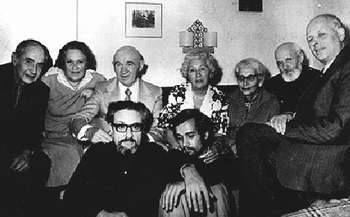
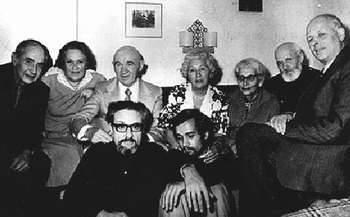
Sakharov and other leading dissidents [1], October 1977
*
[5]
“The Kontinent magazine is three years old” (1 November 1977)
“The main conclusion after three years is that Kontinent has shown itself to be the most interesting and widely read in the USSR of all the Russian journals published abroad…”
*
[6]
Sakharov (and Bonner)
“To the President of Yugoslavia, Josip Broz Tito” [2], 25 November 1977
“We welcome the amnesty for political prisoners in Yugoslavia, which, as far as we know, is the first in the history of a country in the socialist camp. We hope that this humane and wise step of the Yugoslav government will serve as an example to the governments of other countries.
“A worldwide political amnesty for prisoners of conscience would be healthy for the political climate of the whole world and would promote the preservation of peace on our planet.
With respect,
Elena Bonner-Sakharova-Alikhanova
Andrei Sakharov
Moscow, 25 November 1977
*
[7]
“Speech for a meeting of the AFL-CIO” (28 November 1977)
A.D. Sakharov, who was invited to a congress of the AFL-CIO (CCE 47.15 [24]), sent the text of his proposed speech. Having noted that the AFL-CIO influences domestic and international affairs to a high degree, he writes:
“They say that the character of the American people, their active and practical goodwill and sense of their own worth are embodied in the question which has become a national tradition, ‘How can I help you?’ It seems to me that by inviting me to this meeting, you are also putting this question to me.”
Sakharov distinguishes, first and foremost, the question of communication, which is “of decisive importance for the whole struggle for human rights in the USSR”. “The authorities in the USSR”, says Sakharov, “take the most brazen measures to cut off channels of communication with the West.” He tells of the seizing of correspondence, the disconnection of telephones, and wiretapping and gives an up-to-the-moment example:
“… I received an envelope with an offensive sketch inside it” [instead of the invitation to the AFL-CIO Congress, Chronicle]. “This morning, after we had discussed this letter aloud in our flat, which is bugged through and through by the KGB, I finally received your invitation.”
Further he says:
“What actions do we expect from you? To promote a wide-ranging campaign in the press and at your congress against violations of the exchange of information, to promote the resolution of this question at the level of international negotiations …
“I am counting on the AFL-CIO to continue actively supporting the struggle for free choice of one’s country of residence. I consider this problem to be important and crucial in the struggle for freedom of the individual from the tyranny of the state…
“At present prominent participants in the movement for human rights in the USSR (Sergei Kovalyov, Semyon Gluzman, Anatoly Marchenko, Andrei Tverdokhlebov, Malva Landa, Mykola Rudenko, Oleksa Tikhy and many others) are in prison or exile.
“Gamsakhurdia, Gajauskas, Ginzburg, Kostava, Marinovich, Matusevich, Orlov, Pailodze, Petkus and Shcharansky are awaiting trial. The clergymen Vins and Romanyuk and many dozens of believers and the leader of the All-Russian Social-Christian Union for the Liberation of the People, Igor Ogurtsov, are in prison.
“Many who have tried to leave this country — the participants in the so-called Leningrad aeroplane case [CCE 20.1], Zosimov, Fedorenko and dozens of others — are in prison and psychiatric prisons, unjustly accused of betrayal of the motherland [Article 64].
“It is a matter of American honour to bring about the release of the Ukrainian artist Pyotr Ruban, condemned for preparing a commemorative gift (a wooden book with a portrayal of the Statue of Liberty) to be given to the American people in honour of the 200th Anniversary of Independence.”
Speaking of the decision by the Association of American Scholars and Engineers Working in the Field of Computer Technology to break off contacts with their colleagues in the USSR if Shcharansky is condemned, Sakharov states:
“I await similar steps regarding the unjustified refusals to permit Slepak, Meiman, Golfand and many others to emigrate. I consider steps such as the withdrawal of contacts to be justified in the struggle for each individual life and fate…”
*
[8]
“A Look at the Past Year”, 14 December 1977
“In 1977 one of the main trends of modern times continued: the antagonism between totalitarianism and the ideology of human rights.”
Sakharov enumerates the most important events of this process in 1977: the statement by US President-elect Carter proclaiming the defence of human rights throughout the world to be the moral basis of American policy; “Charter-77” in Czechoslovakia; open unofficial activities in Poland, East Germany and Rumania; the formation of Helsinki groups in the USSR; the change in the position of a number of the most important European Communist Parties on the issue of defending human rights; the stepping-up of repressive measures in the USSR and the countries of Eastern Europe; the Belgrade Conference; the political amnesty in Yugoslavia.
*
1978
[9]
Interview with the Italian magazine Grazia [3], 31 January 1978
Q. 3 — In the West many people, especially communists, ask what freedoms the Russian dissidents want: after all, they have no unemployment, there is free medical care, etc. What then is it they want? How can one explain what lack of freedom means in the USSR?
You have to live in our country, with a Soviet ‘passport’ [internal ID document], on a Soviet wage, in Soviet flats, with the beggarly Soviet level of health care, education and pensions, with the extremely harsh ideological Party dictates from kindergarten to the end of one’s life, with the monolithic press, with censorship, without the right to strike, with the law on parasitism, in conditions of KGB shadowing, the lack of rights of the ordinary citizen before the bosses, and so on and so forth — then everything becomes clear. […]
Q. 5 — Under the USSR Constitution Soviet citizens enjoy freedom of religion, freedom of convictions, and so on. In what way are such freedoms actually annulled?
All economic, political and ideological power is concentrated in the hands of the Party, or, more precisely, of its leaders. The life of each person and his well-being — totally, in all its details and in what is most important — depends on his loyalty, even if only expressed in words. Instructions, orders, many laws, and traditions, formed over decades, of submission by ordinary citizens and of official power having no checks on it — all this constitutes the lack of freedom. […]
[Q. 6-9]
Q. 10 — Do you believe in socialism as a politico-economic teaching? Is socialism with a human face possible?
I am not a theoretician in the field of politics and economics, and it is not this that is the main, most clearly defined aspect of my books and pronouncements. I am against totalitarianism, against violation of human rights, against lack of freedom.
I see — and indeed everyone who cares to look with open eyes sees — that socialism of the Soviet type, the socialism that actually exists has everywhere where it has been able to develop its potential led inevitably to a party-state monopoly, and, equally inevitably, to crimes and lack of freedom. I am for pluralism of authority, for convergence, for a mixed economy, for ‘the human face of society’, and for me it is not all that important what it is called.
*
[10]
“About the Belgrade Conference” [4] 9 March 1978
“Like many others I’m concerned by the non-fulfilment of the Helsinki agreement in the part that deals with human rights by the USSR and other Eastern European countries. I was disillusioned by the lack of concrete analysis and even of a clear mention of these problems in the final document of the Belgrade Conference. It is precisely this part of the Helsinki agreement which is non-trivial in character and therefore especially important.
“Nonetheless I do not consider the Belgrade Conference a failure.
“For one thing, in the course of preparations for the conference a large quantity of reliable materials on violations of human rights in the USSR and countries of Eastern Europe was collected and systematized. Discussion of these materials in Belgrade and in the world press furthered an understanding of the situation with regard to human rights in the USSR and countries of Eastern Europe, despite the negative, obstructionist position taken by the delegates of these countries (and in part precisely thanks to this). It is very important that a further conference to monitor the Helsinki agreement [Madrid 1980] has been arranged …”
=================================
NOTES
- Andrei Sakharov (1921-1989) was a figurehead of the human rights movement in the USSR and its best-known representative and spokesman in the West.
As the Chronicle records and documents, and he himself frequently acknowledged, there were many other activists, older and younger than himself. A number are shown in a photo taken in 1977. From left to right: Naum Meiman, Sophia Kalistratova, Petro and Zinaida Grigorenko, Natalya Velikanova (mother of Tatyana and Ksenia) and Father Sergy (Zheludkov). In front of them sit Grigory Altunyan from Kharkov, and a 25-year-old Alexander Podrabinek.
↩︎ - Yelena Bonner’s father Georgy Alikhanov, who was shot at the end of the 1930s, was well acquainted with Josip Tito (Chronicle).
↩︎ - Grazia (est. 1938), is a widely-read, Italian woman’s weekly magazine.
↩︎ - The 1977-1978 CSCE conference in the Yugoslavian capital Belgrade gathered to discuss the implementation of the Helsinki Accords, signed by its 35 member-States three years earlier. It ran from 4 October 1977 to 10 March 1978.
It was followed in 1980 by the CSCE conference in Madrid.
↩︎
==============================
 A Chronicle of Current Events