On Poiski (Searches) see issues CCE 51-55 [1].
*
STATEMENT: LAST ISSUE
On 31 December 1979, the editorial board of the journal Poiski issued a statement to its readers. It opens issue No. 8:
“Twenty months have passed since the first issue of Poiski appeared. We are now offering the reader the last issues — 6, 7 and 8 — and would like somehow to sum up …
“Persecution which is systematically intensifying has deprived us of most of the resources needed to continue work. For attempting to break through the blockades against dialogue, for being open about our names and actions, we have already paid with the arrest of one of our editors — Valery Abramkin. It is grievous to think that a man of exceptional intellectual energy and moral steadfastness is behind the bars at Butyrka …
“Confronted with an involuntary and corrupting choice — to accept the right of certain people to place limits on intellectual enquiry or to go underground — we reject both options as equally wrong.
“We retain the basic right to decide for ourselves the form and time schedule for carrying on our cause, a cause which is the same as our purpose in life.
“We refuse now, and in the future, to hide and to argue in whispers.
“We were not ‘playing at politics’ and we do not agree to the conditional draw which they are evidently waiting for us to agree to. We repeat that all of us together with Valery Abramkin are prepared to argue our belief in the legality of Poiski and the necessity of honest dialogue for our country, citizens and State.”
On 3 January Victor Sokirko was interrogated in the case of the journal Poiski, He was threatened with arrest.
On 8 January 1980 Investigator Burtsev interrogated Angelina Gorgan (CCE 55.2) and her husband Mikhail Sukhotin. He asked them about their acquaintance with Abramkin.
*
The Arrest of Grimm and Sokirko
23 JANUARY 1980
On 23 January 1980, after searches at their apartments, Yury Grimm and Victor Sokirko, members of the Poiski editorial board, were arrested. They are both being held in Butyrka Prison; like Valery Abramkin they have been charged under Article 190-1 (RSFSR Criminal Code).
In anticipation of his arrest, Sokirko prepared a letter. Poiski No. 8 closes with his words:
“Dear friends,
“You are well aware I have not the slightest wish to be arrested and if I have not managed to avoid it, this is only because I had to take a risk today in order to make my life easier in the future.
“You know that as a committed materialist I believe in my immortal soul only as the totality of ideas and impressions which will be communicated to the people of today and tomorrow through my words and actions …
“I ask all who love me to save my soul — its main and most important part. I ask you to read, argue over and circulate my articles. For I did not write them for myself and they are bigger than I am …
“This is my main request. The awareness that you will respond to it will give me strength to serve my sentence, however long it might be, with calmness, and to wait for juster times.”
*
His letters and articles were, for the most part, what was taken from Sokirko (see CCE 56.27-1 and CCE 56.28).
At a search at Grimm’s home a typewritten copy of “Faithful Ruslan” (by Georgy Vladimov), letters and statements by Yevgeny Nikolayev, Vsevolod Kuvakin and Mikhail Zotov, a list of foreign correspondents’ telephone numbers, and a typewriter were confiscated.
Before the search a friend of Grimm’s, N. Nizovtseva, had called to see him. A packet of carbon paper was taken from her.
After the search they were taken to Police Station 3.
From there Grimm was taken away; Nizovtseva was asked what telephone number Grimm had communicated to her in the car. Then the investigator filled out a search warrant for Nizovtseva’s flat (the blank form used already had a signature and a stamp).
An Old Testament was confiscated from Nizovtseva and she was then interrogated again at home. The questions concerned Grimm. The investigator promised to phone later and invite her for a ‘chat’; he asked her not to tell anyone about Grimm’s arrest for a few days.
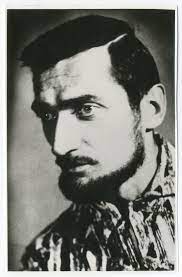
Yury L. Grimm (1935-2011)
*
SEARCHES
On the same day searches took place in the case of the journal Poiski at the homes of Tatyana Samsonova-Yegides, Victor Dzyadko, Vyacheslav Repnikov (CCE 47.8-1 [8]) and Gleb Pavlovsky (CCE 52.4-4, CCE 55.2).
The search at Dzyadko’s apartment was conducted by Investigator Knyazev.
One volume of the five-volume “Scriptures” (YMCA Press), certain materials on the trial of Alexander Ginzburg, and Solzhenitsyn’s interview with the magazine Der Spiegel were confiscated. Dzyadko’s parents inquired about the reason for the search. Those conducting it referred to the previous day’s announcement of Sakharov’s exile (CCE 56.1). When the parents objected that their son did not know Sakharov, they were told that he knew Ginzburg. When they said that he did not know Ginzburg either they were told that Dzyadko knew Irina Zholkovskaya (Ginzburg’s wife) and he worked for the Political Prisoners’ Relief Fund.
During the search at Repnikov’s the second volume of the Gulag Archipelago, letters, and a typewriter with Latin script were confiscated. Investigator Novikov, who conducted the search, interrogated Repnikov at a police station. Repnikov refused to speak about third persons.
*
PAVLOVSKY (I)
Pavlovsky was summoned to the KGB for a conversation. From there he was taken to a search which was conducted by investigator Borovik and a KGB official whom Pavlovsky had seen during the conversation before the search. The collection Self-Awareness [2] the almanac Renaissance, several rough drafts and Pavlovsky’s letter in defence of Abramkin were confiscated.
During the conversation Pavlovsky composed a statement, under pressure from KGB officials, in which he expressed his desire to leave the USSR.
*
On 7 February 1980, Pavlovsky wrote a new statement:
“Having now thought over the situation as a whole, I have reached the conclusion that my basic aims are inseparably linked with living in Russia.
“To retain this, as a last resort I am willing to agree — of my own free will and with reference to myself alone — to a number of restrictions on my actions. Consequently, I intend to refrain from participating in political activities — whether oppositional or official — both as an individual and as a writer, regardless of my moral attitude towards such activities.
“Specifically, this includes my refusal to participate in any political actions whatsoever; meetings, demonstrations and so forth; my refusal to belong to any organizations which have political goals; and my refusal to make any political statements or to give interviews, as well as to support such statements by personal participation …”
This statement was the fruit of a compromise agreement with KGB officials and was considered sufficient grounds for discontinuing the persecution of Pavlovsky (this, in any case, was what he was told).
However, in April 1980 Pavlovsky was again summoned to an interrogation (see below).
***
On 29 January 1980, three of Grimm’s colleagues were summoned to the Moscow city procurator’s office.
On 29 or 30 January the police chief of Pushkino and a man in civilian clothes visited Victor Sorokin at work. They demanded that Sorokin write a statement saying that he would not commit any actions that were harmful to the State (CCE 56.8). The conversation ended in a compromise: he wrote that his articles in Poiski did not contain slanderous fabrications, nor did he intend to include any in his articles in the future.
On 6 February 1980, the case of Sorokin, charged under Articles 192 & 192-1 (RSFSR Criminal Code, CCE 55.2), was closed ‘for lack of proof’.
*
INTERROGATIONS
Between 25 and 29 February 1980, Chief Investigator Burtsev summoned more than 25 people to interrogations about Poiski.
Vladimir Gershuni, a member of the journal’s editorial board, did not go to the interrogation.
Felix Serebrov was serving 15 days in jail at the time (CCE 56.4).
Alexei Smirnov stated on the telephone that he would not go to the interrogation.
Maria Petrenko and Lev Kopelev conveyed statements to Burtsev in which they refused to take part in the investigation.
*
On 16 March 1980, Investigator Burtsev conducted a search at Victor Tomachinsky’s flat (CCE 56.27-1 [3]). His own literary works and statements, the works of Mandelstam, the collection “Unpublished Works” by Grigory Pomerants [3] and six issues of Poiski were confiscated. Tomachinsky managed to insist that they did not take his typewriter but only a sample of the script.
During the search Vronsky, a friend of Tomachinsky’s [4], called to see him; the works Vronsky carried with him were confiscated. Tomachinsky was summoned to an interrogation on 19 March, but he did not go.
*
ROMANOVA
On 18 April 1980, a search was carried out at Avgusta Romanova’s flat. Investigator Vorobyov led the search. The following were confiscated:
- A photocopy of the issue of The USSR Supreme Soviet Gazette containing the UN Covenants on Human Rights,
- a list of political prisoners,
- lists of signatures under appeals in defence of Tatyana Velikanova and Andrei Sakharov,
- two issues of a bulletin issued by the Tatyana Velikanova Defence Committee,
- a few samizdat articles,
- a photocopy of a book of M. Voloshin’s poetry,
- personal notes, blank post-cards, envelopes and
- a letter in defence of Abramkin.
Romanova was told that Alexander Chekalin (former political prisoner: CCE 33.5, CCE 33.6-2 [79], CCE 33.10, CCE 41.6-2) had been detained. He had told her on the telephone, he testified, about an explosion at a factory, and that she had asked him to provide information of this sort in the future. She was promised a face-to-face confrontation with Chekalin.
Chekalin really did phone Romanova. On 11 March, he told her, an explosion had taken place at a military factory in the town of Rubezhnoye (Voroshilovgrad Region), as a result of which ten people had died. The funeral on 15 March had been attended by a huge gathering of people; on the day of the funeral, the town was inundated with police.
A few days later Chekalin phoned Romanova again: why had the information he gave her, he asked, not yet been broadcast over the radio.
*
KURGANSKY
In April O. Kurgansky was summoned for a ‘chat’ at the Procuracy.
He was asked about his acquaintance with Grimm, his involvement in Poiski and the FIAWP (The Free Inter-Trade Association of Working People). Kurgansky replied that he
“had not been involved in Poiski and had joined FIAWP’s Council of Representatives of his own free will; Grimm had not ‘enticed’ him to join either.”
He subsequently left FIAWP, he went on to say, because he had seen no real advantage from its activities.
Had Grimm given him any books? Kurgansky replied in the negative.
The investigator put two more questions to him: What did Kurgansky know about the Helsinki Group? What did he think about the democratic movement in the USSR?
The Helsinki Group was a “defence league for Jews”, Kurgansky replied, while democracy was historically alien to the Russian people. It had never existed in Russia, and owing to the peculiarities of the Russian character it never would. Kurgansky was asked to ‘collaborate’, and in exchange for this he was promised help with obtaining an apartment and with getting back into an institute.
He refused.
*
PAVLOVSKY (II)
On 24 April 1980, Pavlovsky was again summoned to an interrogation with Investigator Burtsev.
He was told that a draft of a letter from one of the members of the Poiski editorial board was at the disposal of the investigation in which the author notified the foreign publishers of Poiski that the “two youngest and most impetuous members of the editorial board” had sent the fifth issue of the journal to Andrei Sinyavsky. Burtsev asked whether Pavlovsky and Abramkin were the youngest members of the editorial board and whether they had sent the fifth issue of Poiski abroad.
Pavlovsky replied that he and Abramkin were indeed the youngest members of the editorial board; however, the full membership of the editorial board has not been published. He also said that neither he nor Abramkin could handle the journal without the consent of the other members of the editorial board, adding that neither of them was mentioned in the letter by name, and that the letter itself could not serve as a legal document.
============================================
NOTES
- And see Contents Pages, 16.1: Social Issues, Veche, Poiski, Obshchina.
January 1979 searches and interrogations (CCE 52.4); March 1979 searches in Moscow and Leningrad in connection with Case 46102 (CCE 53.16); August 1979 searches (CCE 54.2-1 [3]); December 1979 searches and arrest of Abramkin (CCE 55.2-2); Issue 8 statement, January 1980 arrests of Grimm and Sokirko (CCE 56.5).
Issues of Poiski were summarised in ‘Samizdat Update’: Nos. 1-3, December 1978 (CCE 51.21 [18]); Nos. 4 & 5, March 1979 (CCE 52.17); Nos. 6, 7 & 8, March 1980 (CCE 56.28 [13-15]) plus five articles by Victor Sokirko (‘K. Burzhuademov’).
↩︎ - Pavel Litvinov et al. (ed.), Samosoznanie [Self-awareness], Khronika Press: New York, 1976.
↩︎ - Grigory Pomerants, Neopublikovannoye [Unpublished Works], Possev Verlag: Frankfurt, 1972.
↩︎ - Probably Yulian Vronsky (CCE 11.1, letter 4).
↩︎
=================================
 A Chronicle of Current Events