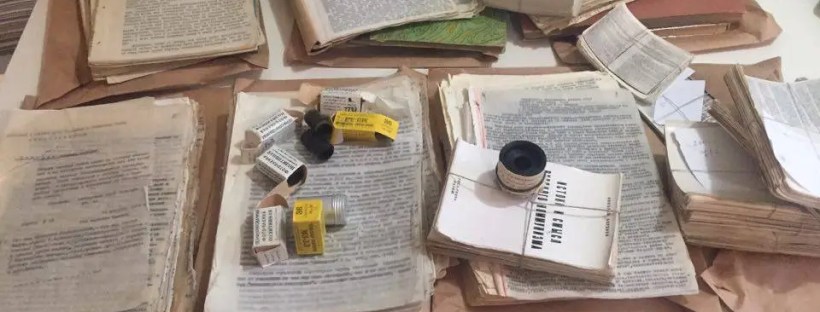
18 ITEMS
*
PERIODICALS (1-5)
[1]
SOCIAL ISSUES, 15
No. 15, January-February 1972.
The collection consists of three sections.
CONTENTS
(1) LAW
This section contains:
a translation of an article entitled “Collective Rights and Collective Action under English Law” (author, T.C. Daintith); and
a letter from Valery Chalidze to John Carey, Chairman of the International League for the Rights of Man [1]. The letter concerns the problem of the defence of the rights of servicemen who become such not of their own free will, or as mercenaries, but because it is their legally stipulated obligation in many countries.
(2) DOCUMENTS ON LEGAL PRACTICE
This section contains:
Replies by the Uzbek SSR Supreme Court and the Uzbek SSR Procuracy to Chalidze’s complaints requesting a review of the case of the priest Adelgeim (CCE 24.12 [17]). In both instances the complaints “were rejected”.
(3) DOCUMENTS OF “THE HUMAN RIGHTS COMMITTEE”
This section contains:
a Note by Valery Chalidze on the use of primary sources of information in Documents of the Committee; and
a Report on the proceedings of a meeting of the Committee on 10 February 1972, at which this Note was discussed.
*
At the beginning of the collection, in his “Compiler’s Note”, Chalidze writes:
‘‘With this issue I am bringing to a close the regular publication of the collection Social Issues [2]
“The position at present is such that, apart from translations and UN documents, which are difficult to procure we would find ourselves basically publishing only Documents of the Human Rights Committee.
“These documents can be published separately which will improve their circulation, while translated articles and UN Documents can be conveniently distributed from time to time amongst a narrow circle of persons interested in irregular publications on particular issues.
“I would point out that the collection has nevertheless apparently contributed to the propagation of the idea that even when the situation forces people into an enormous concern to discuss immediate specific developments in public life, the regular and constructive study of social issues is an important activity”.
*

Samizdat, tamizdat and microfilm
Confiscated from Kronid Lyubarsky in the 1970s; returned to his daughter Veronika by the FSB in 2016
*
[2]
DEMOCRAT, 5
No. 5, 1971
Also written on the cover, “Outlet of Democratic Forces”. The last page concludes with the words: “Publisher, the Democratic Movement of the Soviet Union”.
CONTENTS
(1) A statement “On Russo-Chinese Relations”, commencing with the words:
“The journal Democrat has been authorized by the Democratic Movement of the Soviet Union to publish a statement concerning the Sino-Soviet conflict”.
The statement consists of five points. The final point begins with the words: “The Democrats have their own plan for the peaceful settlement of territorial disputes between the USSR and China”.
(2) An article “On the Question of Illegal Forms of Struggle”, begins as follows:
“October 1969 saw the publication of the ‘Programme of the Democratic Movement of the Soviet Union, which had been drawn up and adopted by the Democrats of Russia, Ukraine and the Baltic lands. In June 1970, the Democrats published their ‘Tactical Principles of the Democratic Movement of the Soviet Union’, a document which explains and, in many respects, expands the programme’s tenets.”
(see CCE 11.16 and CCE 14.12 [9]).
The article continues: “The Democrats replied to all the critical observations made about the ‘Programme’ in the ‘Memorandum of the Democrats to The USSR Supreme Soviet’.” The authors state that the “Memorandum” came out on 5 December 1970.
The article addresses several reproaches to the Chronicle:
‘‘The CHRONICLE’s editors, when condemning illegal methods of struggle, somehow forget that the CHRONICLE itself operates in illegal conditions, observing the strictest rules of conspiracy. … So why does it censure us Democrats, who are operating under identical conditions?
“Is the author of the critical note really so naive as to believe that the CHRONICLE on its own is sufficient for the whole of the Soviet Union and that therefore it alone has the right to operate illegally, while everyone else who reads it must act legally? If one were to adhere to this notion, the KGB, in the space of a few days, or even hours, would isolate not only the readers but also the persons who gather information and those who circulate the Chronicle. …
“We cannot agree with the interpretation of the ‘Tactical Principles of the DMSU published in No. 14 of the Chronicle of Current Events.
“We value the Chronicle highly; we copy it and circulate it. It is difficult to overestimate the importance of the Chronicle for the DMSU. At the same time, we should like to point out in a friendly spirit that, since the publication of the “Tactical Principles’, circles closely connected with the Chronicle‘s editors have not been sufficiently active in circulating official documents of the DMSU, in particular the ‘Memorandum of the Democrats to the Supreme Soviet’.”
- 3. The first part of an article by S. Radonezhsky, “Basic Concepts of Society” [3].
- 4. A report commencing with the words: “In the last year the KGB has begun to carry out on a large-scale unofficial searches of dissidents’ homes”. There is an account of a search of this kind at A. Solzhenitsyn’s dacha (CCE 21.4).
- 5. An obituary of Nikita Sergeyevich Khrushchev.
- 6. “What the Soviet papers don’t write about. . . .”
- 7. “On the Unexpectedness of the War with Germany (1940-1941)”.
- 8. “Why a Relaxation of Tension has Begun in Europe”.
- 9. “The Moral Code for a Renaissance”.
- 10. Verses by M. Benediktov-Sibirtsev: “On the Death of Khrushchev” (and eight other themes).
- 11. The editors of Democrat (“on behalf of the DMSU”) announce a competition to compose the words and music of an “Anthem of the Democrats”. The anthem “must reflect the striving for freedom of the individual, the striving for the abolition of all forms of dictatorship”. It “must consist of three stanzas and a chorus”.
*
The Chronicle repeats its belief that by using such expressions as “Outlet of Democratic Forces”, “Publisher, the Democratic Movement’’, or “The journal . . . has been authorized to state”, the publishers of Democrat are indulging in wishful thinking and thereby confusing the reader.
In reply to Democrat‘s rebuke of inconsistency, the Chronicle states:
“the necessary precautions involved in the publication of an information bulletin such as the Chronicle in the conditions of our country are one thing; an underground organization (see CCE 14.12, “The Tactical Principles of the Democratic Movement of the Soviet Union”) is another.”
*
[3]
REVIEW, 3
[Obozrenie], No. 3, April 1972
CONTENTS
1. “The Hounding of Solzhenitsyn”.
An account of the interview given by Solzhenitsyn to Western correspondents (this issue, CCE 25.3). In writing of the reviews of August 1914 published in the Soviet press, the author comes to the conclusion that their writers had not read the novel.
2. The Czechoslovak Union of Journalists.
A report that about half the members of the Czechoslovak Union of Journalists have been expelled, and about one half dismissed from their jobs.
A “Czech Union of Writers” is being created, its members totalling seventy (the old Writers’ Union had 320 members), and 90 % of these are pensioners. Rudolf Kalcik, who in 1946 wrote “Twelve Letters about Stalin”, has been appointed editor of Literary News (due to start in September 1972). There is an account of the contents of the first issue of Political Monthly. …
The text is given of a speech by V. Bilak at the Plenum of the Central Committee of the Czechoslovak Communist Party, in which he criticizes in particular the leadership of four contries: of Romania for its “alliance with China”; of Hungary for its “risky economic experiments”; of Poland for its “spinelessness with regard to anti-socialist elements”; and of East Germany for its “political sclerosis”.
3. From the History of Samizdat.
An account of the samizdat journal Political Diary, of which more than 70 issues appeared from 1964 to 1970. Its publishers (writers, historians, sociologists, Old Bolsheviks) described themselves to Western correspondents as “Liberal Communists” and gave them eleven issues of the Diary.
The author disapproves of this action, as he does of the fact that the “Diaries” were circulated amongst a very narrow circle of people.
4. From the History of the USSR.
An account of the semi-constitutional conference of a majority of the members of the Central Committee of the All-Union Communist Party (Bolsheviks), which took place in the apartment of G.I. Petrovsky at the end of 1925 and at which the question of the replacement of Stalin by Dzerzhinsky as Secretary-General was discussed.
Voting figures are given for the 17th Party Congress (1934), when 270 persons voted against Stalin; thanks to the efforts of Kaganovich it was announced that only three persons had voted against Stalin, the same number as had voted against Kirov.
*
There is also discussion of the system of identity documents (internal “passports”), abolished in Russia in 1917 and reintroduced in 1932.
5. Literary Chronicle.
Notes on the following:
- the novel Balance by P. P. Dudochkin (from Kalinin [Tver]) about the hard life of collective-farm workers in the 1950s;
- an anthology of verse by the Vinnitsa poet Felix Raburin, who committed suicide at the age of 19, unable to endure the strains of military service;
- an autobiographical account, about his 12-year term in a camp, by Roald Mukhamedyarov [4]; and
- a satirical article, “Monologue of a Soviet Worker” by Vladimir Gusarov [5].
6. Kaleidoscope.
Reflections on the remarkable stability in their jobs of top- and medium-level Party personnel since October 1964; A comparison of the average standards of living in the USSR and the USA; Some details of two recent meetings of the CPSU Central Committee, discussing measures to intensify the struggle against dissenters (CCE 24.2, note 4).
*
[4]
PROGRAMME
the Estonian National Front (10 August 1971)
The programme proclaims as the aim of the Estonian National Front (ENF) the holding of a referendum on the self-determination and status of Estonia and formulates principles for an independent Estonian political and social system.
The Chronicle does not know how large is the circle of people who support or make up the Front.
*
[5]
ESTONIAN DEMOCRAT, 5
(1972 No. 1 (5) in Estonian)
CONTENTS
1. “Memories of the Days of Independence.”
Extracts from the memoirs of three leading Estonian nationalists concerning the congress of federalists convened in Kiev in the summer of 1917 on the initiative of the Ukrainian Central Rada. The congress discussed questions of secession from Russia in connection with the chauvinist policy of the Provisional Government.
2. “Programme of the Estonian National Front” (ENF) see above.
3. “Waiting for the Carnival”, a satirical piece.
4. “My Thoughts about the Liberators”: cites instances of the chauvinism of ordinary Russian people, as displayed in their daily life.
5. A letter by 17 anonymous Latvian Communists to the Communist Parties of Rumania, Yugoslavia, Austria, France, Switzerland and Spain, and also to Louis Aragon and Roger Garaudy.
The letter sharply criticizes the deliberate Russification of Latvia and cites numerous facts.
6, A translation from Russian of two of Solzhenitsyn’s ‘Micro-stories’: “Lake Segden” and “It’s not us who’ll die”.
7. ‘’When emotions and instinct prevail over intellect, then millions perish”.
The author cites historical instances when the Estonian people might have influenced their own destiny and even the fortunes of the whole world. Because of the narrow-mindedness of certain politicians, they did not do so. For example, in 1918 Estonian units in Petrograd might have prevented the dispersal of the Constituent Assembly, and wanted to do so: Estonian diplomats in Petrograd forbade them to interfere in Russian affairs.
*
COLLECTIONS, ARTICLES, REVIEWS (6-11)
*
[6]
“I Succeeded in Doing too Little …” (1972, 106 pp)
A collection of materials on the case of Vladimir Bukovsky. It contains, among other things:
- a short biography of Bukovsky,
- his interview with AP correspondent Holger Jensen, published in the Washington Post (17 May 1970),
- Bukovsky’s letter to the editor of the Washington Post (CCE 14.4) [6],
- his letter to psychiatrists in the USA, England and elsewhere, enclosing forensic-psychiatric diagnostic materials relating to Vladimir Borisov, Natalya Gorbanevskaya, Petro Grigorenko, Victor Kuznetsov, Victor Fainberg and Ivan Yakhimovich (CCE 19.1),
- letters in defence of Bukovsky (CCE 19.1 and CCE 24.1),
- Bukovsky’s final speech at his trial (CCE 23.1).
The title of the collection is taken from the concluding sentence of his final speech at the trial.
The Chronicle knows that the paper Russkaya Mysl (Paris, 2 March 1972) carried a full record of the trial of Bukovsky (CCE 24.1).
*
[7]
Malva Landa
“Searches and preliminary interrogation: testimony and reflections of a witness”
(October 1971, 9 pp.)
On 21 October [7] 1971 a search was carried out at the home of Sergei Myuge (CCE 22.8 [7]).
On the same day, and apparently in connection with the same case, searches were carried out at the home and place of work of the author, Malva Noyevna LANDA (a 53-year-old geologist (CCE 24.1). The searches were followed by an interrogation.
Samizdat confiscated from Landa included: Chaadayev’s Philosophical Letters [written c. 1830], an anthology of prose and anthologies of verse by Osip Mandelstam, Alexander Galich and Bulat Okudzhava.
Listing the confiscated items, the author observes that she has never, in any of the samizdat texts known to her, come across any “mendacious information”.
*
“AUGUST 1914” (8-11)
[8]
Anatole Shub
“Solzhenitsyn’s New Book” (review)
International Herald Tribune (19 June 1971)
Remarking on the literary innovativeness and formal perfection of August 1914, the author of the review stresses that as a writer and thinker Solzhenitsyn does not come within any of the traditional categories, neither the traditionally monarchist, nor the traditionally “revolutionary”, neither the rationalist nor the mystic.
Speaking of the “serenity and verve of Solzhenitsyn the writer, the reviewer at the same time regards his view of life and history as a profoundly tragic one, and his new work as a tragedy in the truest and loftiest sense of the word.
*
[9]
Georgy Adamovich
August 1914 (review)
A review written under the fresh impression of the book in Russkaya Mysl (24 June 1971).
While expressing a number of comparatively detailed criticisms of Solzhenitsyn’s new novel, the reviewer nevertheless asserts in all certainty that “the book is remarkable, although not irreproachable”. He takes as the most important expression of the author’s standpoint the words of one of the characters: “No-one will ever answer the main question.” . . .
“This is probably the reason why great Russian literature has found its continuation in Solzhenitsyn: quite apart from his talent, he is that rare man among writers today who knows, understands and feels this, and, whatever he may write about, always remembers it”.
*
[10]
Prince S. Obolensky
“The ‘fabric of history’ in Solzhenitsyn” (review)
The author of this review (Vozrozhdeniye, Paris, No. 234, July 1971) characterizes August 1914 as “first and foremost a Russian book, utterly contemporary and at the same time rooted not only in Russian events of half a century ago, but also in the immemorial depths of Russia’s past”.
The reviewer is particularly attracted to, and admiring of Solzhenitsyn’s philosophy of history, his contrasting of his own view of the irrationality of the historical process with the banal “progressive” themes voiced, with numerous variations, by the “left-wing” characters in the book, and, above all, his conscious rejection of Tolstoyan fatalism and his affirmation of the importance of the Christian theme of personal responsibility.
*
[11]
Victor Frank
“Solzhenitsyn and Tolstoy” (review)
Speaking of the parallels that suggest themselves between War and Peace and August 1914, which have been remarked upon by numerous reviewers of Solzhenitsyn (including A. Shub, above, item 8), the author of this review (Possev 7, 1971) attaches far greater importance to Solzhenitsyn’s deliberate challenge to Tolstoy with respect to his choice of a concept of the philosophy of history (compare the previous review).
The reviewer appears to refrain from making a judgment between the two concepts, leaving the choice to the reader, but his sympathies undoubtedly lie with the contemporary author. “The philosophy of history embodied in War and Peace is, despite the supreme craftsmanship and conviction, in the final analysis a philosophy of irresponsibility.
“… Solzhenitsyn’s heroes, however, are guided by the feeling of responsibility, the consciousness that if they do not carry out the work that has fallen to their lot, no-one else will do it, . . . Is not Solzhenitsyn himself permeated by this same pathos, the pathos of sober, sensible, but irrevocable personal responsibility? … A proud and humble sense of individual responsibility — there we have the kernel of Solzhenitsyn’s ethic, both as a writer and as a man”.
*
OTHER TEXTS (12-16)
[12]
Lev Ventsov
“The poetry of Alexander Galich”.
An attempt to analyse the social and moral significance of Galich’s song-writing.
In the author’s opinion, the poetry of Galich is a most striking expression of the “home-based culture” that has developed in our country over the last few years: it has been conditioned, on the one hand, by the suppression of any creative initiative and, on the other, by the pressing need for free intellectual intercourse.
For this original form of culture Galich [8] has created the song-play, the song-drama genre.
*
[13]
Solzhenitsyn
Letter to M.P. Yakubovich.
A response to his third and fourth letters, about Kamenev and Stalin. While valuing the letters highly, Solzhenitsyn indicates some of their shortcomings [9].
*
[14]
Valery N. Chalidze
“The Right of Convicted Persons to Leave their Country (draft)”, 1972.
In Uppsala (Sweden) in June 1972 the “International League for the Rights of Man” (FIDH) and the “International Institute for the Rights of Man” (IIDH, founded by Rene Cassin, CCE 26.14 [15]) will hold a conference on the “right to leave any country and the right to return to one’s own country”.
Valery Chalidze, a member of the Human Rights Committee in Moscow, was invited to address the conference. An invitation was sent on three occasions, hut not once did it reach the addressee.
*
[15]
K.T.Popugayev
“Press Review for 1984″,
a pamphlet.
Composed by Member of the USSR Academy of Sciences K. T. Popugayev, this is a futuristic Marxist-Leninist model of the world press for the Year 1984, which has already become the canonical endpoint for prognostications.
A few items from the review [10]:
A witty and topical report by Times correspondent S. Blayhead, 5 January 1984, “They Wrote for Appearances’ Sake . . .”, analyses why
“… the toilers of a Scottish district gathered an unprecedented harvest of cucumbers last year while on the counters of London’s greengrocers cucumbers were somewhat scarce”.
Paese Sera (4 February 1984) carries a report from Rome: “For You, Youngsters!”
“… thousands of young boys and girls from the capital went out to the super-strenuous construction site run by the Komsomolia [Italian for Communist Youth League].
“The erection has begun of a sports complex for young people. Where St. Peter’s once stood [in Rome], now bulldozers and scrapers snarl. …”
*
[16]
Anonymous
“At the age of 18”.
The story of a youth who was in camp and exile in the 1920s and 1930s. The action takes place in Siberia and Central Asia.
*
PASSOVER 1972 (17-18)
[17]
Rady Raikhlin
compiler (see CCE 24.12 [15])
“Hagada shel pesach”, Passover Tales (18 pp.)
Several short accounts by witnesses and victims of the events of 29 March 1972 outside the Moscow synagogue and in the square near the monument to the 1877-1878 “Heroes of Plevna” (this issue CCE 25.8).
*
[18]
Vadim Belotserkovsky [11]
An appeal to the Soviet public and government.
An Open Letter commenting on the events of 29 March 1972, the dispersal of Jews at the Moscow synagogue by police and druzhinniki (CCE 25.8).
Here are some excerpts from the letter:
“This dispersal and the assaults, which smack of a pogrom, are an ominous PRECEDENT!
‘Do not bring evil into the world’, it is written in the Scriptures. For one evil leads of necessity to another, or, as people write nowadays, to an escalation of evil and violence.
“And my anxiety for the assailants is even greater than for the assaulted.
“Do you realize what it is to be the first to strike a man’s face/and a man without any opportunity to defend himself at that? To seize him, raise one’s arm and stick one’s fist in his face! Simply because he was singing ‘Hava naguilah’, simply because he is a Jew ! ‘At last, we’ve given you what for, Yids!’
“Respect for the rule of law, for laws, for the individual, is as necessary to the country and its people today as the air we breathe. … Everything is very simple and sad. The screw turns, and mistrust and animosity spiral one upon the other.
“… Of course, the Jews are a ‘restless’ people, inclined to critical thinking, and so on, but is not such ‘restlessness’ a quality most beneficial to the life of any society?! Incidentally, Poland, for example, has got rid of its Jews, but, as we know, it still hasn’t gained tranquillity! So apparently troubles don’t come just from the Jews.”
==============================================
NOTES
- US organisation, renamed the “International League of Human Rights” in 1976.
↩︎ - See Contents page 16-1. Social Issues, Veche, Poiski, Obshchina (1969-1980).
↩︎ - Also author, almost certainly pseudonymous, of the samizdat book, The World, Man and Time which is, possibly, a variant of Man and the World (CCE 11.5).
↩︎ - On Roald Mukhamedyarov, see CCE 14.12 [3], CCE 15.11 [1] and CCE 24.2.
↩︎ - On Vladimir Gusarov, see CCE 7.13 [14], CCE 11.14 [13], CCE 12.10 [3, 9] and Name Index.
↩︎ - The Russian text of Bukovsky’s transcript of his June interview with Procurator Vankovich was published in Russkaya mysl (3 & 10 February 1972); a slightly condensed translation appeared in the New York Review of Books, the following month (9 March 1972).
↩︎ - The search at Sergei Myuge’s home was in fact carried out in September 1971.
↩︎ - On Galich, see CCE 5.1 [22], CCE 23.9 [1], CCE 24.10 [1] and Name Index.
↩︎ - Dated 19 June 1966, Solzhenitsyn’s letter to Yakubovich was also published in Political Diary No. 33 (see //note 59).
On Yakubovich see Uncensored Russia (pp. 397-402), Roy Medvedev, Let History Judge and CCE 10.8.
↩︎ - “Press Review for 1984″. This pseudonymous samizdat work appeared in Possev 1, 1972.
↩︎ - Belotserkovsky (b. 1928) graduated in chemistry from Moscow University, taught in a school, then began to publish. See his stories in Moskva: Nos. 9 (1958), 8 (1959) and 12 (1962).
↩︎
========================
 A Chronicle of Current Events