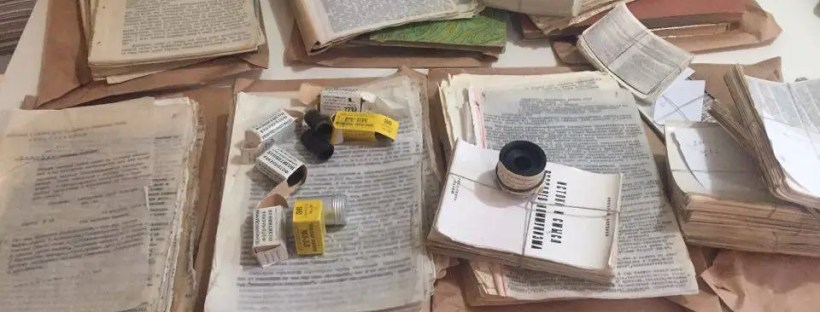
SEVEN ENTRIES
[1]
Yu. Glazov, V. Kabachnik, V. Turkina and Yu. Shtein
“A message from friends” (Open Letter)
The expulsion of Alexander Galich from the USSR Union of Writers [1].
… Fifteen writers, by voting for his expulsion,
have covered themselves with a new shame:
We shall remember the names of all
Who raised their hands!Four, Valentin Katayev among them, …
asked that the poet should only be … reprimanded.
The authors of the letter recall Galich’s words (“Prospector’s waltz”):
How easy it is to become rich!
How easy it is to become famous!
How easy it is to become a hangman!Keep quiet! Keep quiet! Keep quiet!
*
[2]
Grigory Svirsky
“Why?” (November 1971; 7 pages)
An Open Letter to his friends on the reasons for his decision to leave for Israel.
Svirsky is a writer who in 1965 spoke at a writers’ Party meeting against anti-Semitism. Since then, for seven years, his name has been on the prohibited list: nothing written by him has been printed.
The main reason for his determination to emigrate, Svirsky writes, is the anti-Semitism which exists in the USSR. The expression “Entry No. 5” (“nationality” in the Soviet identity document or internal ‘passport’) has now become part of the language, and is clear proof of this. In addition Svirsky cites instances from literary life: the publication of Ivan Shevtsov’s pogrom-minded novels and of V. Mishin’s book Social Progress (Gorky, 1970), which welcomed the numerus clausus (see Svirsky’s letter about this book, CCE 21.11 [6]); lines from Fate, the collection of poems by Ivan Lystsov (Moscow Worker newspaper, 1969, p. 93); the confessions by two Central Committee secretaries, Pelshe and Demichev; and so on.
“If my very name is banned, then that is the same as killing me or hounding me out of the country!
“I choose a different road … I have not changed my beliefs: I have not ceased to love the land for which I shed my blood, nor my friends, nor the Russian language as a medium in which to work … I am a former soldier of Russia, who spent four uninterrupted years in battle, … I am a Russian, born and bred, my great-grandfather fought for the salvation of Russia during the first defence of Sevastopol [1854] …
“I do not want to be the highest among equals, nor the lowest among equals – I want to be equal … ‘Go to your Israel! ’ I have seen in the eyes of people who exclaim: ‘How is it possible for him to be a Russian writer – and a Jew?!’
“All right, my friends, that suits me … I no longer believe in the assimilation of the Jews in Russia.
“I have the right to live as each one of you lives, whether you be Russians, Ukrainians or anything else – without any ‘Entry No. 5’ [nationality entry in Soviet “passport”], among my own national majority …”
*
[3]
Viacheslav Chornovil [2]
“What Bohdan Stenchuk stands for and how he does it”
About the book What Ivan Dziuba stands for and how he does it [3]. Published in English by the Society for Cultural Relations with Ukrainians Abroad (Kiev, 1969), by the author ‘Bohdan Stenchuk’, pseudonym for a group of staff members at the Kiev Institute of Marxism-Leninism.
*
[4]
Vladimir Skutina
“A Prisoner of the President”
translation of an article in the April 1968 issue of the Czech magazine Reporter
The story of a Czech journalist who later became a television commentator. In 1961 Skutina was summoned by the state security organisation and accused of calling President Antonin Novotny “a tyrant, a scoundrel and an idiot” in 1958. At his trial, which took place in January 1962, the prosecution was unable to substantiate this change for lack of witnesses, and Skutina was given a suspended sentence of six months’ imprisonment.
Since no-one can be tried twice for the same offence, V. Skutina shortly afterwards announced that he had never called the President an idiot, but since he had been convicted of doing so then it was clearly God’s will that he should. In May 1962 he was arrested and sentenced to 16 months’ imprisonment for undermining the authority of the President. The greater part of the article deals with the period spent by the author in various Czech prisons.
Skutina was later freed under an amnesty, and was legally exculpated even before 1968.
On 18 February 1971 he was again convicted, this time of activity hostile to Czechoslovakia and her allies, and was sentenced to two years’ imprisonment. On 30 June 1971 he was sentenced to another four years’ imprisonment. In September he became seriously ill in prison.
*
PERIODICALS (5-7)
*
[5]
Social Issues, 13
No. 13 [4] September-October 1971 (Moscow, 13 pages)
Selected samizdat texts devoted to social issues, compiled by Valery Chalidze
CONTENTS
This issue includes the following UN documents:
- draft Declaration on the Rights of the Mentally Backward; a
- resolution on the acceptability of reports by a Sub-commission on the Prevention of Discrimination and the Protection of Minorities; and
- a draft of the principles of Freedom from Arbitrary Arrest and Detention.
- *
The section “Documents of the Committee for Human Rights” includes a note on the term “political prisoner”, which was submitted to the Committee by the compiler of this collection.
In an addendum to the note, which was written after it had been discussed by the Committee, the author particularly emphasises that of the two possible approaches to a definition of the term “political offence” – an action carried out with political aims or an action prosecuted by the State with political aims – he has chosen the latter, though he makes it clear that this is not the only possible approach.
One consequence is that the author is not inclined to regard political motives for a crime either as aggravating or extenuating circumstances. In this he differs from widespread opinions to the contrary.
*
[6]
Herald of the Exodus, 2
No. 2, 1971 (For No. 1, CCE 20.12 [1])
CONTENTS
Trials
- The second Leningrad trial (CCE 20.1); the Kishinyov Trial of the Nine CCE 20.3); the trials of Valery Kukui (CCE 20.4), Reiza Palatnik (CCE 20.5) and A. Gorbach (Kharkov) CCE 19.7 [2];
- reactions to the trials;
- information on hunger-strikes by Jews;
- the “emigration case” of Allan-Edgar Kroncher (CCE 20.10 [2]);
- a brief account of the trial of Boris Azernikov [5]; and
- a report on activities in Kiev on 29 September 1971 marking the day of remembrance for those who lost their lives at Baby Yar (NBSJ, No. 203).
*
The section “Facts and Documents” includes a statement by Lazar M. Lyubarsky, a resident of Rostov-on-Don, against whom criminal proceedings were instituted in September 1970 (CCE 19.11 [21]) under Article 190-1 (RSFSR Criminal Code) [6].
In August 1971, proceedings were ended under Article 6 of the RSFSR Criminal Procedural Code (“Termination of Proceedings owing to a Change of Circumstances”). Lyubarsky is demanding that V. A. Smirnov, Procurator of Rostov’s Zheleznodorozhny district, issue a statement that proceedings were terminated on the grounds that there was no evidence that a crime had been committed.
He also wants the return of items confiscated during a search of his home, viz. notebooks containing verses in Modem Hebrew, and recordings of Jewish folk and classical music and of the voice of his eight-year-old daughter.
*
The “News in Brief” section contains reports on extra-judicial persecution and the plight of Jewish political prisoners.
*
[7]
Review, 1
[Obozrenie], No. 1, October 1971
A typewritten journal made up of six sections
CONTENTS
1. The death of Khrushchev (11 September 1971)
A report about N.S. Khrushchev’s death only appeared two days after the event in the USSR (with no obituary).
In Warsaw, normal radio broadcasting was interrupted to announce the death of the former First Secretary of the CPSU Central Committee. The statement spoke of the services of the deceased to the cause of de-Stalinisation in the USSR, which was a direct stimulus to the de-Stalinisation of Poland.
Richard Nixon, Pietro Nenni, Anwar Sadat, Janos Kadar and many others commented on the event, as did the majority of newspapers, including the Communist press (Borba, Politika). Not only Khrushchev’s merits were recalled, but also his crimes: repression against those who took part in the 1956 Hungarian Revolution, and the construction of the Berlin Wall (1961).
Like its Soviet counterpart, the Chinese press gave a brief report of Khrushchev’s death. The Albanian press, on the other hand, called him “the leader of a revisionist group which attempted to restore capitalism in the USSR”.
About a thousand Muscovites tried to attend his funeral, but entry to the cemetery was only by special pass. Only a few individuals managed to pay their last respects to Khrushchev, among them the poet Yevgeny Yevtushenko and Alexander Nekrich, the historian. (Pyotr Yakir was detained by the police that morning and was released only after the funeral had ended.)
Speeches were made at the grave by Sergei Khrushchev, Vadim Vasilyev (whose father had been posthumously rehabilitated) and Nadezhda Simanshevich, an old Party-member from the Donbass.
A wreath was sent by the Central Committee and the Council of Ministers. A wreath from Mikoyan’s family was also laid.
*
2. An interview with J. Smrkovsky
given to an Italian Communist weekly at the end of September 1971 [7]
Fabrications to the effect that “fraternal aid” was given to Czechoslovakia at the request of many thousands of Czechoslovak Communists are described by Smrkovsky as “a stupid and abortive fiction which no schoolboy of the meanest intellect would ever believe” … The people of Czechoslovakia will never become reconciled to the occupation, and so it is necessary to find a solution acceptable to them. It would have been feasible to continue with the reform programme, though at a reduced pace, even after the occupation, if there had been unity in the Party leadership.
After the interview J. Smrkovsky was subjected to interrogation by the state security agency and warned that if any such action were to take place again, criminal proceedings would be instituted against him.
*
3. Vladimir Bukovsky
A brief biography of Bukovsky and the protests at his latest arrest.
*
4. From the history of samizdat
The early post-war years in the USSR saw the appearance of underground anti-Stalinist organisations (“Leninist opposition”, “Leninist group”, “Workers’ opposition”), which circulated leaflets and proclamations among the population.
The first samizdat journals were: Syntax (1959) compiled by Alexander Ginzburg (CCE 1.1); Boomerang (1960) compiled by Vladimir Osipov [8]; and Phoenix (1961), compiled by Yury Galanskov (CCE 28.1) [9].
Samizdat activity has been increasing in intensity since 1965 [10].
*
5. Kaleidoscope
At some time after 1954, in connection with the Beria Affair, S. M. Shtemenko was dismissed as Head of the General Staff and demoted to be chief of a divisional HQ (with a corresponding reduction in rank from army General to Major-General). He re-appeared on the scene in the second half of 1965.
In August 1971 the writers Yury Belostotsky (a member of the USSR Writers’ Union), Leonid Topchy and Avan Taktash were questioned in Kazan by the KGB. The officials wanted to know about the circulation of the Chronicle of Current Events and other samizdat material in Kazan literary circles.
Yury M. Aranovich, conductor since 1964 of the All-Union Radio & Television Symphony Orchestra, has been removed from his job for submitting documents to emigrate to Israel (see Reuters dispatch, 21 November 1971).
*
(The editors of the Review propose to introduce a new section, “From the history of the USSR”.
The next issue, for example, will contain information on the fall of NKVD chief Yagoda, on his successor Yezhov and on the Trials of 1937-1938 [11]).
*
6. Literary chronicle
Notes are provided on the following works:
- The Seven Days of Creation (Sem dnei tvoreniya, Frankfurt, 1971) by V. Maximov;
- August 1914 by A. Solzhenitsyn;
- Dear Kinfolk by P. Dudochkin [12];
- My Daddy Murdered Mikhoels [13] by V. Gusarov (with his essay “And Shepilov who joined them” [14]); and
- Yury Dombrovsky’s The Faculty of Useless Knowledge. //Part 2 of his novel Guardian of Antiquities, published in Novy mir (1964), and in English translation, 1996.
Biographies of the authors are given in brief.
The issue ends with notes on the journal Veche edited by Vladimir Osipov. On issue 1, CCE 18.11 [6]; issue 2, CCE 20.12 [5]; and issue 3, CCE 22.9 [7].
================================================
NOTES
- See text in Possev 2, 1972. See also the letter by Glazov, Shtein and three others to The Times, 9 March 1972. By mid-March Kabachnik, Shtein and his wife V. Turkina had left the USSR.
↩︎ - Viacheslav Chornovil was one of a dozen and more Ukrainian intellectuals arrested in mid-January 1972 (CCE 24.3). See The Economist (London, 26 February) and The Guardian (London, 13 March), and an attack in Pravda Ukrainy (Kiev, 11 February) on Chornovil, Ivan Svetlychny and Yevhen Sverstyuk.
↩︎ - On the book by “Stenchuk”, see the editor’s postscript to the 2nd edition of Internationalism or Russification? (London, 1970), by the Kiev critic Ivan Dziuba, who was expelled from the UkSSR Writers’ Union in February 1972 (CCE 24.10 [3]).
↩︎ - Issues 1-8 of Social Issues are due to be published in spring 1972 by the “International Institute for the Rights of Man” (Strasbourg, France). Issues 9-13 are now also available and will appear in due course.
↩︎ - A Leningrad dentist (b. 1946), Boris Azernikov was sentenced by the Leningrad City Court on 6-7 October 1971 to 3½ years of strict-regime camps (see The Times, 1, 9 and 11 October).
There is an extended passage by him in the account of the first “Political Prisoners’ Day, 30 October 1974” (CCE 33.1), and about Azernikov in the same issue (CCE 33.4).
↩︎ - See also NBSJ (17 July 1971) for Lyubarsky’s letter to Podgorny, and No. 210 (5-15 January 1972).
↩︎ - Smrkovsky gave his interview to the PCI weekly Giorni – vie nuove (16 September 1971). See long extracts in The Times (17 September).
↩︎ - Boomerang (Moscow, 1960); Project for the Study of Dissidence and Samizdat, Toronto University.
↩︎ - Syntax appeared in Grani (Frankfurt), No. 58; Phoenix appeared in No. 52 of the same émigré journal.
↩︎ - This anodyne comment may be compared to Andropov’s late 1970 report to the Politburo about the increasingly political character of samizdat in the USSR: 15 January 1971 (St-119-11) (Bukovsky Archive).
↩︎ - A period now referred to as “The Great Terror” (August 1937 to October 1938) during which 1½ million were arrested, of whom half were executed and the rest sent to the camps, in most cases without formal judicial proceedings (see Map of Memory).
↩︎ - See CCE 13.9 [20] on an article by Dudochkin and Possev: 4-yi spetsialnyi vypusk (4th special issue), Frankfurt, June 1970.
↩︎ - On the actor and prolific samizdat author Gusarov’s book about Mikhoels (CCE 11.14 [13]) see Reddaway, Uncensored Russia, p. 418 (fn 5): “six other essays have been listed by the Chronicle“.
From March to May 1971, Gusarov was forcibly interned in a psychiatric hospital.
↩︎ - Gusarov’s shorter text, “And with them Shepilov” was published in three successive issues of Russkaya mysl, Paris (Nos. 2834-2836), 1971.
↩︎
==============================
 A Chronicle of Current Events