On 8 May 1971 the measure of restraint imposed on Anatoly Emmanuilovich LEVITIN-KRASNOV, who was at liberty during the investigation, was changed: he was taken into custody.
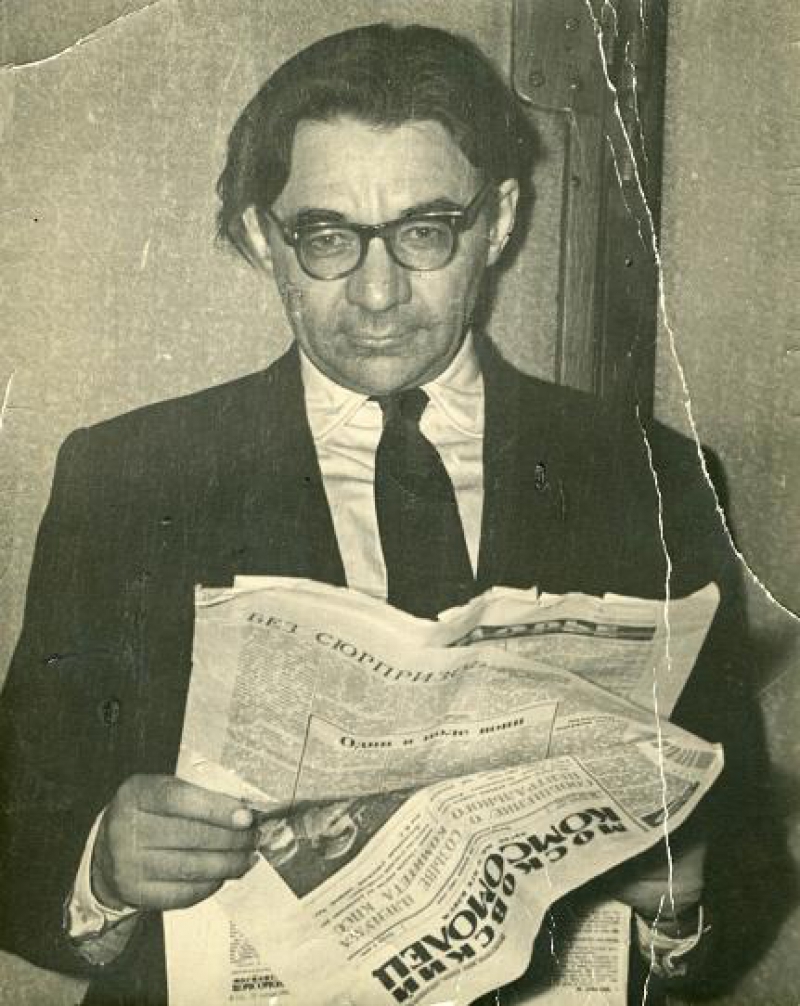
Anatoly Krasnov-Levitin (1915-1991)
On 19 May 1971 the Moscow City Court convened at the premises of the Lyublino district court to hear the case against the Orthodox writer A.E. Krasnov-Levitin, charged under Articles 190 & 142, para. 2 (RSFSR Criminal Code).
The Judge was Vladimir V. Bogdanov who presided at the trials of Natalya Gorbanevskaya (CCE 15.1), Olga Joffe (CCE 15.2), and Mikhail Makarenko (CCE 16.7); the prosecutor was Procurator Biryukova; counsel for the defence was A.A. Zalessky.
A group of friends and relations had gathered in front of the courthouse but only his step-mother, G.A. Levitina, and Academician Sakharov were allowed into the courtroom.
*
INDICTMENT
The indictment contained many quotations from Krasnov’s works. These formed the basis for charges of slandering the Soviet social and political system (Article 190-1) and “inciting servants of the church to violate the law on the separation of Church and State” (Article 142).
A.E. Krasnov-Levitin was also charged with signing a number of appeals and petitions in 1968-1969, of which the Letter to the Budapest meeting of Communist and Workers Parties (CCE 1.4) and the Appeal to the UN of May 1969 [1] were singled out for special attention.
Krasnov-Levitin pleaded not guilty on all counts, claiming that the arguments in the indictment were based on an arbitrary and incorrect interpretation of excerpts from his works.
His works contained criticism of individual phenomena, he explained, not slander against the system, and he had expressed his actual opinions, not deliberately false fabrications. Krasnov informed the court that several of the quotations cited in the indictment as examples of “anti-Soviet slander” were texts from the Holy Scriptures.
Witnesses testified that they had read the works of Krasnov and saw nothing slanderous in them: Gleb Yakunin and V. Borozdinov (both priests); Father Agafangel (Dogadin), a priest-monk at the Pskovo-Pechorsky monastery; Vera Lashkova [2], V. Berestov, Ye. Kushev [3], V. Shavrov, L. Kusheva and others.
Procurator Biryukova repeated the indictment and asked that Krasnov-Levitin be sentenced to three years of ordinary-regime corrective-labour camps.
Defence counsel A.A. Zalessky refuted the arguments of the indictment, point by point, and asked the court to draw its own conclusions from his address.
*
FINAL WORDS
In his final words Krasnov-Levitin said:
“I am a believing Christian. But the mission of Christianity consists in more than going to church. It consists in putting the behests of Christ into practice.
“Christ called upon us to defend all who are oppressed. That is why I defend people’s rights, whether they be Pochayev monks [4], Baptists or Crimean Tatars, and if convinced opponents of religion should some day be subjected to oppression I shall defend them too.
“… No right-thinking person considers it a crime to criticise individual tenets of the law and suggest how they be adjusted. This democratic right of every citizen was won in the hard struggle for freedom by the English, French and October Revolutions.
“. . . I have written the truth and nothing but the truth. Everything in my work is based on documentary facts and is in accordance with reality. … I consider that the Procurator’s address is a disgrace to Soviet justice. . . .”
(For information: A transcript of Krasnov-Levitin’s final address, circulating in samizdat, contains a few factual inaccuracies.)
*
SENTENCE
In its verdict the court deleted three items from the indictment: the paragraphs on the Pochayev monks; on blessing the water; and on excerpts from the letter to TASS.
The court changed one charge from Article 142 (pt. 2) to Article 142 (pt. 1).
It sentenced A.E. Levitin to: (a) a year of corrective labour at his place of work with a 20% deduction from his wages (Article 142, pt. 1); and (b) three years in ordinary-regime camps (Article 190-1).
*
(On Krasnov-Levitin and his writings, see Samizdat Survey CCE 5.1 [16, 19-22] and the Case of Levitin-Krasnov, CCE 15.5, CCE 17.12 [23].)
*
APPEALS
The Action Group has sent an appeal to:
- the UN Human Rights Commission;
- Pope Paul VI; and
- to the General Assembly [Pomestny Sobor] of the Russian Orthodox Church.
It describes Anatoly Emmanuilovich KRASNOV-LEVITIN as a man of high morals, a convinced opponent of any sort of violence or political extremism, his weapon of choice being the public word addressed to the conscience.
“The verdict of the Moscow City Court can be seen as yet another act of arbitrary tyranny by the authorities against dissenters, against believers, against fighters for human rights in our country.”
The appeal was supported by 30 people.
*
Academician Sakharov has appealed to Podgorny, chairman of the USSR Supreme Soviet, to alleviate the fate of Krasnov [5]. He writes
“The works of Levitin on which the charges against him were based in fact express a viewpoint natural for a believer on the moral and philosophical meaning of religion; they state opinions on present-day internal church problems, and also discuss from loyal and democratic standpoints the problems of freedom of conscience. …
“I was present in court and am convinced that there has been no violation of the law by anything Levitin has done.”
*
An Open Letter by Gennady Smirnovsky (Moscow), “Behind the closed portals of Themis”, reports from Krasnov-Levitin’s trial. It has appeared in samizdat.
*
PRISON TRANSFER
In June 1969, before the sentence was even confirmed by the Appeal Court, Krasnov was transferred from one Moscow prison to another, from the MVD’s Remand Prison Butyrka to the Krasnaya Presnya Transit Prison, where he was put on general duties.
========================================
NOTES
In the photograph Levitin is reading the Moscow Komsomol daily newspaper.
*
- English translations of the texts can be found in Alexander Brumberg’s In Quest of Justice: Protest and Dissent in the Soviet Union Today, London, 1970 (pp. 171-173, 458-461).
↩︎ - Vera Lashkova was a co-defendant with Galanskov, Ginzburg and Dobrovolsky at their trial in January 1968 (CCE 1.1).
↩︎ - A godson of Levitin. Kushev’s book of verse, Ogryzkom karandasha (Possev Publishers: Frankfurt-am-Main, 1971), has a foreword by Levitin.
↩︎ - See Krasnov-Levitin’s materials in Zashchita very v SSSR [Defending the faith in the USSR; «Защита веры в СССР»], Ikthus publishers: Paris, 1966 (pp. 63-87).
The monks came from Pochayev in Western Ukraine.
↩︎ - The full text was published in Russkaya mysl, Paris, 11 September 1971.
↩︎
=====================
 A Chronicle of Current Events