Professor Julian [Yulian] Grigorevich OKSMAN, Doctor of philological sciences, died on 15 September 1970 in his seventy-sixth year.
*
J.G. Oksman was born on 30 December 1894 in Voznesensk, Kherson Province (south Ukraine). After leaving high school in 1911 he entered the History and Philology Faculty of St. Petersburg University. For about a year he worked abroad, studying the history of civilisation and the science of source materials (istochnikovedeniye) in Bonn, attending lectures in Heidelberg.
From the summer of 1915 he began to work in the archives (presumably in St. Petersburg?), studying the history of Russian censorship and the press. After the 1917 February Revolution he took part in the preparation and implementation of archive reform in Russia.
*
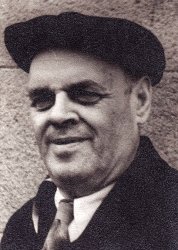
Julian Oksman (1894-1970)
From 1919 to 1923 Oksman taught in institutes of higher education in Odessa, and was the acting head of the archive of the Odessa Region. From the end of 1923 onwards, he was a lecturer at Leningrad University, then reader and later professor. After 1927, Oksman chaired the Pushkin Commission at the State Institute of Art History.
In the 1930s he was deputy-head of “Pushkin House”, the USSR Academy of Sciences’ Institute of Russian Literature. He was the initiator of much research on Russian literature and 19th-century social movements: Oksman helped prepare the Academy’s Complete Works of Pushkin, the multi-volume 1825 Decembrist Uprising, and many other works, including (in recent years) the Complete Collected Works of Alexander Herzen.
*
Arrested in 1937, Oksman was fortunate to return from imprisonment and exile in 1947.
He first worked in South Russia at Saratov University. After rehabilitation (in the mid-1950s), he worked at the Institute of World Literature in Moscow; he led the Herzen group; and he prepared for publication Belinsky’s Works and Days (Trudy i dni), for which he was awarded the Gold Medal of the Academy of Sciences.
In 1963, Oksman’s flat was searched. He was suspected of supplying the Western press with material about the provocative activities [1] of a number of Soviet writers (Elsberg [2], Samarin [3], and Lesyuchevsky [4]).
In autumn 1964, Oksman was expelled from the Writers Union and, at the same time, compelled to leave the Institute of World Literature. Since then his publications have either not appeared or only under pseudonyms. His name has been removed from published works, and the censors remove all mention of him.
Briefing translators for the International History Congress in Moscow a few weeks before Oksman died death, a KGB official referred to the scholar as one “representative of the Soviet intelligentsia who easily falls for western propaganda”.
*
Oksman was buried on 18 September 1971 at the Russian cemetery in Vostryakovo (southwest Moscow). It proved impossible to post a notice of his demise in the Moscow press.
============================================
NOTES
- Oksman’s article was published in Possev (Frankfurt) in July 1963 and also in the Menshevik periodical Socialist Herald.
↩︎ - Ya. E. Elsberg has been described elsewhere in the Chronicle (see CCE 14.10) as a “well-known informer and witness at the secret trials of the 1930s and 1940s”.
↩︎ - In 1958, R.M. Samarin, Professor of Foreign Literature at the Institute of World Literature, criticised the journal Foreign Literature for its careless selection of material for translation; in 1969 he was critical of Volume 5 of the Concise Literary Encyclopedia for its “excessive” liberalism.
↩︎ - In the Soviet Union, it is said that N.V. Lesyuchevsky, board chairman of the “Sovetsky Pisatel” publishing house, denounced the poets Benedict Livshits (1887-1938 shot), Boris Kornilov (1907-1938 shot), and Nikolai Zabolotsky (in camps, 1939-1943) and the prose-writer Yelena Tager during the Great Terror.
↩︎
====================
 A Chronicle of Current Events