In July 1970 Revolt Ivanovich PIMENOV (D.Sc), a research officer at the Maths Institute, was arrested in Leningrad. For the previous search of Pimenov’s flat on 18 April, see CCE 13.10 [17, 18].
*
Revolt Pimenov (b. 1931) graduated from the Mathematics & Mechanics faculty of Leningrad University.
In 1949, after he had submitted his resignation from the Communist Youth Movement (Komsomol), he was forcibly hospitalised in a psychiatric institution with a diagnosis of schizophrenia.
A second commission headed by Professor Goland [correction CCE 32.23] judged Pimenov to be healthy; the only requirement on which the professor insisted when discharging Pimenov was that he should withdraw his resignation from the Komsomol.
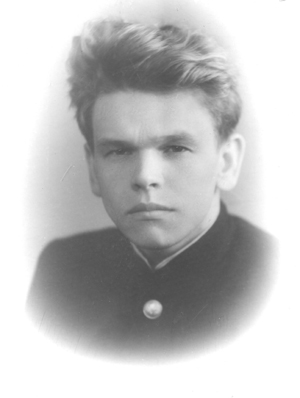
Revolt Pimenov (1931-1990)
In March 1950, threatened with a second hospitalisation, Pimenov agreed to remain in the Komsomol. He was expelled from the Komsomol again in 1951, reinstated by the district committee, and then expelled from Leningrad University.
Pimenov was reinstated in the University and graduated in 1954. He worked as a mathematician.
*
On 25 March 1957, Pimenov was arrested again.
On 26 August he was put on trial under Articles 58-10 & 58-11 (Counter-Revolutionary Activities: 1924 RSFSR Criminal Code), together with four others: Boris B. Vail, K.G. Danilov, I.D. Zaslavsky and I.S. Verblovskaya.
Charged with writing articles about “The Fate of the Russian Revolution” and “The [Secret] Speech of N.S. Khrushchev”, and an essay on “The Hungarian Revolution”, Pimenov was also accused of attempting to set up an anti-Soviet group among the students at the Leningrad Institute of Librarianship.
Boris Vail (18) a first-year student of the Librarianship Institute, was charged with trying in company with Pimenov to create an anti-Soviet group, and with the possession and circulation of anti-Soviet literature.
Only Article 58-10 of the 1924 RSFSR Criminal Code [1] was applied to the other three accused; they were acquitted of charges under Article 58-11.
Pimenov was sentenced to six years’ imprisonment; Vail to three; and K.G. Danilov, I.D. Zaslavsky and I.S. Verblovskaya were each sentenced to two years’ loss of liberty.
*
CASE REHEARD
In December 1957, after an appeal by the Leningrad Procurator, the Judicial Board for Criminal Affairs of the RSFSR Supreme Court ruled that the case should be re-tried.
In January 1958 a new trial sentenced Revolt Pimenov to ten years, with three further years’ deprivation of rights; Boris Vail received six years, Zaslavsky and Verblovskaya five years, and Danilov four years. This time all were prosecuted under Article 58-11.
*
By a decision of the Presidium of the Supreme Court (15 July 1963), Revolt Ivanovich PIMENOV was released on parole. He was given a probationary period of three years, and the deprivation of his rights was quashed.
A year later Pimenov defended his Candidate’s dissertation at the USSR Academy of Sciences’ Mathematical Institute. At the end of 1969 he defended his Doctoral dissertation. A member of the Committee on Gravitation, he is author of Spaces of the Kinematic Type (a book about the mathematical theory of space-time) and of many mathematical papers.
In addition Pimenov has written several plays, and an article entitled “How I searched for the English spy Sidney Reilly” [2].
Boris B. Vail was tried a second time in the camp, and his term of imprisonment was increased to eight years. He was released in September 1965 and lives in Kursk (west-central Russia), where he works in a puppet theatre.
*
In April 1970 Pimenov’s flat was searched. At the same time Vail‘s flat in Kursk was searched. Both searches were carried out on the instructions of the Obninsk City Procuracy.
Immediately after the search Pimenov was repeatedly summoned for questioning as a witness in the case of Valentina I. Zinovieva. He was questioned by V.I. Borisov, an investigator of the Obninsk Procuracy and Deputy Procurator of the city of Obninsk, who had come to Leningrad, and by junior counsellor I.P. Filimonov, an investigator of the Leningrad Procuracy.
*
PIMENOV TALKS TO VADIM MEDVEDEV
Besides this, Pimenov was summoned for a talk by V.A. Medvedev, the ideology secretary of the Leningrad City Party committee [3]. There follow excerpts from their conversation on 20 April 1970 in Medvedev’s office at the Smolny Institute, Party headquarters in Leningrad.
Medvedev: “You understand that you and I have to talk about things other than science. Your scientific achievements are all well and good, but there is this other matter … You’re behaving badly.” (Silence.)
Medvedev: “There’s this whole collection of anti-Soviet literature which has been confiscated from you.”
Pimenov: “There was not a single line in it containing calls for the overthrow, weakening or undermining of the Soviet regime.”
Medvedev: “Well, procedural subtleties aren’t my strong point. It’s for the investigation to determine whether the literature is anti-Soviet.
“But a collection of undesirable literature has been confiscated from you. Legal subtleties are not my business, I’m talking to you straight … Why are you so interested in this sort of literature?”
Pimenov: “Well, I’ll try to explain it to you.
“The whole point is that some time ago we scholars lost our sense of personal security. At about the end of 1966. Until then fear somehow didn’t arise. And the feeling of fear made us think: why are we afraid? The need arose to determine the social causes of that fear.
“For scientific work one needs to be certain of the morrow. When such certainty exists, then specialists in narrow fields can appear, who are concerned solely with their science and are not remotely interested in social relationships.
“… A threat to one’s personal security prompts one to take up politics.
“And it all started with those trials [i.e., the Sinyavsky-Daniel trial, January 1966; the Ginzburg-Galanskov trial in January 1968, CCE 1.1, ed.]. The main thing about them was the way they were conducted. The violation of procedural regulations riveted people’s attention to them and aroused public opinion …”
Medvedev: “What is it you want? If you think that some day we’ll let everyone say and write just what they like about everything, then that will never happen. We won’t allow that …
“Change your ideology. Of course, we haven’t the power to make everybody think alike, but we do still have enough power not to let people commit acts which will harm us. There will never be any concessions at all in the sphere of ideology! Remember that once and for all. I can enumerate to you on my fingers those basic truths which may not be violated.”
Pimenov: “There’s no need to enumerate them. I should merely like you too to bear in mind that subjectively, at any rate, I have never acted against the interests of the State. I may make mistakes, but I act with a view to the State’s interests…”
Medvedev: “That’s what the White Guards said!
“Everyone hides behind the interests of the State. The Kronstadt rebels, too, said that they were for the Soviet regime. Hitler, too, said he was a socialist. Nowadays everybody says he is acting in the name of the State, of socialism, for the people! Who will dare to say nowadays that he is against socialism, against progress?! Against the Soviet regime?!
“But we shan’t let anyone get in our way! We shan’t let anyone harm us! Just you remember that and re-think your philosophy! I realise, of course, that one conversation isn’t enough, but at any rate I advise you to think over your behaviour very carefully.”
Pimenov: “I have understood you …”
*
Subsequent interrogations on the “Obninsk case” were conducted by Investigator G.N. Porukov of the Leningrad Procuracy. From the very first interrogations it became clear that Zinovieva was giving the investigator names and listing samizdat works which had not been confiscated during searches.
In May 1970, Valentina Zinovieva was released from custody until her trial. In conversation she explained the motives behind her behaviour during the investigation: her principal desire was to protect N.N. Ivanovsky, who had been “picked up with literature on him”. (Ivanovsky was detained on the morning of 18 April in I.S. Verblovskaya‘s flat in Leningrad.)
Reproached with slandering Pimenov by saying that he had given her things which she had in fact not received from him, Valentina Zinovieva said:
“Nothing will happen to him – the Academicians will intercede for him!
“But see here: I was in prison and they kept me for four whole days on bread and water.”
The reason for Zinovieva’s testimony against Boris Vail, which coincided exactly – even in the titles of works – with her testimony against Pimenov, is unknown.
*
During the investigation the witness Pimenov had two confrontations with witnesses: N.G. Pugach, a woman graduate student of the Leningrad Agricultural Institute; and I.M. Startsev. Pugach had once brought Startsev to Pimenov’s home. Now they claimed that Pimenov had supplied her with samizdat literature.
In late July 1970, Pimenov was summoned for questioning and detained without charge.
After numerous interrogations in Kursk, Boris Vail was summoned to the Leningrad Procuracy, and after a confrontation with Valentina Zinovieva he was charged under Article 190-1. Vail’s wife was also questioned.
Pimenov too has now been charged under Article 190-1 (RSFSR Criminal Code).
(For the trial of all three, see CCE 16.2 “The trial of Pimenov and Vail”)
=========================================
NOTES
- Article 58 was added to the 1924 Criminal Code in 1926.
↩︎ - Sidney Reilly (1874-1925), the “Ace of Spies”, born in Odessa.
↩︎ - In 1970 Vadim Medvedev moved to Moscow to take up his appointment as deputy head of the CPSU Central Committee’s Propaganda Department.
During the ‘Perestroika’ years (1985-1991) Medvedev, together with Alexander Yakovlev and Eduard Sheverdnadze, was one of Mikhail Gorbachov’s ‘liberal’ supporters in the CPSU Politburo and Central Committee.
(From 1993 to 2006 he headed the Canadian-Russian Public Politics project, jointly run by the University of Calgary and the Gorbachov Foundation.)
↩︎
=====================
 A Chronicle of Current Events