TWELVE ITEMS
[1]
Pyotr Grigoryevich GRIGORENKO is still being held (CCE 14.2) in the Psychiatric Hospital in Chernyakhovsk (Kaliningrad Region).
On 3 July 1970, his wife Zinaida M. Grigorenko, his son Andrei and his son’s fiancée travelled there to visit him. The head of the hospital, Major Belokopytov, refused to allow the visit without giving any reason, although Dr. Bobylev had no objection to the visit on the grounds of Pyotr Grigoryevich’s health. To a request for at least a five-minute visit, so that the young couple could receive a parental blessing, Major Belokopytov replied: “Don’t beg. At work I have no feelings, just orders.”
Responding to Zinaida Grigorenko’s remark that the journey had been costly, the major said: “That’s not the way I’ll bankrupt you. I’ll teach you how to live.” A parcel was accepted only the next day.
*
On 8 August Andrei Grigorenko and his wife again went to see his father.
Permission was given for two one-hour meetings. To their request for a meeting on the third day, as is normal for visitors who have travelled a long way, Major Belokopytov said: “That’s enough. Otherwise you’ll have too much.”
Petro Grigorenko is alone in his ward. He is deprived of paper and pencil.
*
[2]
Larissa Bogoraz, wife of Yuly Daniel, has been told at the district office of internal affairs in Chuna (Irkutsk Region, eastern Siberia) that although the surveillance agencies have no claims against her, she cannot be nominated for release on parole.
This is because she has not changed her views on the sending of troops into Czechoslovakia, and she refused to take part in the June elections to the Supreme Soviet. It was suggested to her that she should write a statement that her views were mistaken, and that this would serve as grounds for her release.
A Cand. Sc. (Philology), Bogoraz is working as a scaffolding loader. She has been told by the police that there can be no question of any other work, let alone work in her speciality.
*
[3]
On 28 July 1970, American television showed a 65-minute film in which Bill Cole, correspondent of the CBS television company, interviewed Andrei Amalrik, Vladimir Bukovsky and Pyotr Yakir. The programme also included a tape-recording of Alexander Ginzburg describing conditions in the camps, which had itself been brought out of a camp.
In his interview Amalrik talks about the prospects for the development of the Soviet State. Bukovsky describes conditions in present-day camps and psychiatric institutions of special type. Yakir describes the positive features of democratisation in our country, and the fight on its behalf.
*
[4]
It has become known that Andrei Amalrik, who was arrested in May of this year (CCE 14.1), will be put on trial with Lev G. Ubozhko (CCE 13.10 [2]), whom he does not know.
When Ubozhko was arrested, Amalrik’s “Open Letter to Kuznetsov” was confiscated from him.
*
[5]
On the day of Amalrik’s arrest, 21 May 1970, searches of a number of Moscow flats were carried out.
In particular, officers of the Kuibyshev district procuracy and of the USSR Ministry of Internal Affairs (MVD) carried out a search of Yu. M. Vilansky’s flat. At the beginning of June Vilansky was questioned as a witness on the premises of the RSFSR Procuracy. The questioning was conducted by I. Kirinkin and Kalyazin.
[6]
Vladimir Dremlyuga has now been in his new camp at Lensk in Yakutia (Soviet Far East) for about eight months.
During that time only two letters from him have been received, he has received only one parcel. It has been learned that the camp administration is biased against him: he has been repeatedly deprived of correspondence and placed for no reason in solitary confinement.
*
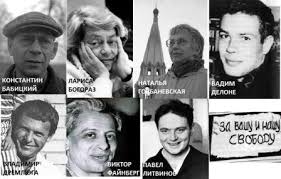
August 1968 Red Square protestors
(top row) Babitsky, Bogoraz, Gorbanevskaya, Delaunay
(bottom row) Dremlyuga, Fainberg, Litvinov; “For your freedom, and for ours” (poster)
At the end of July 1970 Dremlyuga declared a hunger strike, the result of which is unknown.
His physical condition is poor. The camp administration does not reply to the inquiries of Dremlyuga’s defence counsel, who wished to travel to see his client in order to draw up a complaint for review by the Supreme Court (two telegrams have been sent).
*
[7]
At the beginning of this year Suslonsky, a school-teacher of language, was arrested in Kishinyov (Moldavia). He is accused under Article 70 (RSFSR Criminal Code).
The charges concern tape-recordings of BBC broadcasts (about Solzhenitsyn) and the circulation of samizdat literature. The principal item of evidence is a diary which Suslonsky gave two or three witnesses to read.
*
[8]
On 3 July 1970 a search in connection with an unknown case was carried out at the flat of Victor Krasin, exiled from Moscow to Makovskoye village (Krasnoyarsk Region, central Siberia) “for parasitism” (CCE 11.8). The search warrant was signed by L. S. Akimova, Senior Investigator of the Moscow City Procuracy: it was dated 30 March.
Krasin asked the men carrying out the search, plainclothes men and a lieutenant (deputy police commandant from the town of Yeniseisk), “What is this about?” and “Why is the warrant dated 30 March?” They replied: “We don’t know ourselves, we get our instructions and carry them out”; “The warrant took a long time to get here, so we’ve come to you today.”
During the search Petro Grigorenko‘s notes from Tashkent Prison (CCE 12.1) were confiscated, as well as Krasin’s draft works, on the Stalin camps and on the Soviet civil rights movement, and his notes on current events in the USSR and in Czechoslovakia.
Krasin protested at the confiscation of his personal drafts: the confiscated items had nothing to do with the case in connection with which the search was being carried out, he said. The men replied: “We don’t know, they’ll sort it all out.” Krasin entered his protest in the record.
*
After the search Krasin was questioned.
He was asked whether he knew Natalya Gorbanevskaya, B.I. Tsukerman and Andrei Amalrik. Krasin answered the questions in the same way:
“I refuse to answer all questions connected with the civil rights movement and its participants, since we are being persecuted unlawfully.”
The investigator conducting the interrogation promised that criminal proceedings would be taken against Krasin for refusing to give evidence.
*
[9]
In the centre of Tartu on the morning of 17 April, a wooden stand with a picture of Lenin was burned down. Soon afterwards a youth was apprehended in another district; later he confessed to starting the fire.
He is a worker at the local comb factory, born in 1952. According to some reports, a forensic-psychiatric examination has judged him to be of unsound mind. His name is not known.
*
[10]
Catholic Churches Closed in Belorussia
The executive committee of Novaya Ruda, a small place in the Grodno Region (Belorussia), decided to close the church and turn it into a grain store. Belakova, the committee chairwoman, travelled to Moscow to get permission to close the church.
Requests from believers not to close the church went unheeded.
*
On 26 June 1970, Belakova’s deputy Zakharchenko changed into police uniform and hid in the wood with a group of policemen; they waited two hours for the inhabitants to go to work. The church was then surrounded. Zakharchenko smashed the lock, and the policemen collected the church plate and loaded it on to a lorry.
Some women who saw this tried to stop the policemen. After experiencing “physical persuasion” (their arms were twisted), they lay down in front of the vehicles, being desperate to prevent the church plate from being taken away. The driver refused to drive the lorry, but then Zakharchenko took the wheel and the policemen dragged the women off the road.
The lorry drove off. The church was closed.
*
In summer 1969 the church in Shuchin (Grodno Region) was closed. The priest refused to abandon his flock.
*
[11]
At the beginning of August there appeared an appeal to workers, peasants and intellectuals signed by the “Committee of Struggle for Socialist Democracy”. The subject of the appeal was the erection of a bust of Stalin under the Kremlin wall next to Lenin’s mausoleum. The authors argue from Leninist positions against the resurrection of Stalin.
“Let us give all our strength to the building of a socialist democracy in our country,” they urge.
*
[12]
We here give the addresses of:
Ilya Gabai (Moscow) in a central Siberian camp (CCE 12.3) — Kemerovo-28, postbox 1612/40, brigade 44.
Vladislav Grigoryevich NEDOBORA (Kharkov) in a Ukrainian camp (CCE 13.4) — Dnepropetrovsk Region, Zholtye vody (town), postbox 308/28, 3-32.
Vladimir Vladimirovich PONOMARYOV (Kharkov) in a Ukrainian camp (CCE 13.4) — Vinnitsa Region, Peschany district, Trudovoi (town), IV 301/59, brigade 24.
Arkady Levin (Kharkov) in a Ukrainian camp (CCE 13.5) — Rovno Region, Gorodishche (town), OR 318-96 ‘5’.
=========================================
NOTES
 A Chronicle of Current Events