At 6 p.m. on 17 June 1968 in Mayakovsky Square (Moscow), three young English people attempted to distribute leaflets demanding the liberation of Soviet political prisoners.
*
20-year-old Janette Hammond, 21-year-old John Careswell and 25-year-old Vivian Broughton, were detained by State Security agencies and deported the next day from the Soviet Union.
They are members of the youth organization ‘Church’, a union of Christian radicals, Marxists and anarchists founded a year ago. It is well known for its many street demonstrations against American aggression in Vietnam.
In January 1968, after the Moscow trial of Galanskov and Ginzburg, its members organized a six-hour demonstration outside the Soviet embassy in London.
*
FLYER
In no way is the ‘Church’ leaflet of an anti-Soviet nature.
In it both the words of the authors of the leaflet and the declaration by Bertrand Russell express only the regret and concern felt by many of the friends of our country about the repressive measures which have been taken in the Soviet Union against the freedoms of speech and conscience.
*
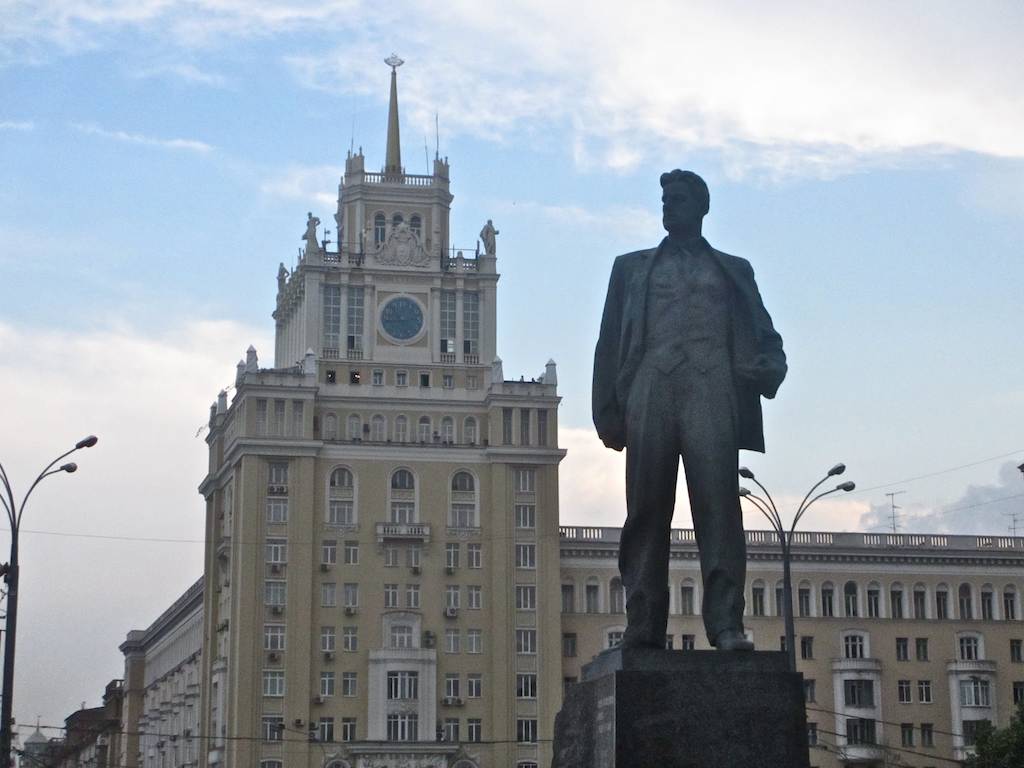
Mayakovsky Square, Moscow [1]
*
The leaflet opens with pictures of Yury Galanskov and Lord Bertrand Russell, and the slogans FREEDOM FOR GALANSKOV, FREEDOM FOR THE BAPTISTS, FREEDOM FOR ALL POLITICAL PRISONERS IN THE USSR.
The leaflet contains short informatory notes about five of the political prisoners: Andrei Sinyavsky, Yuly Daniel, Yury Galanskov, Alexander Ginzburg and Vladimir Bukovsky, and on the persecution of the Baptist Christians in the USSR.
An excerpt from the appeal “To World Public Opinion” (CCE 1.2-1) by Larissa Bogoraz and Pavel Litvinov, is also printed in the leaflet, together with the declaration of Bertrand Russell, which is presented below in slightly abridged form as in the leaflet:
“There is an influential body of people in the West which is always ready to condemn as wicked anything that happens in the Soviet Union, whilst at the same time boasting of the ‘liberty’ and ‘democracy’ enjoyed in the so-called Free World. Such people live in a black-and-white world and show no willingness to judge questions on their merits. Those of us in the West who have struggled over the years against these Cold Warriors have welcomed the enormous changes in the Soviet Union in the past fifteen years, changes which have undoubtedly led to greater human happiness and freedom.
“These admirable developments are endangered by the mock trial just held in Moscow. So intolerably unjust were the procedures of the court that even the official journal of the British Communist Party, normally a faithful spokesman for the Soviet Union, felt compelled to publish its criticisms. The Soviet writers should be retried before an open court and have the right to defend themselves fully.”
*
Earlier, on 6 June, a representative of the Flemish Committee for Co-operation with Eastern Europe, Roger de Bie, distributed near the Arbatskaya underground (Metro) station copies of the committee’s petition for the release of certain political prisoners, and also postcards bearing their pictures.
He too was detained and deported.
*
On 23 June, Larissa Bogoraz and Pavel Litvinov made the following statement:
“We are deeply touched by the courageous action of three young English people in openly demonstrating in defence of human rights in our country. We realized some months ago that our protest had found a response among leading men of culture in Europe and America. That was for us a tremendous moral support.
“Now we are happy to see, from the example of the Flemings and the English, that progressive young people in the West also understand the meaning of our struggle.”
=========================================
NOTES
- The statue of the poet Vladimir Mayakovsky (1893-1930) was erected in 1958 on the square at the intersection between Gorky (Tver) Street and the capital’s inner Ring Road. (It is to the north of Pushkin Square.)
In the late 1950s and early 1960s — see Galanskov and Ginzburg (CCE 1.1), Vladimir Osipov and Eduard Kuznetsov, CCE 4.7 [9] — the square became the location for poetry reading and gatherings.
In June 1969 it was the scene of a famous Crimean Tatar demonstration in Moscow (CCE8.5).
↩︎
==========================
 A Chronicle of Current Events