Episodes in the campaign
[1]
NOVOSIBIRSK.
Akademgorodok
In Novosibirsk, the central theme in the persecution campaign has come to be the aim of purging Akademgorodok, i.e., the university and SSAS institutes (Siberian Section of the USSR Academy of Sciences) of those who signed the Novosibirsk letter.
This aim has found expression in many forms [1].
There have been more or less insistent suggestions that these people should leave “at their own request”, for example, and outright threats: several lecturers in the School of Physics and Mathematics have been offered posts and flats in Novosibirsk (anywhere, in fact, but in Akademgorodok) .
A 36-year-old corresponding member of the Academy’s Siberian Section, Roald Sagdeyev, said:
“They should all be driven out of Akademgorodok — let them go and load lead ingots.”
Rumour has it that Academician Trofimchuk, corresponding members of the Academy Dmitry Belyayev and Slinko, and the Pro-rector of the University, Yevgeny Bichenkov, are distinguishing themselves in the persecution campaign.
*
Because some of its lecturers had signed the letter, the Department of Mathematical Linguistics at Novosibirsk University has been disbanded on the initiative of the Dean of the Humanities Faculty, corresponding-member Valentin Avrorin.
The continued existence of the Philology Department of the Humanities Faculty, and of the Department of Northern Languages and Siberian Literature at the SSAS Institute of Philosophy, History and Literature, is threatened.
*
[2]
MOSCOW
Union of Artists
Three members of the Moscow Section of the Union of Artists, Boris Birger, Yury Gerchuk and Igor Golomshtok, were discussed and condemned at a meeting, but only verbally, no sanctions being imposed.
Then the board presidium was convened, no notice of this being given, however, either to those to be discussed or to the five presidium members who might have been expected to object to sanctions. Only by chance did Birger and these five people hear of the meeting and attend. Thanks to this the motion to expel the three men failed.
*
The Union of Soviet Writers
After certain phrases appeared in the press, especially in the weekly Literatunaya gazeta and in Literary Russia, about the incompatibility of signing letters about the trial and remaining a member of the Writers’ Union, it is said that several writers (the names of Vasily Aksyonov, Yevgeny Yevtushenko and Vladimir Tendryakov have been mentioned) approached the Union Secretariat.
On behalf of one hundred (other versions say 120 or 150) members of the Union, or so it is said, they declared that if even one signatory were expelled, they too would leave the ranks of the Writers Union.
A similar statement, it is said, was presented by Veniamin Kaverin (cf. CCE 2.5), in his own name and on behalf of Pavel Antokolsky [2], Konstantin Paustovsky and Kornei Chukovsky [3].
*
The role of Lev Skvortsov
During a discussion at the Institute of the Russian Language concerning 11 research officers who had signed letters about the trial, Lev Skvortsov, a 32-year-old Master of Philological Sciences, distinguished himself, showing the greatest zeal in condemning them. This is approximately what he said:
“I know that there is an anti-Soviet organization in Moscow; its centre is to be found in our Institute.”
Lev Skvortsov is known as a secret participant [4] in the expert textual examination conducted in the Sinyavsky-Daniel case; the official expert was, as is well-known, Academician Victor Vinogradov.
Skvortsov was also a consultant during the investigation into the case of Yury Galanskov (CCE 1.1) and others, but the results of his textual analysis were not presented to the court for scrutiny because of their hypothetical nature. It is said that among his conclusions the “Letter to an Old Friend”, for example, was pronounced to be the joint work of Galanskov and Ginzburg, although to an unbiased eye and without resorting to stylistic and textual study, it is evident that it was written by a person of another generation.
Since the “Letter to an Old Friend” was pronounced an anti-Soviet document in the court’s verdict, and had been presented as such in the indictment, the seriousness of an accusation of authorship may be well understood.
=============================================
NOTES
Marc Shagal, “Over the Town” (1918)
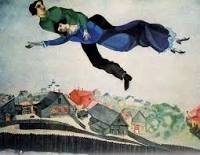
- In addition to the other repressive measures taken in Novosibirsk, the central press weighed in, and Akademgorodok’s famous art gallery was closed down. (Pictures permanently on show were taken to Moscow and buried for years in the basement of the Tretyakov Museum.)
Novosibirsk’s academic community was thus saved from contamination by the gallery’s imminent Chagall exhibition. Two years later its outstanding director, Mikhail Makarenko, stood trial (CCE 16.7 [2]) and was given an eight-year sentence.
↩︎ - A poet and member of the Writers Union, Pavel Antokolsky (1896-1978) was admitted to the Communist Party in 1943. He signed the Writers’ Letter (CCE 1.2, Letter 2:3) in 1968 and received a “severe Party reprimand”.
↩︎ - Paustovsky and Kornei Chukovsky, “two grand old men of Soviet literature”, died in 1968 and 1969 respectively.
↩︎ - Lev Skvortsov is described as participating in the expert linguistic assessment of the 1966 Sinyavsky-Daniel case. In fact, he did not take part.
Establishing its future reputation for accuracy and honesty, the Chronicle corrected its initial statement, adding that (CCE 5.5) “the work was actually done by Kostomarov, … at present director of the Centre for Russian Language Teaching (Moscow University).”
↩︎
================================
 A Chronicle of Current Events