The unprecedented extent of the movement of protest about the trial of Galanskov, Ginzburg, Dobrovolsky and Lashkova (this issue CCE 1.1) provoked a series of repressive measures.
*
1
At the beginning of February 1968 Mrs L.I. Ginzburg, Irina Zholkovskaya (respectively, mother and fiancee of Alexander Ginzburg) and Olga Timofeyeva (Galanskov’s wife) were summoned to the Moscow Procurator’s office.
Obedience being legally compulsory when a witness is summoned, but the notices making no mention either of the purpose of the summons or of the consequences of failure to appear, O. Timofeyeva did not answer the summons. Mrs Ginzburg and Miss Zholkovskaya were subjected to a ‘prophylactic chat’ [1] for allegedly spreading false information about the trial. The chat ended with a threat that Article 190-1 (RSFSR Criminal Code) might be invoked against them.
Following this, Bogoraz, P. G. Grigorenko, Litvinov and Yakir were summoned for similar ‘prophylactic chats’, but this time to the KGB offices (Litvinov did not obey either the first or the second summons, but later, in March, was called to the Moscow Procurator’s office). The content of the chats was identical: all the persons summoned were warned that they should cease their ‘public activities’.
Pyotr Yakir, the son of lona Yakir, the army commander who was shot in 1937, was told: “You aren’t your father’s spiritual heir! We are his spiritual heirs.” When Larissa Bogoraz said that she would not talk until she was allowed to make a statement about the grossly illegal methods of persecution practised in the case of former political prisoner Anatoly Marchenko, she was told that this statement was yet further evidence of her ‘anti-social activities’.
In a letter to Andropov, KGB chairman, Grigorenko described his own lengthy chat, which had been full of threats. He too received no reply no his letter.
*
2
PSYCHIATRIC TREATMENT
On 14-15 February, two of the most active participants in the protests Alexander Volpin (Candidate of Physical-Mathematical Sciences) and Natalya Gorbanevskaya, a translator, were forcibly interned in psychiatric hospitals.
2.1
Without any warning and without her relations’ knowledge, Gorbanevskaya was transferred on 15 February from Maternity Clinic 27, where she was being kept with a threatened miscarriage, to ward 27 of the Kashchenko Psychiatric Hospital.
The decision to transfer her was taken in consultation with the duty psychiatrist of the Timiryazev district, and the transfer was said to have been motivated by the patient’s requests to be discharged. On 23 February Gorbanevskaya was discharged from the Kashchenko Hospital as the psychiatrists admitted she was not in need of treatment.
2.2
On 14 February A.S. Volpin was taken from his home by the police and the duty psychiatrist of Moscow’s Leningrad district Albert Matyukov. The reason given was that Volpin had not reported for a long time to the psychiatric out-patients’ department where he was registered (and to which he had not once been summoned during the past four years).
He was put in ward 3 of the Kashchenko Hospital, where he was roughly handled by the ward supervisor, A.A. Kazarnovskaya, and the house doctor, Leon Khristoforovich (who did not give his surname). On 16 February, on an order signed by I. K. Yanushevsky, chief psychiatrist of Moscow, Volpin was transferred to No. 5 hospital at Stolbovaya, seventy kilometres from Moscow (this is a hospital mainly for chronically ill patients and also for petty criminals sent for compulsory treatment). Appeals made to I. K. Yanushevsky by his relatives remained unanswered.
Only after an appeal addressed to the USSR Minister of Health, Academician B. V. Petrovsky, initially by Academicians A. N. Kolmogorov and P. S. Alexandrov and then by a further ninety-nine academics (including the most eminent Soviet mathematicians: Academicians, professors and Lenin Prize-winners), was some improvement made in Volpin’s situation. At the present moment he is back again in Kashchenko Hospital, but in ward 32 which is quieter than ward 3.
2.3
The only official basis for such actions could be the instruction “On the immediate hospitalization of mentally ill persons who constitute a danger to society” (see the collection Health Legislation, vol. 6, Moscow, 1963) [2].
In the first place, however, this is only official and not legal, since the very fact of compulsory hospitalization conflicts with Articles 58-60 of the RSFSR Criminal Code, according to which compulsory measures of a medical nature are prescribed by a court. Moreover, the hospitalization of ‘socially dangerous’ persons directly conflicts with a fundamental principle of legality — that of the presumption of innocence, since it is a person who has actually committed an offence who is recognized as socially dangerous and this can be decided only by a court verdict. Secondly, even this rather cruel and illegal instruction was flagrantly disregarded.
A person sent to hospital must, within twenty-four hours after arrival, be examined by a commission of three people: this was not done in either Volpin’s or Gorbanevskaya’s case. Their relatives were not informed, which is also obligatory according to the instruction. Finally, a commission appointed after the letters from the mathematicians merely established that Volpin was in need of treatment, and to some extent improved the conditions of his internment. According to the instruction the commission is in any case bound to examine a patient once a month and, furthermore, to issue a finding not as to whether he is ill or not, but as to whether his illness is still of the ‘socially dangerous’ type — if it is not, the patient should be discharged into the care of relatives. The regular commission, which met on 17 April, also declared that Volpin needed to undergo another one and a half months of ‘treatment’.
*
3
PARTY MEMBERS
The next, and so far the widest, wave of repressions affected CPSU members who had signed one or other of the letters.
All the district Party committees in Moscow were sent copies or photostats of the letters (including even those whose authors had addressed them to the court and the Procuracy, without even sending copies to the CPSU Central Committee). The district Party committees went through the lists of signatories and hunted down ‘their’ members. In almost all cases identical action was taken — expulsion from the Party, regardless of the decision taken by local Party cells [3] and of whether the particular case had ever been considered at a meeting of the Party organization. The following 20 individuals were expelled from the Party:
1. Ludmila Alexeyeva [4], editor in the Nauka publishing-house. She had signed “the Letter of 80”. On the Party district committee’s recommendation she was dismissed from her job.
2. Ludmila Belova, Cand.Sc. (Philosophy) [5], participant in the Great Patriotic War, decorated, a research officer at the Institute of the History of the Arts, signed “the Letter of 80”.
3. Boris Birger, artist, member of the Moscow branch of the Artists’ Union, signed “the Letter of 24” (the “writers’ letter”).
4. Pyama Gaidenko, Cand.Sc. (Philosophy), research officer at the Institute of the International Workers’ Movement, signed “the Letter of 80”.
5. Alexander Ogurtsov, Cand.Sc. (Philosophy), research officer at the Institute of the International Workers’ Movement, signed “the Letter of 80”.
6. Leonid Pazhitnov, Cand.Sc. (Philosophy), research officer at the Institute of the History of the Arts, signed “the Letter of 80”. On the Party district committee’s recommendation he was dismissed from his job.
7. Valentin Nepomnyashchy, critic, member of the Journalists’ Union, head of the Soviet literature department in the journal Voprosy Literatury [Literary Issues], signed “the Letter of 24” (the ‘writers’ letter’). Removed from post of departmental head.
8. V. M. Rodionov, D.Sc. (Biology), at the Institute of Medical Biochemistry, signed the Letter of 120.
9. Fedot Suchkov, critic, member of the Writers’ Union, subjected to repression in Stalin’s time, signed “the Letter of 24” (the ‘writers’ letter’).
10. Moisei Tulchinsky, Cand.Sc. (History), took part in the Great Patriotic War, decorated, works at Nauka publishing house, signed “the Letter of 120”.
11. Isaac Filshtinsky, Cand.Sc. (History), senior research officer at the Institute of the Peoples of Asia, subjected to repression in Stalin’s time, wrote a letter with his wife to A. N. Kosygin asking for a humane review of the case.
12. Sergei Fomin, D.Sc. (Physico-Mathematical Sciences), Moscow University professor, signed the letter of the 99 mathematicians on behalf of Volpin.
13. Aron Khanukov, chief engineer in a building materials plant, signed the letter of ten friends of Ginzburg sent to Komsomolskaya pravda. Removed from his job as chief engineer.
14. Boris Shragin, Cand.Sc. (Philosophy), research officer at the Institute of the History of the Arts, signed “the Letter of 80” and gave his address as sender of the letter; also signed appeal to the Budapest conference (more about this appeal later). On the Party district committee’s recommendation dismissed from his post.
15. Grigory Yablonsky, physicist (Novosibirsk).
16. Ivan Yakhimovich, chairman of Jauna Gvarde collective farm, Kraslava district, Latvian SSR. Wrote letter to the CPSU Central Committee. Removed from chairmanship of collective farm.
17. Valery Pavlinchuk, physicist (Obninsk), signed the Letter of 170. Deprived of his security pass and dismissed ‘because of staff cuts’.
*
At the same time as participants in the protest campaign began to be expelled from the Party, the lawyer B. A. Zolotukhin (No 18), defence counsel for Ginzburg, was also expelled “for adopting a non-Party, non-Soviet line in his defence” [6].
In his defence speech the lawyer convincingly refuted all the prosecution’s evidence and — for the first time in many years’ experience of political trials — called for the complete acquittal of his client. After his expulsion from the Party B. A. Zolotukhin was removed from his post as head of a legal consultation office.
Simultaneously with this Party ‘purge’, two other persons were expelled for quite different reasons: Yury Karyakin (No 19), philosopher and literary critic, for an anti-Stalin speech made at an evening held in memory of the writer Andrei Platonov; and Grigory Svirsky (No 20), writer and member of the Writers’ Union, for a speech made at a meeting of the Moscow Writers’ Party Organization devoted to the danger of a Stalinist revival and the problem of censorship.
To the extent that some members were expelled without being given a hearing, all the expulsions involved violations of the Party Statutes.
*
4
“NON-PARTY MEMBERS”
In the case of many of the non-Party members who had signed various letters, ‘chats’ were held at their place of employment and suggestions were frequently made that they should resign ‘at their own request’.
Some persons were deprived of foreign assignments already scheduled for them. Fresh lists of ‘undesirable’ authors appeared in editorial and publishing offices. Some manuscripts already scheduled for publication were rejected.
*
Yury Aikhenvald and his wife Valeria Gerlina were dismissed from their teaching jobs [7] for signing “the Letter of 170”. Both were victims of repression in Stalin’s time.
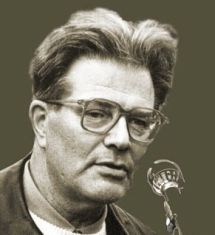
Yury Aikhenvald (1928-1993)
Yury Glazov, Cand.Sc. (History), who signed “the Letters of 170 and 80” and the appeal to the Budapest conference (CCE 1.4), was dismissed from the Institute of the Peoples of Asia.
For ‘staff reduction’ reasons the following were dismissed from their jobs: Alexander Morozov and Dmitry Muravyov (“the Letter of 120”), editors in the Iskusstvo publishing-house, Irina Kristi, junior research officer at the Institute of Theoretical and Experimental Physics (“the Letters of 170 and 99”), and the head of a laboratory in the same Institute, Alexander Kronrod, Doctor of Mathematical Physics (“Letter of 99”).
Sergei Vorobyov, an editor in the Soviet Encyclopaedia publishing-house, was expelled from the Komsomol for having at a meeting expressed dissatisfaction with the methods of discussion: signatories of letters were being condemned, yet none of the persons present had read the letters.
1.4 Appeal to Communist Parties Conference …
===========================
NOTES
- On 19 January 1968 Ginzburg’s mother and Galanskov’s wife tried to hold a press conference about the trial, but the Western correspondents in Moscow obeyed an order by the Soviet authorities not to attend. See Andrei Amalrik’s account, “The press conference of Ginzburg and Timofeyeva which did not take place” (Litvinov, ed., The Trial of the Four, 1972, Appendix 3).
↩︎ - In 1971 (CCE 28.9) directives about the “Urgent Hospitalization” of mentally-Ill individuals who represent a ‘danger’ to society were finally issued (but //not published).
↩︎ - In autumn 1968 the Chronicle reported (CCE 5.3): “A number of people have been readmitted to the Party on appeal, expulsion being replaced by the lesser sanction of a ‘severe reprimand’.”
↩︎ - On Alexeyeva, see CCE 2.1 [4]; CCE 34.18 [10], CCE 37.14 [12], CCE 40.14 and name index.
↩︎ - Those who studied philosophy at the postgraduate level in Soviet universities were obliged to be Marxist-Leninists and join the Party.
↩︎ - Defence lawyer Zolotukhin gave a remarkable speech at the Ginzburg-Galanskov trial. That and his speech at the appeal hearing, appear in Litvinov, 1972 (sections III and IV). An English text of the first speech is also in Brumberg, ed., In Quest of Justice, 1970 (document 13).
Zolotukhin was dismissed from the Collegium of Lawyers’ presidium. Finally, in June, he was expelled from the Collegium itself, i.e. deprived of the right to appear for the defence. The reasons for his expulsion were that “he uttered careless, politically vague formulations which gave our political enemies the chance to use them to the detriment of the Soviet State and Soviet justice, and did not take measures to deny them”.
His appeal for readmission to the Party (CCE 2.1 [30]), presented to the Party Control Committee, was not upheld.
↩︎ - The record of a discussion of Gerlina‘s case at a trade union meeting at her school and in the education department of the local Soviet soon began circulating in samizdat (partial text in Possev 10, 1968, and in Brumberg, 1970, document 77).
In the next issue of the Chronicle this roll-call of people subject to extra-judicial reprisals was extended to make a list of 91 (CCE 2.1). This total included people named above, especially those whose fate required correction or updating, but also added many more.
In late October the Chronicle did the same again, adding a further 63 names (CCE 5.3), although naturally only a small proportion of these had been persecuted in connection with protests against the Galanskov-Ginzburg trial.
↩︎
============================
 A Chronicle of Current Events