BELGORODSKAYA.
INTERROGATIONS & CONFRONTATIONS
(JAN-JUNE 1973).
*
(For Case 24, part 1: November-December 1972, see CCE 28.3)
[1]
THE BELOGORODSKAYA CASE
Irina Belgorodskaya was arrested on 3 January 1973 in Moscow.
According to her husband Vadim Delaunay, Investigator Zhuchkov, who was handling the Belogorodskaya case, stated that her arrest was linked to the appearance of No 27 of A Chronicle of Current Events, even though the investigators knew that she had not taken part in producing that issue.
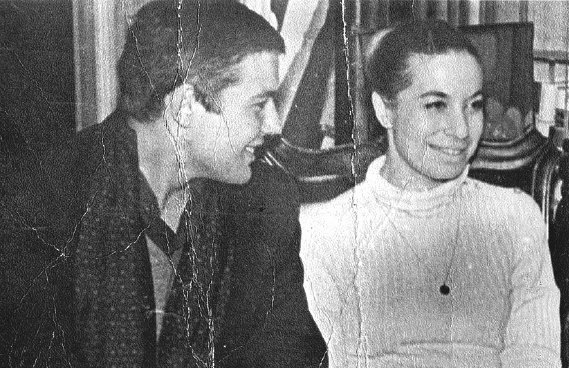
Vadim Delaunay (1947-1983) and Irina Belogorodskaya (b. 1938)
The KGB thereby fulfilled the promise it had made in November 1972 through the agency of the arrested Pyotr Yakir: “If No. 27 of the Chronicle comes out, a person not necessarily having any connection with it will be arrested” (see “Case 24, part 1”, CCE 28.2).
This was the second arrest for Belogorodskaya, an engineer by profession.
She was first arrested in 1968 for distributing a letter in defence of Anatoly Marchenko (CCE 3.1), and was sentenced to a year in the camps (trial, CCE 6.1).
*
In late January 1973 Delaunay was allowed to write a letter to his wife in the Lefortovo Prison.
In that letter Delaunay, who had had numerous talks with Investigator Zhuchkov, conveyed to Belogorodskaya recommendations for her behaviour. Despite this, as has become known, she refused to embark on the giving of testimony.
In February 1973, according to unverified information, Belogorodskaya either met or corresponded with Victor Krasin.
*
In the course of the spring, testimony by Belogorodskaya began to figure in the interrogations of Irina Yakir, Ludmila Alexeyeva and others. It became known that this testimony mentioned the names of Irina Yakir, Gabriel Superfin, Yury Shikhanovich, Ivan Rudakov, Natalya Kravchenko and Ludmila Alexeyeva in a rather “criminal” context.
Confrontations were arranged between Belogorodskaya, on the one hand, and Kravchenko and Alexeyeva, on the other.
*
[2]
INTERROGATIONS AND CONFRONTATIONS
JANUARY-JUNE 1973
(Notes [1] have been provided by the AI editors of the translation)
*
[2.1]
JANUARY 1973
Victor Krasin’s wife Nadezhda Yemelkina, exiled to eastern Siberia (CCE 23.2), was brought back to Moscow early in January to be interrogated about “Case 24”.
She was allowed a meeting with her husband.
On 20 January 1973 there was a face-to-face confrontation between Yemelkina and Pyotr Yakir. At first, Yemelkina gave details under interrogation only about her own actions. Subsequently, she testified about an association of Irina Yakir and Anatoly Jakobson with the Chronicle.
Yakir’s wife, Valentina Savenkova, was interrogated three times. On 18 January 1973 she had a meeting with her husband.
*
A confrontation was arranged between Krasin and Yury Gendler of Leningrad (CCE 3.4 & CCE 4.5).
Gendler [2] was arrested in August 1968. During the investigation and at his own trial in December 1968 (CCE 5.2) he testified that Krasin had given him samizdat materials in summer 1968 for distribution in Leningrad.
At an interrogation in June 1972 Gendler denied this testimony, but after the January 1973 confrontation he again confirmed it.
*
At about the same time there was a confrontation between Krasin and Father Sergy Zheludkov, an Orthodox priest [3]. According to Krasin’s testimony, the latter had received from him philosophical and religious books published in the West.
Father Sergy Zheludkov refused to testify “for professional reasons”.
*
Yury Maltsev [4] was repeatedly interrogated, after which confrontations were held between him, on the one hand, and Krasin and Yakir, on the other.
Krasin and Yakir accused Maltsev of having had contacts with Italian correspondents (Maltsev is a specialist on Italy) and of transmitting information and manuscripts to the West.
According to Yakir, Maltsev brought the “Programme of the DMSU [Democratic Movement of the Soviet Union]” (CCE 14.12, item 9) back from the Baltic region.
According to Krasin, Maltsev read samizdat literature at his (Krasin’s) home. Maltsev was a “signatory” of appeals etc. (This is the only item of evidence which Maltsev confirmed.)
*
Andrei Dubrov was interrogated and had a confrontation with Yakir.
As has become known, Dubrov gave testimony against, in particular, Yevgeny Kushev and the two Kozilo brothers (against the latter proceedings have been instituted) [5].
*
Yuly Kim was interrogated several times in the case of Yakir and Krasin. Kim also had confrontations with them. Kim did not confirm the testimony of Yakir and Krasin.
*
[2.2]
FEBRUARY 1973
A search was conducted at the flat of Gyuzel Makudinova, the wife of Andrei Amalrik, who was convicted in 1970 (see CCE 17.1).
Personal correspondence and money were confiscated during the search. It is assumed that this search was associated with the testimony about her husband given by Yakir and Krasin.
On 12 February 1973 Makudinova was interrogated by the KGB about Krasin’s testimony.
*
On 16 February there were confrontations between Yuly Kim, on the one hand, and Yakir and Krasin, on the other.
*
In February 1973 the following were also interrogated in connection with Case 24:
Ludmila Alexeyeva, Tatyana Velikanova, L. Ziman, Irina Kaplun, L. Kardasevich, Sergei Kovalyov, L. Kusheva, Pavel Litvinov, Grigory Podyapolsky, Gabriel Superfin, Tatyana Khodorovich, Irina Yakir, and Anatoly Jakobson.
Some of them were presented with an order to take “specimens of handwriting for graphological analysis”, because of the great amount of “handwritten materials figuring in the case”.
*
Anatoly Jakobson was interrogated about the Chronicle and documents of the Action Group.
He confirmed his participation in the letters of the Action Group [6] but did not answer other questions. Specimens of handwriting were taken from him for graphological analysis.
*
During an interrogation of Pavel Litvinov Investigator Alexandrovsky reproached him: by advising his acquaintances not to give testimony, Litvinov was exerting a bad influence on them and subjecting them to risk. Litvinov was being cruel and “was left with the truth, but not with Christ”.
Litvinov did not give a deposition.
*
Tatyana Velikanova, Tatyana Khodorovich and Sergei Kovalyov refused to cooperate in the investigation, for example in the graphological analysis. They cited the following grounds for their refusal:
- systematic procedural violations in the conduct of trials under Articles 190-1 & 70 (RSFSR Criminal Code);
- the injustice of the verdicts under these Articles, since in no known case had the information disseminated via samizdat been proven false, let alone knowingly false;
- the absence of proof of any intent to undermine the State’s authority in trials under Article 70.
During the interrogation of Kovalyov, Investigator Alexandrovsky made indirect threats against the members of the Action Group.
*
Grigory Podyapolsky was twice interrogated about the Chronicle and the letters of the Action Group.
Since he effectively gave no testimony, on the occasion of the second interrogation, at the suggestion of the investigator, an entry was made in the record to the effect that he had refused to cooperate in the investigation.
*
In February and March 1973 Gabriel Superfin [7] was repeatedly interrogated.
He was suspected of having proof-read Peter Reddaway’s (1972) book, Uncensored Russia published in London. Threatening arrest, the investigators also demanded that he turn over the “archives” of the Chronicle. Statements about Reddaway’s book and the archives of the Chronicle also figured in Krasin’s testimony at a confrontation with Superfin in May.
Superfin did not confirm this testimony.
For purposes of graphological analysis Superfin wrote out texts in the English and Russian languages.
*
In February Ilya Gabai was interrogated on the basis of testimony given by Yakir and Krasin. The greater part of this testimony was not confirmed by Gabai.
*
A confrontation was held between Yuly Kim and Stasis Jakas (see CCE 28.7, item 3).
Jakas had previously been convicted under an article of the Lithuanian Criminal Code corresponding to Article 190-1 (RSFSR Code) and was sentenced to two years in the camps. He had been arrested in the same case as Vaclav Sevruk (the Vilnius offshoot of “Case 24”).
He was brought from camp for the confrontation. Jakas testified that he had received the Chronicle from Kim, and given Kim items for the Chronicle. Kim did not confirm this testimony.
*
V. Semendyayev, a participant in the Crimean Tatar movement was brought from Melitopol in Ukraine for interrogations.
Previously he had been interrogated in Melitopol, where the investigators had played for him a tape recording of his telephone conversations with Yakir. In Moscow Semendyayev had a confrontation with Yakir.
*
Vladimir Bukovsky was brought from Vladimir Prison to Moscow.
*
[2.3]
MARCH 1973
Yelena Smorodinova [8], a former colleague of Belogorodskaya, was summoned by the KGB for interrogation in the latter’s case. It is known that Smorodinova gave extensive testimony.
*
Vladimir Rokityansky [9] was interrogated on the basis of testimony given by Krasin.
Krasin had stated that Rokityansky had contacts with foreign correspondents, and gave them copies of the Chronicle. Rokityansky did not confirm this.
*
In late March Andrei Amalrik, then serving the last months of his camp sentence in the Magadan Region (Soviet Far East), was taken to a special KGB prison in Magadan.
It appears likely that Amalrik is being questioned about the case of Yakir and Krasin.
*
Natalya Kravchenko was interrogated on the basis of testimony given by Irina Belogorodskaya.
*
Vladimir Bukovsky was returned to Vladimir Prison.
*
Alexander Alshutov was interrogated on the basis of testimony given by Pyotr Yakir.
*
On 30 March 1973 Alexander Lavut was questioned by Investigator Rastorguyev, who described “Case 24” as a case involving the preparation, possession and distribution of the Chronicle.
Lavut refused to testify. His grounds: investigations of this sort obstruct the free dissemination of information.
*
[2.4]
APRIL 1973
Academician Sakharov received a letter from Yakir in the Lefortovo Prison [10]. The letter was delivered by a KGB officer.
After assuring Sakharov of his deep respect, Yakir called on Sakharov to desist from all types of public statement, since (as Yakir had come to realize) they are harmful to people and are used by anti-Soviet propaganda.
*
The interrogation of Irina Yakir continues.
They are being conducted by Investigator Kislykh. “Out of humanitarian considerations” they are held in a district police station, so that Irina Yakir can nurse her infant during the breaks. (She has a two-month-old daughter.)
Confrontations were held between Irina Yakir and her husband Yuly Kim, on the one hand, and Krasin on the other. At one of them Krasin handed over a letter addressed to Yuly Kim and also intended for his “friends who are free”.
*
Krasin states that recently the “Democratic Movement” has taken a direction dangerous to the State and the State has been compelled (and is entitled) to defend itself.
The defeat of the “Democratic Movement” should be acknowledged. The cessation of all opposition activities is not sufficient to save people from repression. The authorities require guarantees, and these guarantees can be assured only by all-round cooperation with the investigation. Krasin calls upon people to overcome the psychological barrier and testify freely, not only about their own activities but also about those of others.
Andrei Amalrik was returned to his camp.
*
Anatoly Levitin (Krasnov) was brought from his camp for interrogations on “Case 24”.
*
[2.5]
MAY 1973
On 7 May 1973, there was a confrontation between Irina Yakir and her father Pyotr Yakir.
*
A confrontation was arranged between Pyotr Yakir and Ludmila Kardasevich.
*
Valentina Savenkova was interrogated, on the basis of testimony from Yakir, Krasin and Yemelkina, about 4,000 roubles which were transmitted from abroad.
*
Victor Timachev, Yuly Kim, Galina Gabai and Lyudmila Kusheva were interrogated on this same subject. They all refused to confirm the testimony of Yakir, Krasin and Yemelkina.
*
Nadezhda Yemelkina was again brought to Moscow from Siberia (Krasnoyarsk Region). She confirmed her testimony about the money.
*
On 28 May there was another confrontation between Irina Yakir and Victor Krasin. Krasin stated that he had turned over 600 roubles to her for helping political prisoners and their families.
Irina Yakir refused to answer any questions.
*
The case of Irina Belogorodskaya was separated from Case 24 and made into a separate proceedings.
*
[2.6]
JUNE 1973
Vladimir Dremlyuga [11] was brought from the Yakutsk camps (Soviet Far East) for interrogation about “Case 24”.
*
The interrogation of Irina Yakir was completed. Frequent interrogations were conducted over a period of two and a half months, sometimes every day.
The interrogations were at first conducted by G. V. Kislykh, then by Istomin from the city of Perm. During this time Irina Yakir had several confrontations with her father Pyotr Yakir and with Victor Krasin.
At first Irina Yakir refused to answer questions. Subsequently she began to confirm testimony which “concerned her personally”.
*
At confrontations with I. Belogorodskaya, Ludmila Alexeyeva and N. Kravchenko denied Belogorodskaya’s testimony about their part in the preparation of the Chronicle.
*
Ludmila Alexeyeva [12] was interrogated on the basis of testimony given by Pyotr Yakir.
*
Early in June, in accordance with Article 201 of the RSFSR Code of Criminal Procedure, Yakir, Krasin and their lawyers Yudovich and Shveisky began studying the case files.
On 18 June 1973, in accordance with Article 201, Yakir and Krasin signed that they had completed the process.
(For the Trial of Victor Krasin and Pyotr Yakir, see CCE 30.1)
=================================
NOTES
- Of the people who figure in this section, the following were in 1969 founder-members of the Action Group for the Defence of Human Rights in the USSR: Victor Krasin, Pyotr Yakir, Anatoly Jakobson, Tatyana Velikanova, Tatyana Khodorovich, Sergei Kovalyov, Grigory Podyapolsky, Alexander Lavut and Anatoly Levitin.
For more about them see Reddaway, Uncensored Russia (Chapter 7: “The Action Group”), and other issues of the Chronicle (e.g., CCE 8.10).
↩︎ - In late 1973 Gendler emigrated and now lives in New York.
↩︎ - On Father Zheludkov, see CCE 5, CCE 7, CCE 25-27 & CCE 32.
↩︎ - On Maltsev, see CCE 8, 10, 11, 13, 14 & CCE 21. In 1974 Yury Maltsev emigrated to Italy.
↩︎ - On Dubrov and Kushev, who emigrated in 1973 and 1974, respectively, see CCE 25 & 27 and 5 & 20 respectively. The initials of the Kozilo brothers are D and S.
↩︎ - See Reddaway, Uncensored Russia, pp. 150-153. On Jakobson see CCE 1, 3-6, 8-11, 14, 16, 18, 25 & CCE 30.
↩︎ - See this issue, also CCE 30. Superfin signed a protest against the Galanskov-Ginzburg trial in 1968. ↩︎
- Samorodina was an engineer who signed a letter of protest about the Galanskov-Ginzburg trial in 1968.
↩︎ - This (not Rakityansky) appears to be the correct spelling.
On Rokityansky see CCE 6 and the note in CCE 26, where, however, an error was committed in the copy received. As suggested in CCE 27 (Amnesty International edition, note 16), the item concerns Raketsky, not Rokityansky.
↩︎ - See text of Yakir letter to Sakharov in A Chronicle of Human Rights in the USSR 1973 (No. 2).
↩︎ - On Dremlyuga see CCE 3-5, 8, 10, 15, 17, 19-22, 27. In December 1974, he emigrated from the USSR. ↩︎
- On Alexeyeva, see CCE 1-3, 6, 8 & CCE 21.
↩︎
===========================
 A Chronicle of Current Events