HELSINKI GROUPS UNDER INVESTIGATION
- 3-1. The case of Alexander GINZBURG
- 3-2. Yury Orlov; Persecution of the Working Commission
- 3-3. Anatoly SHCHARANSKY; Matusevich and Marinovich
*
1. SHCHARANSKY
From August to November 1977 people in 20 towns and cities across the Soviet Union were interrogated in the case of Anatoly SHCHARANSKY. In total about one hundred people, mostly refuseniks, were questioned; the majority did not know Shcharansky.
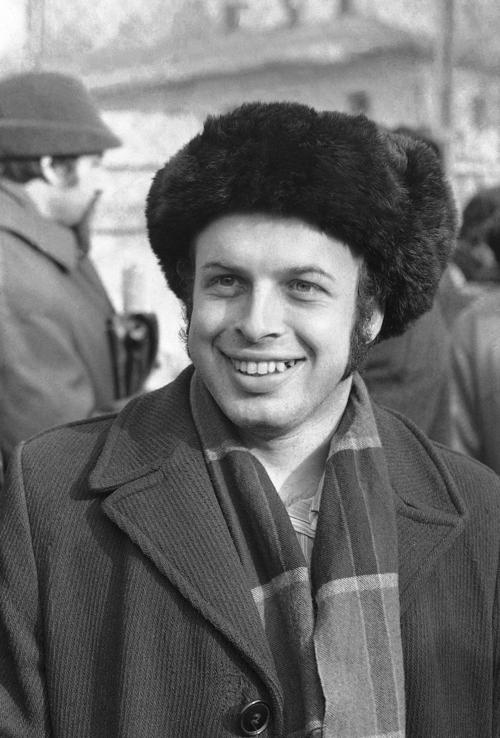
Anatoly Shcharansky, b. 1948
*
INTERROGATIONS IN MOSCOW
Leonid Shabashov was interrogated on 1 and 8 August.
To the first interrogation he was brought by force, and his bag was searched with the object of seeing whether he was “carrying a weapon”. His answers were recorded in distorted form. He was told that his exit visa depended on his conduct at the investigation.
Shabashov wrote a complaint to the procurator’s office. The reply said that the facts in the complaint had not been corroborated.
*
On 19 August 1977 Arkady Mai was interrogated.
Investigator Skalov conducted the interrogation. Mai was asked, principally, about the seminar of Jewish culture and history which he directs. Then he was presented with a few pages of a typewritten text, allegedly a list of refuseniks compiled by A. Shcharansky. To Mai’s question: “What does this list have to do with espionage?” the investigator replied that the list, of course, was not espionage, but secret information could have been communicated together with it.
A. Mai indicated in the protocol that he had never discussed his place of work with anyone, and had written about it only at the Department of Visas & Registration (OVIR).
*
The same day Alexander Gvinter was interrogated. Having received the answer from Gvinter that he did not know Shcharansky, the investigator questioned him about himself and about the collective letters signed by him.
At the beginning of September Vladimir Lazaris was interrogated. Investigator Naloichenko said to Lazaris that now he was a witness, but a charge against him was only a matter of time. (In November Lazaris left the USSR.)
On 28 and 29 September Zakhar Tesker was summoned to interrogations. Basically, the questions put were about himself.
*
On 28 October TASS correspondent Victor Vladimirov communicated an agency statement to the West:
“Anti-Soviets at work
“In the last few days Zionist organizations in the West have been going all out to blow up an anti-Soviet campaign around the case of the traitor Anatoly Shcharansky. In Washington, Paris, the Hague, Hamburg and Oslo special demonstrations are being organized where he is portrayed as ‘an innocent victim of tyranny’, a simple ‘Jewish fighter for civil rights’. ‘Witnesses’ confirm this at various disreputable get-togethers. Like scenery on theatrical tours, they are transferred at someone’s expense from Europe to America and vice versa.
“What does Anatoly Shcharansky — this supposedly innocent fighter for civil rights — stand for in reality? As has already been reported, Shcharansky has been charged with rendering assistance to a foreign state in conducting hostile activities against the Soviet Union. The facts testify that Shcharansky systematically engaged in collecting and fabricating slanderous information about Soviet reality and communicating it to the West to be utilised widely for anti-Soviet ends. At the commission of his masters he supplied the West with facts about Soviet enterprises and institutions which conduct trade with capitalist countries; together with his accomplices, he assisted by every means circles interested in breaking of? the trade of these countries with the Soviet Union.
“The guilt of Shcharansky and his comrades-in-arms is attested, in particular, by the already widely known (including the US State Department and the United Nations) statement of Sanya Lipavsky [see CCE 44.9, Chronicle], a Soviet citizen whom American intelligence attempted to draw into criminal subversive activity against the USSR. An agent of the special services, Robert Toth, former correspondent of the Los Angeles Times in Moscow [CCE 46.5-2, Chronicle], did not consider it necessary to conceal the work of Shcharansky in the interests of US intelligence; after he had been expelled from the Soviet Union he stated that Shcharansky had served him as a source of information.
“The moral aspect of the ‘Jewish fighter for civil rights’ does not look any better. Just the following detail gives some idea about him. In the last three years alone Anatoly Shcharansky has gone through three wives. The second of them — Natalya Shtiglits, who is now doing the rounds of all sorts of demonstrations under the guise of the inconsolable wife of Shcharansky — should know that her spouse was at first intending to leave for Israel at the summons of his ‘fiancée’ Ershkovich, whom, as he explained in OVIR (the Department of Visas & Registration), he loved ardently and passionately. But after Shtiglits herself departed for Israel he did not grieve for long about parting with her. As his new wife Shcharansky replaced Natalya Shtiglits with a certain Lida Voronina.
“Such are the facts, and they cannot be refuted by any slanderous rabble-rousing. And yet another thing — the organizers of the rabble-rousing do not conceal that their aim is to exercise pressure on the organs of Soviet justice. Your attempts are in vain, gentlemen. The traitor to his country will be punished according to the full severity of Soviet law, in complete accordance with its letter and spirit.”
*
On 15 November 1977 Yelena Sirotenko and her father were interrogated.
Investigator Skalov told Sirotenko that Shcharansky had not acted alone, but within the framework of a far-flung organization: “We won’t try them yet.” He said that Jews wanted to determine the policies of the USSR, but they should not think that they would succeed in this.
According to him, refuseniks were collecting anti-Soviet information which Israel then bought up for money and parcels. “Shcharansky was working for anti-Soviet and Zionist organizations, for the CIA and American capital.” In addition, he announced that military experts had, allegedly, proven that R. Toth was a spy. Sirotenko was presented with several collective letters of Jews with her signature under them.
*
The same day Victor Brailovsky was interrogated again (CCE 45.16).
The interrogation, which was conducted by Investigator Koval, lasted 12 hours. Brailovsky was presented with a large collection of documents put together by refuseniks. Brailovsky refused to answer questions. They tried to persuade him to change his position, referring to the samizdat essay by Vladimir Albrekht “How to conduct yourself at interrogations” [1].
On 16 November Investigator Litvinovsky interrogated Vladimir Albrekht. He was asked, specifically: ‘Did you render any help whatever to other refuseniks on matters connected with leaving for Israel?’ The interrogation lasted 10 hours. On 21 November Albrekht was once again interrogated in the Shcharansky case.
*
On 16 November Ida P. Milgrom, Shcharansky’s mother, was also summoned to an interrogation.
Investigator Gorbunov conducted the interrogation. Milgrom stated that she refused to be a witness at the investigation as she was not convinced that after it she would be admitted to the trial. She expressed bewilderment with regard to the TASS statement of 28 October (see above). Investigator Gorbunov advised her not to pay any attention to it. He said that it was some form of provocation.
Gorbunov asked Ida Petrovna to relate in detail the story of her son’s life. She agreed and talked about Anatoly for several hours.
When the protocol was read out it became clear that in recording it Gorbunov had distorted her tale. For example, in place of “Anatoly lived in the flat of L. Voronina” he had written “Anatoly lived with L. Voronina at her flat”.
*
On 17 November 1977 the father and brother of Shcharansky were summoned to Investigator Chechetkin. Shcharansky’s father, B.M., did not go to the interrogation and handed in a written statement of his refusal to take part in the investigation as he did not consider it objective.
Leonid Shcharansky appeared at the interrogation.
Requested to relate the story of his brother’s life, Leonid replied that he would not do so because his mother had already told them everything the day before. A long conversation followed, took place as to whether Leonid considered the investigation to be objective. He said that he shared the opinion of his father. The investigator proposed to record this and said that Leonid Shcharansky would have to answer for slander.
After this, Chechetkin for a second showed Leonid a piece of the protocol where in Anatoly Shcharansky’s handwriting it was written that he had no complaints to make: but it was not clear whether this referred to the investigation, or to an investigator, or to the conduct of the given interrogation (Leonid did not manage to read it through).
Chechetkin tried to convince Leonid that now he must recognize the investigation as objective and unprejudiced. Leonid insisted that his opinion on this subject be recorded in the protocol.
*
On 18 November Larisa Vilenskaya was summoned to an interrogation. Major Yu.F. Kudryavtsev conducted the interrogation. He asked about signatures under collective letters.
Kudryavtsev threatened Vilenskaya, saying that she would be answerable for refusing to give evidence, even though she answered his questions.
*
On 23 and 25 November Lev Gendin, who was serving 10 day jail sentence (he was arrested near the synagogue), was interrogated in special reception room No. 6 at the internal affairs department of the Moscow City Soviet Executive Committee.
Lieutenant-Colonel Chechetkin conducted the interrogation. Although Gendin was ill at the time and had a high temperature, the interrogations lasted eight hours each. Chechetkin asked, in particular, what role Shcharansky played in organizing demonstrations by refuseniks. A photograph was produced of a demonstration next to the statue in Moscow of Yury Dolgoruky; it showed both Gendin and Shcharansky.
Evidence by Leonid Tsypin was read to Gendin about how in October 1974 A. Lunts organized and financed trips by Shcharansky, Gendin and Tesker to towns and cities in the Soviet Union, gathering information about refuseniks to send to the office of US Senator Henry Jackson before the vote on his ‘amendment’. (Amongst refuseniks over the last few years the opinion has prevailed that Tsypin is a provocateur. On 17 May 1977 the newspaper Vechernaya Moskva [Evening Moscow] published a statement by Tsypin ‘unmasking’ Jewish activists.)
The interrogation was constantly interrupted by insulting remarks directed at Gendin, Shcharansky and other refuseniks. Chechetkin repeatedly threatened Gendin with long terms of imprisonment for various criminal offences.
After the second interrogation Gendin wrote a complaint against the actions of the investigator to Procurator-General of the USSR Rudenko.
*
On 24 November 1977 Major Kasumov interrogated Josif Ass (CCE 51.16 [29]).
When Ass was given the protocol of the interrogation to sign, it turned out that his answers had been ‘edited’ in the protocol. Ass refused to sign such a protocol. Kasumov, having refused to record the answers of Ass word for word, began writing that the witness would not answer questions, and threatening him with criminal responsibility under Article 182 (RSFSR Criminal Code).
On 27 November Ass sent a complaint to the USSR Procurator’s Office. Having described the circumstances of the interrogation, he asked for the complaint to be added to the Shcharansky case materials.
*
On 25 November 1977 famous Jewish activists and close friends of Shcharansky were summoned to the KGB: Maria and Vladimir Slepak, Dina and Iosif Beilin, Julia and Alexander Lerner, Ida Nudel and Naum Meiman.
ON 25 November only the Beilins and Ida Nudel appeared at the interrogation. They were interrogated by Investigators Skalov and Sherudilo.
Vladimir Slepak appeared at an interrogation on 28 November. He was interrogated by Koval. The witnesses were not allowed to record their evidence themselves; the investigators refused to enter additions and corrections in the protocol; the evidence was noted down in the protocol in a distorted form; statements made by witnesses during interrogations were not admitted to the case. Investigator Skalov said that Shcharansky had committed a crime and called him a criminal.
All those interrogated gave Shcharansky glowing character references, setting this out in their evidence and statements.
The Lerners, Maria Slepak and Naum Meiman did not turn up for interrogation, stating that they considered the case fabricated and the investigation biased.
*
In the middle of November 1977 Lev Talyanker was taken from work to an interrogation. Talyanker informed them that he was not acquainted with Shcharansky. The investigators were interested in an article by Talyanker on the emigration policies of the Soviet authorities.
At the end of November Yevgeny Liberman, Mark Novikov and Mikhail Chlenov were interrogated. They were shown letters of Jewish activists signed by them. All three refused to give evidence, referring to the fact that if writing these letters were considered a criminal act, then witnesses moved into the category of suspects.
At the same period G. Vigdarov (CCE 46.5-2) was interrogated for the second time. The same questions were put to him as in July. Vigdarov said, as before, that he did not know Shcharansky.
*
IN OTHER TOWNS AND CITIES
LENINGRAD. At the end of August and beginning of September Investigator Stepanov from Moscow and Investigator Medvedev from Leningrad interrogated many refuseniks.
Questions concerned Moscow and Leningrad refuseniks, signatures under collective letters of Jews, a mythical organization (‘Sherut Aliyah’) and some ‘refusal groups’. Vladimir Knokh refused to answer the questions, having said that the Shcharansky case was directed against all refuseniks, which meant against him personally as well. Grigory Goman would not answer the questions because he had not been informed with what Shcharansky was charged. Lazar Kazakevich was summoned to an interrogation by a deception — he was told that he was needed for clarification of matters connected with his exit visa. The majority of refuseniks from Leningrad were not acquainted with Shcharansky.
*
KIEV. From 6 to 8 September Investigator Koval interrogated Vladimir Kislik. The first interrogation lasted 12 hours. Kislik was asked about Shcharansky and collective letters of Jews, but most of all about himself.
Other witnesses interrogated in Kiev (Bedrin, Lebed, Pargamanik and Gertsberg) were asked about Kislik. None of them knew Shcharansky. (On Kislik, see this issue CCE 47.8-4.)
*
MINSK. On 5, 6 and 8 August L.P. Ovsishcher was interrogated. The investigator was Major Skalov, After the interrogation Ovsishcher stated:
“The investigator did not produce a single piece of material or question which confirmed the truth of the charges brought against Shcharansky. He also has no information about the presence in the information communicated of any secrets, nor can he have. Clearly the desire of the investigator was to find out everything possible about our struggle to leave.”
In Minsk another four Jewish activists (Goldin, Khess, Rainer and Zubarev) were interrogated. None of them was acquainted with Shcharansky.
One of the questions was who came to the funeral of Colonel Yefim Davidovich (CCE 39.4, CCE 40.6). In reply to the bewilderment over this question Skalov said that a meeting with foreigners could have taken place in the train, during which secret information could have been handed over.
*
VILNIUS. Interrogations took place at the beginning of September 1977.
A member of the Lithuanian Helsinki Group summoned as a witness, Eitan Finkelstein (CCE 43.10), refused to take part, since he thought the investigation was being conducted by methods incompatible with the existing legislation.
Many other refuseniks were summoned including nursing mothers, pregnant women and people on the sick-list. They all informed the investigation that they were not acquainted with Shcharansky.
*
RIGA. Interrogations were conducted at the beginning of September by Investigator Kochetkov.
Valery Kaminsky, brought to the interrogation on a warrant, was told that a ‘second Shcharansky’ would be made out of him. Yakov Gordin was also brought to interrogation on a warrant. Arkady Tsinober refused to participate in the investigation.
Questions were asked about how a list of refuseniks in Riga landed up in Moscow, At one of the interrogations Investigator Kochetkov stated that the investigation was being conducted not in the interests of justice, but in the interests of the State.
*
ODESSA. At the end of August 1977, Liliya and Lev Roitburd and D. Skulsky were interrogated in the Shcharansky case. The questions concerned the trial of Roitburd (CCE 37.3). In the middle of November Leonid Tymchuk and Valentina Barladyanu were interrogated.
KHARKOV. In May Vladimir Pevsner was interrogated; he has now left for Israel. He was asked about himself and about how his complaints reached the West.
In August, Faktor, Pshonik and Lander were summoned. None of them is acquainted with Shcharansky. Investigator Naloichenko asked how letters of Kharkov refuseniks had reached Moscow and the West, and about acquaintances in Moscow.
LVOV. On 1st, 5th and 6 October 1977 a local investigator interrogated five people on the instructions of the Moscow KGB.
The investigator told them that Shcharansky was the head of the Moscow organization ‘Aliyah’, and during the period of his activities more than ninety slanderous documents had been composed which Shcharansky sent to the West through foreigners. ‘Aliyah’ had deputised Shcharansky to join the Helsinki Group as its representative.
In addition, Shcharansky collected and handed over information later used by Western secret services to harm the Soviet State, and he established contact with foreign journalists, to whom he gave tendentious materials. The result of his activities was the 1974 Jackson-Vanik Amendment.
*
ROSTOV-ON-DON. At the beginning of November 19-year-oId L. Brusilovsky was interrogated. He was asked whether Lazar Lyubarsky (now in Israel) gave any assignments to Shcharansky. Because of the interrogations the emigration of Brusilovsky, who had already obtained permission, was delayed.
DUSHANBE. In May and August Amnon Zavurov and his father (CCE 44.11) were interrogated, and several other refuseniks, about 10 in all. They all stated that they had never seen Shcharansky. Despite the fact that the majority of them have many relatives in Israel, they were asked how the West knew about them.
KISHINYOV. Having shown witnesses a photograph of Shcharansky, an investigator stated that he was a criminal of international class.
Besides this, interrogations took place in: Saratov, Tula, Krasnodar and Kaliningrad (RSFSR); Vinnitsa and Chernovtsy (Ukraine); Bendery and Beltsy (Moldavia); Kaunas (Lithuania) and Frunze (Kirghiz SSR).
*
In the last few months collective letters in defence of Shcharansky have been written by Jews in Minsk, Vilnius and Leningrad.
Seventeen Minsk refuseniks, in a letter to Brezhnev, demanded that Shcharansky be released and given the right to leave for Israel. Eleven Vilnius Jews wrote that the threat hanging over Shcharansky is a blow to all Jewish activists, refuseniks, to all wishing to emigrate, and to all Jews in the USSR. Seventeen Leningraders summoned as witnesses in the Shcharansky case also wrote that the case is directed against all active refuseniks.
*
On 30 September 1977 the coordinator of the Shcharansky case, Volodin (CCE 45.5), received Shcharansky’s mother Ida Milgrom.
In reply to her petitions about granting her son the opportunity to use the services of a defence lawyer during the investigation and about a meeting with her son, Volodin said that she could hire a Soviet lawyer with security clearance, but he would only be allowed to act after the end of the pre-trial investigation and during the judicial proceedings. He also said that Shcharansky would not be allowed to use the services of foreign barristers.
Volodin informed her that meetings with Shcharansky were not being granted to relatives, as, afterwards, distorted information would be broadcast over the radio. Volodin tried to compromise Shcharansky’s friends in the eyes of his mother.
On 31 October, after numerous inquiries about the possibility of a barrister taking part in the pre-trial investigation, Milgrom received an answer from the USSR Procurator’s Office signed by Senior Counsellor of Justice S.A. Zakharov: “Insofar as there are no circumstances preventing the accused from exercising his right to defence, there are no grounds for satisfying your petition.”
In November Shcharansky’s parents were told they should start looking for a defence lawyer.
***
2. The Case of Matusevich and Marinovich
On 2 August 1977 Vasyl Ovsiyenko [2] was interrogated in Zhitomir in the case of Matusevich and Marinovich [3].
Ovsiyenko denied that he knew Matusevich. He was shown evidence from his niece Ludmila Ryabukha, saying that in spring a man called ‘Mykola’ had visited her uncle. On 3 August Ovsiyenko wrote to Ludmila, advising her to say at interrogations only what went into the protocol, and only with those conducting the protocol.
On 26 August Zhitomir KGB officials (Chaikovsky, Shishuk and Kotvitsky) ‘chatted’ with Ovsiyenko [4]. They threatened him with criminal prosecution for “deliberately false evidence”, “impelling a witness … to give false evidence”, and “disclosing facts of the pre-trial investigation”. In addition, they asserted that in letters Ovsiyenko wrote between 3 and 17 August 1977, he had circulated “deliberately false fabrications” .
=======================================
NOTES
- See full text of Albrekht’s advice in Volnoe slovo [The Free Word], Frankfurt, No. 27, 1977 (pp. 3-75).
↩︎ - On OVSIYENKO, see CCE 32.12, CCE 35.7, CCE 39.2-1, CCE 44.17-3, CCE 45.12 [2], Name Index and note 4 (below).
↩︎ - Matusevich and Marynovych were both were sentenced to seven years of imprisonment and five years in exile on 29 March 1978 (CCE 49.3).
↩︎ - Vasyl Vasylyovych OVSIYENKO was sent to the camps for four years in 1974. On completion of his term of imprisonment he remained under surveillance in the Zhytomyr Region (Ukraine); he was not permitted to work in his profession as a literary man.
Ovsiyenko was tried for a second time in Radomyshl (Zhytomyr Region) on 7-8 February 1979 and sentenced to three years in strict-regime camps (CCE 52.2).
It was Ovsiyenko who oversaw the KHPG project “The Dissident Movement in Ukraine“, writing many of the entries himself.
↩︎
==========================
 A Chronicle of Current Events