- 1-1. Trial: charges, witnesses …
- 1-2. Trial: closing words, Soviet press, public response
*
Closing words
The summing-up then began.
*
PROSECUTION
The procurator’s speech began and ended with quotations from Lenin.
In the middle he referred to the international situation, saying that Velikanova’s activities served the interests of reactionary groups in the West. This was confirmed by her links with émigrés such as Bukovsky, Plyushch, Ludmila Alexeyeva, Litvinov, Julia Zaks, Amalrik, Shragin and Tatyana Khodorovich. These people were all connected with anti-Soviet organizations in the West.
Proof of this could be seen in the correspondence confiscated from Velikanova, in the evidence of witnesses Glazko, Zainutdinov and Kozharinov, and in materials from the cases of Sergei Kovalyov (CCE 38.3) and Gabriel Superfin (CCE 32.3).
He asked for Velikanova to be sentenced to four years in the camps, followed by five years in exile.
*
DEFENCE
Defence counsel Batova remarked in her speech that it was her first experience of such a complex case. The accused had insistently refused the services of defence counsel, “who was now the person closest to her”:
“I say this in order to stress how difficult are the conditions in which I am working.”
Nearly all the activities cited against the accused concerned the period up to 1974. Velikanova received an official ‘warning’ in 1974, which indicated that all her activities were well known. However, she was not arrested then, even at the height of the case of Yakir and Krasin (the Yakir-Krasin case ended in September 1973, CCE 30.2).
Batova stated that the same crime could not be punished twice. The evidence given by Korolyova, Zainutdinov, Alexeyev and Kozharinov proved nothing, as it did not directly relate to Velikanova.
Defence counsel read out a character reference from Velikanova’s last place of work, as an orderly in a children’s hospital. It stated that she worked conscientiously and was sympathetic to the children. (Here someone in the courtroom shouted: “How remarkable!”) The accused had brought up three good, healthy children.
Of course, the documents which she had signed “bore an unmistakable stamp, but then punishment is intended to educate, not serve as revenge; is that not so, Comrade Judge?”
Article 70 provided for a wide range of punishments, one of which was two to five years’ exile. Defence counsel considered it possible to sentence Velikanova to a punishment which did not involve imprisonment.
*
When requested to make a final speech Velikanova merely said: “The farce is ended, it’s over.”
*
On 29 August sentence was passed: four years in strict-regime camps and five years in exile. Velikanova preferred not to appeal.
On 28 September she was despatched from Moscow; on 3 October she arrived in Mordovian Camp 3.
*
Soviet press
The Soviet press responded to Velikanova’s trial with a long article “With a Shield of Libel”, published in the Sovetskaya Rossiya daily newspaper on 31 August. It was signed “V. Ivanov”.
Particular emphasis was laid in the article on Velikanova’s links with the West. There were a large number of quotations from letters written to her from abroad.
Much attention is given to Chronicle of Current Events, without mentioning it by name:
“The case materials leave no room to doubt what the authors of this anti-Soviet trash considered to be the ‘truth’: during the trial the evidence presented included both typewritten lampoons and other libellous trash printed in New York by the anti-Soviet publishers Khronika Press and smuggled into the USSR.
“All this ‘information’ was concocted according to the same recipe. Once it was learned that someone had been committed for trial, even some petty thief or hooligan, they reported immediately about persecution for beliefs. If they heard of punishment imposed in some camp for violations of discipline, then at once they set up a cry about alleged brutality against prisoners …
“Velikanova and her accomplices, who call themselves ‘defenders of rights’, are least of all interested in rights in the broad and full sense in which they are proclaimed and guaranteed by the Constitution of the USSR.
“Their interests are limited to an extremely small set of subjects: prisons, corrective labour camps and arrests. In brief, any filth is collected, from rumours and gossip to open slander, and it arouses feelings of revulsion in any normal person, surrounded as it is with an odour of refuse and garbage …
“Muscovites will remember the incident of the bomb in the Metro, when criminals caused injury to 44 people, seven of whom died. Now in court we are shown one of the latest issues of a journal which Velikanova was about to send abroad. Its slanderous contents include an entire section headed “The Case of the Explosion on the Underground” [CCE 52.1, Chronicle].
“Every line of this section is a mixture of fiction and malicious libel. It expresses regret at the ‘excessively harsh sentence’, and hints that the criminals had some alibis or other …”
*
RESPONSE
After the trial those members of the “Committee to Defend Tatyana Velikanova” who were still at liberty — Larissa Bogoraz, Yelena Bonner, Sophia Kalistratova and Lev Kopelev — signed the following statement:
“… It is pointless to talk about violations of the law in Velikanova’s case.
“There was never a whiff of the law. The outward appearances were there, the phoney symbols of legality: the court building, cordoned off by three rows of policemen; the courtroom, more heavily defended from her friends than an ammunition store; the Procurator, the Judges and a person called the Defence Counsel who was rejected by Velikanova (‘I don’t need a second prosecutor!’) but who played out her role; people taking the part of witnesses – including some who had never seen Tanya face to face, nor heard anything about her or her activities; and twelve volumes of ‘case materials’.
“Tatyana Velikanova was assigned the role of accused, a role she refused to play. The show fell to pieces and crumbled.
“There was no trial, and the only reality left was the escort (in military, police and plain-clothes) which separated Tatyana from her friends, and the prison van which at the end removed her from normal life for nine years.
“We, Tanya’s friends, stood in the street for three days outside the court, trying hard to get inside, not to ‘listen to the trial’ but to take one last look at her before a long separation which actually began ten months ago.
“What was there to listen to in the courtroom?
“The Judge’s questions about the soup in the camps, the confused and irrelevant replies of the ‘witnesses’, the helpless mumblings of the defence counsel, the vacuous rumblings of the Procurator, the rehearsed shouts (‘Not enough!’) about the sentence from the invited ‘public’ – it was all about nothing and to no purpose. The whole mess could have been spun out for a week or omitted entirely. Velikanova remained silent, and the blows prepared against her struck empty air. ‘The farce is ended,’ she said after the judgment was read out.
“After the trial of Tatyana Velikanova the trials to come lose all their significance for the authorities: Bakhmin, Abramkin, Podrabinek, [Tatyana] Osipova, Lavut, Ternovsky and others await their turn in prison. For what purpose? The escort, the prisons, the camps, and the black Marias are always at the ready and need no trials.
“On the first day of the trial Tanya managed to wave to us from afar.”
*
On 29 August the Moscow Helsinki Group adopted Document 140, “The Trials of Tatyana Velikanova and Father Gleb Yakunin”.
The same day a letter about the sentences received by Velikanova and Yakunin, “Who stands Condemned?” was signed by 57 people:
Yekaterina Alexeyeva, S. Anishchenko, N. Babitskaya, F. Babitsky, Larissa Bogoraz, Ludmila Boitsova, Yelena Bonner, Yu. Velichkin, Yekaterina Gaidamachuk, Yury Gastev, Vladimir Gershuni, Mikhail Gefter, Angelina Gorgan, A. Gotovtsev, S. Grimm, Z. Dzeboyeva, V. Dolgy, M. Dubakh, M. Zotov, V. Istomin, N. Istomina, A. Kabinova, D. Kazachkova, Sophia Kalistratova, Ivan Kovalyov, N. Komarova (Nekipelova), Lev Kopelev, E. Kostyorina, V. Kronrod, Vsevolod Kuvakin, T[atyana?] Lavut, Malva Landa, Raissa Lert, Mikhail Liyatov (Yakovlev), Naum Meiman, I. Myaskovsky, M. Novikov, Gleb Pavlovsky, Z. Perchatkina, Maria Petrenko (Podyapolskaya), V. Poleshchuk, G. Poleshchuk, K. Popov, N. Prokopchik, T. Prokopchik, Andrei Sakharov, Felix Serebrov, A. Smirnov (Kostyorin), B. Smushkevich, V. Sorokin, Seitkhan Sorokina, L. Ternovskaya, V. Tolts, Sergei Khodorovich, Yury Shikhanovich, //Vadim Shcheglov and F. Yasinovskaya (Litvinova).
*
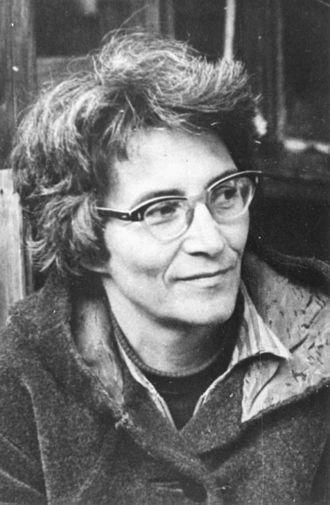
Tatyana Velikanova (1932-2002)
*
Tatyana Velikanova graduated from the Mechanics & Mathematics Faculty of Moscow University in 1954. Then she taught at a school in the northern Urals.
On returning to Moscow she worked as a mathematician and programmer: first at the computing centre of the USSR Academy of Sciences, then in the Central Institute for Mathematical Economics, and afterwards at the computing centre of the Moscow Main Auto Transport Administration.
In 1977 she left the centre to work for some time as an orderly in a children’s hospital.
======================================
NOTE
In 1987, the fortnightly Vesti, 4.1, 28 February (Munich) noted that “Tatyana Velikanova, Zoya Krakhmalnikova and Felix Svetov have refused to write a plea to be pardoned and have not been released.”
===========================
 A Chronicle of Current Events