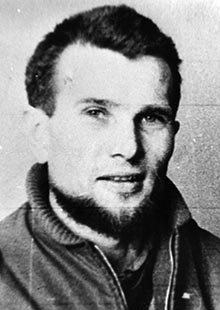
Ivan Yakhimovich was arrested on 24 March 1969 in the town of Jurmale in the Latvian SSR.
*
Yakhimovich is 38 and was born into a family of Polish workers. He completed a course in the faculty of history and philology of the Latvian State University. After university he worked as a teacher and inspector of a district education department.
In 1960 he went to work as the chairman of the “Young Guard” collective farm in the Kraslavsky district. Whilst working on the collective farm he enrolled as an external student at the agricultural academy. A few years ago, the paper Komsomolskaya Pravda wrote about Ivan Yakhimovich in ecstatic terms (30 October 1964, pp. 1-2).
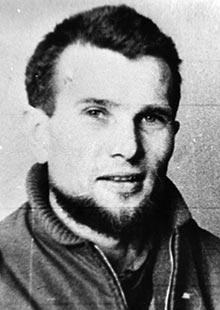
Ivan Yakhimovich (1931-2014)
In January 1968 Yakhimovich wrote a letter [1] to the CPSU Central Committee, addressed to M. A. Suslov, protesting against the trial of Yury Galanskov, Alexander Ginzburg and others. In March 1968 Yakhimovich was expelled from the Party.
In May 1968, in violation of the statute on agricultural cooperatives, he was dismissed as chairman of the collective farm by higher organs without a collective farm meeting being held. More recently he has worked as a stoker at the “Belorussia” sanatorium in Jurmale.
*
Issues 4 and 6 of the Chronicle contain information on the search carried out in September 1968 in Yakhimovich’s flat (CCE 4.5), and on the opening of the investigation against him (CCE 6.3).
On three occasions this year (5 February, 19 and 24 March), Yakhimovich was called for questioning by the investigator of the Riga procurator’s office, E. Kakitis. After the third interrogation he was arrested.
Before his arrest Ivan Yakhimovich wrote an open letter, “Instead of a Final Speech”. In the letter he spoke about himself, and about the investigation based on negative character reports and on false evidence; then he appealed to a number of his friends, to some public figures, to the workers and peasants, to Latvians and Poles, to communists from all countries, not to reconcile themselves to injustice.
The completion of the investigation in the Yakhimovich case is expected in the middle of May.
*
The family of Ivan Yakhimovich consists of his wife Irina and their three daughters aged 5, 6 and 7.
Irina completed a course at the faculty of history and philology, and for a long time worked as a school teacher: she is now forced to work as a nanny in a kindergarten. People recount how during the search, before Yakhimovich’s arrest, his three daughters stood in the garden below the window and sang the “International”.
A group of Yakhimovich’s friends have written a letter protesting about his illegal persecution. Together with the letters written either by Ivan Yakhimovich himself or in collaboration with like-minded friends, this protest letter is included in the collection of material which has been circulated in samizdat.
=============================================
NOTE
Pyotr Grigorenko has described how he got to know Yakhimovich in March 1968 when the latter came to Moscow to seek out Pavel Litvinov and Larissa Bogoraz.
“He heard their appeal ‘To World Public Opinion’ on the foreign radio [CCE 1.2].
“This made an impression on him and he had written, as one communist to another, a comradely letter to Suslov … The latter, as is normal in relations between high party functionaries and ordinary communists, did not answer. However, the letter aroused great interest in samizdat circles, began to be passed around quickly, and soon found its way abroad.
“After it had been broadcast on the foreign radio Yakhimovich was called to the KGB. In the course of a long conversation, it was stated to him among other things that Litvinov and Bogoraz had not signed any appeal, that the appeal was a fabrication, an invention of the BBC. To find out who was right – the KGB or the BBC – was why he had come to Moscow.”
*
- In his January 1968 letter to Suslov Yakhimovich condemned the sentencing of
“the most energetic, brave and high-principled members of our young generation … Too bad for us if we are not capable of reaching an understanding with these young people. They will create, inevitably they will create, a new party. Ideas cannot be murdered with bullets, prisons and exile.”
Moreover, he continued,
“I live in the provinces, where for every house with electricity there are ten without, where in winter the buses can’t get through and the mail takes weeks to arrive. If information [on the trials] has reached us on the largest scale you can well imagine what you have done, what sort of seeds you have sown throughout the country. Have the courage to correct the mistakes that have been made before the workers and peasants take a hand in the affair.”
↩︎
=========================
 A Chronicle of Current Events