THE CASE OF “POISKI”
- 7-1. The case of “Poiski”, introduction,
- 7-2. Victor Sokirko on trial,
- 8-1. Valery Abramkin on trial,
- 8-2. Abramkin’s prison letters,
- 9-0. Yury Grimm on trial.
*
On 29 and 30 September 1980 the Moscow City Court, presided over by N. A. Baikova (who tried Bakhmin, this issue CCE 58.2), heard the case of Victor Vladimirovich SOKIRKO (b. 1939). The prosecutor was Procurator T. P. Prazdnikova, who also prosecuted Bakhmin.
Sokirko refused the appointed defence counsel.
The trial was held in the Moscow City Court building. Apart from a ‘special public’, Sokirko’s wife and two of his friends were admitted to the courtroom. On his own initiative Sokirko had drawn up a list of ‘non-dissident’ friends whom he wanted to see at the trial. (The investigation crossed out all but two of those names.)
*
Sokirko was charged
- with involvement in the composition and circulation of issues 4-7 of the journal Poiski (this issue, CCE 58.7-1), and
- compiling, under the pseudonym ‘K. Burzhuademov’, issues 1-6 of the journal In Defence of Economic Freedoms (CCE 49.20 [3] & CCE 56.28). Issue 7 was not cited in the charges against Sokirko.
During the pre-trial investigation the pseudonym ‘K. Burzhuademov’ was investigated, even though Sokirko did not deny that it was his.
A petition by the accused for expert witnesses to be called — the authors of the official reviews of Poiski and Sokirko’s journal — was rejected by the court. A review of In Defence of Economic Freedoms had been submitted by Kapustin, Director of the Institute of Economics, USSR Academy of Sciences.
*
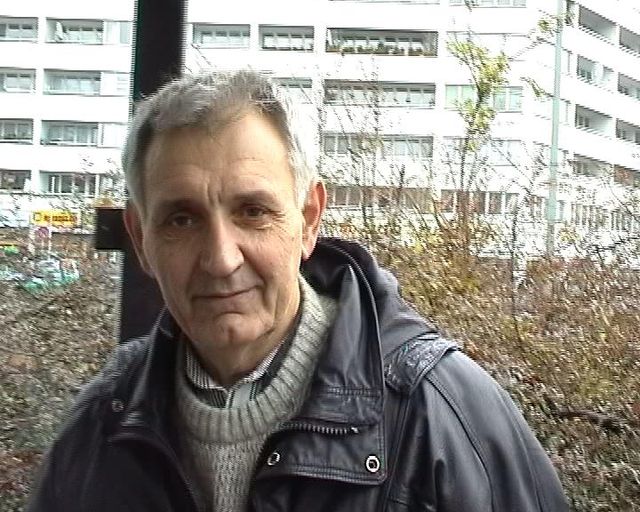
Victor Sokirko, 1939-2018
*
Asked “Do you plead guilty?” Sokirko replied: “My answer to this question is complex. I have given it in my statement, which I shall now read out.”
He then read the statement which he had signed on 3 September (CCE 58.7-1).
During negotiations with the investigators shortly before his release from prison Sokirko had made an agreement with a certain ‘overseer’ (claiming not to belong to the KGB) that when asked: “Do you plead guilty?” he would read out such a statement and would refer to it when refusing to make a final speech.
The statement was only given to Sokirko by the ‘overseer’ in the metro (underground) immediately before the trial. As requested by the ‘overseer’. Sokirko added to the title the words “To the court” and changed the date on it.
Judge: The court must record whether you plead wholly or partially guilty, or not guilty.
Sokirko: I insist that my reply is contained in the statement I have read out and I ask you to enter it in the record. I will say that in so far as my writings were used abroad for hostile anti-Soviet activities, I recognize my guilt, but I do not accept the charge of libel, as I do not understand it.
Judge: Therefore, you plead partially guilty, and we shall enter your statement in the record of the proceedings.
*
During the trial Sokirko admitted his involvement in Poiski and in compiling the journal In Defence of Economic Freedoms.
He stressed that he had been moved by his sense of civic responsibility (as he then understood it). “I voiced my thoughts”, he stated, “in the many letters which I sent to the State authorities and to the Soviet press, but I hardly ever received any specific answer.” His concern for the country’s future had moved him to try to increase the circle of people who participated in discussions of the burning economic and moral problems of our society.
At the time Sokirko considered that the persecution of samizdat in the court was a “type of judicial error”. In his opinion, judicial and investigative agencies had ‘paid very little attention’ in such cases to the need to find clear proof of libel, and this was ‘a bad tradition’.
Sokirko was convinced that libel and debate were “logically, and therefore judicially, incompatible”. He referred to the openness of Poiski, and said that the editors of the journal were convinced that they had acted within the law. He insisted that the indictment had incorrectly referred to Poiski and his own journal as being illegal.
Sokirko had no involvement in the technical aspects of publishing Poisk. He disagreed with many items in the journal, but did not consider any of them libellous.
He knew of the proposed publication of the journal abroad, but had not objected; he also knew that the journal was being sent abroad. His attitude toward links with the West were on the whole cautious: “I avoided them myself, but considered them essential.” He had not received any financial assistance from abroad for the journal.
*
As regards In Defence of Economic Freedoms, Sokirko stated that he was in fact the only person involved in their composition and circulation in the Moscow area.
When the problem of speculation, which was discussed in his journal, was mentioned (‘K. Burzhuademov’ had considered that speculation played a positive role in the country’s economy). Procurator Prazdnikova asked: “So you opposed the law? But the law expresses the will of the people …”
Sokirko: I consider that laws should actually be observed. Yet it is quite possible to dispute them intellectually …
Procurator: Who made the photocopies of the journal, and where? After all, photocopies cannot be made without official permission.
Sokirko: It has now become common practice to make photocopies of artistic literature. Artistic samizdat circulates, and my journal was among such books. It aroused no questions. As for who actually copied them, I couldn’t remember at the time, tried to forget afterwards, and now even more so.
Procurator: Then you refuse to answer the question.
Sokirko: You may take it that I do.
Procurator: Who did you give copies of the journal to? Did you give it to Velikanova?
Sokirko: Yes, I gave it to Velikanova, but as for how Belanovsky, Abramkin and Pomerants got hold of it, I don’t know. It could even be that they got it from me.
*
WITNESSES
Victor Sorokin, Mikhail Yakovlev, Victor Tomachinsky, T. Petrova (the typist who typed Sokirko’s articles), A. Shmidt (Sokirko’s boss at the All-Union Research Institute for Oil Industry Machinery), G. Avdeyeva and E. Polishchuk were called as witnesses during the trial.
*
Victor Sorokin [1] described Sokirko as “an honest, thoughtful person” who never allowed himself to make “knowingly false judgments”.
Sorokin told the court that the journal Poiski did not contain, and in principle could not contain, “assertions known to be untrue”: it simply publicized opinions and judgments, which, ‘by definition’, could not be libellous. Sorokin was then questioned about the search conducted at his home on 25 January 1979 (CCE 52.4-2), and about the testimony which, according to the record of the interrogation, he gave on 26 January.
This record stated that he had read issue No. 3 of Poiski at Abramkin’s home; that he had seen issue No. 4 only when it was confiscated from Maikova, who had visited the Sorokins during the search; and that issue No. 5 was typed in his apartment.
At the end of a second interrogation Sorokin had stated that he repudiated the records of both interrogations, since his testimony had been written down in generalized terms and was capable of being interpreted very broadly, and also because the interrogations had been conducted in ways which, in many respects, violated the Code of Criminal Procedure.
In reply to questions from the court, Sorokin stated: that his questioning on 26 January was not an interrogation but a ‘chat’; that issue No. 4 of Poiski had not been confiscated from him personally; and that he had never said that issue No. 5 had been typed in his apartment. He accepted that the signature on the record was his own.
The judgment noted that the judicial board did not believe Sorokin’s testimony given in court, in which “he denied that issue No. 5 of Poiski was copied at his apartment, since he gave no reason for renouncing his former testimony”.
No ruling was made concerning Sorokin when sentence was pronounced.
However, on 4 November the Moscow City Procuracy issued an order for Sorokin’s prosecution under Article 181, pt. 1 (RSFSR Criminal Code: “Perjury”; penalty, up to one year in camps). The case file on Sorokin included a “decision of the judicial board of the Moscow City Court” to instigate criminal proceedings against him under Article 181 [2].
Referring to his right and obligation, under Article 283 of the RSFSR Code of Criminal Procedure, to relate all he knew concerning the case, Sorokin asked to be informed of the charge against Sokirko.
This was “none of his business”, the court replied. After questioning, Judge Baikova refused Sorokin permission by to remain in the courtroom.
*
The issue of Poiski confiscated from him during a search had not been given to him by Sokirko, testified Mikhail Yakovlev [3]. He refused to answer when asked who had told him of the journal’s existence.
He read the first seven issues of Poiski, stated witness Victor Tomachinsky (CCE 56.5): he found nothing libellous in them. When asked where he had obtained them he said he hoped the court would not begin a political investigation. Tomachinsky did not know Sokirko and had never visited his home.
Petrova stated in evidence that she had met Sokirko for the first time in April 1979. On 10 May 1979 she had been called to a police station and forced to write a statement that she had been copying material containing libels for Sokirko.
She was ordered to ‘maintain contact’ and, in particular, to make an agreement with Sokirko to take some more material from him for copying, and to arrange a meeting for this purpose. At this meeting Sokirko was detained and searched (CCE 53.16).
Shmidt described Sokirko as a good worker.
The testimony of Sokirko’s neighbour V. Konkov, a lecturer at the Moscow Motor Road Institute, was read out in court. Konkov lives on the same floor as Sokirko, but at the time of the trial he was abroad on a work-related visit. His testimony related how once, when taking his dog for a walk, he had looked up and seen the light from a cinema projector in Sokirko’s window.
The Sokirkos were always receiving visitors who stood smoking on the landing. These included a woman whom, after some thought, he had labelled for himself ‘the Jewess’, and a young man who called her ‘Mummy’. When this testimony was read out those present in the courtroom could hardly restrain their laughter, including the ‘special public’.
*
The Procurator asked the court to give Sokirko a suspended sentence.
*
During the trial Sokirko tried not to argue with the prosecution.
However, when speaking in his own defence he was not bound by his agreement with the ‘overseer’, and he analysed the indictment and demonstrated the juridical hollowness of the charge of libel. Concerning one particular point of the indictment, he showed that a text attributed to him (as the author of In Defence of Economic Freedoms), and termed slanderous, was in fact taken from Brezhnev’s memoir Virgin Soil [4]. “In which case,” observed Sokirko, “he belongs with me here”: during the next recess he was reprimanded by the ‘overseer’.
Ending his speech, Sokirko said in part:
“I recognize my great guilt before the State in allowing my name and writings to be used abroad to the detriment of the State by its enemies … I must now, in undertaking my own defence, list the factors which mitigate my offence:
“[1] I never acted with evil intentions, and could only have made innocent mistakes, since I was certain that I was fulfilling my civic duty, trying to free myself from a feeling of profound alarm, tortured as I was by my responsibility for the future of my country and my children.
“[2] I always tried to retain a patriotic standpoint, and was therefore always very restrained in my attitude towards the passing of our writings to the West, which I considered an unfortunate necessity, although I was in principle in favour of the free exchange of information and ideas. As the indictment states, the economic journals compiled by me were circulated only within Moscow. Finding myself in my present position, I have made a statement forbidding the use of my writings and my name for purposes hostile to our country.
“[3] I have given my word to cease henceforth my involvement in samizdat and to avoid the repetition of similar situations.
“[4] I have always had a large work capacity: I am industrious, and this is borne out by all references from my work-place including that given to the investigators. I ask you to give me the chance to recompense by normal work the harm I have done,
“[5] I have a large and good family. Four children depend on me. Concern for their fate has to a large extent dictated my decisions and behaviour all along.
“Even if you do not find all the arguments of my defence convincing, I beg the court not to impose a punishment on me which would separate me from my normal job and my children, because otherwise my family will be punished more than myself.“
As he had agreed, Sokirko waived his right to make a final speech.
The Judge was surprised. Then Sokirko repeated his plea for a punishment which would not separate him from his family.
*
The judgment stated in part:
“The judicial board cannot agree with Sokirko’s statement that the material contained in the journal Poiski and the journal In Defence of Economic Freedoms which was examined during the trial is not intentionally libellous.
“The reasons are as follows.
“During the trial the accused Sokirko explained that he did not agree with the contents of certain of the articles printed in the journal Poiski, of which he was an editor, and yet he did not object to their publication. This explanation by Sokirko confirms his intention of preparing and circulating knowingly false fabrications which defame the Soviet social and political system.
“This is also confirmed by Sokirko’s testimony given in court concerning the article written by him in issue No. 3 of In Defence of Economic Freedoms, entitled ‘A Final Analysis of the Counterarguments in the Debate and K. Burzhuademov’s Repentance’. This article admits that in his previous articles the author had misrepresented certain aspects of our State because he had not been clear about some of the questions raised in his articles.
“At the same time, even after this Sokirko continued to write and publish articles on economics of a libellous nature. Moreover, the accused Sokirko stated that he had refused to speak at a seminar where the new Draft Constitution of the USSR was to be discussed, claiming that his speech would disrupt the work of the seminar. This fact also indicates Sokirko’s awareness of the deliberate falseness of his writings and of other material appearing in Poiski and In Defence of Economic Freedoms.
“All this is sufficient grounds for believing that Sokirko, as an author and editor of Poiski and In Defence of Economic Freedoms, included in them material which he knew to be false fabrications …“
The accused Sokirko confirmed all the factual circumstances of his crime, and submitted to the court a statement in which he said that he acknowledged the anti-social nature of his activities and condemned them. Sokirko has good references concerning his work and place of residence, and has four dependent children.
The court gave Sokirko a sentence of three years’ imprisonment, suspended.
*
BIOGRAPHY
Sokirko completed his studies at the Bauman Higher Technical College in Moscow.
In 1961 he was expelled from the Komsomol for “lack of Marxist-Leninist conviction, slandering Soviet reality and an incorrect interpretation of comradeship”; all this consisted of sending a letter criticizing the Programme of the CPSU and refusing to name those with whom he had discussed the subject.
In 1973 Sokirko was sentenced to six months’ corrective tasks by Moscow City Court for refusing to give evidence at the trial of Yakir and Krasin (CCE 29.11 [10]).
In 1974 he was warned “in accordance with the Decree” about his responsibility for circulating samizdat and giving a slide show which was ‘tendentious’. Under the pseudonym ‘K. Burzhuademov’ he published a book, Essays on a Growing Ideology (Anti-Galbraith), subsequently published in the West [5]. Between the years 1976 and 1979, under the same pseudonym, he compiled three collections debating Solzhenitsyn’s appeal “Do not Live by Lies”. In 1977 he wrote an Open Letter to Brezhnev and to Sakharov about the Draft Constitution (CCE 46.18 & CCE 47.16).
*
In the years 1978-1979 Sokirko issued seven collections called In Defence of Economic Freedoms. In 1978 he joined the editorial board of Poiski.
In January 1980 he sent Brezhnev, “An Appeal for the Withdrawal of Troops from Afghanistan” (CCE 56.27-1 [4]).
===========================================
NOTES
- Victor Sorokin: search and interrogation, Jan-Feb 1979 (CCE 52.4-2); search, Aug 1979 (CCE 54.2-1 item 3); search, Nov-Dec 1979 (CCE 55.2-2); statement and case, Jan 1980 (CCE 56.5).
↩︎ - In December 1980 Sorokin was given a one-year sentence (CCE 60.5). He was freed in March 1981 after an appeal court changed the sentence to one year of correctional tasks and the loss of 20% of his salary.
↩︎ - On Mikhail Yakovlev, see CCE 53.16, CCE 54.2-1 & CCE 55.2-2.
↩︎ - The title of the third volume, and of the entire trilogy, of memoirs published under Brezhnev’s name (1978-1979).
↩︎ - Sokirko’s Anti-Galbraith was published (in Russian) in Munich in 1974.
↩︎
==============================
 A Chronicle of Current Events