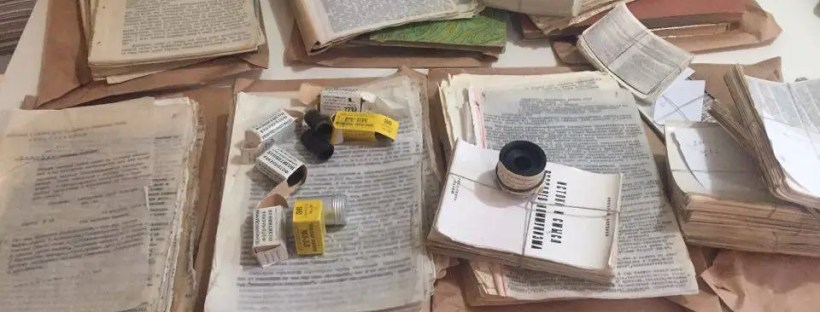
TEN ENTRIES
(Periodicals, 4-10)
*
[1]
Ernst Orlovsky
“Self-interview” (1979, 10 pp).
1. Do you consider yourself a dissident? Who are dissidents? What do they want?
Yes, I consider myself a dissident.
… a dissident is a person who disagrees with some or other important aspect of the political and/or economic system in the USSR and openly expresses his disagreement.
… there are several demands which all or nearly all dissidents put forward. First of all, they demand that the chance to discuss freely the basic problems of the country’s economic and political development be assured. They also demand that Soviet laws governing human rights be strictly observed and that they be brought into the line with the international commitments the Soviet Union has made. These demands also imply’ as a natural consequence, an end to repression for political motives.
3. What, in your opinion, is the nature of the political and economic structure of the USSR? Do you consider the USSR a socialist country?
The question of the nature of the system in a given country can be answered intelligently only after criteria for classification have been established and the various types of system defined. Moreover, there is no generally accepted definition for a concept like socialism.
… if we take Marxism as a starting-point (in its Soviet version), then undoubtedly there is socialism in the USSR. It should be noted, however, that according to this criterion China should also be classed as a socialist country, … Kampuchea under Pol Pot should also undoubtedly be classed as a socialist country… Moreover, according to this criterion several countries with a market economy which are usually classed as capitalist should be included among the socialist countries. For instance, in Austria the state sector plays a leading role in the economy.
4. Which aspects of the economic and political system of the Soviet Union are, in your opinion, most in need of improvement?
A lot needs improving. But if we are to isolate the most important, then it would be, in the economy, the evaluation of the work of enterprises and the criteria for making planning decisions, and’ in politics’ the participation of the broad mass of the population in government.
5. What is your attitude to emigration from the USSR?
The Chronicle omits the answer to this question as it is explained in the author’s writings as summarized in CCE 49.19-1 [16] and CCE 51.21 [16].
*
[2]
M. Zotov
“To Be or Not to Be” (March 1979, 6 pp.)
The author talks about himself and about the latest issue of Poiski {Searches} (CCE 51.21 [18]). He reflects about our life. He also writes:
“Attracted by the dream of equality, justice and happiness communism is supposed to provide, they [the pro-communist elements in the West, Chronicle] stubbornly will not believe the evidence from communist countries.“
*
[3]
“Selected Questions from the Oral Examination in Mathematics”
Mechanics & Mathematics Faculty
(Moscow University, 1979).
The compiler selected 25 problems set for those especially talented high-school leavers whom it was necessary to ‘fail’ (for a similar 1978 compilation, see CCE 51.21 [9]).
One of these questions was given at the 12th International Mathematics Olympiad for Schools (1970); one version of another was given at the All-Union student Olympiad in 1977; a variation of another at the All-Russia Olympiad of 1965; a considerably simplified variant of another at the Republic Olympiad in 1979; one question at the final round of the Kiev Olympiad in 1978; two questions are to be found as ‘starred’ problems in the book by D. O. Shklyarsky, N. N. Chentsov & I. M. Yaglom, Selected Problems and Theorems in Plane Geometry (GITTL [1]: Moscow, 1952).
A particular case of one problem appears in D. O. Shklyarsky, N. N. Chentsov & I. M. Yaglom’s Geometrical Evaluations and Problems from Combinative Geometry (Nauka publishers: Moscow, 1974). One problem features in I. M. Yaglom’s Geometric Transformations, Vol. 1 (GITTL: Moscow, 1955): to solve it you have to refer to several previous theorems in the same book. Two problems can be found in V. B. Lidsky, L. V. Ovsyannikov, A. N. Tulaikov and M. I. Shabunin’s Problems in Elementary Mathematics (Nauka publishers: Moscow, 1969): one is accompanied by guidelines, the other is the final problem in a subsection (within each section the problems are given in increasing order of difficulty).
Finally, half another problem is given as a ‘starred’ problem in L. M. Lopovok’s Collection of Problems in Solid Geometry (Uchpedgiz publishers: Moscow, 1959) [2 ].
*
PERIODICALS (4-10)
ITOGI (1-2)
[4]
ITOGI, 1
“Summary” (No. 1, 1979) 72 pp.
The editorial announcement of this new ‘reference journal’ states:
“The modest aim of this publication is to help the reader to find his way in the turbulent and contradictory spiritual life of our country; a less modest aim is to search for ways of SYNTHESIS. This aim is the main principle governing the contents of the journal.
“The editors will strive, as far as possible, to be up-to-date and to cover the whole range of samizdat… we also intend to give synopses of of publications abroad [tamizdat], to include information on literature of lasting worth which has been passed for publication by the censors, and gradually to discuss the most interesting publications of previous years. Relevant material from other publications may be reprinted. The journal will appear four times a year…
“The editors would be interested in receiving abstracts and other relevant material. If, when you read some work, you feel like reacting, arguing, or copying out an extract — do not put it off; write it and send it to us. All pseudonyms are acceptable; the absence of a signature will be seen as permission to edit the text received at our discretion.“
The journal consists of three sections:
- A. Synopses and Extracts;
- B. Points of View. Reviews; and
- C. Contents of Recent Publications. (Section C gives only tables of contents — or even only titles.)
Sections A and B of this issue contain 51 articles.
44 articles relate to material in samizdat publications:
- Concerning the Draft Constitution Nos. 1, 2, 3 (CCE 46.18, CCE 47.16);
- Poiski [Searches] Nos. 1/2, 3 (CCE 51.21 [18]);
- Obshchina [Community] No. 2 (CCE 51.21 [19]);
- The Watch [Chasy], Nos. 14, 15;
- Tarbut (Culture) No. 11;
- Jews in the USSR, Nos. 14, 18
and journals published abroad: Kontinent No. 15; Syntaxis No, 1; Russian Revival No. 1; Herald of the Russian Christian Movement [Vestnik RKhD] No. 124; and New Journal No. 126.
These sections also contain
synopses of the following books: V. Gershuni, Superepus (samizdat, 1976); L. Regelson, The Tragedy of the Russian Church, 1917-1945 (YMCA Press, 1977) and K. E. Bailes, Technology and Society Under Lenin and Stalin: The Origins of the Soviet Technical Intelligentsia, 1917-1941 (Princeton University Press 1978);
reviews of Metapolitics by A. Moscovit (CCE 38.20 [4]) and of the anonymous and anti-Semitic Appeal of the Russian Liberation Movement to the Russian and Ukrainian People, and
extracts from V. Ozolis’s article ‘Questions and Answers’ and L. Kopelev’s article ‘The Lie Will be Conquered Only by Truth’.
Section C gives the tables of contents of the following samizdat publications: Kaluga, July 1978 (CCE 50.3); Searches Nos. 1/2, 3; Community No. 2; The Watch No. 15; Jews in the USSR No. 18; A Chronicle of Current Events No. 50; and the journal “37″ No. 15.
*
[5]
ITOGI, 2
“Summary” (No. 2, 1979) 75 pp.
Sections A and B of this issue contain 45 articles.
36 articles concern material in samizdat publications:
- Searches Nos. 1/2 & 4 (CCE 52.17 [7]);
- The Watch, Nos. 16-18;
- “37″, Nos. 16, 17;
- two issues of the collection Memory, which came out in samizdat and was reissued abroad;
- the almanac Metropol,
- and journals published abroad (Kontinent Nos. 15, 16; Syntaxis Nos, 1, 2; Herald of the Russian Christian Movement No. 125; and Twenty-Two Nos. 1, 3).
These sections contain synopses of the collection of articles and speeches by A. D. Sakharov, Hopes and Fears (Khronika, 1978); the book by R. Kennedy, 13 Days. The Cuban Missile Crisis (Macmillan, 1969); the book by M. Baitalsky (pseudonym of M. Domalsky); Russian Jews Yesterday and Today (‘Aliyah 20’ Publishers); and the article The Situation in Soviet Mathematics (CCE 51.21 [6]).
They also contain information about FIAWP (CCE 51.19-2 [14]) and the poetry almanac ‘Voice’ (10 issues have already appeared), reviews of the book by A. Rabinowitch, The Bolsheviks’ Road to Power (New York, 1976) and of the article by L. S. Pontryagin, ’A Short Biography of L. S. Pontryagin Compiled by Himself’ (in the journal Progress in Mathematical Science, 1978, No. 6), and extracts from the article by Yu. Orlov, “Is Non-totalitarian Socialism Possible?” (CCE 38.20 [2], CCE 50.1 indictment).
Section C contains the tables of contents of the samizdat publications: Searches No. 4; The Watch Nos. 16-18; Jews in the USSR No. 19; the journal “37” Nos. 16, 17; and of the almanac Metropol (CCE 52.14).
Section D (‘Supplement’) gives the tables of contents of issues 1-3 of the collection Memory (CCE 42.12 [2], CCE 51.21 [17], CCE 52.17 [9]) and summaries of issues 1 and 2.
*
LITHUANIAN SAMIZDAT (6-10)
[6]
PERSPEKTYVOS
Perspektyvos, Nos. 8-12
This journal has been coming out since 1978. There are notes on Nos. 1-4 in CCE 51.21 [20], and on Nos. 5-7 in CCE 52.17.
*
[7]
ALMA MATER
Alma Mater, Nos. 1-3.
The journal has been coming out since January 1979. It includes both literary and socio-political articles. Each issue is about 100 pages long.
*
[8]
VYTIS
Vytis (Knight Errant), Nos. 1-2.
Issue No, 1 (June 1979, 105 pp.). The place of publication is given as ‘occupied Lithuania’.
The introductory article designates ‘enemy number one’ as the ‘occupying administration’. Excerpts are published from the articles of Jonas Jurasas (CCE 39.8, CCE 52.17 [10]) and his wife Ausra, criticizing the Lithuanian creative intelligentsia for their indifference to the fate of the Lithuanian people; there are also two articles on the attitude of the Lithuanian Communist Party towards the national question, articles dating from 1949 on the partisan movement, an article on the murder of the ethnologist Untulis and a declaration by the former prisoner Brukstus, in which he promises to collaborate with the KGB (1964), Another article criticizes the journal Perspektyvos for opening its pages to the ‘Union of Lithuanian Communists’ (CCE 52.10).
Issue No. 2 (July 1979, 46 pp.) prints a complaint to the Lithuanian SSR Supreme Soviet about the Petkus Case (150 signatures), an article by Mart Niklus, ‘The Trial in Vilnius through the Eyes of an Estonian’, and ‘An Open Letter to Viktor Kalnins by A. Terleckas’ (CCE 52.17 [5]).
*
[9]
AUSRA
Ausra (Dawn), No. 15 (55), February 1979.
The issue opens with the article ‘An Unforgettable Day’, dedicated to the 61st anniversary of Lithuanian independence (16 February 1918). This is followed by the article ‘The Russians are Colonizing Latvia’, a declaration by Angele Paskauskiene (CCE 52.10), a biography of Klimauskas (CCE 41.5 [2], CCE 44.22 and CCE 51.11, see ‘Releases’), a declaration protesting against the arrest of Ragaisis (CCE 52.10) and the articles ‘The bestial outrages in Juodupe’ (before the arrival of the Germans the local communists killed the people they had arrested) and ‘A Shameful Attack by the Soviet Union’ (about the attack on Finland in 1939).
*
[10]
AUSRA
Ausra, No. 16 (56), May 1979.
The article ‘On the Approaching Jubilee’ is dedicated to the 40th anniversary of Lithuania’s incorporation into the USSR, which will be in 1980. Then come: excerpts from the letters of political prisoner Paulaitis (CCE 46.23-2, CCE 49.20 [8], CCE 51.21 [20]), a letter from Father Garuckas to the First Secretary of the Lithuanian CP Central Committee, written three weeks before his death (this issue CCE 53.23), a letter to the chief editor of Tiesa protesting against the publication of a libellous article about Gajauskas (trial CCE 49.5) and an excerpt from the biography of Petkus (trial CCE 50.5).
The article ‘A new wave of Russification’ describes the impending reforms in teaching the Russian language (this issue CCE 53.23). After 1980 Russian will be taught in kindergartens, Pioneer and Komsomol meetings in schools will be conducted in Russian, the social sciences will be taught in Russian secondary and higher educational establishments, the Scholars’ Journal issued by the various republic universities is to be published in Russian, as well as student journals and wall-newspapers.
There is also an excerpt from the decree of the Minister of Higher and Specialized Secondary Education of the USSR, V. Elyutin, “On the further improvement of the teaching of the Russian language in the Union republics” (6 October 1978).
=======================================
NOTES
- GITTL = State Publisher of Technical-Theoretical Literature.
↩︎ - See also Andrei Sakharov’s statement about this whole episode in CHR 35 (Russian edn., Khronika zashchity prav v SSSR), New York, 1979.
↩︎
========================
 A Chronicle of Current Events