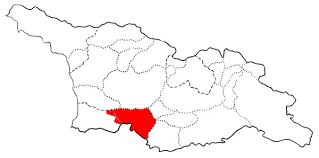
In 1944 300,000 Turks, or Meskhetians, were forcibly deported from Meskhetia (southern Georgia). Up to the present they are forbidden not only to return to their homeland, but also to register their names in their passports as either Turks or Georgians: they are registered as, for example, Azerbaijanis.
There have been reports about the struggle of the Meskhetians for their rights in several preceding issues of the Chronicle [1].
*
TBILISI
In spring 1976 L. Abashidze (Ayubov) and A. Abastumaneli (Iskanderov), representatives of the deported Meskhetians, arrived in Tbilisi and tried to be received by Eduard Shevardnadze, the First Secretary of the Party Central Committee of Georgia. lashvili, in charge of appointments, told them:
“Shevardnadze does not receive anyone to discuss matters concerning the national question. What does it matter where you live within the USSR? Does it make any difference who you are registered as in your passport? The national question in the USSR was settled long ago.”
On 26 June 1976 delegates from the Meskhetians arrived in Tbilisi once more. V. Alpenidze, Shevardnadze’s assistant, said in a conversation with them on 28 June that Shevardnadze was unable even to pose such a question to Moscow, and advised them to try in Moscow to achieve their return to their homeland. (In Moscow, at the CPSU Central Committee and the Supreme Soviet, they had regularly been told: ‘Georgia must settle this matter itself.’) On 2 July a Meskhetian representative was called in to the KGB, where Colonel Zardalishvili, the head of the ideological department, promised to give him a permit for a trip to Meskhetia. On the evening of the same day Georgian intellectuals arranged a large reception for the representatives of the deported Meskhetians, a dinner in the flat of the historian Victor Rtskhiladze.
Early in the morning of 3 July the delegates who had arrived were detained ‘on suspicion of speculating in carpets’ and taken to a police station. At 4 p.m. they were all released, each having been ordered beforehand to write down autobiographical details and to indicate his reason for coming to Tbilisi.
V. AIpenidze did not receive the delegates again, and the promised permits for Meskhetia were not given to them.
*
On 7 July representatives of the deported Meskhetians appealed to Shevardnadze in a letter, in which they asked him to provide a very swift solution to the question of the return of the Meskhetians to Georgia, and meanwhile: to allow the start of a mass acceptance of their children into Georgian boarding-schools and the acceptance of 10-15 Meskhetian school-leavers into Georgia’s higher educational institutions; to invite lecturers on the history and culture of Georgia into the districts where the deported Meskhetians were living; and to send them documentary films about Georgia.
Simultaneously with this letter, Meskhetians deported to Central Asia, Azerbaijan and Kabardino-Balkaria sent a letter to the Helsinki Group. On the same subject the Action Group for the Defence of Human Rights in Georgia sent a letter to L. I. Brezhnev. Moreover, a member of the group, Merab Kostava, in whose flat Meskhetian delegates had been detained, sent a letter to L. I. Brezhnev. He wrote:
“I register a determined protest against the arbitrary action of the KGB, who have violated the sacred custom of hospitality, and I demand the return of my brothers, 300,000 Georgians, to their homeland, and that the nationality taken from them forcibly in 1944 be returned to them. I demand that the government of Georgia be accorded competence to resolve independently her own problems in the bosom of her people.”
M. Kostava has also written a historical note, ‘Meskhetian Turks or Meskhetian Georgians’ [2], in which he reports that ‘Meskhetians are the oldest Georgian tribe’ and that ‘the linked use of the words “Meskhetians” and “Turks” is pure nonsense’. Kostava notes reproachfully that issues of the Chronicle of Current Events, and A. D. Sakharov in his book My Country and the World have made this mistake.
The Chronicle is not competent in this historico-ethnographic problem [3], but it is known to the Chronicle that many representatives of this nationality (at least when speaking Russian) call themselves Turks, Turkish Meskhetians or Meskhetian Turks [note ?60]. This serves as the reason for the use of this name in the present issue.
===============================================
NOTE
- On the Meskhetian struggle, see CCE 7.6,CE 9.7, CCE 19.6 and Contents page 10.
↩︎ - See Kostava, “Meskhetian Turks or Meskhetian Georgians”.
↩︎ - See Rtskhiladze response to this comment, CCE 43.17-2 [2] and CCE 45.19-2 [1-3].
↩︎
==========================
 A Chronicle of Current Events