SEVENTEEN ITEMS
*
CHORNOVIL, 1-2
[1]
Viacheslav Chornovil (23 July 1973).
Declaration to the Military Procurator of the Trans-Carpathian Military District
In his long (19-page) declaration Chornovil gives details of the way in which his case was investigated in 1972-1973.
The basic method used to influence him while he was under investigation was false information passed on to him through his cell-mate, a ‘stoolie’ called Dubinyak, and also directly through his investigator. Chornovil was informed, for example, that he was going to be charged under Article 56 (UkSSR Criminal Code = Article 64, RSFSR Code): i.e., ‘treason’, for which the penalties include execution. The investigator and his cell-mate told him that his friends and relations had been arrested — when they had either not been arrested at all, or were arrested only later. Chornovil was even told that, after the arrest of Pyotr Yakir (who had not then been arrested), the latter’s friends had tried to assassinate N. V. Podgorny.
Later they changed their tactics. They began to tell Chornovil about some sort of high-level conference at which, under pressure from the Italian and Canadian communist parties, it had been decided to release him, Dzyuba and Svetlichny (Dzyuba had not yet been arrested at this point), but to “severely punish” the others arrested. The only way he could help them was to tell the investigators about his participation in the publication of The Ukrainian Herald.
Chornovil made such a statement only after he had been told the date of his wife, Atena Pashko’s, imminent arrest, 17 May. Later, in the middle of August, Chornovil’s wife and sister were indeed arrested for a few days, and Chornovil saw his wife — ‘by chance’ — in the corridor of the investigation prison. This happened after he had refused to make a more concrete statement.
*
At the beginning of 1973 Chornovil renounced his ‘confession’ in writing, and explained the methods by which it had been obtained. This statement was removed from the case materials. However, traces of the trickery and false information which had been used remained in the investigation records.
In a declaration dated 23 July 1973 Chornovil asks the procurator to make out criminal charges against Captain M. E. Boyechko, a senior KGB investigator for the Lvov Region (who led the group investigating his case), for violating Article 175 (UkSSR Criminal Code: “coercing someone to give evidence”).
In a letter dated 1 August 1975 he reports that the military procurator of the Transcarpathian military district passed on his declaration to the procurator’s office of Lvov Region, i.e., acted as if Chornovil had asked for a re-examination of his case. After a second complaint, dated 26 August 1973, he received a reply stating that there was no basis for bringing criminal charges against M. E. Boyechko.
*
[2]
Viacheslav Chornovil (1 August 1975).
Open letter to the President of the USA
The letter is an attempt to take part in the dialogue between East and West; Chornovil feels that the thoughts he expresses reflect the opinions of “a wide circle of Soviet political prisoners of various nationalities”.
His basic argument is that a lasting détente in international relations ’can be achieved not so much by military disarmament as by psychological demilitarization’. Soviet leaders, however, link the process of detente with an intensification of the ideological struggle. In practice, this leads to mass arrests, like those in the Ukraine in 1972-1973. ‘If something similar were to occur in the USA,’ writes Chornovil, ‘in order for your countrymen to learn to “unanimously approve” of the actions of the authorities, half of them would have to be put in jail, and the other half made prison warders.’
Detente in its present form is turned, in this way, against the opposition in the USSR. It is precisely because of this that political prisoners approve of the well-known [Jackson-Vanik] amendment of the US Congress to the Trade Agreement: ‘An alternative to the Mordovian and Perm labour camps and the psychiatric hospitals, namely the possibility to leave the country,’ could lead to some humanization of the regime. ‘And that, in its turn, could be the precursor of a true relaxation of tension, not merely a detente on paper.’
*
[3]
Yury P. Fyodorov
Letter to the President of the USA.
The letter takes as its theme the spread of communist influence in the world and criticizes the principle of non-interference in the internal affairs of the USSR. In conclusion, Fyodorov describes the conditions in the special-regime labour camp in which he finds himself, and asks the President to use his authority to support his demands to the Soviet government. The first among these demands is that an end be put to forced labour.
*
[4]
Vasyl Stus, “J’Accuse!”
The author accuses the KGB of being responsible for the following:
- the organization of the rigged trials of 1972-1973 in the Ukraine, in particular the rigging of his own ‘case’;
- the confiscation, during searches, of works of Ukrainian, Russian and world literature;
- having hereditary links with those who organized the Stalinist terror, as proved by the KGB’s aggressive reactions to references to this period, for example, to those made by Stus;
- the persecution of those who hold non-communist convictions, as for example in the Stus case — i.e., the violation of ‘the most elementary human rights’;
- responsibility for the torture to which some Ukrainian political prisoners were subjected to in the camps;
- causing ‘irreparable harm to the Ukrainian nation and its culture’ through the 1972-1973 acts of repression in the Ukraine which was ‘on a scale unprecedented in the USSR in recent times’.
‘A generation of the young Ukrainian intelligentsia, . . has been transformed into a generation of prisoners.’
Stus names the KGB’s ‘internal reviewers’ who wrote about the confiscated works of Ukrainian writers: A. Kaspruk, Ukrainian SSR Academy of Sciences’ Literary Institute, and A. Kovtunenko (same institute); A. Skaba, CPSU Institute of History, and V. Yevdokimenko, Yu. Zbanatsky, V. Kazachenko and L. Nagornaya (all from the same institute); P. Nedbailo, Kiev University; V. Chirok, Pro-Rector of the Higher Party School; M. Shamota; and P. Vashchuk, senior lecturer at the Lvov University Faculty of Journalism.
“I feel that their responsibility for acts of mass repression”, writes Stus, “is equal to that of the professional KGB officials.”
Stus suggests that his statement be used as eye-witness evidence in a future trial of the KGB, which he might not live to see.
*
[5]
Father Vasyl Romanyuk [1]
Appeal to the Pope and the World Council of Churches
The subject of both appeals by this Ukrainian priest, sentenced to ten years for openly speaking out in defence of V. Moroz, is the violation of human rights in the USSR.
The author calls for attention to be given to the fate of imprisoned women.
He appeals to all religious activists abroad, especially holders of the Lenin prize for their contributions to peace between nations, to press the Soviet government to grant political prisoners the opportunity to leave the USSR.
‘Help us to win the possibility to leave this terrible country, where a man can be given 10-15 years in prison for his beliefs alone!’ Fr Vasily considers that the aforementioned prize-winners have a moral right to their titles only if they can bring influence to bear on the Soviet government; if they cannot do so, they should renounce their titles.
Fr Romanyuk announces that to underline his appeals he will declare a hunger-strike from 1 August 1975. He has a second aim in declaring a hunger- strike — to obtain a Bible, which he has now been refused for three years. The second appeal has a postscript:
“If you can do nothing else to ease my fate, at least help me to obtain a Bible, for I will continue my hunger-strike until I have a Bible m my hands, and I ask you, beloved fathers and brothers in Christ, to help me m this.”
Yours sincerely.
Father V. Romanyuk
*
SHINKARUK (6-7)
[6]
Trofim Shinkaruk
Letter to the broadcasting station ‘Radio Free Europe’ (27 June 1975).
Trofim Yefimovich SHINKARUK, a 44-year-old Ukrainian, has already spent 26 years in camps and prisons. At the moment, he is in a special-regime camp (Camp 1 in the Mordovian complex). He has years left to serve. He hopes to publicize his ‘call to the nations of the world’ through the agency of the broadcasting station ‘Radio Free Europe’.
The ‘call’ is a desperate appeal to people to reject communist Ideology and not ‘to stretch out their hands’ to the communist leaders.
Shinkaruk is convinced he will die behind barbed wire. However, he wants his fate and the fate of millions of other prisoners to act as a warning to the West of the danger of losing freedom.
*
[7]
Trofim Shinkaruk
Letter to the UN Secretary-General (27 June 1975).
After describing the situation of Ukrainian political prisoners, Shinkaruk writes: ‘I appeal to you, and through you to all nations in the world, to turn your attention to this horrifying situation.’
Shinkaruk wants the UN to force the Soviet Union, under threat of expulsion, to ‘abolish’ the Article on ‘anti-Soviet agitation and propaganda’ from the Criminal Code.
*
[8]
Alexander Bolonkin
A supervisory complaint (4 October 1974).
In his complaint, addressed to the USSR Procurator-General and the USSR Supreme Court, A. A. Bolonkin (CCE 30.4) lists the many violations of the law which occurred in his case, during the pre-trial investigation, at the trial, and after the trial.
*
[9]
V. V. Kislik
To the Presidium of the USSR Supreme Soviet (12 May 1975).
The author writes that at present he is a citizen of two states: Israel and the USSR. Because his wife and son live in Israel and he himself is trying to emigrate there, and because the Soviet government does not recognize double citizenship, he asks the Presidium to allow him to renounce his Soviet citizenship.
He also lists the illegalities committed by the Visa Department of the Administration of Internal Affairs in Kiev while dealing with his application to renounce his Soviet citizenship.
*
[10]
Nina Bukovskaya, Two Open Letters:
- UN Secretary-General about International Women’s Year (18 June 1975);
- Amnesty International and the Society for the Defence of Human Rights, FIDH (16 August 1975).
Vladimir Bukovsky’s mother reports that her seriously ill son has been placed on the starvation ‘strict-regime’ for half a year for his refusal to work in Vladimir Prison. She also reports that she, a pensioner, is being forced to pay for her son’s upkeep in prison [as, otherwise, money for his food would be taken from his own account, Chronicle]. She states that the strict-regime food in prison costs only 25 kopeks a day.
*
[11]
Victor Sokolov
Letter to Georgy Voronkov, Chief Psychiatrist of the Ukrainian SSR (27 June 1975).
V. Sokolov, a Muscovite, appeals on behalf of Leonid Plyushch. The letter ends as follows:
“And bear in mind that history will remember, not the anonymous monsters of the KGB, but you — Georgy Voronkov, Chief Psychiatrist of the Ukrainian SSR, with whose certain consent the murder of Leonid Plyushch is continuing!”
*
[12]
Ludmila Alexeyeva
Letter to US Congressman Senator Javits (4 July 1975).
The author asks that persistent pressure be exerted to obtain permission for Anatoly Marchenko to leave the country soon, as
“otherwise he may not live to see that day. In exile Marchenko has been assigned work as a loader, which is impossible for him, as his health has been undermined by 11 years of imprisonment in Soviet camps and prisons, and it has recently deteriorated greatly because of his 50-day hunger-strike in protest against his unjust trial.”
*
[13]
Nodar Tsuleiskiri
Complaint to Georgian Communist Party’s Central Committee.
On 25 July 1975 Colonel Zardalishvili interrogated the writer Nodar Tsuleiskiri at KGB headquarters about the publication of the speech he made at a Party meeting of the Georgian SSR Writers’ Union in the samizdat journal Golden Fleece, issue 1 (May 1975) [2]. After Tsuleiskiri had refused to provide the evidence demanded, Zardalishvili began to shout at him and threatened him with arrest ‘for not informing’. This is the subject of Tsuleiskiri’s complaint to the Central Committee.
*
[14]
Malva Landa
“Humanity and Respect for Human Rights — Soviet Style” (14 August 1975).
This open letter gives details of the persecution of many people for their beliefs or for attempting to exercise their legal rights.
*
[15]
Zviad Gamsakhurdia
Letter to the Chairman of the USSR KGB (11 August 1975).
“This is the second time I have been searched by officials of your institution at Domodedovo Airport in Moscow. It is typical that on both occasions they carried out the search masked as ordinary policemen. On the first occasion, on 22 May 1975, during the registration of tickets for the flight to Tbilisi.
“I was standing in a queue by the counter. A policeman came up to me and asked me to go with him for a ‘customs check’. However, it was strange that this ‘customs check’ applied only to me. As is well-known, passengers usually undergo customs checks immediately before boarding. The policeman took me to a middle-aged man in civilian clothes who carried out the search himself but did not sign the record. In answer to my questions, he told me that he was from the Criminal Investigation Department and that his name was Tarayev, but he did not show me his professional identity card. He confiscated from me some books published abroad, and samizdat material of an informational nature [A Chronicle of Current Events, A Chronicle of Human Rights in the USSR, P. G. Grigorenko’s book Thoughts of a Madman, published in 1973 by the Herzen Foundation, etc., Chronicle].
“I consider such actions to be unlawful, for it is well-known that the Soviet Union, back in 1948, signed the Declaration of Human Rights, which guarantees free exchange of information (if, of course, the information does not concern military or State secrets).
“On the second occasion I was searched in a rude and insulting manner.
“On 31 July I was stopped by a policeman on the square in front of the airport, who took me to the official on duty. Again people in civilian clothes appeared, once more calling themselves officials of the Criminal Investigation Department, though, again, they did not show me their identity documents, nor did they sign the personal search record which they drew up. One of them said that his name was Chernov. They turned out my pockets and took off my shoes. A samizdat leaflet was confiscated from me. I was not given a copy of the search record.
“I protest against this kind of arbitrary behaviour. I also protest against the fact that a personal search was carried out without any reason being given.
“I ask you to take steps to prevent the recurrence of such incidents.”
*
[16]
Nine signatories
To the Presidium of the USSR Supreme Soviet
A Petition
We ask you to grant a general political amnesty, i.e. an amnesty for all persons convicted for ideological or political opinions and activities, or for their religious beliefs and religious activities.
We ask you to apply this amnesty also to persons deprived of their citizenship for the same reasons.
We ask you to extend the amnesty also to persons convicted for exercising the rights laid down in the UN Declaration of Human Rights.
We ask you to grant individual amnesties to persons convicted for other legal offences, whose prosecution was in fact motivated by ideological or political considerations.
First and without delay we ask you to grant an amnesty to all women political prisoners and also to women convicted for their religious beliefs and activities.
We ask you not to make the amnesty conditional on lengths of sentence, favourable character references, or any other stipulations.
At the same time, we ask you to release from psychiatric hospitals persons forcibly incarcerated therein because of their world outlook or political views and activities.
The first general political amnesty in the history of the USSR would be a weighty proof that the USSR seriously intends to put into effect the principles of detente.
16 August 1975.
Signed:
Larissa Bogoraz (Moscow), Anatoly Marchenko (Chuna, Irkutsk Region), Tatyana Velikanova (Moscow), Alexander Lavut (Moscow), Andrei Sakharov (Moscow), Malva Landa (Krasnogorsk, Moscow Region), Grigory Podyapolsky (Moscow), Nina Bukovskaya (Moscow), Alexander Ginzburg (Tarusa, Kaluga Region).
The authors have appealed to Soviet citizens and their countrymen abroad to support their Petition.
*
[16]
Efrem V. Yankelevich
Letter to the USSR Procurator-General (21 August 1975).
The author writes: “I have reason to believe that the approaching trial of S. A. Kovalyov will turn into an unlawful kangaroo court.”
Explaining his reasons, the author concludes:
“Comrade procurator-general, according to my deepest convictions your immediate intervention to preserve the impartiality, publicity and legality of these court proceedings could break the terrible tradition of secret vengeful trials of those charged under Articles 190-1 and 70 of the RSFSR Criminal Code …
“I request you to answer my letter publicly. I shall try to publicize my own letter myself.”
*
[17]
Valentin Turchin
Declaration (4 September 1975).
The chairman of the Soviet Amnesty International group writes:
“It is now a year since the day our group was founded. In this time we have encountered serious obstacles to our work. Above all, letters we send abroad, and letters sent to us from abroad, are being quite arbitrarily blocked . . . Also, materials sent by us to the Secretariat of Amnesty International in London are not being allowed through … I also call the attention of public opinion to the fact that two members of our group — Sergei Kovalyov and Andrei Tverdokhlebov — have been arrested on political charges …
“I ask the leaders and citizens of countries which were signatories to the Helsinki Agreements to demand from the Soviet government that the trials of Kovalyov and Tverdokhlebov be open to the public and, in particular, to foreign journalists and observers from Amnesty International.”
========================================
NOTES
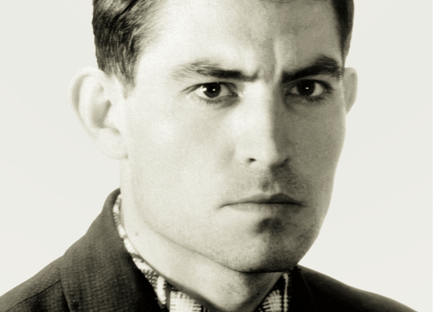
The feature photo shows the Ukrainian poet and activist Vasyl Stus [item 4].
*
- On Vasyl Romanyuk, see CCE 17.2, CCE 25.2 [6], CCE 28.7 [3] and Name Index.
↩︎ - See report on issue 1 of the Golden Fleece in “Samizdat Update”, CCE 38.20 [5].
↩︎
*
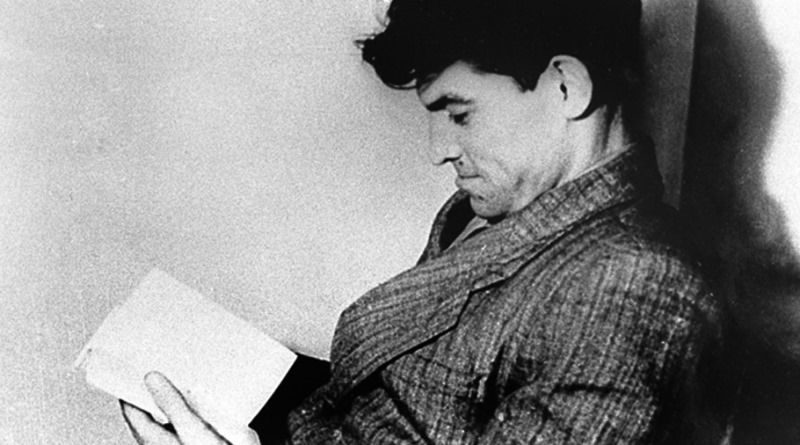
Vasyl Stus (1938-1985)
==========================
 A Chronicle of Current Events