*
Special Psychiatric Hospitals [SPH]
Kazan SPH
Colonel Konstantin Leonidovich Sveshnikov is head of the Kazan SPH. The head doctor is First Lieutenant Ravyl Olegovich Valitov. The deputy head for discipline and security is Major Saifulin.
There are 750 patients altogether in Kazan SPH; of these, about 120 are political prisoners.
*
In September 1976, 16 political prisoners were transferred here from Dnepropetrovsk SPH. These included Nikolai Plakhotnyuk (CCE 28.7 [1], CCE 43.8) and Vasily Ruban (CCE 30.9).
Kim Davletov (CCE 39.3) was given injections of a powerful neuroleptic drug, Moditen-depo, for six months continuously.
Recently Anatoly Ilyn (CCE 41.7) has not been given any medicines. He is being kept in strict isolation, as before. He is alone in a ward meant for four persons. A female nurse who tried to give him some food, sent to him by other prisoners, was dismissed.
*
Chernyakhovsk SPH
Ye. Zhikharev (55 years old) — an engineer; he was arrested in 1975 under Article 70 (RSFSR Criminal Code) and charged in connection with the book he had written, The Great Affair.
V. Karaliunas — turned up here in 1975 for writing a proclamation calling on factory workers to come out on strike, and for renouncing his Soviet citizenship.
Kashin (b. 1949) — a journalist from Sochi; he was arrested in 1974 under Article 190-1 (RSFSR Criminal Code) because of some prose work of his that he had sent to the journal Yunost (Youth).
V. Popov (45 years old) — a Muscovite, arrested for attempting to cross the border, charged under Article 64 (RSFSR Criminal Code); has been here for over four years.
A. Cehanavicius (b. 1949) — a medical student from Kaunas.
In April 1973 a search was carried out at his apartment in which an exercise-book containing poetry and tape-recordings of broadcasts by ‘Voice of America’ and Vatican Radio were confiscated. He was charged with “Anti-Soviet Agitation & Propaganda”. He was diagnosed as ‘schizophrenic and psychopathic’. The court sent him for compulsory treatment in an ordinary hospital. In 1975 Cehanavicius was transferred to Chernyakhovsk SPH (for reasons unknown to the Chronicle).
*
In 1976 G. A. Bychkov (CCE 41.7) and V. M. Moiseyev (CCE 41.7) were transferred from here to ordinary psychiatric hospitals.
P. Cidzikas (CCE 34.18 [4], CCE 39.3) was transferred to an ordinary psychiatric hospital. Since 1976 he has been at liberty.
*
Ordinary Psychiatric Hospitals
TERELYA
On 28 April Josyp Terelya (CCE 43.8, CCE 45.14) was forcibly placed in an ordinary psychiatric hospital (CCE 45 was inaccurate on this point) in the town of Beregovo, Trans-Carpathian Region.
In a conversation with Yelena Terelya, Terelya’s wife, an official of the Trans-Carpathian KGB referred to a letter written by Terelya in defence of Mykola Rudenko (CCE 46.4) as a proof of Terelya’s illness.
*
On 19 May Josif Terelya escaped from the hospital.
On 2 June he was caught in Ivano-Frankovsk and sent back to Beregovo psychiatric hospital.
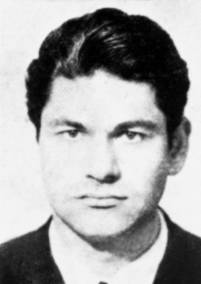
Josyp Terelya
On 21 June a Beregovo court ordered Terelya to be transferred to a Special Psychiatric Hospital.
Yelena Terelya appealed for help to the Working Commission to Investigate the Use of Psychiatry for Political Purposes (CCE 44.10) and to the British psychiatrist Gery Low-Beer (CCE 35.1).
*
BELOV
The Krasnoyarsk Regional Court did not want to review the question of ending the compulsory medical treatment of Yury Belov (CCE 45.14) and sent his case to Vladimir, the city where the compulsory treatment had been ordered.
On 25 May the Vladimir Regional Court refused to end Belov’s compulsory treatment. The decision of the Court, taken at the insistence of Obraztsov, deputy procurator of Vladimir Region, stated:
“Taking into account the fact that Yu. S. Belov has twice been sentenced for especially dangerous crimes against the State and has been ruled a particularly dangerous recidivist, and that while he was in Vladimir Prison in 1969-1971 he again committed a crime and was declared not responsible for his actions:
“the decision of the doctors of Krasnoyarsk psycho-neurological hospital No. 1 at Tiiskaya Station that he is allegedly ‘practically healthy’ and does not suffer from schizophrenia, but is a psychopathic personality in a deep and lasting remission, is not founded, because Yu. S. Belov is socially dangerous and has been treated for only a short time.”
On 30 May, on the orders of I. A. Alexeyeva, head psychiatrist of Krasnoyarsk Region (Krai), Yury Belov was transferred to Krasnoyarsk City Psychiatric Hospital (14 Kurchatov Street). Alekseyeva declared that the reports about Belov on Western radio-stations and letters in his defence which had reached the psychiatric hospital from West Germany and Switzerland, had to be regarded as constituting a deterioration in his psychological condition.
Belov is in Section 4. The doctor in charge is V. Ya. Chistyakov, the leading expert on forensic psychiatry in Krasnoyarsk Region (Krai).
*
In April Vladimir Vedernikov was forcibly incarcerated in Leningrad Psychiatric Hospital No. 5 for distributing pamphlets of a religious nature in defence of Alexander Ginzburg.
In the hospital he has been given a course of electric shock therapy, injected with haloperidol and given aminazine and sulphazine.
*
BOROVSKY
On 12 May Viktor Borovsky was forcibly sent to Kharkov Psychiatric Hospital No. 15 (CCE 45.14).
On 17 May he was questioned by a commission about his beliefs, the books which he had read, and his acquaintance with Mykola Rudenko.
Borovsky was transferred to Kharkov Psychiatric Research Institute.
On 27 May he was seen by another commission. When asked what he intended to do in future, Borovsky replied that he wanted to leave the USSR. (He had already tried to apply to the Visa Department, but got nowhere as he had no invitation from abroad.) The members of the commission promised Borovsky that no objections would be raised to his emigration and said a great deal depended on them. The commission declared Borovsky to be sane.
On the instructions of the Regional psychiatrist Nikitin, Borovsky was detained in the hospital for another week. When Borovsky’s mother demanded that he be released, L. F. Gritsenko, the doctor treating him, stated: it’s not wise to demand: this morning he might be healthy and this evening he might be ill again.’
On 3 June Borovsky was released and applied to the Visa Department (OVIR) or permission to emigrate.
*
A search was carried out at the home of the former wife of Lev Konin, who was put in Leningrad Psychiatric Hospital No. 6 on 27 April (CCE 45.14), but nothing was confiscated.
A commission of doctors told Konin that he was clinically healthy and that he would have to answer to the law for his actions.
On the orders of the section head, Konin’s friends were not allowed in to visit him (he has no relatives in Leningrad).
On 4 June Konin was released and placed under the supervision of a psychiatric clinic.
==========================
 A Chronicle of Current Events