INVESTIGATION OF HELSINKI GROUPS
- 5-1. Ginzburg & Orlov.
- 5-2. Shcharansky, Ukraine, Georgia.
*
[1] The Shcharansky Case
AZBEL
On 20 May 1977, Mark Azbel (CCE 45.18 [9]) was summoned to the central KGB office.
A KGB general, who did not give his name, demanded that Azbel should change his attitude at interrogations. He threatened to bring him to book for making public information about an investigation. Finally he informed Azbel that he would never leave the USSR if he behaved in this way. Azbel did not express willingness to change his attitude. The conversation was heated.
Azbel was not questioned further. On 5 July he left the USSR.
*
In June another witness in the Shcharansky Case, Veniamin Fain (CCE 45.5), emigrated.
*
DEFENCE LAWYER
On 31 May 1977, Ida Petrovna MILGROM, Shcharansky’s mother, received official notice that her son was being charged under Article 64 (RSFSR Criminal Code: “Betrayal of the Motherland”).
On 15 June she turned for help to the lawyer Dina Kaminskaya (CCE 43.7 [8]), asking her to act as defence counsel for her son. Milgrom asked permission of I.I. Sklyarsky, deputy chairman of the Moscow City Bar Association. Kaminskaya did not deal with cases of this kind, she was told: Kaminskaya was long ago deprived of the relevant ‘pass’.
On 16 June Ida Milgrom sent a telegram to R. A. Rudenko, USSR Procurator-General.
She asked once again (CCE 45.5) that her son should be allowed to have a lawyer during the pre-trial investigation and pleaded to be allowed to visit her son, as she wanted to make sure he was alive and well.
*
ROBERT TOTH
On 14-15 June 1977 Robert Toth, correspondent of the US newspaper Los Angeles (LA) Times, was questioned in Lefortovo Prison.
Robert Toth had spent three years in Moscow.
He had intended to leave the USSR on 17 June, with his wife and three children [1].
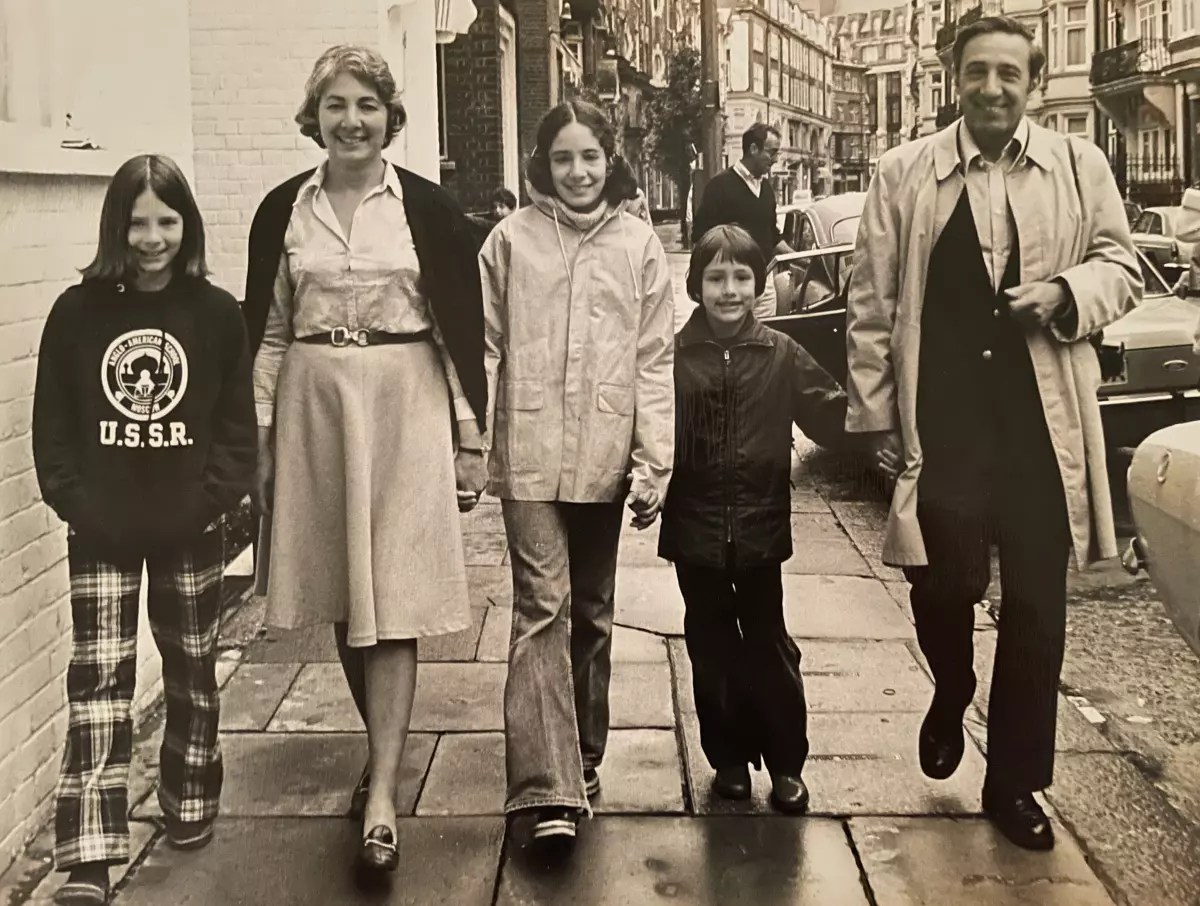
Robert Toth and his family in London (1977)
On 11 June Toth met the biologist V. R. Petukhov near his home and received a manuscript article from him about parapsychology. Immediately after this meeting Toth was detained by men in civilian clothes and taken to a police station.
There KGB officials confiscated Petukhov’s manuscript from him and subjected him to a three-hour interrogation, Toth said that he first heard of Petukhov from a Soviet scientist now living in Israel. A few months ago his friend Shcharansky told him that Petukhov wanted to meet him. Petukhov told Toth about his unofficial work on parapsychology and asked for help in publishing the results of his work in the American press. Toth understood nothing of Petukhov’s theories but had undertaken to help him.
*
On the morning of 14 June a note from the USSR Ministry of Foreign Affairs was handed to the American Embassy in Moscow.
Robert Toth had received material containing secret information from Petukhov, it said. The Ministry protested at Toth’s “impermissible activities”: he would be summoned for interrogation, the note continued, “so his departure from Moscow before the end of the investigation is undesirable”.
That afternoon Toth was interrogated for four hours in Lefortovo Prison. He was questioned by Major Dobrovolsky. Neither a representative from the US Embassy nor Toth’s interpreter was allowed to be present: an Intourist official acted as interpreter. The questions mainly concerned Petukhov. Toth asked how it could be maintained that parapsychology was secret. On the whole this science was not secret, Dobrovolsky replied, but it could contain areas of secrecy and the expert L. M. Mikhailov (USSR Academy of Sciences) maintained that Petukhov’s materials were secret.
At the end of the interrogation Dobrovolsky read out the record. It contained statements which Toth had never made: Toth protested and Dobrovolsky promised to strike out these phrases. Toth did not want to sign the record, saying he did not understand the handwritten Russian text.
Dobrovolsky objected. According to Soviet law, he said, a witness did not have the right to refuse to sign the record; moreover, refusal to sign was equivalent to confessing that he had given false evidence. Toth signed the record, adding a note: “This record was translated to me and I do not object to the substance of the translation.”
On 15 June Toth was interrogated by Colonel Volodin (CCE 45.5) and Major Chernysh. Volodin told Toth that he was being questioned as a witness, but refused to tell him which case and which charge this was connected with.
This was followed by questions about Shcharansky and the information Shcharansky had passed on to Toth. Shcharansky spoke English better than other ‘refusenik’ Jews, Toth replied, and had therefore represented them at press-conferences. Shcharansky had issued information about obstacles to emigration and other infringements of human rights.
Toth then gave evidence about his own article, “Russia Indirectly Reveals Centres of Secret Work” (published in the LA Times and the International Herald Tribune). The majority of refusals to issue emigration visas to Jews, the article stated, were linked with the secrecy of their work. So a list of the institutions in which ‘refuseniks’ worked would be a list of “centres of secret activity”. Toth testified that he had asked Shcharansky for his help in writing this article.
Shcharansky replied that Jewish ‘refuseniks’ had compiled lists of those refused visas over the last few years. These records were handed to Jewish organisations in the USA and England, and proved that most of the refusals on security grounds were false. Many Western activists concerned with the emigration of Jews from the USSR were in possession of them.
In his work as a journalist Toth had devoted much attention to the development of science in the USSR, During the interrogation almost all his articles on this subject were mentioned.
Where he had got to know the contents of a secret decree about Party disciplinary action, Toth was asked, against three senior scientists at the Kurchatov Institute of Atomic Energy. “From another scientist, who has now emigrated,” he replied. He replied in the same way when asked where he had got information about the dismissal of Igor Melchuk (CCE 40.13).
Volodin told Toth that:
- (a) he and Shcharansky had met the sociologist Alexander Zinoviev [2];
- (b) at his request, Shcharansky put four questions about genetic engineering to the biologist Goldfarb;
- (c) Toth conversed, in the presence of Shcharansky, in ‘refusenik’ Lev Ulanovsky’s flat with psychiatrist Ernst Axelrod (also a ‘refusenik’) about the training of Soviet cosmonauts.
Toth confirmed all this.
This time the interrogation record was translated in writing into English. Toth signed both records.
*
On 17 June Toth left the USSR with his family.
On 19 June Toth published “From the Depressing to the Ridiculous”, an article about what had happened. (Information about his interrogations was taken from this article in the LA Times.)
On 12 July TASS issued a statement in English that Robert Toth used his position as a correspondent to receive and pass on secret information: there was accurate evidence, it said, about his activities as a spy.
In spite of this, TASS wrote, the Soviet authorities had shown their good will by questioning him as a witness and allowing him to leave the Soviet Union, not starting a criminal case against him. Now Toth had started a press campaign and was writing fantasies to try to clear his accomplices, one of whom was now under investigation.
*
AXELROD
On 4, 9 and 22 July 1977, Ernst Axelrod was interrogated in connection with the Shcharansky Case by Investigator Solonchenko. At the first two interrogations he did not give any specific evidence, maintaining that he had not been told what Shcharansky was being charged with.
On 22 July, Axelrod was told that Shcharansky was charged with composing statements hostile to the Soviet Union, which had been used by enemies of the USSR for libellous anti-Soviet aims. The investigator quoted to him part of Article 64 (RSFSR Criminal Code: “helping a foreign State to carry out hostile activities against the USSR”).
After this Axelrod answered questions about meeting Toth in Lev Ulanovsky’s flat. He himself arranged this meeting, he said, and had chosen the place. He was very sorry that Shcharansky had chanced to visit the home of his friend Ulanovsky at that time.
*
ULANOVSKY
On 4 and 9 July, Lev Ulanovsky was interrogated on the same subject.
He had not been home, he said, when Axelrod met Toth. Ulanovsky refused to answer questions about Shcharansky and his private life: he had not been told, he explained what specific actions Shcharansky was being accused of.
*
At the beginning of July the lawyer Konstantin Simis (CCE 43.7 [8]) was summoned for interrogation at Lefortovo Prison in connection with the Shcharansky Case.
He told the investigators that he did not know Shcharansky.
*
Corresponding Member of the USSR Academy of Sciences, Veniamin Levich was interrogated for eight hours.
How he had come to know Shcharansky, he was asked, and about meetings with American senators, at which Levich had been present together with Shcharansky.
After the interrogation Levich told foreign journalists that he had refused to participate further in the investigation [3]: the interrogation had definitely convinced him of Shcharansky’s innocence.
*
At the end of July, 37 ‘refuseniks’ appealed to Jewish communities throughout the world in connection with the Shcharansky Case.
Under the pretext of the ‘Shcharansky Case’, they write, Jews are being summoned for interrogations that last many hours. During such questioning they are intimidated and threatened with criminal prosecution for writing letters and appeals to Jewish and world public opinion, giving information about Jewish emigration from the USSR.
(See also CCE 46.17 [4, 5].)
*
[1.1] THE SHCHARANSKY CASE WORLDWIDE
PARIS
A public hearing on the Shcharansky case in Paris ended its three-day sitting on 18 July 1977.
Three independent judges and a jury made up of well-known public figures (including Laurent Schwartz, head of the French Group for the Defence of Anatoly Shcharansky) listened to three lawyers who set out the case.
The lawyers were: R. Rappoport, a PCF member and head of the French group to Combat Racial Discrimination & Antisemitism; the chairman of the French Committee for the Defence of Human Rights; and the head of the French Association of Jurists.
The tribunal questioned the witnesses Vitaly Rubin and David Azbel (who were mentioned in the Soviet press as organisers of Shcharansky’s activities as a spy), and also Veniamin Fain and Mark Azbel. The hearing took place behind closed doors. The results of the hearing were sent to Soviet embassies in five European countries. The tribunal is refraining from publication of its materials for the time being.
Soon the first sessions of similar tribunals should take place in London and Washington.
*
Some Jewish ‘refuseniks’ have sent written evidence about Shcharansky to these tribunals.
They are Dina Beilina, Victor Brailovsky, Victor Yelistratov, Yu. Kosharovsky, F. Kandel, Alexander Lerner, A. Mai, Naum Meiman, Ida Nudel, Vladimir Slepak, Eitan Finkelstein, Z. Tesker, Lev Ulanovsky and V. Shakhnovsky.
Beilina, Slepak, Lerner, Ulanovsky, Finkelstein and Shakhnovsky knew Shcharansky well; the others were only acquaintances.
These statements describe Shcharansky’s activities as a translator at press-conferences and meetings with foreign religious, social and political figures., No secret information was ever transmitted on such occasions, they say.
Lerner, Slepak and Finkelstein are well acquainted with the teaching system in the Institute of Physics & Technology from which Shcharansky graduated. They are familiar with the set of scientific problems he was working on: there is no basis for denying Shcharansky an emigration visa, they insist, on the grounds that he is in possession of secret information.
*
From 18 to 22 July the following Jewish ‘refuseniks’ were interrogated in connection with the Shcharansky Case: A. Polishchuk, D. Shchiglik, Ya. Rakhlenko, B. Chernobylsky, L. Volvovsky, A. Stolyar, Veniamin Levich, the Vigdarov married couple, M. Kremen, Tsitovsky, the Lainer married couple, O. Mendeleyev and A. Kogan. The investigators included Gorbunov, Kasumov, Skalov, Martemyanov and Sherudilo.
The questions were mostly about Open Letters from Jewish ‘refuseniks’ which had been signed both by the person being questioned and by Shcharansky. It was said of the letters that they were subverting Soviet-American relations and were being used for anti-Soviet ends. All the witnesses confirmed their signatures under these letters as being genuine.
In addition, the investigators enquired if Shcharansky had collected information about ‘refuseniks’. None of the witnesses could answer this question.
*
[2] Ukraine
In June, on Mykola Matusevich’s birthday, a large parcel was accepted from his wife (Olga Geiko), as he was said to be “behaving himself”.
*
The pre-trial investigation in the case of Matusevich and Marinovich (CCE 45.7) comes to an end in August.
*
The Ukrainian Helsinki Group — Oles Berdnik, Nina Strokata, Oksana Meshko, Ivan Kandyba, Lev Lukyanenko, Petro Grigorenko, Pyotr Vins and Olga Geiko — has sent two letters to the Belgrade Conference.
“Letter No. 1” lists the persecution to which members of the Group have been subjected.
“Letter No. 2” lists infringements of human rights, documented in letters received by the Group.
*
After the arrest of Matusevich and Marinovich (23 April) Helsinki Group members Lev Lukyanenko and Oksana Meshko were interrogated (in addition to those listed in CCE 45.7).
Also interrogated were Nadiya Svetlichnaya and Liliya Ruban, wife of Petro Ruban (CCE 45.3). Yevgeny Obertas was interrogated six times, Antonenko-Davidovich three times and Nadiya Svetlichnaya, twice.
While she was being interrogated in connection with the case of Matusevich and Marinovich, Nadiya Svetlichnaya (Ukr. Svitlychna) was told that they would be “tried for creating an anti-Soviet group”.
When he was interrogated in connection with the same case, Lev Lukyanenko was told the exact opposite. He refused to answer any questions: “After all, you said they won’t be tried because of the Group. What am I here for then?”
*
Boris Marinovich, first cousin of Myroslav Marinovich, was taken off a train during a tourist trip and sent back to Kiev. There he was interrogated for two days in a row.
*
After the arrest of Mykola Matusevich, his wife Olga Geiko declared that she was resigning from the Komsomol.
On 18 July she was summoned for interrogation by the KGB, in connection with her husband’s case (Case 51; Investigators Berestovsky and Beryoza). She was asked about documents of the Ukrainian Helsinki Group, which the investigator called ‘anti-Soviet’, and documents confiscated, in her absence, on 4 July from her place of work.
It was the first time Geiko had seen some of the documents she was shown.
*
[3] Georgia
The campaign in the Georgian press which preceded the arrest of Zviad Gamsakhurdia, Merab Kostava and Victor Rtskhiladze was much more widespread than reported before (CCE 45.9).
*
NEWSPAPERS
On 23 March 1977 an editorial “Who profits from this?” was published, in the newspapers Zarya Vostoka (in Russian) and Komunisti (in Georgian).
On 29 March the newspaper Akhalgazrda Komunisti (Young Communist) published a long anonymous article “Traitors and Pharisees”.
On 30 March the newspaper Tbilisi included “An Unworthy Son”, an article by Kh. Kartvelishvili.
On 31 March under the rubric ‘To the Pillory with Spiritual Renegades!’, the Zarya Vostoka newspaper published an article “Scum” by A. Bregvadze, D.Sc. (History).
The same day the newspaper Soplis tskhovreba (Village Life) printed a letter, “My curse on the Fascist traitors!”, signed by “Tamara Giunashvili, pensioner, mother of a soldier who never returned”.
That day the newspaper Tbilisi published a letter titled “Father and Son”: it was signed by
- “Participants in the 31 March 1977 Session of the USSR War Veterans Committee (Tbilisi section);
- “war veterans;
- “Heroes of the Soviet Union (10 surnames)”.
*
On 1 April 1977 the newspaper Komunisti published a letter from Professor V. Kvachakhia “Slanderers and provocateurs must be brought to book!” (Professor Kvachakhia is one of those whom Zviad Gamsakhurdia accused of collaborating with the KGB.)
The same issue printed an announcement “From the Editors” about an expanded meeting of the Tbilisi University administration (CCE 45.9). The same day the Literaturuli Sakartvelo (Literary Georgia) newspaper included an article “Do not bear false witness!” Dated 17 March, it was signed by David the Vth, Catholicos-Patriarch of all Georgia, Metropolitan Gaioz and two other bishops (CCE 45.9).
On 2 April the newspaper Tbilisi published “A Worthy Answer by Georgian Writers”.
*
On 19 May 1977 leaflets were pasted up in Tbilisi in the Polytechnic Institute, calling for an open trial for Zviad Gamsakhurdia and Merab Kostava.
*
The Investigator in charge of the Gamsakhurdia-Kostava case is Sadzaglishvili.
*
‘FAWCETT’
On 25 May 1977 Manana Gamsakhurdia, Zviad Gamsakhurdia’s wife, Elizaveta Bykova and members of the Georgian Helsinki Group (Viktor Rtskhiladze, the brothers Grigory and Isai Goldstein, Beglar Bezhuashvili and Teimuraz Dzhanelidze) issued a report entitled “CIA plots or KGB provocation?”
*
A man who spoke English with an indeterminate accent, it recounted, and called himself William Fawcett (a businessman from Canada) turned up on 21 May at the flat of Grigory Goldstein.
In a Radio Liberty broadcast about the arrested men Zviad Gamsakhurdia and Merab Kostava, Fawcett [4] explained, he had heard the surname ‘Goldstein’. He obtained Goldstein’s address from the Tbilisi register of addresses: Fawcett was holding a note from the address registry office in his hand. Fawcett asked to be taken to Zviad’s wife Manana, as he wanted to ask her some questions.
In Manana’s house Fawcett asked Grigory Goldstein to translate from English into Russian and vice versa. He knew that Manana’s husband, said Fawcett, was being charged with treason against the State. He knew that Manana had recently met Western journalists: he insisted on advising her not to make any statements to the journalists, as this could do her husband harm.
Fawcett asked if Manana had any unpublished works by her husband and offered to take them with him to the West. Fawcett inquired if the Georgian Herald [5] was still coming out.
*
On 22 May Fawcett met Viktor Rtskhiladze and Grigory Goldstein in Manana’s house. Fawcett showed an amazing knowledge of Zviad and Manana’s family life.
Zviad’s father had deposited over a million dollars in various Western banks, he announced, adding that Manana could make use of this money. Fawcett said he could pass on any message to Zviad in prison and asked if they wanted to send anything.
Fawcett said that Merab Kostava was giving evidence useful to the investigation and would soon be released. Rtskhiladze would be arrested, Fawcett said, promising him a secure life in the West if he wanted to leave the USSR.
Goldstein was promised by Fawcett that he would be given permission to emigrate soon.
“What if I ring up my KGB investigator and tell him about this conversation?” asked Rtskhiladze.
“I’m not afraid of anything. My business in the USSR has made many millions of dollars. It’s needed by the Soviet authorities and so they won’t do anything to me,” replied Fawcett.
*
Fawcett then asked to be left alone with Manana.
Their conversation lasted for about half an hour, after which Manana called in Rtskhiladze and asked him to tell the investigator in charge of her husband’s case at once that Fawcett had suggested to her in perfect Russian that she should work for the CIA. At the same time, in their talk together Fawcett had also said, “the Goldstein brothers will betray you”.
Rtskhiladze fulfilled Manana’s request.
*
On 25 May Viktor Rtskhiladze was asked to come to KGB headquarters. Khazalia, Senior Investigator of Cases of Special Importance, talked to him. When Rtskhiladze asked “What’s happened to Fawcett? You should arrest him”, Khazalia replied:
“We know about him and will take measures to put an end to his activities … The Goldstein brothers will get into real trouble through their ties with foreigners!”
Rtskhiladze asked, “Why don’t you allow them to emigrate from the USSR?” Khazalia said, “We have reasons why we don’t do so yet.”
The report ends:
“If a public investigation proves that Fawcett does not exist at all, or that he did not visit Tbilisi on 21-22 May 1977, then enquiries about the false Fawcett will have to be addressed to the KGB”.
Last year, in Leningrad, a man similar in outward appearance, also calling himself Fawcett, tried to enlist Ilya Levin (CCE 42.3) for the CIA.
==============================================
NOTES
- An account of Toth’s experiences in Moscow as a correspondent are given in the Obituary published on 13 December 2022 in the Los Angeles Times.
↩︎ - On Zinoviev, see CCE 43.14 [2], CCE 44.26-1 [4], CCE 45.18 [18] and Name Index. (Later Zinoviev and his wife were signatories of the 1987 ‘Letter of the Ten’; see Bukovsky, Chapter Six, “The Coming of Gorbachov“.)
↩︎ - Veniamin Levich, chemist (1917-1987), pupil of Lev Landau, Corresponding Member since 1958 of the USSR Academy of Sciences. Left the Soviet Union and moved to Israel in 1978.
↩︎ - ‘FAWCETT’: In August 1977 an official of the Canadian High Commission in London informed the Women’s Campaign for Soviet Jewry that a thorough investigation by the Canadian authorities had failed to identify any Canadian citizen fitting ‘Fawcett’s’ description.
↩︎ - See “Samizdat update”, CCE 45.20, [7] about this uncensored publication (Georgian title “Sakartvelos Moambe”.)
↩︎
===============================
 A Chronicle of Current Events