ELEVEN ENTRIES
Lithuania.
[1]
Not less than six searches were carried out between 19 and 22 April 1977 in Kaunas. Over twenty people were interrogated in connection with the searches.
On 20 April 1977 former political prisoner Balys Gajauskas (CCE 34.7) was summoned for interrogation in Vilnius and arrested there. He was charged under Article 68 pt. 2 (Lithuanian SSR Criminal Code = Article 70, RSFSR Code).
*
On 22 April a search was made at the home of Birute Pasiliene, near Klaipeda.
In 1974-5 Gajauskas and Pasiliene were questioned in connection with Case 345 (CCE 34.7, CCE 35.5).
*
Ona Pranskunaite (CCE 44.22) was arrested at the beginning of 1977.
*
15 Days for Alexander Podrabinek
[2]
On 3 April 1977 at 3 pm Alexander PODRABINEK, a member of the “Working Commission” (CCE 44.10) came to the flat of the Baptist Anatoly Pozdnyakov [1]: Moscow, 108 Shosseinaya Street, flat 45.
A gathering was being held there to consider the Moscow Baptist community’s participation in the defence of their fellow-believer Alexander Voloshchuk (CCE 45.19-2), who had been forcibly interned in a psychiatric hospital.
During the meeting’s period of prayer, policemen and members of the Komsomol ‘operations squad’ of the Lenin Komsomol Car Factory burst in. They demanded that the ‘undesirable meeting’ be ended, photographed the people present, prevented those who wished to leave from doing so, and so on. (Despite these circumstances the service was nonetheless completed and the community supported a letter in defence of Voloshchuk.)
The police demanded that those present show their documents and made a list of the members of the gathering.
Among others, Podrabinek also gave his name. Ignoring the presence of old folk, children and pregnant women, the police roughly grabbed hold of people who refused to give their names, hauled them out of the flat, and shoved them into a van. Alexander Podrabinek told the policemen that they were committing a flagrant illegality and that their actions would receive publicity in our country and abroad. In reply they hurled themselves on him with shouts of “We’ll talk to you separately”, twisted his arms, and, not allowing him to put on his coat, took him away with the believers, wearing only his pullover, to Police Station 103.
The raid on the prayer meeting was led by Lieutenant Sadovnikov, deputy head of Moscow Police Station 103.
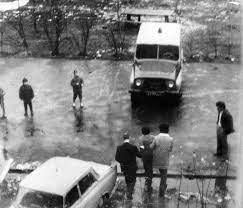
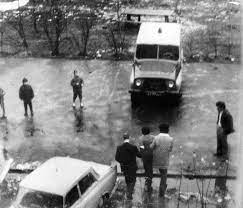
The arrest of Alexander Podrabinek, 3 April 1977
*
During the afternoon all the detained Baptists were released, but Podrabinek was kept at the police station. He spent the night in a cold cell without a coat.
The duty officer of Police Station 103 refused to accept both a formal request from Podrabinek’s father that witnesses of the occurrence should be summoned, and a statement by 19 eye-witnesses that Alexander Podrabinek had shown no resistance to the police.
The same day Pyotr Grigorenko and Father Gleb Yakunin sent a request to the USSR Minister of Internal Affairs, the RSFSR Procurator, and the head of Police Station 103 “to postpone judicial proceedings until the arrival of a defence lawyer and witnesses to the actual behaviour of Alexander Podrabinek”.
On 4 April at 11 am Podrabinek was brought to the people’s court of Moscow’s Lyublino district, together with several people detained in connection with other cases.
Judge Grinyukov heard the cases of three detainees, but postponed the hearing of Podrabinek’s case due to the non-appearance of police witnesses. Asked whether the Podrabinek case would be heard that day the judge replied that the police would decide this.
*
At the police station Podrabinek’s father and his friends were told that the trial would be the next day.
However, in the evening, at 4 pm, Podrabinek was again taken to court. (Over the previous days he had been given nothing to eat and had been deprived of the cigarettes sent to him at the jail.) This time the case was heard by a different judge, Kadykov. Before the hearing the judge held a lively conversation with people ‘in civilian clothes’.
During the hearing the judge sharply interrupted Podrabinek, stating that he understood everything anyway and that the police would not detain someone for nothing. The judge was indignant that Podrabinek had dared to threaten the police with publicity and said: “Go away to your West”. The judge sharply refused to hear a witness Podrabinek had petitioned for. The trial lasted 15 minutes and some parts of the proceedings drew laughter from those present. “Stop laughing!” shouted the judge.
The judge sentenced Podrabinek to 15 days in jail “for disobedience to the authorities”.
On 5 April 1977 Podrabinek was taken under escort to the executive committee of the Dzerzhinsky district soviet. There secretary of the committee Gladkova stated, in the presence of representatives of the first-aid station where Podrabinek works, that “his prolonged and many-sided anti-Soviet activities were already well known to them”. “[I]f he didn’t stop participating in activities harmful to the Soviet political and social system,” (she added) “then he would be committed for trial”.
For refusing to work during his jail sentence Alexander Podrabinek was held for several days in a cold cell on the orders of Major Kryuchkov, head of Police Station 71 to which Podrabinek had been transferred. On 14 April it was announced to him that for refusal to work his term of detention would be prolonged by another 15 days. As a protest, on 15 April 1977 Podrabinek began a hunger-strike, sending a statement about this to the Lyublino district procurator. He was transferred to a solitary cell. On 18 April he was released.
*
During Podrabinek’s imprisonment a meeting was held at his place of work, where his fellow-employees were told that Podrabinek was engaged in anti-Soviet activities.
A Statement to the World Public (dated 4 April 1977) was made by members of the Helsinki group Pyotr Grigorenko and Vladimir Slepak, fellow members of the Working Commission (Felix Serebrov, Vyacheslav Bakhmin, Irina Kaplun and D. Babich), and members of the Christian Committee Father Gleb Yakunin and Victor Kapitanchuk. It reads:
“Such events are nothing new: that the police apply force and then the people subjected to it are sent for trial. They themselves beat people and shout ‘alarm!’ We consider the detention of Podrabinek to be the beginning of an assault on him for his struggle against the use of psychiatry to suppress dissent …”
*
Other Cases (3-11)
[3]
On Saturday 16 April 1977 a man in uniform came up to Sergei Ruzer near the Moscow synagogue and rudely demanded to see his documents.
Ruzer asked the man to first show his documents, thereby confirming his right to ask others to show theirs. After a short exchange the other man showed the pass of a police lieutenant. Ruzer at once showed his passport (internal ID document). Then the policeman asked Ruzer to get into a car. Ruzer refused. He was shoved into the car by force, taken to a police station and soon set free.
Two days later Ruzer was summoned to come to the police on 19 April. On the summons was printed ‘in the capacity of witness’. When he arrived he was taken to court and given 15 days in jail “for disobedience to the authorities”.
*
[4]
On 8 April 1977 a search was carried out at the home of Tatyana Khodorovich, a member of the Action Group for the Defence of Human Rights in the USSR, in connection with Case 46012/18-76. (Searches were carried out in connection with this case at the homes of Moscow Helsinki group members in January, CCE 44.2.)
On 11 April Tatyana Khodorovich issued a “Statement to the Press”:
“On Good Friday, 8 April, a search was conducted in my flat. In the search warrant was written: to conduct a search ‘for confiscation of documents, literature, etc. [literally ‘s.t. = and similar things’, T.Kh.] containing knowingly false fabrications which defame the Soviet political and social order’.
“I consider any search for the purpose of confiscating literature to be illegal and an unnatural interference in human thought, and the appearance of the KGB in our flats a shameless and impudent intrusion into our homes, into our personal life.
“Viewing the said search as the preliminary to arrest, I declare the following:
“1. In the documents taken from me there is not and was not previously any slander. I refused to participate in the search procedure, did not read or sign the record, and was not present in the areas that were searched.
“2. I publicly refuse in advance to take part in a pre-trial investigation, to study the ‘case’, or to accept the services of Soviet [i.e., court-appointed] defence lawyers.
“3. Soviet courts do not acknowledge the authority of LAW: they acknowledge the authority of IDEOLOGY. I refuse to appear before a court, since I refuse to submit to an ideology which I do not accept.
“I speak now. At the investigation and trial I shall stay silent.”
On 25 April 1977 Tatyana Khodorovich was summoned to Investigator Ponomaryov for interrogation at the Moscow City Procurator’s Office. She refused to sign anything whatsoever there, even the ‘passport’ page of the record.
And she refused to explain her refusal.
*
[5]
At the end of February 1977 in Ufa (Bashkir SSR) a search was conducted at the home of Boris Razveyev, a participant in the religious seminar of Alexander Ogorodnikov (CCE 43.11).
The search warrant stated that the search was being conducted because of the robbery of a church.
*
[6]
In Moscow on 8 March 1977 a search was conducted in the premises where Eduard Fedotov works as a yard attendant (CCE 43.9). No search warrant was shown and no copy of the search record was left. Religious literature was confiscated. The premises were turned upside-down; mattresses and linen were thrown out into the dirt on the street.
On 9 March Fedotov and G. Kurganov were summoned to Investigator Shilkin for interrogation. Fedotov was threatened with “a permanent bed” in a mental hospital.
*
[7]
In Tashkent (Uzbek SSR) on 14 March 1977, Anatoly Yegorovich KOCHERGIN was detained at the railway station. 200 copies of a collection of religious verse, compiled for the unregistered Adventists (ACTFSDA), were taken from him.
On 19 March in the city of Tashkent the police conducted a search in the flat of Ye.Ya. Peretykin.
Religious literature, tape-recordings ‘on religious themes’, a typewriter, a gun and photographs of Peretykin’s daughter V.S. Kravtsova and Kochergin were confiscated. After the search another daughter of Peretykin (G.S. Kravtsova), who works as a cleaner in a tractor factory, was asked to leave her job ‘voluntarily’: otherwise, she was threatened, she would be sacked ‘for absenteeism’. As a Seventh-Day Adventist, she does not work on Saturdays, cleaning on Sundays instead.
On 20 March the ACTFSDA Chairman, Vladimir SHELKOV, sent a request to the Committee for Human Rights for help in freeing Kochergin and retrieving the literature taken from him.
On 24 March E.Ya. Peretykin and his daughters (V.S. and G S. Kravtsova) sent the Action Group a letter. Entitled “Evidence of Gross Lawlessness by the Dictatorship of State Atheism on 19 March 1977”, it requested help in retrieving the confiscated literature while protesting against the violation of Believers rights.
(See also “Germans” in “The Right to Leave” CCE 45.15.)
*
MOSCOW (8-10)
[8]
In mid-April 1977 Yevgeny Barabanov (CCE 30.7) was summoned to his police station, where he was asked to write down on a form headed ‘Inquiry’ everything he knew about the family of Lev Regelson.
Barabanov asked what sort of case the police were investigating. A police official replied that any citizen was obliged to supply information on any demand by the police. Barabanov wrote on the form that he refused to give any information whatever about the Regelson family.
*
[9]
On 19 April 1977 KGB Major Bondarev had a ‘chat’ with Arie Mizyakin (CCE 34.7, CCE 38.3).
During their conversation Bondarev referred to the evidence of one of Mizyakin’s former fellow-employees to whom Mizyakin allegedly conveyed his intention to place an ‘explosive device’ in the briefcase of a mutual acquaintance to blow him up ‘in a public place’. Bondarev asked Mizyakin to put down in writing his attitude to this evidence and to write whether he was familiar with the technique of preparing such devices.
The ‘brief-case incident’ appeared briefly in the evidence given in 1975 by V.S. Malyshev, Mizyakin’s former fellow-employee, at the trial of Sergei Kovalyov (CCE 38.3). Malyshev then defined Mizyakin’s words as ‘an ill-judged joke’.
*
[10]
In mid-May a search was conducted at the home of Mikhail D. Baitalsky.
The search record starts with the article by Raissa Lert “On Approaches to The Yawning Heights” (a review of the book by A. Zinoviev, CCE 43.14). Other samizdat and tamizdat works were also confiscated.
Mikhail Davydovich BAITALSKY is 75 years old [2]. In 1927 he was expelled from the Party for Trotskyism. He was imprisoned three times ; the last began in 1948. He was legally rehabilitated. Baitalsky took part in the Second World War.
*
[11]
Valery Abramkin and his wife Yekaterina Gaidamachuk (CCE 41.13), working in a geological group in Georgia (CCE 44.27), visited the region of Svanetia on free days.
On 7 April 1977, when they returned to the Tourist House in Mestia where they were staying, they were met by a policeman who told them that one of the residents had lost a watch and some money, and that he, the policeman, was obliged to conduct a search. The policeman inspected their rucksack and also their room.
When he attentively studied notes in a writing-pad, Gaidamchuk remarked that it was immediately obvious that it contained neither watch nor money. The policeman, embarrassed, at once returned the writing-pad to her.
======================================================
NOTES
- Anatoly Pozdnyakov, 39, was a manual worker who had lost his job. As a sufferer from epilepsy, he was getting a pension of 4 roubles a week in 1977. (See article by D. Shipler, New York Times, 2 December 1977).
↩︎ - Baitalsky died in Moscow in 1978.
From 1936 to 1941, he was imprisoned in Vorkutlag. In 1950 he was again arrested and worked in a sharashka in Moscow and Vorkuta, and in the mines: he was freed and rehabilitated in 1956 (see Sakharov Centre, “Recollections of the Gulag and their authors” [R] — https://vgulage.name/ –).
Parts of his memoirs (Notebooks for my Grandchildren) were published in Israel in Vremya i my (Time and Us), a journal edited by Kronid Lyubarsky. Publication of the chapter “Kashketin’s Executions” in Vremya i my No. 11 (1976) may have triggered the search recorded here.
↩︎
================================
 A Chronicle of Current Events