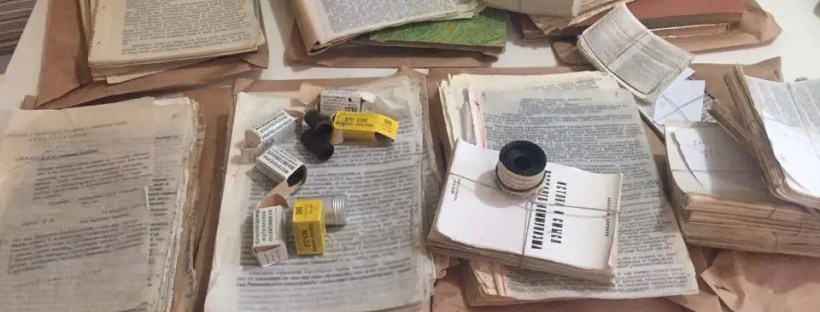
FIFTEEN ENTRIES
(Periodicals: 9, 10, 13)
[1]
Naum Meiman
“The Monument at Baby Yar” (15 September 1977) 4 pp.
Concerns the efforts of the authorities to hide the fact that those exterminated at Baby Yar in September 1941 were primarily Jews.
*
[2]
Tatyana Khodorovich and Victor Nekipelov
To Jimmy Carter:
“Don’t Retreat before the Rhinoceros! Politics and Morality” (8 August 1977) 8 pp.
An appeal to US President Carter “as a Christian and a humanist”. They warmly support his actions in defence of human rights and his statement that “Without respect for human rights there can be no progress, détente or peace on earth”.
*
[3]
Ivan Belov
“What is Socialism?”
An Open Letter to Santiago Carrillo and other Eurocommunists (1977, 20 pp.)
The author considers that there can be no ‘good’ socialism.
He tries to prove that “socialism, the basis of which is public ownership of the means of production, has in an epoch of division of labour, all the characteristics of feudal methods of production”. At the end of his letter the author writes:
“Socialism, as a public form of ownership based on specialized machine production, will inevitably be destroyed by its own logical development. It will be replaced by the capitalist means of production.”
*
[4]
Mikhail Makarenko
“We do not Forgive!” (5 September 1977) 4 pp.
The author, just released after eight years of imprisonment (CCE 46.10-2), writes about the “Remembrance Day for Victims of the Red Terror”.
On 5 September 1918 the Council of People’s Commissars issued a decree “On the Red Terror”, which founded the Soviet system of concentration camps.
In 1977 political prisoners are marking this day for the sixth time. The author describes how the day is marked in the camps. The article ends thus:
“On 5 September all of us, the spiritual sons and daughters of those murdered, say ‘To hell with you, executioners!’ And then perhaps our children, if they repeat these words, will not themselves become executioners.”
*
[5]
Kirill Podrabinek
“The Unfortunates” (1977, 26 pp.)
The author, who served in the army from 1974 to 1976, reports on the ‘fathering’ system that has become solidly rooted in the Soviet barracks.
The ‘fathers’, soldiers in their second year of service, treat their ‘little sons’ (new conscripts) as their slaves, subjecting them to beatings, insults, theft and exploitation.
*
[6]
Vladimir Albrekht
“140 Questions about the Tverdokhlebov Case” (1977) 25 pp.
Albrekht describes how he was interrogated in 1975 as part of the case of Andrei Tverdokhlebov [1].
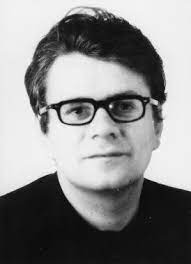
Vladimir Albrekht (b. 1933)
*
[7]
Igor Shafarevich
“Television Interview with the BBC, 26 September 1977” (9 pp.)
Shafarevich answered seven questions put to him about “restrictions on freedom of conscience in the USSR”.
Asked if there were restrictions the author answered in the affirmative, quoting the law which regulates the position of religion in the USSR.
- “What does anti-religious propaganda consist of?”
- “Have you personally experienced the kind of difficulties believers face?”
- “Why is the government afraid to allow Christians freely to confess their faith?”
- “Why does the Church have so much support?”
*
Answering these questions Shafarevich said:
“I feel that in our country religion does not play quite the same role that it does in the West. Some people are weary of the materialist atmosphere of life, and they seek spiritual values in religion.
“Others are trying to come closer to Russian national traditions, so long been suppressed, through the Orthodox Church. A third group sees the foundations of Russian culture in Orthodoxy. Religion fulfils many functions in the spiritual life of a country, besides the basic one — linking men with God. Religion is now a very great spiritual force.
“… Russia came into being as an Orthodox land and has remained so for almost one thousand years. It is impossible to imagine that it could remain spiritually healthy if it lost its ties with Orthodoxy.”
Q. “Tell us about specific cases of people being persecuted for their faith“.
Shafarevich described how a group of Orthodox believers has compiled a list of martyrs of the Orthodox Church: it includes 8,000 priests. He remarked that only a few of these were known in the West.
Q. “We’ve seen churches, both Orthodox and Baptist, filled to over-flowing with people, solemn services uninterrupted by anyone. How can this be reconciled with what you’ve been telling us?”
Shafarevich replied:
“. . . The greater the number of believers and the fewer the number of churches, the more people there will be in each church …
“Church services are not as a rule disturbed … This is in accord with the whole spirit of the legislation on religion and with the entire policy of the authorities: these try to turn religion into ‘cult performance’, to limit its activity to the walls of a church.
“The church-goer will usually not meet with any kind of persecution if his faith is not expressed in any way outside the church: if he attends atheist lectures and gives his children an atheist education; if he does not protest when a priest is dismissed for attracting great numbers of people to his services; if he does not protest when the church he usually attends is closed; and if he does not try to have a new church opened instead of the old one, and so on.
“That kind of believer is in agreement with the spirit and letter of [Soviet] legislation on religion.”
*
[8]
V. Gusarov
“There are no Simple Answers, but the Questions must be Asked”.
The Twentieth Century, a social, political and literary almanac, No. 1 (5 September 1977, 6 pp.)
In welcoming the appearance of a new samizdat almanac, published by Roy Medvedev, the author objects to its polemical attacks: on Solzhenitsyn; on the collection From Under the Rubble; and on Vladimir Maximov and the journal Kontinent.
The aforementioned authors and publications cannot simply be dismissed, writes Gusarov. Although certainly not incontestable, their point of view deserves serious discussion.
*
PERIODICALS
[9]
AUšRA
“The Dawn”, No. 7 (47), August 1977
This issue of the Lithuanian periodical (CCE 45.20 [11]) includes:
(1) “The Hill of Crosses”: a report on the famous hill near Siauliai, which has been “adorned by crosses for a number of centuries”. The hill, to which crosses are brought even from Siberia, is seen by the author as a symbol of faith and hope, a pledge of national revival.
(2) “Our Cultural Heritage”: an article on the Lithuanian Literary Museum, which is situated in Kaunas, in the house of the poet Maironis (1962-1932), “the bard of national revival”. The article is written in the form of a guide to the museum, and answers such questions as “What is missing from room so-and-so?” The statue of Christ is no longer there, nor the panel painted by Daugirdas in the colours of the Lithuanian flag, nor the portrait of Vytautas the Great, nor the picture “The Last Supper”; and the well-known portrait of Maironis has disappeared.
(3) The article, “The Position of Lithuanians in Belorussia” (begun in Nos. 5 & 6) is continued.
*
Aušra No. 7 includes another review of the article in the Communist Party newspaper Tiesa [2] by the writer Baltusis (2 February 1977). The reviewer accuses Baltusis of lying when he describes the events of 1940, and depicts the situation in Lithuania today.
*
There is also a complaint to the USSR Procurator-General from Algirdas Zipre.
Zipre has been trying to obtain his release since 1973. He considers that in 1958 he received a 15-year sentence, not a 25-year sentence. Because of his complaints he has been put in the psychiatric block in Mordovia (CCE 32.12, CCE 34.9).
*
A letter to the 25th CPSU Congress (1977) from the villagers of Pieiis in the Grodno Region (Belorussian SSR) states that their Lithuanian collective farm has been merged with a backward Belorussian kolkhoz, to get rid of their ’Lithuanian island’ and make them forget their native language.
*
Reports are published of searches at the homes of Jonas Petkevičius and Birute Pasiliene (CCE 45.10 and CCE 47.5).
The “News” section of No. 7 reports on the Lithuanian Helsinki Group.
***
[10]
INFORMATION BULLETIN, 2
“The Case of Alexander Ginzburg and Yury Orlov”
Includes written evidence by friends of Ginzburg (the Leningrad literary critic Kirill Uspensky, Valery Ronkin and Svetlana Pavlenkova), which they have sent to the American lawyer E.B. Williams.
Also Williams’s statement in defence of Ginzburg, made on 3 July to the US Congress’s Commission on Security and Cooperation in Europe [addition CCE 48.25].
*
[11]
The Fight for Freedom of Conscience in the USSR
by the All-Union Church of “True and Free Seventh Day Adventists” (20 pp.)
Short history of the All-Union Church (TFSDA). List of Adventists in the camps or prisons at present. The persecution of Adventists. About the new 1977 Constitution.
*
[12]
“Relapse into Hatred of Mankind” (41 pp.)
The author is obviously an Adventist.
The pamphlet is a reply to a series of articles by A. A. Sulatskov entitled “Relapse into Non-Resistance” in Banner of Labour, the Dzhambul Regional newspaper (7-22 October 1977) in Kazakhstan.
An analysis of the problems of military call-up for Adventists and other ‘non-resisters’. The pamphlet is written in a strongly polemical manner.
*
[13]
BRATSKY LISTOK
“Fraternal Leaflet” (1977, No. 4)
The “Fraternal Leaflet”, produced by the Council of Evangelical Christian & Baptist Churches (CCECB), contains a selection of material on KGB attempts to recruit informers among the Initsiativniki, i.e., unregistered Baptist congregations.
*
[14]
“An Anthology of Sundays”
(Moscow 1977, 185 pp.)
Dedicated to the memory of Vera Matveyeva who died in August 1976, the anthology opens with four of her songs.
The anthology also includes: an article-monologue “Fate and Song”, by Pyotr Starchik who ponders how a song becomes “a reality of life”; “Notes on the other side of the page” by Valery Abramkin; and Abramkin’s “Little House on Wooden Foundations: a Historical Cycle”. All of which are dedicated to Vera Matveyeva’s songs.
The poetry section of the anthology includes poems and songs by authors who participated in the ‘Sundays’ (A. Mirzayan, V. Valdshtein and others) and by Ilya Gabai and S. Genkin.
Valery Abramkin contributes an article “Thus it was told . . . (preliminary notes)” on the creative work of Daniil Kharms. Prose is represented by M. Liyatov’s story “The Girl on the Bridge” and chapters from Conquistadors, a novel by S. Bagrov about Siberia at the end of the 1920s. Part of “Memories and Thoughts of the Past” by M. Novinsky (1889-1969) is included.
The volume includes a translation of Oskar Sternbach’s lecture, “The search for happiness and the epidemic of depression”, which analyses the depression prevalent among young people. The author links the widespread and vehement nature of depression with “the removal of limitations in the search for happiness”. An article by A.B. dissects and criticizes statements made in Sternbach’s article.
The “Information” Section at the end of the anthology tells the story of the foundation and development of the Unofficial Song Club in Moscow and its ‘Sundays’ (CCE 41.13).
*
[15]
Daniil Kharms
A Selection (239 pp. plus 11 illustrations)
The selection is the fullest collection of works by the ‘mature’ D. Kharms.
In the introduction the compilers write:
“We have tried to restore the author’s own texts and to include works representing the basic themes of Kharms’s creative work. This book does not include the so-called ‘children’s works (those written for children) by the author.”
Only a small part of the work included in this anthology has been published before in the USSR.
==========================================
NOTES
- On Andrei Tverdokhlebov and the case against him, see CCE 36.1, CCE 37.4, CCE 38.2, CCE 40.2 and Name Index.
↩︎ - The newspaper Tiesa (‘Truth’) then had a circulation of over a quarter of a million. It ceased publication in 1994.
↩︎
=====================
 A Chronicle of Current Events