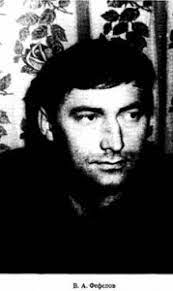
On 1 April 1980, Valery Fefyolov, a member of the Action Group to Defend the Rights of the Disabled in the USSR (CCE 51.17), was issued a “warning in accordance with the Decree”[1].
*
On 17 May the Yuryev-Polsky district newspaper For Communism published an exposé, “Whatever Do You Want, Fefyolov?” The article carried three signatures: A. Chernov, head of the local State Motor-Vehicle Inspectorate; S. Glushchenko, head of the district Social Welfare Office; and A.Basov, head of the district power-station.
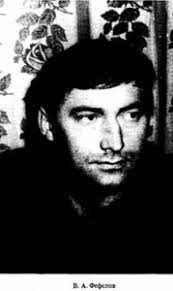
Valery Fefyolov (1949-2009)
*
On 14 May 1980, Malikov and Perepelkin, officers of the Kolchugino district KGB in the Vladimir Region (east central Russia), arrived in the town of Yuryev-Polsky [2]. They handed each of Fefyolov’s relatives a copy of the newspaper, and questioned them about the “reaction of the community” in Yuryev-Polsky to the article. Fefyolov would face criminal prosecution, they said, for the activities described in the newspaper.
That same day, workers meetings were held at the Promsvyaz plant and the Avangard factory and appeals issued to condemn Fefyolov. Resolutions were passed, urging that Fefyolov should be exposed in the nationwide press and stating that “there is no place for him among the working people of the town”.
*
On 15 May 1980, Fefyolov’s wife Olga Zaitseva, also a member of the Action Group, went to see people’s judge Zimina.
Zaitseva wanted to file a suit for libel against the authors of the article about her husband. Zimina replied that the article “corresponds wholly and fully with reality”. Now it had been published, she added, Fefyolov would be deprived of all benefits.
On 16 May 1980, Zaitseva went to Chizhikov, Yuryev-Polsky chief of police.
With her Zaitseva carried a statement about letters addressed to them which were quoted in the article. Chizhikov refused to accept her statement: “You are against the Soviet regime — so don’t go on appealing to it!”
Then he turned crimson: “Out!” he shouted hysterically. “Get out of here!”
*
On 17 May 1980, Fefyolov made an appeal “To All People of Good Will”. Published in full in the Group’s Newsletter No. 9 (“Samizdat update”, CCE 57.25 [4]): The appeal ends as follows:
“I ask all honest people and members of humane organizations, in the event of my arrest, to take up the defence of my wife, and to give moral support to her and our two young children.”
On 25 May, Fefyolov sent a statement to V. Suvorov, editor of For Communism, the district newspaper:
“… I consider that the contents of this article, from beginning to end, are an invented farce aimed at degrading my dignity and honour.
“I shall not list my disagreements with the newspaper article. Let me conclude by asking you, the editor-in-chief, to publish my reply in your newspaper For Communism.”
*
On 30 May 1980, Colonel Shibayev of the Vladimir KGB went with officers Malikov and Perepelkin to the play-school where Zaitseva works as a nurse.
They threatened Zaitseva that she would be fired and would not be able to get work anywhere else. If Zaitseva left her husband, on the other hand, she and her children would be provided with a private flat. (Fefyolov, a semi-paralysed Group I invalid, is presently living with his mother, wife and two children in a damp, two-room apartment of 24 square metres without central heating or telephone.)
They also told Zaitseva that if Newsletter No. 9 was issued her husband would be arrested immediately.
*
On 2 June 1980, KGB officers Malikov and Perepelkin went to see Fefyolov’s father.
On 8 June, the Moscow Helsinki Group adopted Document 134, “On the Persecution of Members of the Action Group to Defend the Disabled in the USSR”.
On 10 June 1980, Judge Zimina went to see Fefyolov. She suggested that he write a letter of repentance to the newspaper. In reply Fefyolov wrote “What I Want”.
His article was published in the Action Group’s Newsletter No. 9:
“… I want:
- Permission for the disabled to have their own association and press;
- for disabled people not to be ashamed of their clothes and their hideous pedal- and motorized wheelchairs; public transport and the streets to be adapted for the disabled;
- opportunities for the disabled to obtain a decent education, and work that corresponds to their particular infirmity or disease;
- for all public places — theatres, cinemas, libraries, etc. — to be open to the disabled;
- for disabled people to be able to buy a car as an item of primary necessity;
- the opportunity for disabled people to obtain medical assistance and access to holiday resorts.
“In sum, the right of disabled people in the USSR to lead a full life.”
*
On 12 June 1980, the second day of Victor Nekipelov’s trial (CCE 56.2), Investigator Plaksin went to see Fefyolov.
He informed Fefyolov that a criminal case was being opened against him, on the basis of two reports by the car inspectorate, under Article 211 (RSFSR Criminal Code: “Infringement of the regulations on traffic safety and the use of transport by persons driving a means of transport”). Plaksin made Fefyolov sign an undertaking not to leave the district.
On 18 June 1980, Olga Zaitseva was summoned to see Semyonov, chairman of the district soviet executive committee. Shibayev, Malikov and Perepelkin were also waiting in his office. Semyonov told Zaitseva that he had received a statement from the parents of children attending the play-school where she works: they can no longer entrust Zaitseva with the education of their children, the parents write, since it says in the newspaper that her husband is an anti-Soviet agitator, and she shares his views.
“But I work with infants!” Zaitseva responded. “And, however much I might want to, I cannot possibly educate them ‘in an anti-Soviet spirit’, as you put it.”
“What about the collective? Don’t you influence the collective you work with?” asked Semyonov. “Anyway, this statement doesn’t concern me. I’m passing it on to my comrades in the KGB: let them settle the matter.”
“I don’t insist on working in a play-school,” replied Zaitseva. “Let them transfer me to another job.”
“Oh no,” replied Colonel Shibayev. “Who on earth would let you into their collective?! There’s not a single collective that would let you work with them.
“We’ll sack you and nobody will hire you, then we’ll imprison you for parasitism like Ivanov.”
(Nikolai Ivanov was sentenced in 1968 as a member of the Social-Christian Union, CCE 1.6. He was released in 1973, Chronicle [3]).
“And we always thought it was Valery who influenced you, but you’re the one who’s influencing him!
“Since you’ve been living with him, look what an activist he’s turned into. We ought to write the same sort of article about you. After all, we already have enough material. If you don’t wise up, Olga Fadeyevna, we’ll have to imprison you. Just sign your name once more, anywhere, and we’ll start a criminal case against you. Have a good think about it.”
“Our laws, unfortunately, are too humane,” said Semyonov. “If Beria [4] was in charge now, we’d be talking to you differently. We have a lot of democracy here, and people like you take advantage of it.”
*
In Moscow, Action Group member Yury Kiselev was forbidden to drive his car out of the yard during the Olympics. To make quite sure, a tyre was punctured and the windscreen wipers removed.
While Kiselev was out, his garage, with all the tools and spare parts inside it, was removed to the junk-heap (CCE 53.26).
=========================================================
NOTES
The background to the events described in this report (and in this issue of the Chronicle) was the invasion of Afghanistan in December 1979, the mounting crisis in Poland, and the holding in Moscow of the 1980 Summer Olympics.
Despite a worldwide campaign, and an unprecedented boycott, the Games went ahead (see Bukovsky, “Pages of Shame“, Judgement in Moscow, for an account of the campaign).
*
- The unpublished 25 December 1972 decree whereby the KGB could issue a preliminary documented warning (or caution) to potential ‘malefactors’, thereby avoiding prosecution and negative statistics. In 1975 KGB chairman Andropov informed his fellow Politburo members that no less than 63,000 individuals had received such warnings between 1971 and 1975.
↩︎ - The population of Yuryev-Polsky in 1979 was 21,091.
↩︎ - While this information is correct in itself, Shibayev was referring to Nikolai Ivanov’s later conviction and imprisonment: on 21 April 1980, Ivanov was sentenced to one year in the camps for alleged parasitism (Article 209, CCE 47.17).
↩︎ - Lavrenty Beria was Stalin’s last head of the secret police (1938-1953) and was himself executed in December 1953, ten months after the Leader’s death.
Beria was appointed after the Great Terror (1937-1938) had ended but was himself responsible for lawless acts of great brutality, e.g. the wartime arrest of thousands of soldiers at the front and the 1941 execution of all detainees in a Ryazan Region transit prison (see Russia’s Necropolis).
↩︎
===============================
 A Chronicle of Current Events