TWELVE ITEMS
[1]
The new investigation of Eduard Kuleshov’s case (CCE 55.9 [1]) is complete.
He is now studying the ‘case file’. Kuleshov has no lawyer: in spite of a severe stammer, he is going to speak in his own defence. Investigator Yu. A. Patoloka told Kuleshov’s brother A. K. Udodov that Kuleshov would be released after the trial.
*
[2]
On 14 February 1980, the appeal hearing in the case of Alexei Stasevich, Vladimir Mikhailov and Alevtina Kochneva (CCE 55.1-3) was held in Leningrad. The sentence remained in force.
It was mentioned in court that a separate case would be started under Article 190-1 (RSFSR Criminal Code) against Yury Zaidenshnir, his wife R. Imenitova and Alexei Osipov (CCE 55.1-3).
*
[3]
On 28 February 1980, the Ukrainian Supreme Court heard an appeal in Yury Badzio’s case (CCE 55.1-1 [5]). It left his sentence unchanged.
*
[4]
Viktor Ryzhov-Davydov (CCE 55.2-4) has been sent to the Serbsky Institute in Moscow for psychiatric examination.
*
[5]
On 30 April 1980, three policemen from Police Station 68 in Moscow took Valery Senderov from his home [1] (see also CCE 56.30).
The police said they had orders to take him to Psychiatric Clinic No 15. Senderov’s mother telephoned the clinic and was told that the orders had been given ‘by other agencies’. As he was leaving the house, Senderov declared an unlimited dry hunger-strike. In the clinic he refused to speak to the commission which examined him (however, he did explain the reasons for the ‘orders’ to a member of the commission in a private conversation). He was quickly released.
*
[6]
Information Bulletin No. 20 of the Working Commission states:
“From time to time, the Soviet press publishes reports about psychiatric repression abroad … As far as possible, the Working Commission will investigate reports in the Soviet press about the abuse of psychiatry in other countries.
“On 15 September [1979], A. Podrabinek sent inquiries to the ambassadors of the USA and the People’s Republic of China, to the editorial offices of Izvestiya and Literaturnaya Gazeta, as well as Roland Jacquard, the author whose article appeared in an abridged translation in Literaturnaya Gazeta.”
From Podrabinek’s letter to the US ambassador:
“On 11 August 1979, the newspaper Izvestiya published a report from Washington by a TASS correspondent, entitled ‘Criminal Experiments’…
“Unable to conduct an independent investigation, the Working Commission requests you, Mr Ambassador, or another competent person, to confirm or refute the report in Izvestiya.
“Bearing in mind the possibility that my correspondence may be intercepted or confiscated, I request you to hand a copy of your reply to Vyacheslav Bakhmin, a member of the Working Commission …”
From Podrabinek’s letter to the editor-in-chief of Izvestiya:
“In the 11 August issue of your newspaper a comment by a TASS correspondent in Washington (whose name was not given) was published under the heading ‘Criminal Experiments’.
“Could you provide us with the following additional information:
- Which sources in particular is the TASS correspondent referring to;
- The names and, if possible, addresses of the Americans whose testimony is quoted in the article;
- The name of the author of the article.”
*
[7]
Late at night on 3 January 1980, Igor N. Khokhlushkin (CCE 45.18 [2]) was beaten up on Kutuzov Avenue in Moscow, as he was leaving a building where foreign correspondents live.
*
[8]
At the end of January, in Moscow, the following members of the Moscow Helsinki Group had their telephones disconnected: Naum Meiman, Alexander Lavut (arrested in April), Maria Petrenko and Yevgeny Gabovich (he emigrated on 30 January 1980, CCE 56.20).
Gabovich’s telephone was disconnected because, apparently, members of Sakharov’s family often used Gabovich’s phone after Sakharov had been exiled and their telephone was disconnected.
*
[9]
On 20 October 1979, Valery Fefyolov, a member of the Disabled Action Group (CCE 51.17, CCE 52.13, CCE 53.26) wrote to the Moscow Region Procurator’s office asking why three issues of the Action Group’s Bulletin had been confiscated during a search of Victor Nekipelov’s flat (26 August 1979, CCE 54.2-1).
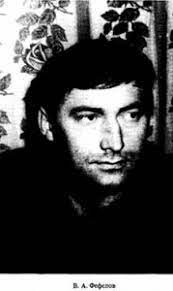
Valery A. Fefyolov (1949-2008)
On 30 November 1979, Fefyolov was visited by Abramov, deputy procurator of the Yuryev-Polsky district, who stated in the name of the Vladimir Region Procurator’s office that “the journals in question will not be returned, as they slander the political and social system”.
On 26 December 1979, Valery Fefyolov received an anonymous letter in the post:
“Greetings on the Happy Holiday of Stalin’s 100th Anniversary.
“You will all celebrate his 101st anniversary behind bars.”
On 13 January 1980, local policeman Captain Karaulov tried to incite Valery Fefyolov’s brother Vladimir to beat up Valery; he told Vladimir that he would not suffer any consequences, as Karaulov would be in charge of investigating the matter.
On 28 January 1980, another ‘delegation’ visited Valery Fefyolov [2].
It was made up of Vladimir City KGB officers (Colonel Shibayev (CCE 52.13) and Investigator Zotov), the new head of the city’s Kolchugino district KGB (Malikov), and the chairman of the Yuryev-Polsky town soviet executive committee (Romanov). An official warning was read out to Fefyolov: if he should continue his activities with the Action Group, it said, a criminal case would be started against him. Then Shibayev, Malikov and Romanov left.
Zotov remained and asked Fefyolov several questions about Nekipelov: when had they become acquainted? How often did they meet? What did they talk about? What did they give each other? “There’s no way we can carry off the Olympic Games,” said Zotov at the end of the conversation. It was not clear to whom he was complaining.
*
That same day the ‘delegation’ visited the play-school where Fefyolov’s wife Olga Zaitseva works as a nurse.
Shibayev told Zaitseva that they had received two statements that she was involved in anti-Soviet propaganda, encouraging people not to vote in the elections (24 February 1980) and asking questions anonymously at political lectures. Zaitseva replied that she was not involved in anti-Soviet propaganda, and only gave her personal opinions in private conversations.
“Am I allowed to have my own opinion?” Zaitseva asked.
“Your opinion must conform to that of society,” Shibayev replied.
If she persisted in working with the Action Group, the KGB officers told Zaitseva, she would be deprived of her parental rights — she has two children, aged four and six — and criminal proceedings would be instigated against her under Article 190-1 (RSFSR Criminal Code).
“Even Sakharov was exiled from Moscow,” she was told;:“and if he continues his anti-social activities, we’ll lock him up. As for you, we’ll deal with you even more severely.”
*
[10]
Students of Tashkent Teacher-Training Institute were informed that the Central Committee of the Uzbekistan Communist Party had decided that grape-producing State farms would be set up in the Mubarek district (Kashkadarinskaya Region), and Crimean Tatars would be sent there.
A newspaper would be published in the Crimean Tatar language, and the next batch of graduates would be sent to work in Mubarek.
*
[11]
On 23 February 1980, the day before the elections, 43 people (including Moscow Helsinki Group members Tatyana Osipova and Ivan Kovalyov, also Vsevolod Kuvakin, V. Shilyuk, I. Patrushev, Boris Perchatkin, Ye. Shmayevich, B. Yelistratova and M. Kremen) sent a joint statement to the Presidium of the USSR Supreme Soviet, refusing to vote in the elections:
“Our experience of life in the USSR has convinced us of the absurdity of the election procedure, which is intended to lend the appearance of democracy to the appointment of people the government finds convenient.
“Today, when violations of human rights are particularly widespread in the USSR, … not one deputy has spoken up in defence of violated rights.
“There is no doubt that the behaviour of the newly-appointed deputies will be exactly the same as that of the previous ones. …”
*
Moscow refusenik Mark Novikov (CCE 51.20, CCE 52.17 [3]) sent a similar statement to his local election commission. The military intervention in Afghanistan, he writes, and increased repression of campaigners for civil rights inside the country are characteristic of the policies of the Soviet leadership.
“For this reason, I felt especially strongly today that I cannot take responsibility for supporting the policies of the country’s leadership.”
*
[12]
Since January 1978, Valentina Timonina (Skvirskaya) has lived with Vladimir Skvirsky (CCE 53.9).
They did not have time to register their marriage before he was arrested (CCE 51.19-2, CCE 52.4-2). They were not able to do so until February 1980, in the place where Skvirsky is exiled (CCE 56.22).
*
On her return to Moscow, Valentina Skvirskaya obtained oral permission from Investigator Yu.G. Zhdanov of the Moskvoretsky district procurator’s office (he had sealed Skvirsky’s room) to remove the seal and move into the room. On 21 February 1980, Skvirskaya was detained in the room by Captain Tarasov and escorted to Police Station 85.
The next day she was taken to the Moskvoretsky district people’s court, where Judge Komyagin examined the materials on Skvirskaya’s ‘insubordination’ presented by Tarasov: she had refused to leave the room. Judge Komyagin, who also tried Skvirsky, found no corpus delicti in Skvirskaya’s actions and she was released.
That same day, Skvirskaya sent a statement to the Moskvoretsky district people’s court, requesting that her right to her husband’s room be recognized. She also sent a statement to the Moskvoretsky district procurator asking for protection from any future attempts to evict her a second time without the Procurator’s sanction. Despite this on 27 February Tarasov, accompanied by KGB officers, entered Skvirskaya’s room while she was out, removed her belongings and sealed the room.
*
On 29 February 1980, Skvirskaya’s friends and acquaintances sent a statement to the USSR Procurator-General and to the USSR Minister of Internal Affairs. They request that “Skvirskaya not be prevented from living in the room until a final decision is made regarding her right to the dwelling-space in question.”
“At the same time, we consider that the strictest measures of criminal or disciplinary punishment should be taken against the persons who have behaved tyrannically and exceeded their authority (Police Captain Tarasov, in particular).”
=====================================
NOTES
- On Senderov, see CCE 45.18 [7], CCE 47.17, CCE 51.19-2 & CCE 55.9 [4] and Name Index.
↩︎ - On Fefyolov, see CCE 52.13, CCE 53.26, CCE 54.22 [11] and Name Index.
↩︎
============================
 A Chronicle of Current Events