- 2-1. Tatyana Velikanova. Gleb Yakunin
- 2-2. The Journal Poiski (Searches), Arrest of Valery Abramkin
- 2-3. The Journal Obshchina (Community)
- 2-4. Arrests of: Yaroslav Lesiv; Victor Ryzhov-Davydov; Rollan Kadiyev; Vitaly Kalynychenko; Search at the Home of Vera Lisovaya; Arrests of: Victor Nekipelov; Mikhail Solovov. Search at the Home of Mart Niklus; Arrest of Lev Regelson
*
The Case of Tatyana Velikanova
At the end of December 1979, former political prisoner Valentin Novoseltsev and Moscow Helsinki Group member Tatyana Osipova were interrogated in Moscow in connection with the case of Tatyana VELIKANOVA.
*
The investigator informed Novoseltsev that a document entitled the “Memorandum of the Fifty-Seven” (CCE 51.19-2) had been confiscated during a search of Tatyana Velikanova’s flat. The investigator asked Novoseltsev whether he was the author of this document. Novoseltsev said he was not. The Chronicle of Current Events had named him as the author of the “Memorandum”, said The investigator, but this was not proof, Novoseltsev replied.
When the investigator asked whether it was true that Novoseltsev was in opposition to the Chronicle of Current Events and to Sakharov, Novoseltsev replied that he was also in opposition to the KGB. Asked whether the Chronicle was objective, Novoseltsev refused to answer.
*
On 29 December 1979, Investigator Katalikov interrogated Osipova. He said that Tatyana Velikanova had been charged with Anti-Soviet Agitation and Propaganda (Article 70).
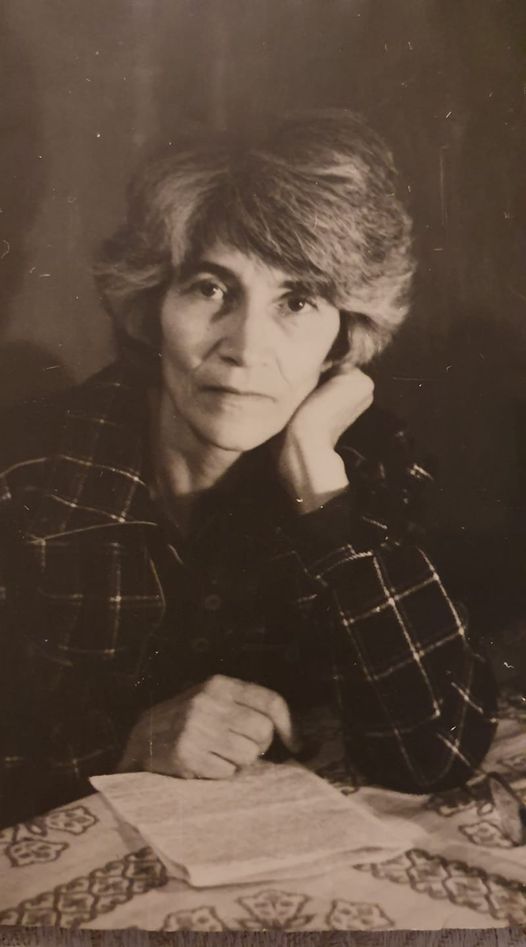
Tatyana M. Velikanova, 1932-2002
(photo taken in exile)
Osipova considered the initiation of criminal charges against Velikanova absurd, she said, and refused to take part in the investigation. She also informed the investigator that several people, herself included, had sent an open appeal to the Presidium of the USSR Supreme Soviet stating that they shared equal responsibility with Velikanova for her activities (CCE 54.1-1).
In spite of Osipova’s refusal to give evidence, Katalikov asked her what she knew about Velikanova’s activities: her involvement in preparing, signing and distributing collective letters, statements and appeals; her anti-Soviet activities in preparing and distributing slanderous documents; and her dispatch abroad of various materials to be used for purposes hostile to the Soviet State.
Having recorded Osipova’s refusal to answer these questions, Katalikov asked whether she understood Article 182 (RSFSR Criminal Code: “refusal by a witness or evasion … in giving evidence”) and what was the purpose of her refusal. Osipova understood the Article, she replied; she had given her reasons, and had no particular purpose in mind.
*
A Committee to defend Tatyana Velikanova has been set up in Moscow. The Committee’s ‘Declaration’ says, in part:
“We consider Tatyana Velikanova’s arrest, the investigation now in progress and the impending trial to be acts of tyranny and lawlessness and we resolve to do everything possible in our situation to serve the function of public defenders and to facilitate publicity and public vigilance in the case.
“We appeal to the public of other countries to form committees to defend TATYANA VELIKANOVA and to inform our Committee of their activities.
“The Committee is resolved to collect and circulate all the information we obtain about the investigation and examination of Velikanova’s case and to give out information about what is being done to defend her. We will publish this information in special bulletins.”
Larisa Bogoraz, Yelena Bonner, Sophia Kalistratova, Lev Kopelev, Alexander Lavut and Leonard Ternovsky make up the Committee. The committee’s Information Bulletin No. 1 (44 pages) was issued on 12 December 1979.
As well as the “first responses” noted in CCE 54.1-3, the Bulletin contains: a letter by Tatyana M. Velikanova’s children describing her ceaseless activities as a human rights worker and the circumstances of her arrest; Mikhail Gefter’s statement “This Should Not Be”; and Grigory Pomerants’s essay “On the Eve of Moloch’s Anniversary”. The Pomerants essay ends thus:
“It is our common duty to fight the shades of Stalin, which are claiming these new victims on the eve of the centenary of his birth, a few more bodies to throw into the mass grave of the 30, 40 or 60 million.”
*
As noted in CCE 54.1-1, the statement “On the Arrest of Tatyana Velikanova” was circulated for signatures. The final number of signatories was 393 [1].
*
The Yakunin Case
On 19 November 1979, a KGB Investigator for Especially important Cases, Lieutenant-Colonel Martemyanov from Saratov, who ‘specializes’ in cases involving Christians, interrogated Larisa Poluektova. (This was her second interrogation, see CCE 54.1-1.)
During the interrogation, the head of the team investigating the Yakunin case, Major Yakovlev, came into the office. “Here you are, not saying a thing,” Yakovlev commented. “Father Gleb, on the other hand, is very chatty. What’s going on? Do you really think the Committee to Defend Believers Rights is a legitimate organization? Father Gleb alleges it is.”

Gleb P. Yakunin, 1934-2014
The following were interrogated as part of the Yakunin case:
- P. Fomin who had worked in the same church as Father Gleb;
- V. Volkov, a member of the Christian Seminar (on which see CCE 41.2-3, CCE 43.9 & CCE 46.8) — at his interrogation on 17 December 1979 he was asked what assignments Father Gleb had given him;
- a certain Alik, the neighbour of Yakunin’s aunt; and
- V. Tamakov, a friend of Yakunin who serves at the Nikolo-Kuzminsky Church.
Tamakov signed a statement at the interrogation condemning Father Gleb’s activities. Later he went to see Yakunin’s wife and offered an explanation: the investigators had twisted his words, he had been very tired and also in a hurry.
One of the witnesses was told that Father Gleb had been charged with Anti-Soviet Agitation and Propaganda (Article 70). Judging by certain questions asked during the interrogation of others, there might be a charge of financial speculation.
For a long while, Yakovlev refused to allow Father Gleb to be given his prayer-book and psalter. Yakunin “ought to know all the prayers off by heart,” he said. Eventually, Yakovlev did allow Yakunin to be given the books, and an Orthodox Calendar published by the Moscow Patriarchate.
*
On 17 November 1979, Father Gleb’s wife Iraida Yakunina wrote to the USSR Procurator-General describing how the arrest and searches of their flat had taken place (CCE 54.1-2).
“I demand a thorough investigation of the violations of legality I have described, the release of my husband and the return of the religious books, holy icons and crucifix illegally confiscated from us,” she said in her letter. “All the other property confiscated at the searches should also be returned. 1 also demand the punishment of those guilty of this tyranny and lawlessness.”
A legal analysis by Sophia Kalistratova was attached to the statement. It lists 12 Articles of the Code of Criminal Procedure violated by KGB officials during the arrest of Gleb Yakunin and searches of his flat [2].
*
The Pentecostalists have published a statement in defence of Father Gleb:
“… The Orthodox priest FATHER GLEB YAKUNIN has been active in the struggle to combat violations of the rights of religious minorities in the USSR. We wish to express our sincere gratitude to Father Gleb for his invaluable work in dissipating the hostility which the atheistic state sows between Orthodox and non-Orthodox Christians…
“We appeal to the governments and parliaments of every country, to the Christians of the world, and to all people of good will, to join in the battle to free Gleb Yakunin, using whatever strength God has given you.”
====================================
NOTES
- In August 1980 Velikanova was sentenced (CCE 58.1-1) to four years in strict-regime camps plus five years of exile.
↩︎ - In August 1980 Yakunin was sentenced (CCE 58.3) to five years in strict-regime camps, plus five years of exile.
↩︎
==========================
 A Chronicle of Current Events