<< No 30 : 31 December 1973 >>
On 28 September 1972 Yury Shikhanovich was arrested after a search of his flat.
Two searches had been conducted there prior to this, one on 14 January (related to “Case 24”) and the other on 6 May (related to the case of K. A. Lyubarsky). Biographical data and a report of Shikhanovich’s arrest appeared in CCE 27.2.
Lieutenant Colonel V. K. Galkin and Balashov conducted the Shikhanovich case.
*
SEARCHES & INVESTIGATION
The homes of the following people were searched in connection with this case: Olga Baryshnikova, a Moscow typist; Boris Vail, an exile in Tobolsk (CCE 16.2); and a certain Mikhailov. Shikhanovich’s name had been mentioned repeatedly at the trial of Lyubarsky and Popov (CCE 28.4).
During the investigation Shikhanovich pleaded not guilty and denied that the documents with which he was incriminated were slanderous in nature or had the aim of undermining or weakening the Soviet regime. He testified that at his request 0. Baryshnikova had typed several samizdat works and, in a confrontation with her, asked her to corroborate this. Apart from this, he gave no depositions about other people.
By midwinter, the questions about Shikhanovich put to his acquaintances during their interrogations had taken on a decidedly “medical” overtone.
The investigation was concluded on 28 June and the case materials reached the court on 5 July, but up to 11 November officials of the Moscow City Court asserted they had not yet received them.
*

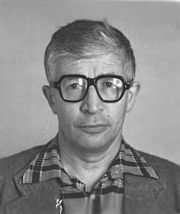
Yury Shikhanovich (1933-2011)
From 22 May to 28 June 1973, Shikhanovich underwent psychiatric examination in the Serbsky Institute. A psychiatric commission composed of Morozov, Lunts, Zharikov and Tabakova declared him non-responsible. The diagnosis: extreme psychopathic personality of the schizoid type; possible presence of a sluggish schizophrenic process.
In a statement made shortly before the trial Shikhanovich indicated that he no longer intended to engage in the activities with which he had been charged; on his release he planned to occupy himself only with teaching or editing work.
On 3 October 1973, Yelena Bonner, Tatyana Velikanova, Sergei Kovalyov and Andrei Sakharov sent a letter to L. N. Smirnov, Chairman of the USSR Supreme Court. Over a year had elapsed since Shikhanovich’s arrest, they pointed out, and over three months since the conclusion of the investigation: yet according to the law a case should be examined in court no later than 33 days after an investigation concluded. Given their longstanding friendship with Shikhanovich, the authors declared that they considered the psychiatric diagnosis unfounded. They demanded an open trial with the participation of the defendant.
In Shikhanovich’s absence the Moscow City Court examined his case on 26 November 1973. (Ryazhsky presided as judge in the case; Yermakov served as prosecutor; Reznikova as counsel for the defence.) Fokin of the Serbsky Institute presented a psychiatric report. Shikhanovich was indicted for the possession, reproduction and circulation of anti-Soviet literature.
The following charges are known to have figured in the trial:
- reproduction and circulation of A Chronicle of Current Events (testimony by Belogorodskaya and Tsfasman);
- distribution of CCE No. 18 (testimony by Yukhnovets); and
- transmission of a “Possev” edition of the Chronicle to Popov (testimony by Popov; see also CCE 28.4).
- circulation of Svetlana Alliluyeva’s memoirs (testimony by I. Rudakov), and
- Semyon Telegin’s article “What Ought One to Do?” According to the prosecution, testimony by Victor Khaustov: see CCE 12.10 (7).
reproduction of the following works:
- “From the Russian Diaspora”,
- “Trade in A Living Commodity”,
- “Trapeznikov’s Self-Denunciation’’ (CCE 27.13 [6]),
- a book entitled The Jews in the USSR after World War II; alleged testimony by 0lga Baryshnikova, and
- circulation of the work “Light After Midnight”; alleged testimony by Irina Kristi.
— as well as the circulation (or possession?) of the following works:
- “What we have Lost over 50 Years’’,
- ‘‘On the Soviet Democratic Movement”, testimony by Irina Belogorodskaya, and
- the pamphlet by Kolakowski “What is Socialism?” (CCE 10.13 [5]), alleged testimony by Ernst Orlovsky.
*
It is reliably known that Baryshnikova, Kristi, and Orlovsky gave no depositions incriminating Shikhanovich. Moreover, it is known that at the trial Yu. Yukhnovets spoke not about the Chronicle but “some letters or other in defence of Galanskov”.
Four witnesses were summoned to the trial: Baryshnikova, Popov, Rudakov and Yukhnovets. The latter two appeared and testified. Popov was ill but his testimony was read in court. Baryshnikova did not appear.
*
The court ruled that Shikhanovich’s activities fell under Article 70 (RSFSR Criminal Code) and issued a decision to have him confined in an ordinary hospital for compulsory treatment.
The verdict contained references to testimony by Belogorodskaya, Tsfasman, Popov, Rudakov, Yukhnovets, Yakir and Khaustov. It also cited “testimony” by Baryshnikova, Kristi and Orlovsky.
==================================
 A Chronicle of Current Events