<< No 30 : 31 December 1973 >>
On 18 October 1973, Alexander Dmitrievich FELDMAN was arrested in Kiev on a charge of hooliganism. The following day his flat was searched, by a search party equipped with its own key.
*
Feldman himself was not present at the search, during which the following items were confiscated: notebooks, letters (including some from abroad), a copy of the Hebrew alphabet, part 3 of A History of the Jewish People, stories by Solzhenitsyn, Nabokov’s Invitation to a Beheading (apparently a photocopy), and a book by Jabotinsky. The search was prompted by “suspicions of a bank robbery”, but no further mention of this “suspicion” was made, hooliganism being the only charge mentioned in the indictment.
The real reason for the arrest appears to have been Feldman’s active role in the struggle for the right to emigrate to Israel. For his participation in Jewish demonstrations in Kiev and Moscow Feldman had already been jailed for 15 days twice before (CCE 26.14 (Kiev), CCE 27.14 [2]).
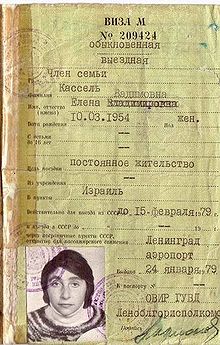
Exit for good (1979 visa)
His recent arrest occurred in the evening, near his home, where he was returning from the synagogue.
Before the investigation was complete, Vecherny Kiev [Evening Kiev] published a feature story on 31 October 1973 giving the prosecution’s version of the case: it made reference to a cake Feldman had knocked out of some girl’s hand, two badly-beaten men who tried to defend her, etc. …
*
TRIAL
On 23 November, the case was examined by the Darnitsky district court in Kiev (judge, Yermakova; prosecutor, Kalyuzhny; counsel for the defence, Yezhov).
The authorities had clearly gone to great lengths to conceal the location of the trial. Not only Feldman’s relatives, but also his lawyer had great difficulty finding the building designated for the hearing. It was held as an assizes session in the canteen of a factory, and no outsiders were allowed in. Feldman’s father, brothers, and friends turned out to be “outsiders”.
Feldman was indicted for committing acts of hooliganism: insulting and shoving a girl, knocking a cake out of her hands, and ripping the clothes of the two men who tried to defend her.
Three witnesses and the injured party were summoned to appear at the trial. Feldman identified two of the witnesses with whom he had allegedly started a fight as KGB agents who had been trailing him unrelentingly on the day of his arrest and for the past several months. The third witness was Khryapa, the Deputy Chief of the Criminal Investigation Department-who had been present during the pre-trial investigation of Feldman’s case.
At the start of the trial, Feldman challenged the composition of the court on the grounds that, as the KGB had inspired the case against him, and the court could not be unaware of this, the court members would be implicated in a violation of the law. After deliberating, the court overruled this challenge.
A. Feldman petitioned the court: (1) to allow his relatives and friends to attend the trial; and (2) to disqualify the witnesses, since they had no legal right to act as such.
His lawyer supported these petitions and demanded to see the witnesses’ identity papers. When it turned out that they had none with them, he objected to their testifying until the passports could be produced. The court overruled his objection, stating that the case file contained biographical particulars of the witnesses.
*
THE “INJURED PARTY”
Cited below are some of the questions asked of the “injured party’’ and her replies:
Where was V. Telyatova going when the incident with the cake occurred?
To the post office, the injured party said, where she had a date to meet someone.
The name of the man she was to meet?
A fellow named Slavik whom she had met at the beach, Telyatova said. She didn’t know his last name.
Was the injured party going out for the evening with a cake?
Judge: “The question is irrelevant.”
Where was V. Telyatova employed?
She worked at Kindergarten No 505.
And now…?
At this point the judge interrupted the defence, insisting that his questions had no bearing on the case.
*
SENTENCE
In his speech to the court the prosecutor (Procurator Kalyuzhny) demanded a sentence of four years’ imprisonment in a strict-regime camp. For the defence, Attorney Yezhov demonstrated that no crime had been committed.
Feldman was sentenced to 3 ½ years’ imprisonment in strict-regime camps. The case was appealed to the Kiev Regional Court.
===========================================
 A Chronicle of Current Events